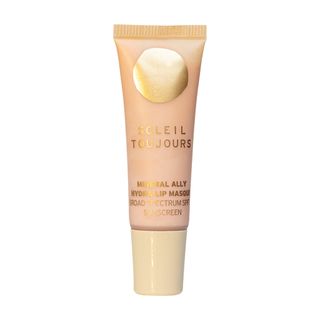
Soleil Toujours Mineral Ally Hydra Lip Masque SPF 15
Works for
2 of 3 advertised claims delivered
Sun protectionSPF 15 · 2 UV filters · Broad spectrumWeak protectionSPF under 30
This product offers broad spectrum sun protection, but it is weak. We recommend to use a broad spectrum sunscreen with at least SPF 30.
This product can be considered "reef safe" because it does not contain the UV filters (oxybenzone and octinoxate) that can be harmful to coral reefs when present in the water in high concentrations.
MoisturizingPalmitoyl tripeptide-1, Copernicia cerifera wax + 14 moreStrong evidence
“Mineral Ally Hydra Lip Masque SPF 15”
This product can help improve hydration of the skin with the two types of ingredients.
The first type is called “humectants”:
these ingredients help attract water.
When humectants are on the surface of the skin, they “pull in” the moisture from the outside environment, or from
within deeper layers of the skin. The following ingredients in this product do the job:
sodium hyaluronate, butylene glycol.
This product also contains ingredients called “occlusives”. They help reduce the speed with which our skin loses moisture to the outside environment. These ingredients also help soften the upper layer of the skin, so it feels less tight and nicer to the touch. The following ingredients in this product do the job: beeswax, caprylic/capric triglyceride.
The following ingredients in this product are especially good for supporting the skin barrier and helping with the hydration level: palmitoyl tripeptide-1
Anti-agingPalmitoyl tripeptide-1, Dipalmitoyl hydroxyproline + 2 moreModerate evidence
“Peptides Repair proteins in the skin to improve elasticity, firmness and smoothness.”
This product contains palmitoyl tripeptide-1. This ingredient might be able to help reduce and prevent fine lines and wrinkles, improve skin elasticity and firmness, but there is not enough evidence that it actually works. The biggest anti-aging effect in this product comes from sun protection. Sun damage is the main factor causing early signs of skin aging. We, however, do not recommend using this product as a sunscreen because the protection it offers is not strong enough).
Can it cause trouble?
Irritancy1 strong irritant: Mentha piperita oilMedium risk
Comedogenic3 ingredients rated 2 or more on the 0–5 pore-clogging scale3 flagged

User reviews
Be the first — your take helps the next person decide.
Ingredients
Filter by role to see what each ingredient is doing.
Zinc oxide5.5%
- Irritation risk
- Low
A broad spectrum sunblock (protects from both UVA and UVB rays). Is suitable for most sensitive skins. In small concentrations, can be used as a colorant
More about Zinc oxideSimmondsia chinensis seed oil~25–38%
- Irritation risk
- Medium
Softens the upper layer of skin and helps restore the healthy skin barrier. Has shown to help calm down inflammation in skin. It is a stable oil, meaning that it retains its properties even when exposed to air.
More about Simmondsia chinensis seed oilEthylene/propylene/styrene copolymer~7.2–10.8%
- Irritation risk
- Low
Used to create a thicker product consistency
More about Ethylene/propylene/styrene copolymerEthylhexyl palmitate~3.8–5.8%
- Irritation risk
- Low
- Comedogenicity
- 3/5
An emollient that helps soften the skin and create a nice product texture
More about Ethylhexyl palmitateCaprylic/capric triglyceride~2.8–4.2%
- Irritation risk
- Medium
A good mix of fatty acids that forms a protective layer on the skin. Improves the shelf life of products. Derived from coconut and glycerin
More about Caprylic/capric triglycerideHelianthus annuus seed oil~2.1–3.2%
- Irritation risk
- Low
A great emollient due to its high linoleic acid content. One of the most effective plant oils in helping skin hydration and repairing skin barrier function
More about Helianthus annuus seed oilButylene/ethylene/styrene copolymer~1.7–2.6%
- Irritation risk
- Low
Used to create a gel-like product texture
More about Butylene/ethylene/styrene copolymerCocos nucifera oil~1.5–2.2%
- Irritation risk
- Low
- Comedogenicity
- 3/5
An emollient. Found to be as effective as a moisturizer for dry skin as mineral oil. Could be comedogenic
More about Cocos nucifera oilDipalmitoyl hydroxyproline~1.2–1.8%
- Irritation risk
- Low
Is claimed to stimulate collagen and elastin production, as well as work as an anti-oxidant. There is however not enough evidence for its effectiveness
More about Dipalmitoyl hydroxyprolineLecithin~1.1–1.6%
- Irritation risk
- Low
Used mostly for creating emulsions - helping oil and water mix together. Helps soften the upper layer of the skin
More about LecithinButylene glycol~0.85–1.25%
- Irritation risk
- Low
Used to create a nice product texture and help delivery of other ingredients. Might be somewhat helpful in attracting water to the upper layer of the skin
More about Butylene glycolPentylene glycol~0.55–1.3%
- Irritation risk
- Medium
Used to preserve products, dissolve other ingredients and create a nice product texture
More about Pentylene glycolSorbitan isostearate~0.45–1.05%
- Irritation risk
- Low
Helps oil and water mix together
More about Sorbitan isostearateTocopheryl acetate~0.4–0.95%
- Irritation risk
- Medium
A more stable but less bio-available form of vitamin E compared to Tocopherol. Might help moisturize and protect the skin from free radicals, but mostly used in low concentrations to stabilize other ingredients.
More about Tocopheryl acetatePolyglyceryl-3 polyricinoleate~0.4–0.9%
- Irritation risk
- Medium
Helps oil and water mix together
More about Polyglyceryl-3 polyricinoleateBeeswax~0.4–0.9%
- Irritation risk
- Low
Forms a protective barrier that holds water and keeps dry skin hydrated. Keeps an emulsion from separating into its oil and liquid components, and increases the thickness of a product. Can be an allergen
More about BeeswaxCopernicia cerifera wax~0.4–0.95%
- Irritation risk
- Low
Helps to soften the upper layer of the skin and create a nice product consistency
More about Copernicia cerifera waxTribehenin~0.35–0.8%
- Irritation risk
- Low
Used to create a thicker product consistency and soften the upper layer of the skin
More about TribeheninPalmitoyl tripeptide-1~0.35–0.8%
- Irritation risk
- Low
A type of peptide. Peptides are excellent moisturizers and might be able support collagen production reducing fine lines and wrinkles
More about Palmitoyl tripeptide-1Silica dimethyl silylate~0.3–0.75%
Tetrahexyldecyl ascorbate~0.2–0.7%
- Irritation risk
- Medium
Being a lipid soluble form of vitamin C, it is more stable than ascorbic acid, but still degrades quickly and needs to be stabilized in a formulation with another ingredient. It is claimed to penetrate skin better than pure vitamin C and have the the similar benefits, but solid studies of its effectiveness are lacking. Is likely to require a higher concentration in a product than pure vitamin C to be effective. It might be able to help reduce pore clogging.
More about Tetrahexyldecyl ascorbateBisabolol~0.15–0.55%
- Irritation risk
- Low
An active component of chamomile plant that historically has been used to calm down irritated skin. A recent study shows that bisabolol indeed can have some anti-inflammatory effect on skin, even though conclusive data is lacking. Bisabolol has a sweet floral scent and can be added to products for its aromatic properties
More about BisabololVanillin~0.15–0.6%
- Irritation risk
- Low
Polyhydroxystearic acid~0.15–0.6%
- Irritation risk
- Medium
Used to create a thicker product consistency and stabilize the formulation
More about Polyhydroxystearic acidIsostearic acid~0.2–0.75%
- Irritation risk
- Low
Used to create a nice product texture
More about Isostearic acidSodium hyaluronate~0.15–0.6%
- Irritation risk
- Low
One of the best moisturizing ingredients. Attracts water into the upper layer of the skin
More about Sodium hyaluronateMentha piperita oil~0.15–0.5%
Tocopherol~0.15–0.55%
- Irritation risk
- Low
Pure form of vitamin E. Can help moisturise and protect the skin from free radicals. Often used to help stabilise other ingredients or the formula itself
More about TocopherolAluminum calcium sodium silicate~0.15–0.6%
- Irritation risk
- Low
Octyldodecanol~0.15–0.55%
- Irritation risk
- Low
An emollient that helps to soften the skin and create a pleasant product texture and stabilize the formulation
More about OctyldodecanolSorbitan oleate~0.15–0.55%
- Irritation risk
- Medium
- Comedogenicity
- 2/5
Helps oil and water mix together
More about Sorbitan oleateCi 15850~0.1–0.45%
Tin oxide~0.2–0.7%
- Irritation risk
- Low
A colorant that can add a pearl-like appearance to the formulation
More about Tin oxideCi 77891~0.1–0.35%
- Irritation risk
- Low
Ci 17200~0.1–0.35%
Iron oxides~0.05–0.3%
- Irritation risk
- Low
An umbrella term for the following three colorants: CI 77491, CI 77492, CI 77499. They might be able to offer some protection against visible light, but the degree of the protection is not clear
More about Iron oxidesCi 77492~0.05–0.25%
Titanium dioxide~0.05–0.25%
- Irritation risk
- Low
Works as a UV filter when used in high concentrations. It is photostable and is effective mostly against the UVB light, with some protection in the UVA range. In small concentrations, used for its ability to improve the color of cosmetic products. Is usually well tolerated by the skin
More about Titanium dioxideIngredient list view
Zinc oxide, Simmondsia chinensis seed oil, Ethylene/propylene/styrene copolymer, Ethylhexyl palmitate, Caprylic/capric triglyceride, Helianthus annuus seed oil, Butylene/ethylene/styrene copolymer, Cocos nucifera oil, Dipalmitoyl hydroxyproline, Lecithin, Butylene glycol, Pentylene glycol, Sorbitan isostearate, Tocopheryl acetate, Polyglyceryl-3 polyricinoleate, Beeswax, Copernicia cerifera wax, Tribehenin, Palmitoyl tripeptide-1, Silica dimethyl silylate, Tetrahexyldecyl ascorbate, Bisabolol, Vanillin, Polyhydroxystearic acid, Isostearic acid, Sodium hyaluronate, Mentha piperita oil, Tocopherol, Aluminum calcium sodium silicate, Octyldodecanol, Sorbitan oleate, Ci 15850, Tin oxide, Ci 77891, Ci 17200, Iron oxides, Ci 77492, Titanium dioxide, Unknown
Compare prices
Retailers ranked by price — lowest first.

Worth comparing, line by line.
Match % combines shared ingredients, the first five ingredients, shared actives and hero ingredients, irritancy (lower counts in the alternative's favour), texture and body area. Only products in the same routine step are compared.
| Soleil ToujoursMineral Ally Hydra Lip Masque SPF 15YOUR PRODUCT | OneSkinOS-01 LIP SPF BROAD SPECTRUM SPF 15+ | |
|---|---|---|
| Match | — | 60% |
| Price | $26.00 | $30.00+$4.00 |
| Shared key ingredients | — | 8 of 10 |
| Key difference | — | Butyloctyl Salicylate |
| Irritancy | Medium | Medium |
| SPF | SPF 15 | SPF 15 |
| Drying alcohol | — | — |
| View product | Shop |
Product summary
"Soleil Toujours - Mineral Ally Hydra Lip Masque SPF 15" offers broad spectrum protection. It means that it protects from both UVA and UVB rays (you can remember UVB as "burning" sunlight - they cause sunburn. You can remember UVA rays as "aging" - they do not lead to sunburn, but they cause photodamage and contribute to early signs of skin aging and hyperpigmentation). On the negative side, the SPF of it is not high enough. We recommend to use a sunscreen with at least SPF 30 daily.
Sunscreen filters
This lip product is a mineral sunscreen. It uses zinc oxide for sun protection. Zinc oxide almost never irritates the skin or stings eyes, but it can leave a white cast.
Irritation risk
This lip sunscreen contains some common irritants, including those without a benefit for the skin. We assess the overall irritancy of it to be medium. For a detailed overview of all potential irritants: click here
You can see the detailed formula review with the breakdown of all actives in the product and the full ingredient list with estimated concentrations in the tables below.
Price
The product retails for 26.00$ in the United States.
For a detailed price comparison: click here.
Sources cited in this review
Every concentration estimate and effectiveness label is anchored to one of these 19 studies and safety reviews.
- 1A review of inorganic UV filters zinc oxide and titanium dioxideonlinelibrary.wiley.com
- 2
- 3
- 4
- 5
- 6

Affiliate links · As an Amazon Associate, WIMJ earns from qualifying purchases.