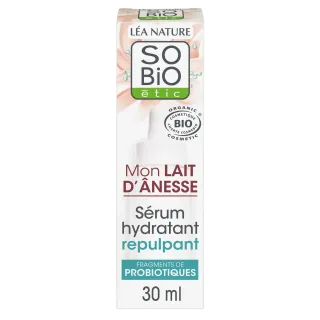
SO'BiO étic Sérum hydratant fortifiant repulpant - Mon Lait d'Anesse
Works for
MoisturizingHelianthus annuus seed oil, Caprylic/capric triglyceride + 9 moreWorks
“Sérum hydratant fortifiant repulpant - Mon Lait d'Anesse”
This product can help improve hydration of the skin with the two types of ingredients.
The first type is called “humectants”:
these ingredients help attract water.
When humectants are on the surface of the skin, they “pull in” the moisture from the outside environment, or from
within deeper layers of the skin. The following ingredients in this product do the job:
glycerin, hydrolyzed hyaluronic acid.
This product also contains ingredients called “occlusives”. They help reduce the speed with which our skin loses moisture to the outside environment. These ingredients also help soften the upper layer of the skin, so it feels less tight and nicer to the touch. The following ingredients in this product do the job: caprylic/capric triglyceride, chondrus crispus extract.
Can it cause trouble?
Irritancy2 strong irritants: Parfum, LinaloolMedium risk
Comedogenic1 ingredient rated 2 or more on the 0–5 pore-clogging scale1 flagged
User reviews
Be the first — your take helps the next person decide.
Ingredients
Filter by role to see what each ingredient is doing.
Water~40–60%
Anthemis nobilis flower water~4.5–6.7%
- Irritation risk
- Low
Donkey milk~3.6–5.4%
- Irritation risk
- Low
Helianthus annuus seed oil~2.8–4.2%
- Irritation risk
- Low
A great emollient due to its high linoleic acid content. One of the most effective plant oils in helping skin hydration and repairing skin barrier function
More about Helianthus annuus seed oilCaprylic/capric triglyceride~2.1–3.2%
- Irritation risk
- Medium
A good mix of fatty acids that forms a protective layer on the skin. Improves the shelf life of products. Derived from coconut and glycerin
More about Caprylic/capric triglycerideTriethyl citrate~1.4–2.1%
Propanediol~1.4–2.1%
- Irritation risk
- Low
Acts as a solvent for other ingredients. Speeds up the absorption of other ingredients into the skin
More about PropanediolGlycerin~1.3–1.9%
- Irritation risk
- Low
One of the best moisturizing ingredients. Naturally present in skin. It attracts water to the upper layer of the skin working as a humectant
More about GlycerinPentylene glycol~1–1.5%
- Irritation risk
- Medium
Used to preserve products, dissolve other ingredients and create a nice product texture
More about Pentylene glycolLactobacillus ferment lysate~0.55–1.3%
- Irritation risk
- Low
A "broth" with parts of dead cells of lactobacteria. Might be helpful supporting diverse microbiome in skin, but evidence is lacking
More about Lactobacillus ferment lysateInulin~0.45–1.1%
- Irritation risk
- Low
Helps attract water to the upper layer of the skin. Is claimed to support the growth of "good" bacteria in skin (as a "prebiotic"), but the research is lacking
More about InulinHydrolyzed hyaluronic acid~0.4–0.9%
- Irritation risk
- Low
One of the best moisturizing ingredients. Attracts water into the upper layer of the skin. A version of it is naturally present in skin
More about Hydrolyzed hyaluronic acidSodium hyaluronate~0.35–0.85%
- Irritation risk
- Low
One of the best moisturizing ingredients. Attracts water into the upper layer of the skin
More about Sodium hyaluronateTocopherol~0.35–0.75%
- Irritation risk
- Low
Pure form of vitamin E. Can help moisturise and protect the skin from free radicals. Often used to help stabilise other ingredients or the formula itself
More about TocopherolSclerotium gum~0.2–0.75%
- Irritation risk
- Low
Used to create gel-like formulas and stabilize emulsions
More about Sclerotium gumGellan gum~0.3–0.75%
Chondrus crispus extract~0.3–0.7%
- Irritation risk
- Low
- Comedogenicity
- 3/5
Red algae extract that helps attract water to the upper layer of the skin and create a nicer product consistency
More about Chondrus crispus extractXanthan gum~0.2–0.7%
- Irritation risk
- Low
Used to create a thicker product consistency
More about Xanthan gumParfum~0.15–0.6%
- Irritation risk
- High
An aromatic blend of unspecified and possibly irritating ingredients
More about ParfumSea salt~0.15–0.6%
- Irritation risk
- Medium
Used to thicken the product formulation and might help to add minerals to the surface of the skin. It is used in scrubs as a physical exfoliant. Can increase sensitivity to other ingredients if left on the skin or used in high concentration
More about Sea saltCalcium citrate~0.15–0.55%
Levulinic acid~0.1–0.45%
Sodium levulinate~0.1–0.45%
Phytic acid~0.1–0.45%
- Irritation risk
- Medium
An alpha-hydroxy acid (AHA), but is mostly used to stabilize product formulations in cosmetics
More about Phytic acidSodium benzoate~0.1–0.4%
Benzyl alcohol~0.05–0.25%
- Irritation risk
- High
A preservative. Can be used to mask unpleasant smell. Can be irritating
More about Benzyl alcoholSodium hydroxide~0.1–0.35%
Lactic acid~0.1–0.3%
- Irritation risk
- Medium
An exfoliating and moisturizing alpha-hydroxy acid (AHA). Typically causes less irritation than other AHAs, for example, glycolic acid. At high concentrations (about 15%), lactic acid can help reduce lines and wrinkles. Recent studies show that lactic acid can support the "good" bacteria living on skin's surface (healthy skin microbiome)
More about Lactic acidLinalool~0.05–0.2%
Ingredient list view
Water, Anthemis nobilis flower water, Donkey milk, Helianthus annuus seed oil, Caprylic/capric triglyceride, Triethyl citrate, Propanediol, Glycerin, Pentylene glycol, Lactobacillus ferment lysate, Inulin, Hydrolyzed hyaluronic acid, Sodium hyaluronate, Tocopherol, Sclerotium gum, Gellan gum, Chondrus crispus extract, Xanthan gum, Parfum, Sea salt, Calcium citrate, Levulinic acid, Sodium levulinate, Phytic acid, Sodium benzoate, Benzyl alcohol, Sodium hydroxide, Lactic acid, Linalool
Compare prices
Retailers ranked by price — lowest first.

Worth comparing, line by line.
Match % combines shared ingredients, the first five ingredients, shared actives and hero ingredients, irritancy (lower counts in the alternative's favour), texture and body area. Only products in the same routine step are compared.
| SO'BiO éticSérum hydratant fortifiant repulpant - Mon Lait d'AnesseYOUR PRODUCT | Dr. Barbara SturmThe Good C Vitamin C Serum | NakeryCollagen Wrinkle Plumping Serum-in-Cream | SimpleBooster Serum 3% Hyaluronic Acid & Vitamin B | |
|---|---|---|---|---|
| Match | — | 40% | 40% | 39% |
| Price | — | $144.51 | — | $6.60 |
| Shared key ingredients | — | 5 of 8 | 4 of 8 | 4 of 8 |
| Key difference | — | Panthenol | Niacinamide | Niacinamide |
| Irritancy | Medium | Low | Low | Low |
| Drying alcohol | — | — | — | — |
| View product | Shop | Shop | Shop |


More alternatives: Formotopia BFFECT Hyaluronic Acid 2% + Na-PCA 1% Serum107 Beauty Double Layer Milky Serum
Product summary
Sources cited in this review
Every concentration estimate and effectiveness label is anchored to one of these 17 studies and safety reviews.
- 1
- 2
- 3Effect of topically applied lipids on surfactant-irritated skinonlinelibrary.wiley.com
- 4
- 5
- 6

Affiliate links · As an Amazon Associate, WIMJ earns from qualifying purchases.