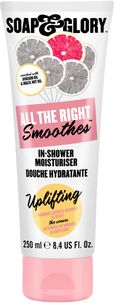
Soap and Glory All The Right Smoothes In-Shower Moisturiser
Works for
1 of 1 advertised claim delivered
MoisturizingPetrolatum, Theobroma cacao seed butter + 8 moreStrong evidence
“Now your shower-time can be a one-stop-shop with All The Right Smoothes In Shower Moisturiser, a time saving miracle worker that is applied to wet skin, for all day hydration.”
This product can help improve hydration of the skin with the two types of ingredients.
The first type is called “humectants”:
these ingredients help attract water.
When humectants are on the surface of the skin, they “pull in” the moisture from the outside environment, or from
within deeper layers of the skin. The following ingredients in this product do the job:
glycerin, butylene glycol.
This product also contains ingredients called “occlusives”. They help reduce the speed with which our skin loses moisture to the outside environment. These ingredients also help soften the upper layer of the skin, so it feels less tight and nicer to the touch. The following ingredients in this product do the job: butyrospermum parkii butter, helianthus annuus seed oil.
The following ingredients in this product are especially good for supporting the skin barrier and helping with the hydration level: petrolatum
Can it cause trouble?
Irritancy7 strong irritants: Parfum, Benzophenone-4 + 5 more — patch-test recommendedHigh risk
Comedogenic3 ingredients rated 2 or more on the 0–5 pore-clogging scale3 flagged

User reviews
Be the first — your take helps the next person decide.
Ingredients
Filter by role to see what each ingredient is doing.
Water~40–60%
Petrolatum~4.8–7.2%
- Irritation risk
- Low
One of the most effective and the most studied occlusive ingredients that creates a protective layer on top of the skin preventing moisture loss
More about PetrolatumHelianthus annuus seed oil~3.7–5.6%
- Irritation risk
- Low
A great emollient due to its high linoleic acid content. One of the most effective plant oils in helping skin hydration and repairing skin barrier function
More about Helianthus annuus seed oilGlycerin~2.7–4%
- Irritation risk
- Low
One of the best moisturizing ingredients. Naturally present in skin. It attracts water to the upper layer of the skin working as a humectant
More about GlycerinCetearyl alcohol~2.1–3.1%
- Irritation risk
- Low
- Comedogenicity
- 2/5
A non-drying alcohol. Works as an emollient. Helps water and oil mix together and creates a nice product texture
More about Cetearyl alcoholBehentrimonium methosulfate~1.7–2.5%
- Irritation risk
- Medium
Helps oil and water mix together
More about Behentrimonium methosulfateCetyl alcohol~1.5–2.2%
- Irritation risk
- Low
A non-drying alcohol that works to soften the skin and stabilize product formulations helping oil and water mix together
More about Cetyl alcoholButyrospermum parkii butter~1.3–2%
- Irritation risk
- Low
- Comedogenicity
- 3/5
A great moisturising ingredient that softens the skin and reduces water loss from its upper layer. It also can be helpful in protecting skin from free radicals
More about Butyrospermum parkii butterParfum~1–1.5%
- Irritation risk
- High
An aromatic blend of unspecified and possibly irritating ingredients
More about ParfumPhenoxyethanol~0.5–1%
- Irritation risk
- Low
A preservative. It helps prevent bacterial growth in cosmetic products
More about PhenoxyethanolBenzyl alcohol~0.5–1%
- Irritation risk
- High
A preservative. Can be used to mask unpleasant smell. Can be irritating
More about Benzyl alcoholTheobroma cacao seed butter~0.45–1.1%
- Irritation risk
- Low
- Comedogenicity
- 3/5
Helps soften the upper layer of the skin and can be helpful in restoring the skin barrier function. Might have some anti-oxidant effect
More about Theobroma cacao seed butterButylene glycol~0.4–0.95%
- Irritation risk
- Low
Used to create a nice product texture and help delivery of other ingredients. Might be somewhat helpful in attracting water to the upper layer of the skin
More about Butylene glycolHydroxyethylcellulose~0.4–0.9%
- Irritation risk
- Low
Used to thicken product formulations and create gel-like textures
More about HydroxyethylcelluloseArgania spinosa kernel oil~0.35–0.85%
- Irritation risk
- Medium
An emollient that helps soften the upper layer of the skin. Might have some weak anti-oxidant properties
More about Argania spinosa kernel oilBenzophenone-4~0.45–1.1%
- Irritation risk
- High
Sulisobenzone. A UV filter. Is typically used to improve the product stability under exposure to UV light. It is effective against both UVA and UVB rays. It can be used is larger concentrations as a sun protection ingredient for the skin, but can be irritating
More about Benzophenone-4Bertholletia excelsa seed oil~0.35–0.8%
- Irritation risk
- Low
Persea gratissima oil~0.35–0.8%
- Irritation risk
- Medium
An emollient that helps soften the skin and could be helpful in repairing its barrier function
More about Persea gratissima oilSodium ascorbyl phosphate~0.2–0.7%
- Irritation risk
- Medium
A stable derivative of vitamin C. It is oil-soluble which means it is more likely to penetrate the skin compared to the pure form of vitamin C (which is water-soluble), but it is less bio-available and is way less effective in stimulating collagen and reducing wrinkles compared to the pure form of vitamin C (L-ascorbic acid) and its other derivatives (for example, magnesium ascorbyl phosphate). At the same time, this vitamin C derivative has been shown in studies to be effective in reducing acne, blemishes and clogged pores. It is less irritating then the pure form of vitamin C
More about Sodium ascorbyl phosphateTocopheryl acetate~0.15–0.6%
- Irritation risk
- Medium
A more stable but less bio-available form of vitamin E compared to Tocopherol. Might help moisturize and protect the skin from free radicals, but mostly used in low concentrations to stabilize other ingredients.
More about Tocopheryl acetateLimonene~0.1–0.45%
- Irritation risk
- High
A common frangrance that can easily irritate skin, especially if exposed to air, light or heat
More about LimoneneBenzyl benzoate~0.1–0.4%
- Irritation risk
- High
Fragrance with sweet balsamic smell. Help to preserve products and dissolve other ingredients. Could trigger allergic reactions and be irritating
More about Benzyl benzoateTetrasodium glutamate diacetate~0.1–0.4%
- Irritation risk
- Low
Helps stabilize the product formulation
More about Tetrasodium glutamate diacetateGeraniol~0.05–0.3%
Linalool~0.05–0.25%
Citronellol~0.05–0.25%
Citric acid~0.05–0.2%
- Irritation risk
- Medium
Can work as an exfoliant but is typically used to adjust the product pH
More about Citric acidCi 19140~0.05–0.15%
Ci 14700~0.05–0.1%
Ingredient list view
Water, Petrolatum, Helianthus annuus seed oil, Glycerin, Cetearyl alcohol, Behentrimonium methosulfate, Cetyl alcohol, Butyrospermum parkii butter, Parfum, Phenoxyethanol, Benzyl alcohol, Theobroma cacao seed butter, Butylene glycol, Hydroxyethylcellulose, Argania spinosa kernel oil, Benzophenone-4, Bertholletia excelsa seed oil, Persea gratissima oil, Sodium ascorbyl phosphate, Tocopheryl acetate, Limonene, Benzyl benzoate, Tetrasodium glutamate diacetate, Geraniol, Linalool, Citronellol, Citric acid, Ci 19140, Ci 14700
Compare prices
Retailers ranked by price — lowest first.

Worth comparing, line by line.
Match % combines shared ingredients, the first five ingredients, shared actives and hero ingredients, irritancy (lower counts in the alternative's favour), texture and body area. Only products in the same routine step are compared.
| Soap and GloryAll The Right Smoothes In-Shower MoisturiserYOUR PRODUCT | Eviline Cosmetics6 Ceramides Deeply Moisturizing, Emollient Body Lotion | Palmerss Cocoa Butter Formula Massage Lotion for Stretch Marks | GarnierBody Repair Body Lotion Dry Skin | |
|---|---|---|---|---|
| Match | — | 64% | 63% | 62% |
| Price | $7.09 | — | $8.68+$1.59 | $8.02+$0.93 |
| Shared key ingredients | — | 5 of 8 | 6 of 8 | 3 of 8 |
| Key difference | — | Mineral Oil | Centella Asiatica Extract | Mineral Oil |
| Irritancy | High | Medium | Medium | Medium |
| Drying alcohol | — | — | — | — |
| View product | Shop | Shop | Shop |


Sources cited in this review
Every concentration estimate and effectiveness label is anchored to one of these 17 studies and safety reviews.
- 1
- 2
- 3Effect of topically applied lipids on surfactant-irritated skinonlinelibrary.wiley.com
- 4
- 5
- 6

Affiliate links · As an Amazon Associate, WIMJ earns from qualifying purchases.