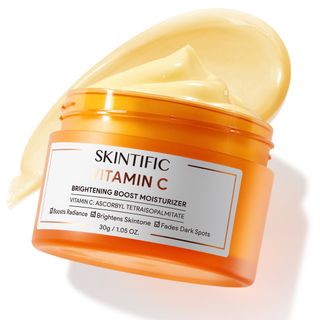
skintific Vitamin C Brightening Boost Moisturizer
Works for
2 of 3 advertised claims delivered
Anti-agingEpigallocatechin gallatyl glucoside, Tocopherol + 1 moreModerate evidence
“Powered with VC-IP (Ascorbyl Tetraisopalmitate), ChronoGlow™, and Illuminyl™ 388, it targets dullness, uneven skin tone, and stubborn dark spots while supporting collagen production and providing antioxidant protection.”
This product contains epigallocatechin gallatyl glucoside. This ingredient might be able to help reduce and prevent fine lines and wrinkles, improve skin elasticity and firmness, but there is not enough evidence that it actually works.
MoisturizingEthylhexyl hydroxystearate, Glycerin + 13 moreGood evidence
“Vitamin C Brightening Boost Moisturizer”
This product can help improve hydration of the skin with the two types of ingredients.
The first type is called “humectants”:
these ingredients help attract water.
When humectants are on the surface of the skin, they “pull in” the moisture from the outside environment, or from
within deeper layers of the skin. The following ingredients in this product do the job:
arginine, glycerin.
This product also contains ingredients called “occlusives”. They help reduce the speed with which our skin loses moisture to the outside environment. These ingredients also help soften the upper layer of the skin, so it feels less tight and nicer to the touch. The following ingredients in this product do the job: arginine, dimethicone.
Evens skin toneAscorbyl tetraisopalmitateWeak evidence
“Powered with VC-IP (Ascorbyl Tetraisopalmitate), ChronoGlow™, and Illuminyl™ 388, it targets dullness, uneven skin tone, and stubborn dark spots while supporting collagen production and providing antioxidant protection.”
Effective ingredients missing or their concentration is too low
Anti-oxidationNot advertised by the brand · Epigallocatechin gallatyl glucoside, Cardiospermum halicacabum flower/leaf/vine extract + 3 moreStrong evidence
This product contains antioxidants (epigallocatechin gallatyl glucoside) that can help neutralize free radicals in skin. By doing so, they can lessen the damage the skin gets from the UV light (sun).
Can it cause trouble?
Irritancy1 strong irritant: ParfumMedium risk
Comedogenic1 ingredient rated 2 or more on the 0–5 pore-clogging scale1 flagged
User reviews
Be the first — your take helps the next person decide.
Ingredients
Filter by role to see what each ingredient is doing.
Water~40–60%
Butylene glycol~5.1–7.7%
- Irritation risk
- Low
Used to create a nice product texture and help delivery of other ingredients. Might be somewhat helpful in attracting water to the upper layer of the skin
More about Butylene glycolDimethicone~3.2–4.8%
- Irritation risk
- Low
A silicone that helps to reduce water loss from the surface of the skin. Can temporarily "fill in" lines and wrinkles, absorb oil, and create a nice product finish
More about DimethiconeIsononyl isononanoate~2.4–3.6%
- Irritation risk
- Low
Forms a protective film on the surface of the skin to prevent moisture loss. Gives a velvety feel to products while reducing tackiness
More about Isononyl isononanoateAscorbyl tetraisopalmitate~1.7–2.5%
- Irritation risk
- Medium
A vitamin C derivative. Studies show that is might be effective in reducing hyperpigmentation, but there are no studies confirming that it is effectively converted into the bioavailable form of Vitamin C in skin. It is not clear how this derivative compares in effectiveness to the topical application of bioavailable form of vitamin C (L-ascorbic acid)
More about Ascorbyl tetraisopalmitateCalcium starch octenylsuccinate~1.3–1.9%
Peg-100 stearate~1.1–1.7%
- Irritation risk
- Low
Helps oil and water mix togehter and creates a nice product texture
More about Peg-100 stearateCollagen~1.1–1.7%
- Irritation risk
- Low
Cannot penetrate the skin barrier so is not particularly useful in skincare products
More about CollagenSoluble collagen~0.95–1.4%
- Irritation risk
- Low
A typically plant-derived compound that is supposed mimic human collagen. Cannot penetrate the skin barrier so is not particularly useful in skincare products beyond attracting water to the upper layer of the skin
More about Soluble collagenEchium plantagineum seed oil~0.55–1.25%
- Irritation risk
- Medium
A plant oil that because of its high content of alpha-linolenic acid help support skin barrier function and moisturize the skin
More about Echium plantagineum seed oilHaberlea rhodopensis leaf extract~0.4–0.95%
- Irritation risk
- Medium
A plant extract that if used in high concentration might help to neutralize free radicals in skin
More about Haberlea rhodopensis leaf extractEpigallocatechin gallatyl glucoside~0.3–0.75%
- Irritation risk
- Low
A synthetic version of green tea polyphenol that helps neutralize free radicals in skin
More about Epigallocatechin gallatyl glucosideDiglucosyl gallic acid~0.2–0.75%
- Irritation risk
- Low
Tocopherol~0.15–0.7%
- Irritation risk
- Low
Pure form of vitamin E. Can help moisturise and protect the skin from free radicals. Often used to help stabilise other ingredients or the formula itself
More about TocopherolHelianthus annuus seed oil unsaponifiables~0.15–0.7%
- Irritation risk
- Low
A great emollient due to its high linoleic acid content. One of the most effective plant oils in helping skin hydration and repairing skin barrier function
More about Helianthus annuus seed oil unsaponifiablesArginine~0.15–0.55%
- Irritation risk
- Low
An amino acid that is naturally present in skin and helps keep it hydrated. When used together with AHAs, it can reduce their irritating effect on the skin
More about ArginineCardiospermum halicacabum flower/leaf/vine extract~0.15–0.55%
- Irritation risk
- High
A plant extract that might have some anti-inflammatory and anti-oxidant properties but evidence is missing
More about Cardiospermum halicacabum flower/leaf/vine extractTamarindus indica seed polysaccharide~0.1–0.5%
- Irritation risk
- Low
1,2-hexanediol~0.1–0.45%
Glycerin~0.1–0.45%
- Irritation risk
- Low
One of the best moisturizing ingredients. Naturally present in skin. It attracts water to the upper layer of the skin working as a humectant
More about GlycerinParfum~0.05–0.3%
- Irritation risk
- High
An aromatic blend of unspecified and possibly irritating ingredients
More about ParfumOctyldodecanol~0.1–0.35%
- Irritation risk
- Low
An emollient that helps to soften the skin and create a pleasant product texture and stabilize the formulation
More about OctyldodecanolCetearyl alcohol~0.1–0.35%
- Irritation risk
- Low
- Comedogenicity
- 2/5
A non-drying alcohol. Works as an emollient. Helps water and oil mix together and creates a nice product texture
More about Cetearyl alcoholCi 77163~0.05–0.25%
Sucrose polystearate~0.1–0.35%
- Irritation risk
- Medium
Helps oil and water mix together
More about Sucrose polystearateHydroxyacetophenone~0.05–0.2%
Mica~0.05–0.25%
- Irritation risk
- Low
Creates an illusion of smoother and more radiant skin tone. Adds shimmer to the skin by reflecting light
More about MicaCi 19140~0.05–0.25%
Pentaerythrityl tetra-di-t-butyl hydroxyhydrocinnamate~0.05–0.3%
- Irritation risk
- Low
Used to increase stability of product formulations
More about Pentaerythrityl tetra-di-t-butyl hydroxyhydrocinnamateCarbomer~0.05–0.25%
- Irritation risk
- Low
Helps create a thicker or gel-like product texture. It is not a surfactant but can be used in gentle cleansing formulations
More about CarbomerEthylhexyl hydroxystearate~0.1–0.35%
- Irritation risk
- Low
Helps soften the upper layer of the skin and reduce water loss from it
More about Ethylhexyl hydroxystearateCi 77891~0.05–0.2%
- Irritation risk
- Low
Disodium edta~0.05–0.2%
Dimethicone/vinyl dimethicone crosspolymer~0.05–0.2%
- Irritation risk
- Low
Used to stabilize product formulations and create a nice product texture
More about Dimethicone/vinyl dimethicone crosspolymerAmmonium acryloyldimethyltaurate/vp copolymer~0.05–0.15%
- Irritation risk
- Low
Increases thickness of a product. Texture enhancer for oil-in-water emulsions
More about Ammonium acryloyldimethyltaurate/vp copolymerOlea europaea oil unsaponifiables~0.01–0.1%
- Irritation risk
- Low
Help soften the upper layer of the skin
More about Olea europaea oil unsaponifiablesTin oxide~0.05–0.25%
- Irritation risk
- Low
A colorant that can add a pearl-like appearance to the formulation
More about Tin oxideCi 15985~0.01–0.05%
Ingredient list view
Water, Butylene glycol, Dimethicone, Isononyl isononanoate, Ascorbyl tetraisopalmitate, Calcium starch octenylsuccinate, Peg-100 stearate, Collagen, Soluble collagen, Echium plantagineum seed oil, Haberlea rhodopensis leaf extract, Epigallocatechin gallatyl glucoside, Diglucosyl gallic acid, Tocopherol, Helianthus annuus seed oil unsaponifiables, Arginine, Cardiospermum halicacabum flower/leaf/vine extract, Tamarindus indica seed polysaccharide, 1,2-hexanediol, Glycerin, Parfum, Octyldodecanol, Cetearyl alcohol, Ci 77163, Sucrose polystearate, Hydroxyacetophenone, Mica, Ci 19140, Pentaerythrityl tetra-di-t-butyl hydroxyhydrocinnamate, Carbomer, Ethylhexyl hydroxystearate, Ci 77891, Disodium edta, Dimethicone/vinyl dimethicone crosspolymer, Ammonium acryloyldimethyltaurate/vp copolymer, Olea europaea oil unsaponifiables, Tin oxide, Ci 15985
Compare prices
Retailers ranked by price — lowest first.

Affiliate links · prices updated regularly
Worth comparing, line by line.
Match % combines shared ingredients, the first five ingredients, shared actives and hero ingredients, irritancy (lower counts in the alternative's favour), texture and body area. Only products in the same routine step are compared.
| skintificVitamin C Brightening Boost MoisturizerYOUR PRODUCT | skin ingredientssk.in marvel | hydro shot | |
|---|---|---|
| Match | — | 50% |
| Price | — | $74.41 |
| Shared key ingredients | — | 3 of 10 |
| Key difference | — | Cyclopentasiloxane |
| Irritancy | Medium | Low |
| Drying alcohol | — | — |
| View product | Shop |
Sources cited in this review
Every concentration estimate and effectiveness label is anchored to one of these 17 studies and safety reviews.
- 1
- 2Final Report on the Safety Assessment of Dimethicone Copolyoljournals.sagepub.com
- 3
- 4
- 5
- 6

Affiliate links · As an Amazon Associate, WIMJ earns from qualifying purchases.