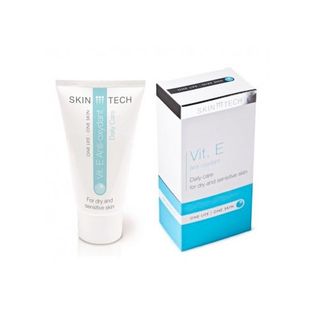
Works for
2 of 2 advertised claims delivered
MoisturizingCeramide 3, Urea + 13 moreStrong evidence
“Designed specifically for hypersensitive skin, this daily moisturising cream is a lightweight fluid that offers immediate and long lasting hydration.”
This product can help improve hydration of the skin with the two types of ingredients.
The first type is called “humectants”:
these ingredients help attract water.
When humectants are on the surface of the skin, they “pull in” the moisture from the outside environment, or from
within deeper layers of the skin. The following ingredients in this product do the job:
alanine, aspartic acid.
This product also contains ingredients called “occlusives”. They help reduce the speed with which our skin loses moisture to the outside environment. These ingredients also help soften the upper layer of the skin, so it feels less tight and nicer to the touch. The following ingredients in this product do the job: caprylic/capric triglyceride, dimethicone.
The following ingredients in this product are especially good for supporting the skin barrier and helping with the hydration level: ceramide 3, urea
Anti-agingAspartic acidModerate evidence
“E Anti-Oxydant Cream”
This product contains aspartic acid. This ingredient might be able to help reduce and prevent fine lines and wrinkles, improve skin elasticity and firmness, but there is not enough evidence that it actually works.
Anti-oxidationNot advertised by the brand · Glycyrrhetinic acid, Tocopheryl acetateStrong evidence
This product contains antioxidants (glycyrrhetinic acid) that can help neutralize free radicals in skin. By doing so, they can lessen the damage the skin gets from the UV light (sun).
Evens skin toneNot advertised by the brand · Glycyrrhetinic acid, AlanineModerate evidence
The following ingredient (ingredients) in this product might be helpful, but there is no evidence to confirm that it actually works: alanine, glycyrrhetinic acid.
Can it cause trouble?
Irritancy4 strong irritants: Hexyl nicotinate, Parfum + 2 more — patch-test recommendedHigh risk
ComedogenicClean of flagged comedogenic ingredientsNone flagged

User reviews
Be the first — your take helps the next person decide.
Ingredients
Filter by role to see what each ingredient is doing.
Water~45–55%
Biosaccharide gum-1~5.9–7.2%
- Irritation risk
- Low
Helps attract water to the upper layer of the skin and is claimed to provide a longer-lasting hydration because of its ability to create a water-binding film on the surface of the skin
More about Biosaccharide gum-1Dicetyl adipate~4.3–5.3%
- Irritation risk
- Low
Caprylic/capric triglyceride~3.1–3.8%
- Irritation risk
- Medium
A good mix of fatty acids that forms a protective layer on the skin. Improves the shelf life of products. Derived from coconut and glycerin
More about Caprylic/capric triglycerideSorbeth-30~2.1–2.6%
Dicaprylyl ether~1.8–2.2%
- Irritation risk
- Low
Helps soften the upper layer of the skin while creating a non-greasy feel on the skin. Helps to dissolve other ingredients
More about Dicaprylyl etherHexylene glycol~1.4–1.7%
- Irritation risk
- Medium
Helps create a more spreadable product texture
More about Hexylene glycolGlucose~1.2–1.5%
- Irritation risk
- Low
Helps attract water to the upper layer of the skin. Could be helpful in restoring the skin barrier function
More about GlucoseFructose~1–1.2%
- Irritation risk
- Low
Helps attract water to the upper layer of the skin
More about FructoseSucrose~0.55–0.85%
- Irritation risk
- Low
Can help attract water to the upper layer of the skin. In crystal form, it can work as a gentle exfoliant, gentler than the salt scrub. Helps stabilize the emulsion
More about SucroseUrea~0.55–0.8%
- Irritation risk
- Low
Naturally present in skin (urea makes up about 7% of natural moisturizing factors in skin). Attracts water to the upper layer of the skin. Also has a positive effect on the skin barrier beyond the humectant action. Can enhance penetration of other ingredients. Is an exfoliating ingredient when used in high concentrations
More about UreaDextrin~0.55–0.8%
- Irritation risk
- Low
A sugar that is used to stabilize the product formulation. Can help attract water to the upper layer of the skin
More about DextrinAlanine~0.4–0.6%
- Irritation risk
- Low
An amino-acid that helps to attract water to the upper layer of the skin and might help to lighten the skin, but solid evidence is lacking
More about AlanineGlutamic acid~0.35–0.65%
- Irritation risk
- Low
An amino-acid that helps attract water to the upper layer of the skin
More about Glutamic acidAspartic acid~0.3–0.55%
- Irritation risk
- Low
An amino-acid that helps increase skin hydration and might help to slightly improve skin firmness, potentially reducing lines and wrinkles
More about Aspartic acidHexyl nicotinate~0.4–0.6%
- Irritation risk
- High
Might be able to enhance blood flow in the skin. Can be irritating and result in skin redness
More about Hexyl nicotinateTocopheryl acetate~0.3–0.6%
- Irritation risk
- Medium
A more stable but less bio-available form of vitamin E compared to Tocopherol. Might help moisturize and protect the skin from free radicals, but mostly used in low concentrations to stabilize other ingredients.
More about Tocopheryl acetatePolyacrylamide~0.3–0.6%
- Irritation risk
- Medium
Used to improve product texture and help oil and water mix together
More about PolyacrylamideC13-14 isoparaffin~0.3–0.55%
- Irritation risk
- Low
Helps soften the upper layer of the skin, dissolve other ingredients and create a thicker product consistency
More about C13-14 isoparaffinLaureth-7~0.25–0.45%
Methyl glucose sesquistearate~0.25–0.45%
- Irritation risk
- Medium
Helps water and oil mix together
More about Methyl glucose sesquistearateEthylhexyl methoxycinnamate~0.4–0.6%
- Irritation risk
- High
Octinoxate. When used in higher concentrations, works as a sunscreen protecting the skin from UVB rays. When used in lower concentration, helps to preserve the product formulation. Is shown to be harmful to coral reefs - consider avoiding bathing in coral reef areas when wearing a product with this ingredient. It can be irritating
More about Ethylhexyl methoxycinnamateHydroxylated milk glycerides~0.2–0.4%
- Irritation risk
- Low
Squalane~0.25–0.45%
- Irritation risk
- Low
An oil naturally present in skin. Works as an emollient to soften the skin and form a protective layer on its surface without a greasy feeling.
More about SqualaneParfum~0.15–0.3%
- Irritation risk
- High
An aromatic blend of unspecified and possibly irritating ingredients
More about ParfumPhenoxyethanol~0.2–0.4%
- Irritation risk
- Low
A preservative. It helps prevent bacterial growth in cosmetic products
More about PhenoxyethanolMethylparaben~0.15–0.3%
Ethylparaben~0.2–0.4%
Propylparaben~0.2–0.35%
Butylparaben~0.2–0.4%
Dea-cetyl phosphate~0.3–0.55%
- Irritation risk
- Low
Benzophenone-3~0.4–0.6%
- Irritation risk
- High
Same as oxybenzone. Protects in the UVB and short UVA range. In small concentrations, used to stabilize product formulation. Can be irritating. Is shown to be harmful to coral reefs - consider avoiding bathing in coral reef areas when wearing a product with this ingredient. It can penetrate the skin and get absorbed into bloodstream faster than other popular filters available in the US. The study that produced this finding did not address any potential health effects of the absorption
More about Benzophenone-3Dimethicone~0.25–0.5%
- Irritation risk
- Low
A silicone that helps to reduce water loss from the surface of the skin. Can temporarily "fill in" lines and wrinkles, absorb oil, and create a nice product finish
More about DimethiconeCeramide 3~0.25–0.45%
- Irritation risk
- Low
A type of lipid similar to ceramides naturally present in skin. Helps to soften the upper layer of the skin and supports the skin barrier function to keep it hydrated. Can help to prevent inflammation in skin
More about Ceramide 3Carbomer~0.2–0.35%
- Irritation risk
- Low
Helps create a thicker or gel-like product texture. It is not a surfactant but can be used in gentle cleansing formulations
More about CarbomerGlycyrrhetinic acid~0.2–0.35%
- Irritation risk
- Medium
Active compound of licorice root. Works to calm down inflammation, as an anti-oxidant, and might be helpful in lightening the skin and reducing hyperpigmentation
More about Glycyrrhetinic acidUrea~0.15–0.3%
- Irritation risk
- Low
Naturally present in skin (urea makes up about 7% of natural moisturizing factors in skin). Attracts water to the upper layer of the skin. Also has a positive effect on the skin barrier beyond the humectant action. Can enhance penetration of other ingredients. Is an exfoliating ingredient when used in high concentrations
More about UreaDiazolidinyl urea~0.1–0.2%
- Irritation risk
- High
A preservative. Works by releasing formaldehyde. Can be irritating
More about Diazolidinyl ureaTriethanolamine~0.1–0.2%
- Irritation risk
- Medium
Used to adjust pH of the product and can help improve the product's smell
More about TriethanolamineDisodium edta~0.05–0.1%
Ingredient list view
Water, Biosaccharide gum-1, Dicetyl adipate, Caprylic/capric triglyceride, Sorbeth-30, Dicaprylyl ether, Hexylene glycol, Glucose, Fructose, Sucrose, Urea, Dextrin, Alanine, Glutamic acid, Aspartic acid, Hexyl nicotinate, Tocopheryl acetate, Polyacrylamide, C13-14 isoparaffin, Laureth-7, Methyl glucose sesquistearate, Ethylhexyl methoxycinnamate, Hydroxylated milk glycerides, Squalane, Parfum, Phenoxyethanol, Methylparaben, Ethylparaben, Propylparaben, Butylparaben, Dea-cetyl phosphate, Benzophenone-3, Dimethicone, Ceramide 3, Carbomer, Glycyrrhetinic acid, Urea, Diazolidinyl urea, Unknown, Triethanolamine, Disodium edta, Unknown
Compare prices
Retailers ranked by price — lowest first.
Worth comparing, line by line.
Match % combines shared ingredients, the first five ingredients, shared actives and hero ingredients, irritancy (lower counts in the alternative's favour), texture and body area. Only products in the same routine step are compared.
| SkintechVit. E Anti-Oxydant CreamYOUR PRODUCT | ACWELLAqua Clinity Cream Double Moisture | Dr. Eve_RyouthVitamin C + Hyaluronic Acid Hydrabright Night Moisturiser | Cosmetex RolandLoshi Horse Oil EX Moisture Skin Cream | |
|---|---|---|---|---|
| Match | — | 57% | 55% | 53% |
| Price | — | $18.26 | $21.40 | $13.23 |
| Shared key ingredients | — | 11 of 15 | 4 of 15 | 3 of 15 |
| Key difference | — | Niacinamide | Cera Alba | Mineral Oil |
| Irritancy | High | High | Medium | Medium |
| Drying alcohol | — | — | — | Contains drying alcohol |
| View product | Shop | Shop | Shop |


Product summary
Based on the ingredients included, "Skintech - Vit. E Anti-Oxydant Cream" works well for moisturizing the skin. To work well, any moisturizer needs to include a combination of water-binding and emollient ingredients. Skintech - Vit. E Anti-Oxydant Cream ticks this box. Humectants in this product (urea, alanine, aspartic acid, biosaccharide gum-1 and fructose) help to increase the water content in the upper layer of the skin. (These ingredients do so by "capturing" water molecules from the outside air or from within the deeper layers of the skin). Emollients in this formulation (ceramide 3, caprylic/capric triglyceride, dimethicone, squalane and c13-14 isoparaffin) help to reduce the moisture loss from the skin. They also soften the skin surface and relieve the feeling of dryness and tightness.
Ingredient callouts
- Another benefit is that this moisturizer contain ceramides (ceramide 3 0.25% - 0.45%). Ceramides are an important part of our natural skin barrier. The ceramides used in skincare are synthetic or come from plants. They help soften the skin and can help "fill the gaps" in the skin barrier, keeping the skin hydrated and resilient for longer.
Irritation risk
This formulation includes some common irritants, including ingredients that do not provide a benefit for the skin. We assess the overall irritancy of this moisturizer to be high. For a detailed overview of all potential irritants: click here
You can see the detailed formula review with the breakdown of all actives in the product and the full ingredient list with estimated concentrations in the tables below.
Sources cited in this review
Every concentration estimate and effectiveness label is anchored to one of these 18 studies and safety reviews.
- 1
- 2Topical urea in skincare: A reviewpubmed.ncbi.nlm.nih.gov
- 3
- 4
- 5
- 6

Affiliate links · As an Amazon Associate, WIMJ earns from qualifying purchases.