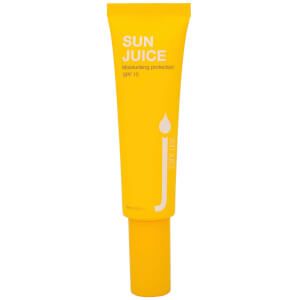
Skin Juice Sun Juice Moisturiser SPF 15
Works for
1 of 2 advertised claims delivered
Sun protectionSPF 15 · 2 UV filters · Broad spectrumWeak protectionSPF under 30
This product offers broad spectrum sun protection, but it is weak. We recommend to use a broad spectrum sunscreen with at least SPF 30.
This product can be considered "reef safe" because it does not contain the UV filters (oxybenzone and octinoxate) that can be harmful to coral reefs when present in the water in high concentrations.
Moisturizing10 ingredients credited for this claimGood support
“Sun Juice Moisturiser SPF 15”
This product can help improve hydration of the skin with the two types of ingredients.
The first type is called “humectants”:
these ingredients help attract water.
When humectants are on the surface of the skin, they “pull in” the moisture from the outside environment, or from
within deeper layers of the skin. The following ingredients in this product do the job:
glycerin.
This product also contains ingredients called “occlusives”. They help reduce the speed with which our skin loses moisture to the outside environment. These ingredients also help soften the upper layer of the skin, so it feels less tight and nicer to the touch. The following ingredients in this product do the job: caprylic/capric triglyceride, persea gratissima oil.
Anti-oxidationNot advertised by the brand · 4 ingredients credited for this claimModerate support
This product contains antioxidants (camellia sinensis leaf extract) that might be able to help neutralize free radicals in skin to lessen the damage it gets from the UV light (sun). There is not enough evidence to confirm their effectiveness in skin though.
Can it cause trouble?
Irritancy3 strong irritants: Cananga odorata flower oil, Parfum + 1 more — patch-test recommendedHigh risk
Comedogenic1 ingredient rated 2 or more on the 0–5 pore-clogging scale1 flagged

User reviews
Be the first — your take helps the next person decide.
Ingredients
Filter by role to see what each ingredient is doing.
Water~45–55%
Ethyl oleate~6.8–8.3%
- Irritation risk
- Medium
Ethyl oleate is a long-chain fatty acid ethyl ester resulting from the formal condensation of the carboxy group of oleic acid with the hydroxy group of ethanol. It derives from an oleic acid. In skincare, it is used to soften the upper layer of the skin, improve the product texture and smell
More about Ethyl oleateZinc oxide~5.4–6.6%
- Irritation risk
- Low
A broad spectrum sunblock (protects from both UVA and UVB rays). Is suitable for most sensitive skins. In small concentrations, can be used as a colorant
More about Zinc oxideCaprylic/capric triglyceride~3.5–4.3%
- Irritation risk
- Medium
A good mix of fatty acids that forms a protective layer on the skin. Improves the shelf life of products. Derived from coconut and glycerin
More about Caprylic/capric triglycerideTitanium dioxide~3.6–4.4%
- Irritation risk
- Low
Works as a UV filter when used in high concentrations. It is photostable and is effective mostly against the UVB light, with some protection in the UVA range. In small concentrations, used for its ability to improve the color of cosmetic products. Is usually well tolerated by the skin
More about Titanium dioxidePersea gratissima oil~2.3–2.8%
- Irritation risk
- Medium
An emollient that helps soften the skin and could be helpful in repairing its barrier function
More about Persea gratissima oilSorbitan oleate~1.8–2.2%
- Irritation risk
- Medium
- Comedogenicity
- 2/5
Helps oil and water mix together
More about Sorbitan oleatePolyglyceryl-3 polyricinoleate~1.5–1.9%
- Irritation risk
- Medium
Helps oil and water mix together
More about Polyglyceryl-3 polyricinoleateSilica~1.6–1.9%
Glycerin~1.2–1.4%
- Irritation risk
- Low
One of the best moisturizing ingredients. Naturally present in skin. It attracts water to the upper layer of the skin working as a humectant
More about GlycerinGlyceryl stearate~0.9–1.1%
- Irritation risk
- Low
An emollient that softens the skin and forms a protective layer on its surface. Helps water and oil mix together
More about Glyceryl stearateTribehenin~0.65–0.95%
- Irritation risk
- Low
Used to create a thicker product consistency and soften the upper layer of the skin
More about TribeheninActinidia chinensis seed oil~0.65–0.95%
- Irritation risk
- Medium
Pichia/resveratrol ferment extract~0.6–0.85%
- Irritation risk
- Low
Terminalia ferdinandiana fruit extract~0.55–0.8%
- Irritation risk
- Medium
A plant extract that might have some anti-oxidant effect in skin, but evidence is lacking
More about Terminalia ferdinandiana fruit extractCamellia sinensis leaf extract~0.5–0.8%
- Irritation risk
- Low
Can contain potent anti-oxidant compounds (abbreviated ECG, GCG, EGC, and EGCG) that might help protect the skin from free radicals. Can help calm down inflammation and has some anti-bacterial properties. Unfortunately, these antioxidants are unstable and lose their effectiveness very quickly in products. The concentration of the antioxidant compounds in the extract also tends to be low to be effective in topical formulation
More about Camellia sinensis leaf extractTocopherol~0.5–0.7%
- Irritation risk
- Low
Pure form of vitamin E. Can help moisturise and protect the skin from free radicals. Often used to help stabilise other ingredients or the formula itself
More about TocopherolStearic acid~0.5–0.75%
- Irritation risk
- Low
Helps oil and water mix together and works as an emollient
More about Stearic acidPelargonium roseum leaf oil~0.25–0.5%
- Irritation risk
- Low
Cananga odorata flower oil~0.25–0.45%
Cholecalciferol~0.3–0.55%
- Irritation risk
- Low
Gluconolactone~0.2–0.35%
- Irritation risk
- Medium
A polyhydroxy acid (PHA) that helps shed the dead cells from the skin surface revealing smoother skin. Is believed to be genter than AHAs. It helps attract water to the upper layer of the skin and can stimulate production of skin's own hyaluronic acid resulting in improved hydration levels. It has been shown to be helpful against acne and clogged pores if used consistently (e.g over a period of 12 weeks) in high enough concentration. It can help reduce fine lines and wrinkles and improve skin tone with long-term application. Can help neutralize free radicals
More about GluconolactoneTotarol~0.15–0.3%
- Irritation risk
- Low
Parfum~0.1–0.2%
- Irritation risk
- High
An aromatic blend of unspecified and possibly irritating ingredients
More about ParfumRosa damascena extract~0.1–0.15%
- Irritation risk
- High
Oil of a very fragrant pink rose used as fragrance in cosmetics. Extensive research has shown it has mixed benefits. In the pro column, inhaling this flower’s scent seems to have relaxing properties and the plant’s petals contain skin-soothing and antioxidant compounds that can benefit skin. On the flipside, the numerous chemicals that create this rose’s distinctive fragrance pose a risk of causing skin aggravation.
More about Rosa damascena extractIngredient list view
Water, Ethyl oleate, Zinc oxide, Caprylic/capric triglyceride, Titanium dioxide, Persea gratissima oil, Sorbitan oleate, Polyglyceryl-3 polyricinoleate, Silica, Glycerin, Glyceryl stearate, Tribehenin, Actinidia chinensis seed oil, Pichia/resveratrol ferment extract, Terminalia ferdinandiana fruit extract, Camellia sinensis leaf extract, Tocopherol, Stearic acid, Pelargonium roseum leaf oil, Cananga odorata flower oil, Cholecalciferol, Gluconolactone, Totarol, Parfum, Rosa damascena extract
Compare prices
Retailers ranked by price — lowest first.

.png)
Worth comparing, line by line.
Match % combines shared ingredients, the first five ingredients, shared actives and hero ingredients, irritancy (lower counts in the alternative's favour), texture and body area. Only products in the same routine step are compared.
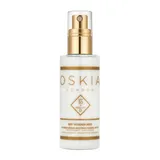
| Skin JuiceSun Juice Moisturiser SPF 15YOUR PRODUCT | DecreeDay Shield SPF 30 | EvolveClimate Veil Tinted SPF20 | OSKIASPF Vitamin Mist SPF30 + Pro-Vit D | |
|---|---|---|---|---|
| Match | — | 61% | 57% | 57% |
| Price | $64.78 | $93.00+$28.22 | $15.34−$49.44 | $60.81−$3.97 |
| Shared key ingredients | — | 6 of 8 | 6 of 8 | 4 of 8 |
| Key difference | — | Palmitoyl Tripeptide-1 | Caryodendron Orinocense Seed Oil | 7-Dehydrocholesterol |
| Irritancy | High | Medium | Medium | Medium |
| SPF | SPF 15 | SPF 30 | SPF 20 | SPF 30 |
| Drying alcohol | — | — | — | — |
| View product | Shop | Shop | Shop |


Product summary
"Skin Juice - Sun Juice Moisturiser SPF 15" offers broad spectrum protection. It means that it protects from both UVA and UVB rays (you can remember UVB as "burning" sunlight - they cause sunburn. You can remember UVA rays as "aging" - they do not lead to sunburn, but they cause photodamage and contribute to early signs of skin aging and hyperpigmentation). On the negative side, the SPF of this moisturizer is not high enough. We recommend to use a sunscreen with at least SPF 30 daily.
This moisturizer should also be hydrating enough to use without an additional moisturizer during the day.
Sunscreen filters
This moisturizer is a mineral sunscreen. It uses titanium dioxide and zinc oxide for sun protection. Both titanium dioxide and zinc oxide almost never irritate even the most sensitive skin and eyes, but can leave a white cast.
Irritation risk
This moisturizer contains some common irritants, including those without a benefit for the skin. We assess the overall irritancy of this moisturizer to be high. For a detailed overview of all potential irritants: click here
You can see the detailed formula review with the breakdown of all actives in the product and the full ingredient list with estimated concentrations in the tables below.
Price
The product retails for 49.00A$ in Australia.
For a detailed price comparison: click here.
Sources cited in this review
Every concentration estimate and effectiveness label is anchored to one of these 21 studies and safety reviews.
- 1A review of inorganic UV filters zinc oxide and titanium dioxideonlinelibrary.wiley.com
- 2
- 3
- 4
- 5
- 6Surfactants and experimental irritant contact dermatitisncbi.nlm.nih.gov

Affiliate links · As an Amazon Associate, WIMJ earns from qualifying purchases.