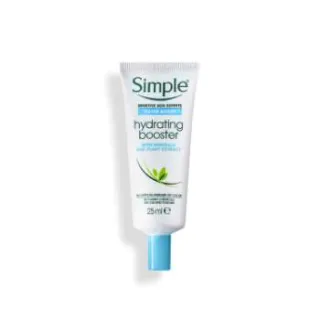
Simple Water Boost Hydrating Booster
Works for
1 of 1 advertised claim delivered
MoisturizingGlyceryl acrylate/acrylic acid copolymer, Dimethicone + 7 moreGood evidence
“Water Boost Hydrating Booster”
This product can help improve hydration of the skin with the two types of ingredients.
The first type is called “humectants”:
these ingredients help attract water.
When humectants are on the surface of the skin, they “pull in” the moisture from the outside environment, or from
within deeper layers of the skin. The following ingredients in this product do the job:
glycerin, glyceryl acrylate/acrylic acid copolymer.
This product also contains ingredients called “occlusives”. They help reduce the speed with which our skin loses moisture to the outside environment. These ingredients also help soften the upper layer of the skin, so it feels less tight and nicer to the touch. The following ingredients in this product do the job: dimethicone, caprylyl glycol.
Can it cause trouble?
Irritancy1 strong irritant: Benzophenone-4Medium risk
ComedogenicClean of flagged comedogenic ingredientsNone flagged
User reviews
Be the first — your take helps the next person decide.
Ingredients
Filter by role to see what each ingredient is doing.
Water~40–60%
Glycerin~4.2–6.3%
- Irritation risk
- Low
One of the best moisturizing ingredients. Naturally present in skin. It attracts water to the upper layer of the skin working as a humectant
More about GlycerinPentylene glycol~3.7–5.5%
- Irritation risk
- Medium
Used to preserve products, dissolve other ingredients and create a nice product texture
More about Pentylene glycolButylene glycol~2.6–4%
- Irritation risk
- Low
Used to create a nice product texture and help delivery of other ingredients. Might be somewhat helpful in attracting water to the upper layer of the skin
More about Butylene glycolDimethicone~2.1–3.1%
- Irritation risk
- Low
A silicone that helps to reduce water loss from the surface of the skin. Can temporarily "fill in" lines and wrinkles, absorb oil, and create a nice product finish
More about DimethiconePeg-8~1.6–2.4%
- Irritation risk
- Medium
Used to create a nice product consistency
More about Peg-8Ammonium acryloyldimethyltaurate/beheneth-25 methacrylate crosspolymer~1.4–2.1%
- Irritation risk
- Medium
Used to stabilize product formulations
More about Ammonium acryloyldimethyltaurate/beheneth-25 methacrylate crosspolymerBenzophenone-4~1.7–2.6%
- Irritation risk
- High
Sulisobenzone. A UV filter. Is typically used to improve the product stability under exposure to UV light. It is effective against both UVA and UVB rays. It can be used is larger concentrations as a sun protection ingredient for the skin, but can be irritating
More about Benzophenone-4Bht~0.95–1.45%
Caprylyl glycol~0.85–1.3%
- Irritation risk
- Medium
Helps preserve products and creates a nice product texture
More about Caprylyl glycolCarbomer~0.5–1.15%
- Irritation risk
- Low
Helps create a thicker or gel-like product texture. It is not a surfactant but can be used in gentle cleansing formulations
More about CarbomerCitric acid~0.4–0.9%
- Irritation risk
- Medium
Can work as an exfoliant but is typically used to adjust the product pH
More about Citric acidGlyceryl acrylate/acrylic acid copolymer~0.35–0.85%
- Irritation risk
- Medium
Helps attract water to the upper layer of the skin and provide a longer-lasting hydration. Can create a thicker product consistency
More about Glyceryl acrylate/acrylic acid copolymerPeg-40 hydrogenated castor oil~0.35–0.8%
- Irritation risk
- Medium
Helps oil and water mix together
More about Peg-40 hydrogenated castor oilPhenoxyethanol~0.2–0.8%
- Irritation risk
- Low
A preservative. It helps prevent bacterial growth in cosmetic products
More about PhenoxyethanolPolyvinyl alcohol~0.2–0.8%
Potassium carbonate~0.15–0.6%
- Irritation risk
- Low
Potassium chloride~0.15–0.5%
- Irritation risk
- Low
Potassium hydroxide~0.1–0.5%
Pvm/ma copolymer~0.1–0.45%
- Irritation risk
- Low
Saccharide isomerate~0.1–0.35%
- Irritation risk
- Low
Helps attract water to the upper layer of the skin
More about Saccharide isomerateSodium chloride~0.1–0.35%
- Irritation risk
- Low
Used to stabilize mixtures of oil and water, and create thicker, gel-like product textures
More about Sodium chlorideSodium citrate~0.05–0.25%
- Irritation risk
- Medium
Helps to control the skin's pH level. Maintains the skin's natural film of amino-lactic acids and oils. Helps to preserve products
More about Sodium citrateSodium lactate~0.05–0.2%
- Irritation risk
- Medium
Helps attract water to the upper layer of the skin. Is often used to adjust the pH level of the product
More about Sodium lactateT-butyl alcohol~0.05–0.1%
- Irritation risk
- Medium
Used to dissolve other ingredients and to improve smell of products. It could be irritating
More about T-butyl alcoholTrideceth-9~0.05–0.1%
Ingredient list view
Water, Glycerin, Pentylene glycol, Butylene glycol, Dimethicone, Peg-8, Ammonium acryloyldimethyltaurate/beheneth-25 methacrylate crosspolymer, Benzophenone-4, Bht, Caprylyl glycol, Carbomer, Citric acid, Glyceryl acrylate/acrylic acid copolymer, Peg-40 hydrogenated castor oil, Phenoxyethanol, Polyvinyl alcohol, Potassium carbonate, Potassium chloride, Potassium hydroxide, Pvm/ma copolymer, Saccharide isomerate, Sodium chloride, Sodium citrate, Sodium lactate, T-butyl alcohol, Trideceth-9
Compare prices
Retailers ranked by price — lowest first.
Affiliate links · prices updated regularly · As an Amazon Associate, WIMJ earns from qualifying purchases.
Sources cited in this review
Every concentration estimate and effectiveness label is anchored to one of these 7 studies and safety reviews.
- 1
- 2
- 3Final Report on the Safety Assessment of Dimethicone Copolyoljournals.sagepub.com
- 4
- 5Benzophenone 4: An emerging allergen in cosmetics and toiletries?pubmed.ncbi.nlm.nih.gov
- 6

Affiliate links · As an Amazon Associate, WIMJ earns from qualifying purchases.