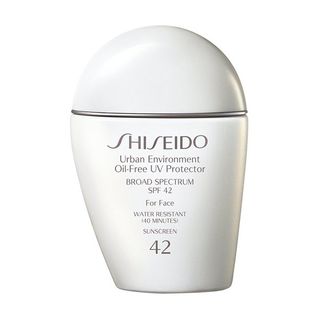
Shiseido Urban Environment Oil-Free UV Protector Broad Spectrum SPF 42 Facial Sunscreen
Works for
2 of 2 advertised claims delivered
Sun protectionSPF 42 · 2 UV filtersBroad spectrum
This product offers a good level of protection against both UVB and UVA rays.
It is a mineral sunscreen. In other words, it contains non-organic UV filters. It will probably not sting your eyes but might leave a white cast.
This product can be considered "reef safe" because it does not contain the UV filters (oxybenzone and octinoxate) that can be harmful to coral reefs when present in the water in high concentrations.
Anti-aging3 ingredients credited for this claimStrong support
“Fine Lines and Wrinkles, Dryness, and Oiliness Formulation.”
This product can help prevent early signs of skin aging because it offers a good level of broad spectrum sun protection. Sun damage is the main cause of premature skin aging, and protecting your skin from the sun is the best anti-aging strategy.
Evens skin toneNot advertised by the brand · 3 ingredients credited for this claimStrong support
This product offers broad spectrum sun protection. It means that it can prevent hyperpigmentation and help keep the skin tone even (sun damage is the main factor causing age spots, darkening of post-acne marks and other discolorations).
MoisturizingNot advertised by the brand · 18 ingredients credited for this claimGood support
This product can help improve hydration of the skin with the two types of ingredients.
The first type is called “humectants”:
these ingredients help attract water.
When humectants are on the surface of the skin, they “pull in” the moisture from the outside environment, or from
within deeper layers of the skin. The following ingredients in this product do the job:
glycerin, sodium hyaluronate.
This product also contains ingredients called “occlusives”. They help reduce the speed with which our skin loses moisture to the outside environment. These ingredients also help soften the upper layer of the skin, so it feels less tight and nicer to the touch. The following ingredients in this product do the job: dimethicone, peg-10 dimethicone.
Can it cause trouble?
Irritancy1 strong irritant: Perilla ocymoides leaf extractMedium risk
Comedogenic1 ingredient rated 2 or more on the 0–5 pore-clogging scale1 flagged
User reviews
Be the first — your take helps the next person decide.
Ingredients
Filter by role to see what each ingredient is doing.
Titanium dioxide4.9%
- Irritation risk
- Low
Works as a UV filter when used in high concentrations. It is photostable and is effective mostly against the UVB light, with some protection in the UVA range. In small concentrations, used for its ability to improve the color of cosmetic products. Is usually well tolerated by the skin
More about Titanium dioxideDimethicone~26–32%
- Irritation risk
- Low
A silicone that helps to reduce water loss from the surface of the skin. Can temporarily "fill in" lines and wrinkles, absorb oil, and create a nice product finish
More about DimethiconeWater~9.6–11.8%
Silica~6.3–7.7%
Zinc oxide13.6%
- Irritation risk
- Low
A broad spectrum sunblock (protects from both UVA and UVB rays). Is suitable for most sensitive skins. In small concentrations, can be used as a colorant
More about Zinc oxideDipropylene glycol~4.1–5%
- Irritation risk
- Low
Helps to dissolve other ingredients in a formulation. Slows down the rate of product drying
More about Dipropylene glycolGlycerin~3.3–4%
- Irritation risk
- Low
One of the best moisturizing ingredients. Naturally present in skin. It attracts water to the upper layer of the skin working as a humectant
More about GlycerinCaprylyl methicone~2.6–3.2%
- Irritation risk
- Low
A type of silicone that helps to soften the upper layer of the skin and create a nice product finish on the skin
More about Caprylyl methiconeDiphenylsiloxy phenyl trimethicone~2.1–2.6%
- Irritation risk
- Low
Help improve the product's texture
More about Diphenylsiloxy phenyl trimethiconeIsododecane~2–2.4%
- Irritation risk
- Low
An emollient that helps soften the skin and can decrease moisture loss. Helps create a nice product texture
More about IsododecaneHydrogenated polydecene~1.6–2%
- Irritation risk
- Low
Helps to soften the upper layer of the skin and create a nice product texture
More about Hydrogenated polydecenePeg/ppg-14/7 dimethyl ether~1.3–1.6%
- Irritation risk
- Low
An emollient that helps soften the skin. It also forms a protective on its surface to reduce water loss
More about Peg/ppg-14/7 dimethyl etherPeg-9 polydimethylsiloxyethyl dimethicone~1–1.2%
- Irritation risk
- Medium
A type of silicone that helps water and oil mix together
More about Peg-9 polydimethylsiloxyethyl dimethiconeBis-butyldimethicone polyglyceryl-3~1.4–1.7%
Peg-10 dimethicone~0.95–1.15%
- Irritation risk
- Low
A silicone that works to soften the upper layer of the skin and reduce its water loss
More about Peg-10 dimethiconeTrehalose~0.7–1.05%
- Irritation risk
- Low
A sugar that attracts water to the upper layer of the skin
More about TrehalosePhytosteryl macadamiate~0.75–1.15%
- Irritation risk
- Low
Helps soften the upper layer of the skin
More about Phytosteryl macadamiateAscorbyl tetraisopalmitate~0.75–1.1%
- Irritation risk
- Medium
A vitamin C derivative. Studies show that is might be effective in reducing hyperpigmentation, but there are no studies confirming that it is effectively converted into the bioavailable form of Vitamin C in skin. It is not clear how this derivative compares in effectiveness to the topical application of bioavailable form of vitamin C (L-ascorbic acid)
More about Ascorbyl tetraisopalmitateThiotaurine~0.65–0.95%
- Irritation risk
- Low
Dipotassium glycyrrhizate~0.6–0.9%
- Irritation risk
- Low
A salt derived from licorice. Works as an emollient to soften the upper layer of the skin and can help calm down inflammation. Might be helpful for skin lightening
More about Dipotassium glycyrrhizateScutellaria baicalensis root extract~0.55–0.8%
- Irritation risk
- High
A plant extract that might contain a compound baicalin that could be helpful in neutralizing free radicals and reducing inflammation in skin. The baicalin concentration in skincare products is often too low for an effective action. Can be used for its fragrant properties
More about Scutellaria baicalensis root extractPaeonia albiflora root extract~0.55–0.8%
- Irritation risk
- Low
Sodium hyaluronate~0.5–0.8%
- Irritation risk
- Low
One of the best moisturizing ingredients. Attracts water into the upper layer of the skin
More about Sodium hyaluronateSanguisorba officinalis root extract~0.55–0.85%
- Irritation risk
- Low
Camellia sinensis leaf extract~0.5–0.8%
- Irritation risk
- Low
Can contain potent anti-oxidant compounds (abbreviated ECG, GCG, EGC, and EGCG) that might help protect the skin from free radicals. Can help calm down inflammation and has some anti-bacterial properties. Unfortunately, these antioxidants are unstable and lose their effectiveness very quickly in products. The concentration of the antioxidant compounds in the extract also tends to be low to be effective in topical formulation
More about Camellia sinensis leaf extractOnonis spinosa root extract~0.5–0.75%
- Irritation risk
- Low
Garcinia mangostana bark extract~0.5–0.75%
- Irritation risk
- Low
Curcuma longa rhizome extract~0.5–0.75%
- Irritation risk
- Medium
A plant extract that might have some anti-oxidant properties but there is no evidence of effectiveness in skin
More about Curcuma longa rhizome extractPerilla ocymoides leaf extract~0.5–0.75%
- Irritation risk
- High
A plant extract that might help neutralize free radicals in skin but solid research is lacking. Contains a number of volatile compounds and could be irritating
More about Perilla ocymoides leaf extractSpirulina platensis extract~0.5–0.75%
- Irritation risk
- Low
- Comedogenicity
- 3/5
An algae extract. Might help to attract water to the upper layer of the skin and have an anti-oxidant effect
More about Spirulina platensis extractAluminum hydroxide~0.55–0.85%
- Irritation risk
- Low
Is used to add opaque (non-transparent) appearance to formulations. Can be used to coat other ingredients for even dispersion. This is a different ingredient compared to the ones used in antipersperants (aluminium chloride and aluminium chlorohydrate)
More about Aluminum hydroxideHydrogen dimethicone~0.5–0.75%
- Irritation risk
- Low
Helps the function of sunscreen and pigment ingredients in the formulation
More about Hydrogen dimethiconeTriethoxycaprylylsilane~0.35–0.6%
- Irritation risk
- Low
A type of silicone that helps oil and water mix well together. Helps to disperse other ingredients, e.g. pigments, evenly in a formulation
More about TriethoxycaprylylsilaneButylene glycol~0.35–0.6%
- Irritation risk
- Low
Used to create a nice product texture and help delivery of other ingredients. Might be somewhat helpful in attracting water to the upper layer of the skin
More about Butylene glycolIsostearic acid~0.5–0.7%
- Irritation risk
- Low
Used to create a nice product texture
More about Isostearic acidDisteardimonium hectorite~0.35–0.6%
- Irritation risk
- Low
A type of clay that is used to thicken the product consistency
More about Disteardimonium hectoriteTrisodium edta~0.35–0.6%
Sodium citrate~0.35–0.6%
- Irritation risk
- Medium
Helps to control the skin's pH level. Maintains the skin's natural film of amino-lactic acids and oils. Helps to preserve products
More about Sodium citrateAlcohol~0.3–0.6%
- Irritation risk
- High
Can be drying and contribute to skin irritation. Used in formulars to dissolve other ingredients, create a thinner product consistency or for its antibacterial properties
More about AlcoholCitric acid~0.3–0.55%
- Irritation risk
- Medium
Can work as an exfoliant but is typically used to adjust the product pH
More about Citric acidSodium metabisulfite~0.1–0.2%
Polysilicone-2~0.3–0.5%
- Irritation risk
- Low
Barium sulfate~0.25–0.5%
- Irritation risk
- Low
Syzygium jambos leaf extract~0.2–0.4%
- Irritation risk
- Low
Tocopherol~0.25–0.45%
- Irritation risk
- Low
Pure form of vitamin E. Can help moisturise and protect the skin from free radicals. Often used to help stabilise other ingredients or the formula itself
More about TocopherolPhenoxyethanol~0.2–0.4%
- Irritation risk
- Low
A preservative. It helps prevent bacterial growth in cosmetic products
More about PhenoxyethanolBenzoic acid~0.15–0.3%
Iron oxides~0.15–0.3%
- Irritation risk
- Low
An umbrella term for the following three colorants: CI 77491, CI 77492, CI 77499. They might be able to offer some protection against visible light, but the degree of the protection is not clear
More about Iron oxidesIngredient list view
Titanium dioxide, Dimethicone, Water, Silica, Zinc oxide, Dipropylene glycol, Glycerin, Caprylyl methicone, Diphenylsiloxy phenyl trimethicone, Isododecane, Hydrogenated polydecene, Peg/ppg-14/7 dimethyl ether, Peg-9 polydimethylsiloxyethyl dimethicone, Bis-butyldimethicone polyglyceryl-3, Peg-10 dimethicone, Trehalose, Phytosteryl macadamiate, Ascorbyl tetraisopalmitate, Thiotaurine, Dipotassium glycyrrhizate, Scutellaria baicalensis root extract, Paeonia albiflora root extract, Sodium hyaluronate, Sanguisorba officinalis root extract, Camellia sinensis leaf extract, Ononis spinosa root extract, Garcinia mangostana bark extract, Curcuma longa rhizome extract, Perilla ocymoides leaf extract, Spirulina platensis extract, Aluminum hydroxide, Hydrogen dimethicone, Triethoxycaprylylsilane, Butylene glycol, Isostearic acid, Disteardimonium hectorite, Trisodium edta, Sodium citrate, Alcohol, Citric acid, Sodium metabisulfite, Polysilicone-2, Barium sulfate, Syzygium jambos leaf extract, Tocopherol, Phenoxyethanol, Benzoic acid, Iron oxides
Compare prices
Retailers ranked by price — lowest first.

Affiliate links · prices updated regularly
Product summary
Based on the ingredient list, we assess that "Shiseido - Urban Environment Oil-Free UV Protector Broad Spectrum SPF 42 Facial Sunscreen" can provide reliable sun protection. It can protect from both UVA and UVB rays. This is great news because not all sunscreens with SPF ratings give UVA protection. (UVA rays do not cause sunburn, but still damage our skin and lead to early aging).
It contains good moisturizing ingredients and can double as a hydrating day cream. Like all broad-spectrum sunscreens, this product has an anti-aging benefit.
Sunscreen filters
This product is a mineral sunscreen. It uses titanium dioxide and zinc oxide for sun protection. Both titanium dioxide and zinc oxide almost never irritate even the most sensitive skin and eyes, but can leave a white cast.
Irritation risk
This formulation includes some common irritants, including ingredients that do not provide a benefit for the skin. We assess the overall irritancy of this product to be medium. For a detailed overview of all potential irritants: click here
You can see the detailed formula review with the breakdown of all actives in the product and the full ingredient list with estimated concentrations in the tables below.
Price
The product retails from 45.12$ up to 139.99$ in the United States.
For a detailed price comparison: click here.
Sources cited in this review
Every concentration estimate and effectiveness label is anchored to one of these 29 studies and safety reviews.
- 1
- 2Final Report on the Safety Assessment of Dimethicone Copolyoljournals.sagepub.com
- 3A review of inorganic UV filters zinc oxide and titanium dioxideonlinelibrary.wiley.com
- 4
- 5
- 6

Affiliate links · As an Amazon Associate, WIMJ earns from qualifying purchases.