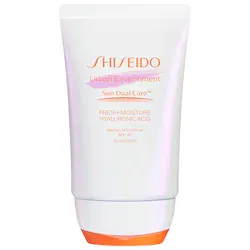
Shiseido Urban Environment Fresh-Moisture Sunscreen Broad-Spectrum SPF 42
Works for
3 of 3 advertised claims delivered
Sun protectionSPF 42 · 5 UV filtersBroad spectrum
This product offers a good level of protection against both UVB and UVA rays.
This sunscreen uses organic (so-called "chemical") sunscreen filters. Organic, or "chemical" filters usually provide reliable sun protection and rarely leave a white cast. Sunscreens with organic filters can sting eyes.
This product can be considered "reef safe" because it does not contain the UV filters (oxybenzone and octinoxate) that can be harmful to coral reefs when present in the water in high concentrations.
Anti-aging3 ingredients credited for this claimStrong support
“Skin Type Normal, Dry, and Combination Skincare Concerns Fine Lines and Wrinkles, Dryness, and Dullness Formulation Lightweight Cream Highlighted Ingredients , Hyaluronic Acid Delivers, attracts, and retains moisture.”
This product can help prevent early signs of skin aging because it offers a good level of broad spectrum sun protection. Sun damage is the main cause of premature skin aging, and protecting your skin from the sun is the best anti-aging strategy.
Evens skin tone3 ingredients credited for this claimStrong support
“, Pearl Light Powder Reflects red light to make uneven skin tone and dullness less noticeable.”
This product offers broad spectrum sun protection. It means that it can prevent hyperpigmentation and help keep the skin tone even (sun damage is the main factor causing age spots, darkening of post-acne marks and other discolorations).
MoisturizingNot advertised by the brand · 13 ingredients credited for this claimGood support
This product contains good ingredients to attract water to the upper layer of the skin. These ingredients are called "humectants": glycerin, sodium hyaluronate.
When humectants are on the surface of the skin, they “pull in” the moisture from the outside environment, or from within deeper layers of the skin. If the air is dry, humectants can speed up the moisture loss from the skin. This is why it is a good idea to use another product on top of this one to help "seal in" the moisture (look for ingredients like dimethicone, squalane, oils and butters).
Can it cause trouble?
Irritancy3 strong irritants: Sd alcohol 40-b, Perilla ocymoides leaf extract + 1 more — patch-test recommendedHigh risk
Comedogenic1 ingredient rated 2 or more on the 0–5 pore-clogging scale1 flagged
User reviews
Ingredients
Filter by role to see what each ingredient is doing.
Butyl methoxydibenzoylmethane2.3%
- Irritation risk
- Medium
Avobenzone. An organic, or so-called "chemical" UV filter. Protects against both UVA and UVB rays. Needs to be combined with other filters in a formulation to be stable.
More about Butyl methoxydibenzoylmethaneHomosalate10%
- Irritation risk
- Medium
A weak sunscreen that offers some protection against the sun rays that cause sunburn (UVB), but does not offer meaningful protection against protect against the most aging sun rays (UVA). It loses its effectiveness quickly when exposed to sunlight. It is an organic, or so called "chemical" sunscreen. When used in low concentrations, helps to stabilize the product formulation
More about HomosalateEthylhexyl salicylate5%
- Irritation risk
- Low
Octisalate. A UV filter. It offers some protection against the sun rays that cause sunburn (UVB), but does not protect against the most aging sun rays (UVA). It loses its effectiveness quickly when exposed to sunlight. It is an organic, or so called "chemical" sunscreen
More about Ethylhexyl salicylateOctocrylene5%
- Irritation risk
- Medium
A weak sunscreen that protects against the sun rays that cause sunburn (UVB) and is somewhat effective against the UVA rays. It is quite stable and can help stabilize other, more vulnerable, sunscreen ingredients like Avobenzone. It is an organic, or so called "chemical" sunscreen
More about OctocryleneWater~45–55%
Butylene glycol~6.8–8.3%
- Irritation risk
- Low
Used to create a nice product texture and help delivery of other ingredients. Might be somewhat helpful in attracting water to the upper layer of the skin
More about Butylene glycolGlycerin~5.4–6.6%
- Irritation risk
- Low
One of the best moisturizing ingredients. Naturally present in skin. It attracts water to the upper layer of the skin working as a humectant
More about GlycerinCaprylyl methicone~4.4–5.4%
- Irritation risk
- Low
A type of silicone that helps to soften the upper layer of the skin and create a nice product finish on the skin
More about Caprylyl methiconeSilica~3.3–4%
Dipropylene glycol~2.2–2.7%
- Irritation risk
- Low
Helps to dissolve other ingredients in a formulation. Slows down the rate of product drying
More about Dipropylene glycolGlyceryl diisostearate~1.8–2.2%
Sd alcohol 40-b~1.5–1.8%
- Irritation risk
- High
Can be drying and contribute to skin irritation. Used in formulars to dissolve other ingredients, create a thinner product consistency or for its antibacterial properties
More about Sd alcohol 40-bPeg/ppg-14/7 dimethyl ether~1.3–1.6%
- Irritation risk
- Low
An emollient that helps soften the skin. It also forms a protective on its surface to reduce water loss
More about Peg/ppg-14/7 dimethyl etherBeheneth-20~1–1.3%
Behenyl alcohol~0.95–1.2%
- Irritation risk
- Low
Non-drying alcohol that helps water and oil mix together. Also serves as an emollient
More about Behenyl alcoholC30-45 alkyl methicone~0.7–1.05%
- Irritation risk
- Low
Trehalose~0.55–0.85%
- Irritation risk
- Low
A sugar that attracts water to the upper layer of the skin
More about TrehaloseAmmonium acryloyldimethyltaurate/beheneth-25 methacrylate crosspolymer~0.55–0.8%
- Irritation risk
- Medium
Used to stabilize product formulations
More about Ammonium acryloyldimethyltaurate/beheneth-25 methacrylate crosspolymerXanthan gum~0.5–0.75%
- Irritation risk
- Low
Used to create a thicker product consistency
More about Xanthan gumAscorbyl tetraisopalmitate~0.55–0.85%
- Irritation risk
- Medium
A vitamin C derivative. Studies show that is might be effective in reducing hyperpigmentation, but there are no studies confirming that it is effectively converted into the bioavailable form of Vitamin C in skin. It is not clear how this derivative compares in effectiveness to the topical application of bioavailable form of vitamin C (L-ascorbic acid)
More about Ascorbyl tetraisopalmitateDipotassium glycyrrhizate~0.45–0.7%
- Irritation risk
- Low
A salt derived from licorice. Works as an emollient to soften the upper layer of the skin and can help calm down inflammation. Might be helpful for skin lightening
More about Dipotassium glycyrrhizateSodium hyaluronate~0.45–0.65%
- Irritation risk
- Low
One of the best moisturizing ingredients. Attracts water into the upper layer of the skin
More about Sodium hyaluronateSanguisorba officinalis root extract~0.45–0.7%
- Irritation risk
- Low
Camellia sinensis leaf extract~0.4–0.6%
- Irritation risk
- Low
Can contain potent anti-oxidant compounds (abbreviated ECG, GCG, EGC, and EGCG) that might help protect the skin from free radicals. Can help calm down inflammation and has some anti-bacterial properties. Unfortunately, these antioxidants are unstable and lose their effectiveness very quickly in products. The concentration of the antioxidant compounds in the extract also tends to be low to be effective in topical formulation
More about Camellia sinensis leaf extractGarcinia mangostana bark extract~0.35–0.6%
- Irritation risk
- Low
Perilla ocymoides leaf extract~0.3–0.6%
- Irritation risk
- High
A plant extract that might help neutralize free radicals in skin but solid research is lacking. Contains a number of volatile compounds and could be irritating
More about Perilla ocymoides leaf extractSpirulina platensis extract~0.3–0.55%
- Irritation risk
- Low
- Comedogenicity
- 3/5
An algae extract. Might help to attract water to the upper layer of the skin and have an anti-oxidant effect
More about Spirulina platensis extractC30-45 olefin~0.3–0.55%
- Irritation risk
- Low
Bis-peg-18 methyl ether dimethyl silane~0.4–0.6%
- Irritation risk
- Low
A type of silicone that helps soften the upper layer of the skin and create a nice product texture
More about Bis-peg-18 methyl ether dimethyl silaneStearyl alcohol~0.45–0.7%
- Irritation risk
- Low
An emollient that helps soften the skin
More about Stearyl alcoholDisodium edta~0.3–0.55%
Potassium hydroxide~0.3–0.6%
Bht~0.3–0.55%
Tocopherol~0.3–0.6%
- Irritation risk
- Low
Pure form of vitamin E. Can help moisturise and protect the skin from free radicals. Often used to help stabilise other ingredients or the formula itself
More about TocopherolCarbomer~0.3–0.55%
- Irritation risk
- Low
Helps create a thicker or gel-like product texture. It is not a surfactant but can be used in gentle cleansing formulations
More about CarbomerAlcohol~0.3–0.55%
- Irritation risk
- High
Can be drying and contribute to skin irritation. Used in formulars to dissolve other ingredients, create a thinner product consistency or for its antibacterial properties
More about AlcoholSodium metabisulfite~0.1–0.2%
Synthetic fluorphlogopite~0.3–0.55%
- Irritation risk
- Low
A mineral that is used as an optical filter (makes the skin looks nicer through light reflection) and to improve the texture of cosmetic products
More about Synthetic fluorphlogopiteSodium citrate~0.25–0.5%
- Irritation risk
- Medium
Helps to control the skin's pH level. Maintains the skin's natural film of amino-lactic acids and oils. Helps to preserve products
More about Sodium citratePhenoxyethanol~0.25–0.45%
- Irritation risk
- Low
A preservative. It helps prevent bacterial growth in cosmetic products
More about PhenoxyethanolParfum~0.2–0.35%
- Irritation risk
- High
An aromatic blend of unspecified and possibly irritating ingredients
More about ParfumMica~0.2–0.4%
- Irritation risk
- Low
Creates an illusion of smoother and more radiant skin tone. Adds shimmer to the skin by reflecting light
More about MicaTitanium dioxide~0.15–0.3%
- Irritation risk
- Low
Works as a UV filter when used in high concentrations. It is photostable and is effective mostly against the UVB light, with some protection in the UVA range. In small concentrations, used for its ability to improve the color of cosmetic products. Is usually well tolerated by the skin
More about Titanium dioxideIngredient list view
Butyl methoxydibenzoylmethane, Homosalate, Ethylhexyl salicylate, Octocrylene, Water, Butylene glycol, Glycerin, Caprylyl methicone, Silica, Dipropylene glycol, Glyceryl diisostearate, Sd alcohol 40-b, Peg/ppg-14/7 dimethyl ether, Beheneth-20, Behenyl alcohol, C30-45 alkyl methicone, Trehalose, Ammonium acryloyldimethyltaurate/beheneth-25 methacrylate crosspolymer, Xanthan gum, Ascorbyl tetraisopalmitate, Dipotassium glycyrrhizate, Sodium hyaluronate, Sanguisorba officinalis root extract, Camellia sinensis leaf extract, Garcinia mangostana bark extract, Perilla ocymoides leaf extract, Spirulina platensis extract, C30-45 olefin, Bis-peg-18 methyl ether dimethyl silane, Stearyl alcohol, Disodium edta, Potassium hydroxide, Bht, Tocopherol, Carbomer, Alcohol, Sodium metabisulfite, Synthetic fluorphlogopite, Sodium citrate, Phenoxyethanol, Parfum, Mica, Titanium dioxide
Compare prices
Retailers ranked by price — lowest first.

Product summary
Based on the ingredient list, we assess that "Shiseido - Urban Environment Fresh-Moisture Sunscreen Broad-Spectrum SPF 42" can provide reliable sun protection. We love that it can protect from both UVA and UVB rays (not all sunscreens with SPF ratings give UVA protection. UVA rays do not cause sunburn, but still damage our skin and lead to early aging).
It also works as a moisturizer, so you do not have to use an additional hydrating product. Like all broad-spectrum sunscreens, this product helps prevent early signs of aging.
Sunscreen filters
This sunscreen uses so-called "chemical", or organic UV filters (organic simply means that their molecules contain atoms of carbon). These filters typically give good sun protection and rarely leave a white cast, but they can be irritating for sensitive skin. Here are the exact UV filters in this sunscreen: avobenzone 2.30% (declared), octisalate 5.00% (declared), homosalate 10.00% (declared) and octocrylene 5.00% (declared).
Irritation risk
This formulation includes some common irritants, including ingredients that do not provide a benefit for the skin. We assess the overall irritancy of this product to be high. For a detailed overview of all potential irritants: click here
You can see the detailed formula review with the breakdown of all actives in the product and the full ingredient list with estimated concentrations in the tables below.
What our users say
Based on 1 review 100% recommend this product- When it comes to comedogenicity, the reviewer found that it does not clog pores.
- As for the white cast, it did not leave a noticeable white residue for the reviewer.
- When it comes to using this sunscreen under makeup, the user found that it pills under a foundation.
- As for using this sunscreen in the eye area, the reviewer reported that it stings eyes.
Price
The product retails for 70.77A$ in Australia and for 38.00$ in the United States.
For a detailed price comparison: click here.
Sources cited in this review
Every concentration estimate and effectiveness label is anchored to one of these 16 studies and safety reviews.
- 1
- 2
- 3
- 4
- 5
- 6

Affiliate links · As an Amazon Associate, WIMJ earns from qualifying purchases.