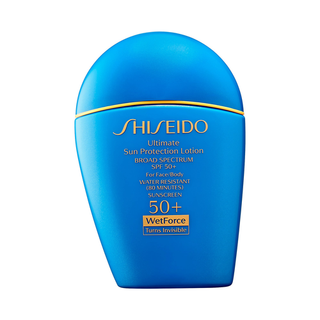
Shiseido Ultimate Sun Protection Lotion WetForce Broad Spectrum Sunscreen SPF 50+ Mini
Works for
2 of 2 advertised claims delivered
Sun protectionSPF 50 · 4 UV filtersBroad spectrum
This product offers a good level of protection against both UVB and UVA rays.
This sunscreen uses organic (so-called "chemical") sunscreen filters. Organic, or "chemical" filters usually provide reliable sun protection and rarely leave a white cast. Sunscreens with organic filters can sting eyes.
Evens skin toneNo ingredient credited for this claimStrong evidence
“Ultimate Sun Protection Lotion WetForce SPF 50+ provides powerful sun protection in a comfortable lotion formula that turns invisible on any skin tone.”
This product offers broad spectrum sun protection. It means that it can prevent hyperpigmentation and help keep the skin tone even (sun damage is the main factor causing age spots, darkening of post-acne marks and other discolorations).
Anti-agingNot advertised by the brand · 1 ingredient credited for this claimStrong evidence
This product can help prevent early signs of skin aging because it offers a good level of broad spectrum sun protection. Sun damage is the main cause of premature skin aging, and protecting your skin from the sun is the best anti-aging strategy.
MoisturizingNot advertised by the brand · 11 ingredients credited for this claimGood evidence
This product can help improve hydration of the skin with the two types of ingredients.
The first type is called “humectants”:
these ingredients help attract water.
When humectants are on the surface of the skin, they “pull in” the moisture from the outside environment, or from
within deeper layers of the skin. The following ingredients in this product do the job:
glycerin, butylene glycol.
This product also contains ingredients called “occlusives”. They help reduce the speed with which our skin loses moisture to the outside environment. These ingredients also help soften the upper layer of the skin, so it feels less tight and nicer to the touch. The following ingredients in this product do the job: dimethicone, isododecane.
Can it cause trouble?
Irritancy3 strong irritants: Benzophenone-3, Sd alcohol 40-b + 1 more — patch-test recommendedHigh risk
ComedogenicClean of flagged comedogenic ingredientsNone flagged
User reviews
Be the first — your take helps the next person decide.
Ingredients
Filter by role to see what each ingredient is doing.
Butyl methoxydibenzoylmethane2.5%
- Irritation risk
- Medium
Avobenzone. An organic, or so-called "chemical" UV filter. Protects against both UVA and UVB rays. Needs to be combined with other filters in a formulation to be stable.
More about Butyl methoxydibenzoylmethaneEthylhexyl methoxycinnamate4.9%
- Irritation risk
- High
Octinoxate. When used in higher concentrations, works as a sunscreen protecting the skin from UVB rays. When used in lower concentration, helps to preserve the product formulation. Is shown to be harmful to coral reefs - consider avoiding bathing in coral reef areas when wearing a product with this ingredient. It can be irritating
More about Ethylhexyl methoxycinnamateOctocrylene5%
- Irritation risk
- Medium
A weak sunscreen that protects against the sun rays that cause sunburn (UVB) and is somewhat effective against the UVA rays. It is quite stable and can help stabilize other, more vulnerable, sunscreen ingredients like Avobenzone. It is an organic, or so called "chemical" sunscreen
More about OctocryleneBenzophenone-33%
- Irritation risk
- High
Same as oxybenzone. Protects in the UVB and short UVA range. In small concentrations, used to stabilize product formulation. Can be irritating. Is shown to be harmful to coral reefs - consider avoiding bathing in coral reef areas when wearing a product with this ingredient. It can penetrate the skin and get absorbed into bloodstream faster than other popular filters available in the US. The study that produced this finding did not address any potential health effects of the absorption
More about Benzophenone-3Water~45–55%
Dimethicone~7.1–8.7%
- Irritation risk
- Low
A silicone that helps to reduce water loss from the surface of the skin. Can temporarily "fill in" lines and wrinkles, absorb oil, and create a nice product finish
More about DimethiconeSd alcohol 40-b~5.5–6.7%
- Irritation risk
- High
Can be drying and contribute to skin irritation. Used in formulars to dissolve other ingredients, create a thinner product consistency or for its antibacterial properties
More about Sd alcohol 40-bTalc~4.2–5.2%
Methyl methacrylate crosspolymer~3.2–3.9%
- Irritation risk
- Low
Helps thicken the product consistency
More about Methyl methacrylate crosspolymerIsododecane~2.5–3.1%
- Irritation risk
- Low
An emollient that helps soften the skin and can decrease moisture loss. Helps create a nice product texture
More about IsododecaneCetyl ethylhexanoate~1.8–2.2%
- Irritation risk
- Medium
An emollient that helps soften the skin and creates a thicker product texture
More about Cetyl ethylhexanoateDiisopropyl sebacate~1.5–1.9%
- Irritation risk
- Low
Helps soften the upper layer of the skin without creatng a greasy finish
More about Diisopropyl sebacateTriethylhexanoin~1.2–1.4%
- Irritation risk
- Medium
Helps soften the upper layer of the skin
More about TriethylhexanoinLauryl peg-9 polydimethylsiloxyethyl dimethicone~1–1.2%
- Irritation risk
- Low
A type of silicone that helps to soften upper layer of the skin and create a nice product texture
More about Lauryl peg-9 polydimethylsiloxyethyl dimethiconeGlycerin~0.75–1.15%
- Irritation risk
- Low
One of the best moisturizing ingredients. Naturally present in skin. It attracts water to the upper layer of the skin working as a humectant
More about GlycerinDextrin palmitate~0.6–0.95%
- Irritation risk
- Medium
Helps water and oil mix together
More about Dextrin palmitateSucrose tetrastearate triacetate~0.65–0.95%
Polybutylene glycol/ppg-9/1 copolymer~0.5–0.75%
- Irritation risk
- Low
Trimethylsiloxysilicate~0.55–0.8%
- Irritation risk
- Low
A type of silicone that helps create a nice product consistency and support the delivery of other ingredients
More about TrimethylsiloxysilicateXylitol~0.45–0.65%
- Irritation risk
- Low
Helps attract water to the upper layer of the skin and repair the skin barrier function
More about XylitolSilica~0.65–1%
Sodium chloride~0.45–0.65%
- Irritation risk
- Low
Used to stabilize mixtures of oil and water, and create thicker, gel-like product textures
More about Sodium chloridePeg/ppg-14/7 dimethyl ether~0.5–0.7%
- Irritation risk
- Low
An emollient that helps soften the skin. It also forms a protective on its surface to reduce water loss
More about Peg/ppg-14/7 dimethyl etherSaxifraga sarmentosa extract~0.3–0.6%
- Irritation risk
- Low
Sophora angustifolia root extract~0.3–0.55%
- Irritation risk
- High
Disteardimonium hectorite~0.3–0.55%
- Irritation risk
- Low
A type of clay that is used to thicken the product consistency
More about Disteardimonium hectoriteIsostearic acid~0.45–0.65%
- Irritation risk
- Low
Used to create a nice product texture
More about Isostearic acidCalcium stearate~0.3–0.55%
- Irritation risk
- Low
Trisodium edta~0.3–0.55%
Vinyl dimethicone/methicone silsesquioxane crosspolymer~0.3–0.55%
- Irritation risk
- Low
A type of silicone that create a smooth product finish and can create an optical soft-focus effect on the skin. Helps to thicken the product consistency
More about Vinyl dimethicone/methicone silsesquioxane crosspolymerAlcohol~0.3–0.55%
- Irritation risk
- High
Can be drying and contribute to skin irritation. Used in formulars to dissolve other ingredients, create a thinner product consistency or for its antibacterial properties
More about AlcoholBht~0.3–0.55%
Butylene glycol~0.3–0.5%
- Irritation risk
- Low
Used to create a nice product texture and help delivery of other ingredients. Might be somewhat helpful in attracting water to the upper layer of the skin
More about Butylene glycolStearic acid~0.5–0.75%
- Irritation risk
- Low
Helps oil and water mix together and works as an emollient
More about Stearic acidSodium metabisulfite~0.1–0.2%
Syzygium jambos leaf extract~0.25–0.5%
- Irritation risk
- Low
Tocopherol~0.25–0.45%
- Irritation risk
- Low
Pure form of vitamin E. Can help moisturise and protect the skin from free radicals. Often used to help stabilise other ingredients or the formula itself
More about TocopherolPolysilicone-2~0.25–0.45%
- Irritation risk
- Low
Methylparaben~0.15–0.3%
Parfum~0.15–0.3%
- Irritation risk
- High
An aromatic blend of unspecified and possibly irritating ingredients
More about ParfumIron oxides~0.15–0.3%
- Irritation risk
- Low
An umbrella term for the following three colorants: CI 77491, CI 77492, CI 77499. They might be able to offer some protection against visible light, but the degree of the protection is not clear
More about Iron oxidesIngredient list view
Butyl methoxydibenzoylmethane, Ethylhexyl methoxycinnamate, Octocrylene, Benzophenone-3, Water, Dimethicone, Sd alcohol 40-b, Talc, Methyl methacrylate crosspolymer, Isododecane, Cetyl ethylhexanoate, Diisopropyl sebacate, Triethylhexanoin, Lauryl peg-9 polydimethylsiloxyethyl dimethicone, Glycerin, Dextrin palmitate, Sucrose tetrastearate triacetate, Polybutylene glycol/ppg-9/1 copolymer, Trimethylsiloxysilicate, Xylitol, Silica, Sodium chloride, Peg/ppg-14/7 dimethyl ether, Saxifraga sarmentosa extract, Sophora angustifolia root extract, Disteardimonium hectorite, Isostearic acid, Calcium stearate, Trisodium edta, Vinyl dimethicone/methicone silsesquioxane crosspolymer, Alcohol, Bht, Butylene glycol, Stearic acid, Sodium metabisulfite, Syzygium jambos leaf extract, Tocopherol, Polysilicone-2, Methylparaben, Parfum, Iron oxides
Compare prices
Retailers ranked by price — lowest first.
Product summary
Based on the ingredient list, we assess that "Shiseido - Ultimate Sun Protection Lotion WetForce Broad Spectrum Sunscreen SPF 50+ Mini" can provide reliable sun protection. We love that it can protect from both UVA and UVB rays (not all sunscreens with SPF ratings give UVA protection. UVA rays do not cause sunburn, but still damage our skin and lead to early aging).
Its formula is also hydrating, so you might not need an additional moistruizer during the day. Like all broad-spectrum sunscreens, this product helps prevent early signs of aging.
Sunscreen filters
This sunscreen uses so-called "chemical", or organic UV filters (organic simply means that their molecules contain atoms of carbon). These filters typically give good sun protection and rarely leave a white cast, but they can be irritating for sensitive skin. Here are the exact UV filters in this sunscreen: oxybenzone 3.00% (declared), avobenzone 2.50% (declared), octinoxate 4.90% (declared) and octocrylene 5.00% (declared).
Irritation risk
We assess the overall irritancy of it to be high. For a detailed overview of all potential irritants: click here
You can see the detailed formula review with the breakdown of all actives in the product and the full ingredient list with estimated concentrations in the tables below.
Sources cited in this review
Every concentration estimate and effectiveness label is anchored to one of these 12 studies and safety reviews.
- 1
- 2
- 3On Photostability of Oxybenzonecore.ac.uk
- 4
- 5Final Report on the Safety Assessment of Dimethicone Copolyoljournals.sagepub.com
- 6

Affiliate links · As an Amazon Associate, WIMJ earns from qualifying purchases.