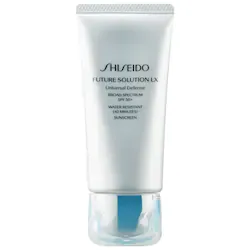
Shiseido Future Solution LX Universal Defense Broad Spectrum SPF 50+
Works for
3 of 3 advertised claims delivered
Sun protectionSPF 50 · 4 UV filtersBroad spectrum
This product offers a good level of protection against both UVB and UVA rays.
This sunscreen uses organic (so-called "chemical") sunscreen filters. Organic, or "chemical" filters usually provide reliable sun protection and rarely leave a white cast. Sunscreens with organic filters can sting eyes.
This product can be considered "reef safe" because it does not contain the UV filters (oxybenzone and octinoxate) that can be harmful to coral reefs when present in the water in high concentrations.
Anti-agingCamellia sinensis leaf extract, TocopherolStrong evidence
“Fine Lines and Wrinkles, Dullness, and Uneven Texture Formulation.”
This product can help prevent early signs of skin aging because it offers a good level of broad spectrum sun protection. Sun damage is the main cause of premature skin aging, and protecting your skin from the sun is the best anti-aging strategy.
Evens skin toneCamellia sinensis leaf extractStrong evidence
“Fine Lines and Wrinkles, Dullness, and Uneven Texture Formulation.”
This product offers broad spectrum sun protection. It means that it can prevent hyperpigmentation and help keep the skin tone even (sun damage is the main factor causing age spots, darkening of post-acne marks and other discolorations).
Anti-oxidationNot advertised by the brand · Camellia sinensis leaf extract, Rosa roxburghii fruit extract + 5 moreModerate evidence
This product contains antioxidants (camellia sinensis leaf extract) that might be able to help neutralize free radicals in skin to lessen the damage it gets from the UV light (sun). There is not enough evidence to confirm their effectiveness in skin though.
MoisturizingNot advertised by the brand · Sodium acetylated hyaluronate, Dimethicone + 10 moreGood evidence
This product can help improve hydration of the skin with the two types of ingredients.
The first type is called “humectants”:
these ingredients help attract water.
When humectants are on the surface of the skin, they “pull in” the moisture from the outside environment, or from
within deeper layers of the skin. The following ingredients in this product do the job:
glycerin, sodium acetylated hyaluronate.
This product also contains ingredients called “occlusives”. They help reduce the speed with which our skin loses moisture to the outside environment. These ingredients also help soften the upper layer of the skin, so it feels less tight and nicer to the touch. The following ingredients in this product do the job: dimethicone, isododecane.
Can it cause trouble?
Irritancy2 strong irritants: Sd alcohol 40-b, ParfumMedium risk
ComedogenicClean of flagged comedogenic ingredientsNone flagged
User reviews
Be the first — your take helps the next person decide.
Ingredients
Filter by role to see what each ingredient is doing.
Ethylhexyl salicylate5%
- Irritation risk
- Low
Octisalate. A UV filter. It offers some protection against the sun rays that cause sunburn (UVB), but does not protect against the most aging sun rays (UVA). It loses its effectiveness quickly when exposed to sunlight. It is an organic, or so called "chemical" sunscreen
More about Ethylhexyl salicylateOctocrylene7%
- Irritation risk
- Medium
A weak sunscreen that protects against the sun rays that cause sunburn (UVB) and is somewhat effective against the UVA rays. It is quite stable and can help stabilize other, more vulnerable, sunscreen ingredients like Avobenzone. It is an organic, or so called "chemical" sunscreen
More about OctocryleneZinc oxide15.4%
- Irritation risk
- Low
A broad spectrum sunblock (protects from both UVA and UVB rays). Is suitable for most sensitive skins. In small concentrations, can be used as a colorant
More about Zinc oxideWater~45–55%
Isododecane~5.6–6.9%
- Irritation risk
- Low
An emollient that helps soften the skin and can decrease moisture loss. Helps create a nice product texture
More about IsododecaneCaprylyl methicone~5–6.1%
- Irritation risk
- Low
A type of silicone that helps to soften the upper layer of the skin and create a nice product finish on the skin
More about Caprylyl methiconeSd alcohol 40-b~3.9–4.8%
- Irritation risk
- High
Can be drying and contribute to skin irritation. Used in formulars to dissolve other ingredients, create a thinner product consistency or for its antibacterial properties
More about Sd alcohol 40-bButylene glycol~2.9–3.6%
- Irritation risk
- Low
Used to create a nice product texture and help delivery of other ingredients. Might be somewhat helpful in attracting water to the upper layer of the skin
More about Butylene glycolGlycerin~2.2–2.7%
- Irritation risk
- Low
One of the best moisturizing ingredients. Naturally present in skin. It attracts water to the upper layer of the skin working as a humectant
More about GlycerinDimethicone~1.9–2.3%
- Irritation risk
- Low
A silicone that helps to reduce water loss from the surface of the skin. Can temporarily "fill in" lines and wrinkles, absorb oil, and create a nice product finish
More about DimethiconePeg-60 hydrogenated castor oil~1.3–1.6%
- Irritation risk
- Medium
Helps oil and water mix together
More about Peg-60 hydrogenated castor oilTocopheryl acetate~1–1.2%
- Irritation risk
- Medium
A more stable but less bio-available form of vitamin E compared to Tocopherol. Might help moisturize and protect the skin from free radicals, but mostly used in low concentrations to stabilize other ingredients.
More about Tocopheryl acetate2-o-ethyl ascorbic acid~0.8–1.2%
- Irritation risk
- Low
Prunus speciosa leaf extract~0.7–1.1%
- Irritation risk
- Low
Angelica acutiloba root extract~0.65–1%
- Irritation risk
- Low
Scutellaria baicalensis root extract~0.5–0.75%
- Irritation risk
- High
A plant extract that might contain a compound baicalin that could be helpful in neutralizing free radicals and reducing inflammation in skin. The baicalin concentration in skincare products is often too low for an effective action. Can be used for its fragrant properties
More about Scutellaria baicalensis root extractRubus idaeus fruit extract~0.6–0.9%
- Irritation risk
- Medium
A fruit extract that might have some anti-oxidant properties but evidence of effectiveness in skin is lacking
More about Rubus idaeus fruit extractSodium acetylated hyaluronate~0.55–0.85%
- Irritation risk
- Low
A type of hyaluronic acid that works as an excellent moisturizer by attracting water into the upper layer of the skin. Is typically feels less sticky on the skin compared to the usual hyaluronic acid
More about Sodium acetylated hyaluronateIsodonis japonicus leaf/stalk extract~0.55–0.85%
- Irritation risk
- Low
Camellia sinensis leaf extract~0.55–0.85%
- Irritation risk
- Low
Can contain potent anti-oxidant compounds (abbreviated ECG, GCG, EGC, and EGCG) that might help protect the skin from free radicals. Can help calm down inflammation and has some anti-bacterial properties. Unfortunately, these antioxidants are unstable and lose their effectiveness very quickly in products. The concentration of the antioxidant compounds in the extract also tends to be low to be effective in topical formulation
More about Camellia sinensis leaf extractRosa roxburghii fruit extract~0.5–0.75%
- Irritation risk
- Medium
A fruit extract that might help neutralize free radicals in skin, but evidence of effectiveness is missing
More about Rosa roxburghii fruit extractPolyquaternium-51~0.55–0.85%
- Irritation risk
- Low
An emollient that helps create a nice silky finish on the skin
More about Polyquaternium-51Polymethyl methacrylate~0.55–0.85%
- Irritation risk
- Low
Is used to enhance product texture and can help to optically mask skin imperfections
More about Polymethyl methacrylatePpg-17~0.45–0.65%
- Irritation risk
- Low
Hdi/trimethylol hexyllactone crosspolymer~0.45–0.65%
- Irritation risk
- Low
Used to create a silky product texture and add volume to products
More about Hdi/trimethylol hexyllactone crosspolymerIsostearic acid~0.45–0.7%
- Irritation risk
- Low
Used to create a nice product texture
More about Isostearic acidPeg-100 hydrogenated castor oil~0.45–0.7%
C30-45 alkyl methicone~0.5–0.8%
- Irritation risk
- Low
Dimethylacrylamide/sodium acryloyldimethyltaurate crosspolymer~0.45–0.65%
- Irritation risk
- Low
C30-45 olefin~0.4–0.65%
- Irritation risk
- Low
Sorbitan sesquiisostearate~0.45–0.65%
Hydrogen dimethicone~0.5–0.75%
- Irritation risk
- Low
Helps the function of sunscreen and pigment ingredients in the formulation
More about Hydrogen dimethiconeTriethoxycaprylylsilane~0.4–0.6%
- Irritation risk
- Low
A type of silicone that helps oil and water mix well together. Helps to disperse other ingredients, e.g. pigments, evenly in a formulation
More about TriethoxycaprylylsilaneCellulose gum~0.5–0.7%
- Irritation risk
- Low
Used to create thicker product consistency and stabilize emulsions
More about Cellulose gumSodium metaphosphate~0.4–0.65%
Succinoglycan~0.45–0.65%
Citric acid~0.4–0.6%
- Irritation risk
- Medium
Can work as an exfoliant but is typically used to adjust the product pH
More about Citric acidAlcohol~0.45–0.65%
- Irritation risk
- High
Can be drying and contribute to skin irritation. Used in formulars to dissolve other ingredients, create a thinner product consistency or for its antibacterial properties
More about AlcoholSilica~0.55–0.85%
Bht~0.35–0.65%
Tocopherol~0.35–0.6%
- Irritation risk
- Low
Pure form of vitamin E. Can help moisturise and protect the skin from free radicals. Often used to help stabilise other ingredients or the formula itself
More about TocopherolDisodium edta~0.3–0.5%
Hydroxypropyl methylcellulose stearoxy ether~0.3–0.55%
- Irritation risk
- Low
Helps create a thicker product formulation
More about Hydroxypropyl methylcellulose stearoxy etherAlumina~0.5–0.7%
- Irritation risk
- Low
The same compound that is used safely in dental implants and bone cements. In cosmetics, it is used to improve the consistency of products
More about AluminaSodium metabisulfite~0.1–0.2%
Sodium citrate~0.25–0.5%
- Irritation risk
- Medium
Helps to control the skin's pH level. Maintains the skin's natural film of amino-lactic acids and oils. Helps to preserve products
More about Sodium citrateTalc~0.45–0.7%
Peg-12 dimethicone~0.3–0.5%
- Irritation risk
- Low
Helps soften the upper layer of the skin and create a nice product texture
More about Peg-12 dimethiconeDisodium phosphate~0.25–0.45%
- Irritation risk
- Low
Helps adjust the product pH and stabilize the formulation
More about Disodium phosphateBarium sulfate~0.25–0.5%
- Irritation risk
- Low
Ergothioneine~0.2–0.35%
- Irritation risk
- Low
Can help neutralize free radicals in skin. Preliminary studies show that it can be more effective than coenzyme Q10 but studies on effective concentration for topical applications are lacking
More about ErgothioneineSodium phosphate~0.15–0.3%
Phenoxyethanol~0.1–0.25%
- Irritation risk
- Low
A preservative. It helps prevent bacterial growth in cosmetic products
More about PhenoxyethanolParfum~0.15–0.25%
- Irritation risk
- High
An aromatic blend of unspecified and possibly irritating ingredients
More about ParfumTitanium dioxide~0.2–0.4%
- Irritation risk
- Low
Works as a UV filter when used in high concentrations. It is photostable and is effective mostly against the UVB light, with some protection in the UVA range. In small concentrations, used for its ability to improve the color of cosmetic products. Is usually well tolerated by the skin
More about Titanium dioxideMica~0.1–0.2%
- Irritation risk
- Low
Creates an illusion of smoother and more radiant skin tone. Adds shimmer to the skin by reflecting light
More about MicaIron oxides~0.1–0.15%
- Irritation risk
- Low
An umbrella term for the following three colorants: CI 77491, CI 77492, CI 77499. They might be able to offer some protection against visible light, but the degree of the protection is not clear
More about Iron oxidesIngredient list view
Ethylhexyl salicylate, Octocrylene, Zinc oxide, Water, Isododecane, Caprylyl methicone, Sd alcohol 40-b, Butylene glycol, Glycerin, Dimethicone, Peg-60 hydrogenated castor oil, Tocopheryl acetate, 2-o-ethyl ascorbic acid, Prunus speciosa leaf extract, Angelica acutiloba root extract, Scutellaria baicalensis root extract, Rubus idaeus fruit extract, Sodium acetylated hyaluronate, Isodonis japonicus leaf/stalk extract, Camellia sinensis leaf extract, Rosa roxburghii fruit extract, Polyquaternium-51, Polymethyl methacrylate, Ppg-17, Hdi/trimethylol hexyllactone crosspolymer, Isostearic acid, Peg-100 hydrogenated castor oil, C30-45 alkyl methicone, Dimethylacrylamide/sodium acryloyldimethyltaurate crosspolymer, C30-45 olefin, Sorbitan sesquiisostearate, Hydrogen dimethicone, Triethoxycaprylylsilane, Cellulose gum, Sodium metaphosphate, Succinoglycan, Citric acid, Alcohol, Silica, Bht, Tocopherol, Disodium edta, Hydroxypropyl methylcellulose stearoxy ether, Alumina, Sodium metabisulfite, Sodium citrate, Talc, Peg-12 dimethicone, Disodium phosphate, Barium sulfate, Ergothioneine, Sodium phosphate, Phenoxyethanol, Parfum, Titanium dioxide, Mica, Iron oxides
Compare prices
Retailers ranked by price — lowest first.
Product summary
We believe that "Shiseido - Future Solution LX Universal Defense Broad Spectrum SPF 50+" can provide reliable sun protection based on the ingredients listed. We love that it can protect from both UVA and UVB rays (not all sunscreens with SPF ratings give UVA protection. UVA rays do not cause sunburn, but still damage our skin and lead to early aging).
This sunscreen should also be hydrating enough to use without an additional moisturizer during the day. This product prevents early signs of aging by protecting against sun damage (all broad spectrum sunscreens do that).
Sunscreen filters
This sunscreen uses a mixture of both mineral and organic (so-called "chemical") UV filters. The organic filters in the product are: octisalate and octocrylene. As for the mineral filters, this sunscreen uses both titanium dioxide and zinc oxide.
Irritation risk
This product contains some common irritants, including those without a benefit for the skin. We assess the overall irritancy of it to be medium. For a detailed overview of all potential irritants: click here
You can see the detailed formula review with the breakdown of all actives in the product and the full ingredient list with estimated concentrations in the tables below.
Sources cited in this review
Every concentration estimate and effectiveness label is anchored to one of these 22 studies and safety reviews.
- 1A review of inorganic UV filters zinc oxide and titanium dioxideonlinelibrary.wiley.com
- 2
- 3
- 4
- 5
- 6

Affiliate links · As an Amazon Associate, WIMJ earns from qualifying purchases.