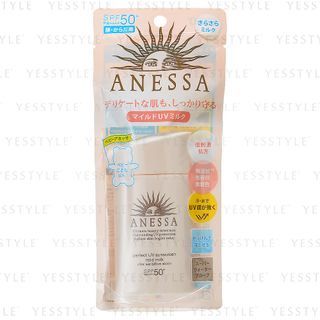
Shiseido Anessa Perfect UV Sunscreen Mild Milk For Sensitive Skin A SPF 50+ PA++++
Works for
0 of 1 advertised claim delivered
Sun protectionSPF 50 · 5 UV filters · Broad spectrumWeak protectionLow filter dose
This product can be considered "reef safe" because it does not contain the UV filters (oxybenzone and octinoxate) that can be harmful to coral reefs when present in the water in high concentrations.
MoisturizingNot advertised by the brand · Triethylhexanoin, Polymethylsilsesquioxane + 14 moreGood evidence
This product can help improve hydration of the skin with the two types of ingredients.
The first type is called “humectants”:
these ingredients help attract water.
When humectants are on the surface of the skin, they “pull in” the moisture from the outside environment, or from
within deeper layers of the skin. The following ingredients in this product do the job:
glycerin, sodium acetylated hyaluronate.
This product also contains ingredients called “occlusives”. They help reduce the speed with which our skin loses moisture to the outside environment. These ingredients also help soften the upper layer of the skin, so it feels less tight and nicer to the touch. The following ingredients in this product do the job: dimethicone, peg-10 dimethicone.
Can it cause trouble?
Irritancy10 flagged ingredientsLow risk
ComedogenicClean of flagged comedogenic ingredientsNone flagged
User reviews
Ingredients
Filter by role to see what each ingredient is doing.
Butylene glycol~22–34%
- Irritation risk
- Low
Used to create a nice product texture and help delivery of other ingredients. Might be somewhat helpful in attracting water to the upper layer of the skin
More about Butylene glycolPeg-9~3.8–5.7%
Prunus mume extract~4.2–6.3%
- Irritation risk
- Low
Propylene glycol~3.2–4.8%
- Irritation risk
- High
Helps oil and water mix together and can enhance the penetration of other ingredients into the skin. It can be irritating
More about Propylene glycolPeg-10~2.5–3.7%
- Irritation risk
- Low
Cyclopentasiloxane~1.9–2.9%
- Irritation risk
- Low
A silicone that helps improve the product texture and spreadability. Can absorb oil creating a short-term mattifying effect on the skin
More about CyclopentasiloxaneZinc oxide~2–3%
- Irritation risk
- Low
A broad spectrum sunblock (protects from both UVA and UVB rays). Is suitable for most sensitive skins. In small concentrations, can be used as a colorant
More about Zinc oxideDiisopropyl sebacate~1.2–1.7%
- Irritation risk
- Low
Helps soften the upper layer of the skin without creatng a greasy finish
More about Diisopropyl sebacateMethyl methacrylate crosspolymer~1–1.45%
- Irritation risk
- Low
Helps thicken the product consistency
More about Methyl methacrylate crosspolymerWater~0.6–1.35%
Cetyl ethylhexanoate~0.55–1.3%
- Irritation risk
- Medium
An emollient that helps soften the skin and creates a thicker product texture
More about Cetyl ethylhexanoatePentaerythrityl tetraethylhexanoate~0.5–1.15%
- Irritation risk
- Low
Used to create a nice product consistency while softening the upper layer of the skin
More about Pentaerythrityl tetraethylhexanoateTriethylhexanoin~0.35–0.85%
- Irritation risk
- Medium
Helps soften the upper layer of the skin
More about TriethylhexanoinDimethicone~0.45–1%
- Irritation risk
- Low
A silicone that helps to reduce water loss from the surface of the skin. Can temporarily "fill in" lines and wrinkles, absorb oil, and create a nice product finish
More about DimethiconeButylene glycol~0.35–0.8%
- Irritation risk
- Low
Used to create a nice product texture and help delivery of other ingredients. Might be somewhat helpful in attracting water to the upper layer of the skin
More about Butylene glycolDiethylhexyl succinate~0.45–1.1%
- Irritation risk
- Low
Helps soften the upper layer of the skin and create a nice product texture
More about Diethylhexyl succinateTitanium dioxide~0.4–0.9%
- Irritation risk
- Low
Works as a UV filter when used in high concentrations. It is photostable and is effective mostly against the UVB light, with some protection in the UVA range. In small concentrations, used for its ability to improve the color of cosmetic products. Is usually well tolerated by the skin
More about Titanium dioxidePolymethylsilsesquioxane~0.35–0.8%
- Irritation risk
- Low
A silicone that improves product texture and helps dissolve other ingredients. Can form a non-greasy film on the skin to prevent moisture loss
More about PolymethylsilsesquioxaneGlycerin~0.3–0.75%
- Irritation risk
- Low
One of the best moisturizing ingredients. Naturally present in skin. It attracts water to the upper layer of the skin working as a humectant
More about GlycerinPeg-9 polydimethylsiloxyethyl dimethicone~0.2–0.8%
- Irritation risk
- Medium
A type of silicone that helps water and oil mix together
More about Peg-9 polydimethylsiloxyethyl dimethiconeSilica~0.35–0.85%
Ethylhexyl triazone~0.35–0.8%
- Irritation risk
- Medium
Uvinul T. A UV filter. Effective against UVB rays. It is photostable. Can increase water resistance properties of the sunscreen. Unfortunately, not approved by the FDA (US) yet
More about Ethylhexyl triazoneDiethylamino hydroxybenzoyl hexyl benzoate~0.35–0.8%
- Irritation risk
- Medium
Uvinul A Plus. A new generation broad spectrum sunscreen that offers an effective protection especially in the UVA range. It is stable in formulations. Unfortunately, is not approved by the FDA (US) yet
More about Diethylamino hydroxybenzoyl hexyl benzoateBis-ethylhexyloxyphenol methoxyphenyl triazine~0.35–0.8%
- Irritation risk
- Medium
Tinosorb S. One of the most effective broad spectrum sunscreen ingredients. Protects from both UVA and UVB rays. It is photostable. Unfortunately, not approved by FDA (US) yet.
More about Bis-ethylhexyloxyphenol methoxyphenyl triazinePeg/ppg-14/7 dimethyl ether~0.3–0.7%
- Irritation risk
- Low
An emollient that helps soften the skin. It also forms a protective on its surface to reduce water loss
More about Peg/ppg-14/7 dimethyl etherSodium chloride~0.15–0.7%
- Irritation risk
- Low
Used to stabilize mixtures of oil and water, and create thicker, gel-like product textures
More about Sodium chloridePotassium glycyrrhizinate~0.2–0.8%
- Irritation risk
- Low
Sodium acetylated hyaluronate~0.2–0.75%
- Irritation risk
- Low
A type of hyaluronic acid that works as an excellent moisturizer by attracting water into the upper layer of the skin. Is typically feels less sticky on the skin compared to the usual hyaluronic acid
More about Sodium acetylated hyaluronatePeg-10 dimethicone~0.35–0.85%
- Irritation risk
- Low
A silicone that works to soften the upper layer of the skin and reduce its water loss
More about Peg-10 dimethiconeDextrin palmitate~0.15–0.7%
- Irritation risk
- Medium
Helps water and oil mix together
More about Dextrin palmitatePotassium hydroxide~0.15–0.6%
Disteardimonium hectorite~0.1–0.5%
- Irritation risk
- Low
A type of clay that is used to thicken the product consistency
More about Disteardimonium hectoriteStearic acid~0.2–0.75%
- Irritation risk
- Low
Helps oil and water mix together and works as an emollient
More about Stearic acidHydrogen dimethicone~0.15–0.55%
- Irritation risk
- Low
Helps the function of sunscreen and pigment ingredients in the formulation
More about Hydrogen dimethiconeSodium citrate~0.1–0.3%
- Irritation risk
- Medium
Helps to control the skin's pH level. Maintains the skin's natural film of amino-lactic acids and oils. Helps to preserve products
More about Sodium citrateSodium hydrosulfite~0.1–0.3%
- Irritation risk
- Low
Tocopherol~0.1–0.35%
- Irritation risk
- Low
Pure form of vitamin E. Can help moisturise and protect the skin from free radicals. Often used to help stabilise other ingredients or the formula itself
More about TocopherolIngredient list view
Butylene glycol, Peg-9, Prunus mume extract, Propylene glycol, Peg-10, Cyclopentasiloxane, Zinc oxide, Diisopropyl sebacate, Methyl methacrylate crosspolymer, Water, Cetyl ethylhexanoate, Pentaerythrityl tetraethylhexanoate, Triethylhexanoin, Dimethicone, Butylene glycol, Diethylhexyl succinate, Titanium dioxide, Polymethylsilsesquioxane, Glycerin, Peg-9 polydimethylsiloxyethyl dimethicone, Silica, Ethylhexyl triazone, Diethylamino hydroxybenzoyl hexyl benzoate, Bis-ethylhexyloxyphenol methoxyphenyl triazine, Peg/ppg-14/7 dimethyl ether, Sodium chloride, Potassium glycyrrhizinate, Sodium acetylated hyaluronate, Peg-10 dimethicone, Dextrin palmitate, Unknown, Potassium hydroxide, Disteardimonium hectorite, Stearic acid, Hydrogen dimethicone, Sodium citrate, Sodium hydrosulfite, Tocopherol
Compare prices
Retailers ranked by price — lowest first.

Affiliate links · prices updated regularly
Product summary
"Shiseido - Anessa Perfect UV Sunscreen Mild Milk For Sensitive Skin A SPF 50+ PA++++" is using UV filters in a relatively low concentration. Because of this, it might not be able to provide reliable sun protection.
Its formula is also hydrating, so you might not need an additional moistruizer during the day.
Sunscreen filters
This sunscreen uses a mixture of both mineral and organic (so-called "chemical") UV filters. Here are the organic filters this product uses: tinosorb s and uvinul t. As for the mineral filters, this sunscreen uses zinc oxide.
Irritation risk
There are some common irritants in this product, including ingredients that do not have benefits for the skin. We assess the overall irritancy of this product to be low. For a detailed overview of all potential irritants: click here
You can see the detailed formula review with the breakdown of all actives in the product and the full ingredient list with estimated concentrations in the tables below.
What our users say
Based on 2 reviews 100% recommend this product- When it comes to comedogenicity, the reviewer believes that it clogs pores.
- As for the white cast, two out of two reviewers say that the product does not leave a white cast.
- When it comes to using this sunscreen under makeup, the user found that it pills under a foundation.
- As for using this sunscreen in the eye area, the reviewer reported that it stings eyes.
Price
The product retails for 42.30$ in the United States.
For a detailed price comparison: click here.
Sources cited in this review
Every concentration estimate and effectiveness label is anchored to one of these 17 studies and safety reviews.
- 1Surfactants and experimental irritant contact dermatitisncbi.nlm.nih.gov
- 2Propylene Glycolpubmed.ncbi.nlm.nih.gov
- 3Skin-sensitizing and irritant properties of propylene glycolonlinelibrary.wiley.com
- 4A review of inorganic UV filters zinc oxide and titanium dioxideonlinelibrary.wiley.com
- 5
- 6

Affiliate links · As an Amazon Associate, WIMJ earns from qualifying purchases.