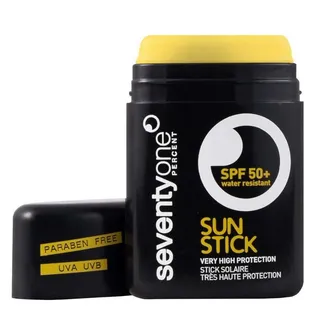
Seventy-One-Percent Sun Stick SPF 50+
Works for
Sun protectionSPF 50 · 5 UV filtersBroad spectrum
This product offers a good level of protection against both UVB and UVA rays.
This sunscreen uses organic (so-called "chemical") sunscreen filters. Organic, or "chemical" filters usually provide reliable sun protection and rarely leave a white cast. Sunscreens with organic filters can sting eyes.
Anti-agingSide benefit · Butyrospermum parkii butterWorks well
This product can help prevent early signs of skin aging because it offers a good level of broad spectrum sun protection. Sun damage is the main cause of premature skin aging, and protecting your skin from the sun is the best anti-aging strategy.
Evens skin toneSide benefit · No ingredient credited for this claimWorks well
This product offers broad spectrum sun protection. It means that it can prevent hyperpigmentation and help keep the skin tone even (sun damage is the main factor causing age spots, darkening of post-acne marks and other discolorations).
MoisturizingSide benefit the brand mentions · Cera microcristallina, Cera alba + 7 moreWorks
“Active antioxidants and moisturizers protect your skin in all conditions; from wind, to salty water and cold, when you are in the ocean or relaxing on the beach.”
This product can help soften the skin and reduce its moisture loss with emollients and occlusives: butyrospermum parkii butter, caprylic/capric triglyceride.
Keep in mind that this product does not contain effective ingredients to attract water to the upper layer of the skin. This is why an additional product with humectants like glycerin or hyaluronic acid can be helpful (apply it before this product for the best results).
Can it cause trouble?
Irritancy1 strong irritant: Ethyl vanillinMedium risk
Comedogenic3 ingredients rated 2 or more on the 0–5 pore-clogging scale3 flagged
User reviews
Be the first — your take helps the next person decide.
Ingredients
Filter by role to see what each ingredient is doing.
Cera microcristallina~22–33%
- Irritation risk
- Low
Helps to soften the upper layer of the skin, reduce water loss from its surface and create a thicker product consistency
More about Cera microcristallinaSilica~6.3–9.4%
Hydrogenated coconut oil~4.4–6.6%
- Irritation risk
- Low
- Comedogenicity
- 3/5
Hydrogenated polyisobutene~3.9–5.8%
- Irritation risk
- Low
Used to improve the product consistency and soften the upper layer of the skin
More about Hydrogenated polyisobuteneHydrogenated polydecene~2.8–4.2%
- Irritation risk
- Low
Helps to soften the upper layer of the skin and create a nice product texture
More about Hydrogenated polydeceneCera alba~2.6–3.9%
- Irritation risk
- Medium
Forms a protective barrier that holds water and keeps dry skin hydrated. Keeps an emulsion from separating into its oil and liquid components, and increases the thickness of a product. Can be an allergen
More about Cera albaRicinus communis seed oil~1.9–2.8%
- Irritation risk
- Medium
A plant oil that can help soften the skin. It might be helpful in calming down inflammation, but solid research is lacking. Is often used in lip products to create the needed product consistency
More about Ricinus communis seed oilEthylhexyl methoxycinnamate~1.9–2.8%
- Irritation risk
- High
Octinoxate. When used in higher concentrations, works as a sunscreen protecting the skin from UVB rays. When used in lower concentration, helps to preserve the product formulation. Is shown to be harmful to coral reefs - consider avoiding bathing in coral reef areas when wearing a product with this ingredient. It can be irritating
More about Ethylhexyl methoxycinnamateHydrogenated microcrystalline wax~1.2–1.8%
- Irritation risk
- Low
Bis-ethylhexyloxyphenol methoxyphenyl triazine~1.4–2.1%
- Irritation risk
- Medium
Tinosorb S. One of the most effective broad spectrum sunscreen ingredients. Protects from both UVA and UVB rays. It is photostable. Approved by the US FDA in 2026 (listed as bemotrizinol on US labels).
More about Bis-ethylhexyloxyphenol methoxyphenyl triazineButyl methoxydibenzoylmethane~1.1–1.7%
- Irritation risk
- Medium
Avobenzone. An organic, or so-called "chemical" UV filter. Protects against both UVA and UVB rays. Needs to be combined with other filters in a formulation to be stable.
More about Butyl methoxydibenzoylmethaneButyrospermum parkii butter~0.8–1.25%
- Irritation risk
- Low
- Comedogenicity
- 3/5
A great moisturising ingredient that softens the skin and reduces water loss from its upper layer. It also can be helpful in protecting skin from free radicals
More about Butyrospermum parkii butterTitanium dioxide~0.85–1.3%
- Irritation risk
- Low
Works as a UV filter when used in high concentrations. It is photostable and is effective mostly against the UVB light, with some protection in the UVA range. In small concentrations, used for its ability to improve the color of cosmetic products. Is usually well tolerated by the skin
More about Titanium dioxideCaprylic/capric triglyceride~0.55–1.3%
- Irritation risk
- Medium
A good mix of fatty acids that forms a protective layer on the skin. Improves the shelf life of products. Derived from coconut and glycerin
More about Caprylic/capric triglycerideHelianthus annuus seed oil~0.5–1.2%
- Irritation risk
- Low
A great emollient due to its high linoleic acid content. One of the most effective plant oils in helping skin hydration and repairing skin barrier function
More about Helianthus annuus seed oilEthylhexyl triazone~0.55–1.3%
- Irritation risk
- Medium
Uvinul T. A UV filter. Effective against UVB rays. It is photostable. Can increase water resistance properties of the sunscreen. Unfortunately, not approved by the FDA (US) yet
More about Ethylhexyl triazoneOryzanol~0.45–1.05%
- Irritation risk
- Low
An anti-oxidant that helps stabilize product formulations. Might help neutralise free radicals in skin
More about OryzanolJojoba esters~0.45–1.1%
- Irritation risk
- Medium
An emollient made of jojoba oil. Helps soften the skin and support its barrier function
More about Jojoba estersTocopheryl acetate~0.4–0.9%
- Irritation risk
- Medium
A more stable but less bio-available form of vitamin E compared to Tocopherol. Might help moisturize and protect the skin from free radicals, but mostly used in low concentrations to stabilize other ingredients.
More about Tocopheryl acetatePolyhydroxystearic acid~0.35–0.85%
- Irritation risk
- Medium
Used to create a thicker product consistency and stabilize the formulation
More about Polyhydroxystearic acidEthyl vanillin~0.3–0.75%
Mimosa tenuiflora bark extract~0.3–0.75%
- Irritation risk
- Low
Saccharin~0.35–0.75%
- Irritation risk
- Low
Bht~0.2–0.8%
Alumina~0.4–0.95%
- Irritation risk
- Low
The same compound that is used safely in dental implants and bone cements. In cosmetics, it is used to improve the consistency of products
More about AluminaMagnesium oxide~0.35–0.75%
- Irritation risk
- Low
Sorbitan oleate~0.2–0.8%
- Irritation risk
- Medium
- Comedogenicity
- 2/5
Helps oil and water mix together
More about Sorbitan oleateTitanium dioxide~0.35–0.8%
- Irritation risk
- Low
Works as a UV filter when used in high concentrations. It is photostable and is effective mostly against the UVB light, with some protection in the UVA range. In small concentrations, used for its ability to improve the color of cosmetic products. Is usually well tolerated by the skin
More about Titanium dioxideCi 77499~0.15–0.65%
Ci 19140~0.15–0.55%
Ci 77491~0.15–0.5%
- Irritation risk
- Low
A red colorant made of iron oxide. Typically is not irritating
More about Ci 77491Ci 15850~0.1–0.5%
Ci 77492~0.1–0.4%
Ci 42090~0.1–0.4%
Ci 15985~0.1–0.35%
Ingredient list view
Cera microcristallina, Silica, Hydrogenated coconut oil, Hydrogenated polyisobutene, Hydrogenated polydecene, Cera alba, Ricinus communis seed oil, Ethylhexyl methoxycinnamate, Hydrogenated microcrystalline wax, Bis-ethylhexyloxyphenol methoxyphenyl triazine, Butyl methoxydibenzoylmethane, Butyrospermum parkii butter, Titanium dioxide, Caprylic/capric triglyceride, Helianthus annuus seed oil, Ethylhexyl triazone, Oryzanol, Jojoba esters, Tocopheryl acetate, Polyhydroxystearic acid, Ethyl vanillin, Mimosa tenuiflora bark extract, Saccharin, Bht, Alumina, Magnesium oxide, Sorbitan oleate, Titanium dioxide, Ci 77499, Ci 19140, Ci 77491, Ci 15850, Ci 77492, Ci 42090, Ci 15985
Compare prices
Retailers ranked by price — lowest first.
Affiliate links · As an Amazon Associate, WIMJ earns from qualifying purchases.
Worth comparing, line by line.
Match % combines shared ingredients, the first five ingredients, shared actives and hero ingredients, irritancy (lower counts in the alternative's favour), texture and body area. Only products in the same routine step are compared.
| Seventy-One-PercentSun Stick SPF 50+YOUR PRODUCT | La Roche-PosayAnthelios Oil Control SPF 50+ Gel-Cream | AbibAiry Sunstick Smoothing Bar SPF 50+ | SkinCeuticalsOil Shield UV Defense Sunscreen SPF 50 | |
|---|---|---|---|---|
| Match | — | 29% | 29% | 28% |
| Price | — | $29.76 | $13.30 | $40.42 |
| Shared key ingredients | — | 4 of 12 | 1 of 12 | 4 of 12 |
| Key difference | — | Dimethicone | Copernicia Cerifera Wax | Glycerin |
| Irritancy | Medium | Low | Low | Low |
| SPF | SPF 50 | SPF 50 | SPF 50 | SPF 50 |
| Drying alcohol | — | — | — | — |
| View product | Shop | Shop | Shop |


More alternatives: SVR Fluide Photo-Age SPF50+OMI Verdio UV Moisture Essence SPF 50+ PA++++
Product summary
"SeventyOne Percent - Sun Stick SPF 50+" is using UV filters in a relatively low concentration. Because of this, it might not be able to provide reliable sun protection.
This sunscreen should also be hydrating enough to use without an additional moisturizer during the day.
Sunscreen filters
This is a so-called "chemical" sunscreen. It means that it uses organic UV filters. They typically offer good sun protection and rarely leave a white cast, but they can be irritating for some people with sensitive skin. These are the sun protection ingredients in this sunscreen: tinosorb s 1.40% - 2.10%, avobenzone 1.10% - 1.70%, octinoxate 1.90% - 2.80% and uvinul t 0.55% - 1.30%.
Irritation risk
We assess the overall irritancy of this product to be medium. For a detailed overview of all potential irritants: click here
You can see the detailed formula review with the breakdown of all actives in the product and the full ingredient list with estimated concentrations in the tables below.
Sources cited in this review
Every concentration estimate and effectiveness label is anchored to one of these 15 studies and safety reviews.
- 1
- 2Safety Assessment of Polyene Group as Used in Cosmeticscir-safety.org
- 3
- 4
- 5
- 6

Affiliate links · As an Amazon Associate, WIMJ earns from qualifying purchases.