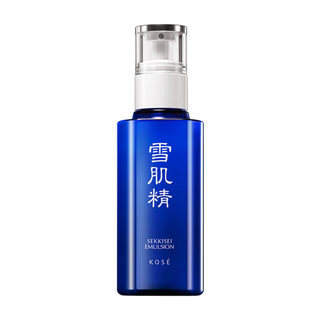
SEKKISEI Emulsion
Works for
2 of 3 advertised claims delivered
Moisturizing9 ingredients credited for this claimGood support
“This product is a quick-absorbing, lightweight moisturizer with five Oriental herb extracts to help brighten the complexion while softening skin with a non-tacky, highly emollient formula.”
This product can help soften the skin and reduce its moisture loss with emollients and occlusives: dimethicone, squalane.
Keep in mind that this product does not contain effective ingredients to attract water to the upper layer of the skin. This is why an additional product with humectants like glycerin or hyaluronic acid can be helpful (apply it before this product for the best results).
Evens skin tone1 ingredient credited for this claimModerate support
“Vitamin C helps to brighten skin tone.”
The following ingredient (ingredients) in this product might be helpful, but there is no evidence to confirm that it actually works: ascorbyl glucoside.
Anti-blemishNo ingredient credited for this claimNo support
“Citric Acid and Witch Hazel help to refine pores.”
Effective ingredients missing or their concentration is too low.
Anti-oxidationNot advertised by the brand · 3 ingredients credited for this claimModerate support
This product contains antioxidants (ascorbyl glucoside) that might be able to help neutralize free radicals in skin to lessen the damage it gets from the UV light (sun). There is not enough evidence to confirm their effectiveness in skin though.
Anti-agingNot advertised by the brand · 1 ingredient credited for this claimModerate support
This product contains ascorbyl glucoside. This ingredient might be able to help reduce and prevent fine lines and wrinkles, improve skin elasticity and firmness, but there is not enough evidence that it actually works.
Can it cause trouble?
Irritancy4 strong irritants: Alcohol, Rosa damascena extract + 2 more — patch-test recommendedHigh risk
Comedogenic1 ingredient rated 2 or more on the 0–5 pore-clogging scale1 flagged
User reviews
Ingredients
Filter by role to see what each ingredient is doing.
Water~40–60%
Alcohol~5.3–8%
- Irritation risk
- High
Can be drying and contribute to skin irritation. Used in formulars to dissolve other ingredients, create a thinner product consistency or for its antibacterial properties
More about AlcoholButylene glycol~2.9–4.4%
- Irritation risk
- Low
Used to create a nice product texture and help delivery of other ingredients. Might be somewhat helpful in attracting water to the upper layer of the skin
More about Butylene glycolDipropylene glycol~2–3%
- Irritation risk
- Low
Helps to dissolve other ingredients in a formulation. Slows down the rate of product drying
More about Dipropylene glycolAscorbyl glucoside~1.5–2.3%
- Irritation risk
- Medium
A vitamin C derivative that is more stable but less potent than pure form of vitamin C. Has a potential to boost collagen production, nutralise free radicals and reduce hyperpigmentation, but the required concentration is likely to be much higher than for the pure form of vitamin C, limiting the ingredient's effectiveness in products
More about Ascorbyl glucosidePropylene glycol dicaprate~1.1–1.7%
- Irritation risk
- Low
An emollient that helps soften the upper layer of the skin
More about Propylene glycol dicaprateDimethicone~0.95–1.4%
- Irritation risk
- Low
A silicone that helps to reduce water loss from the surface of the skin. Can temporarily "fill in" lines and wrinkles, absorb oil, and create a nice product finish
More about DimethiconeCetyl alcohol~1–1.5%
- Irritation risk
- Low
A non-drying alcohol that works to soften the skin and stabilize product formulations helping oil and water mix together
More about Cetyl alcoholDipentaerythrityl hexahydroxystearate/hexastearate/hexarosinate~0.5–1.2%
- Irritation risk
- Low
Squalane~0.55–1.3%
- Irritation risk
- Low
An oil naturally present in skin. Works as an emollient to soften the skin and form a protective layer on its surface without a greasy feeling.
More about SqualaneAngelica acutiloba root extract~0.35–0.85%
- Irritation risk
- Low
Rosa damascena extract~0.2–0.75%
- Irritation risk
- High
Oil of a very fragrant pink rose used as fragrance in cosmetics. Extensive research has shown it has mixed benefits. In the pro column, inhaling this flower’s scent seems to have relaxing properties and the plant’s petals contain skin-soothing and antioxidant compounds that can benefit skin. On the flipside, the numerous chemicals that create this rose’s distinctive fragrance pose a risk of causing skin aggravation.
More about Rosa damascena extractLac~0.15–0.65%
- Irritation risk
- Low
Helps form a film on the surface of the skin and disperse other ingredients (like colorants) in cosmetics. Lac is a resinous substance secreted by parasite insects living on trees
More about LacGentiana lutea extract~0.2–0.7%
- Irritation risk
- Low
Hamamelis virginiana extract~0.1–0.5%
- Irritation risk
- High
A plant extract that can help calm down inflammation in skin. Can, however, itself be irritating
More about Hamamelis virginiana extractInula britannica flower extract~0.1–0.5%
- Irritation risk
- Low
Melothria heterophylla root extract~0.1–0.45%
- Irritation risk
- Low
Paeonia albiflora root extract~0.1–0.4%
- Irritation risk
- Low
Polyphosphorylcholine glycol acrylate~0.1–0.45%
- Irritation risk
- Low
Tocopheryl acetate~0.1–0.3%
- Irritation risk
- Medium
A more stable but less bio-available form of vitamin E compared to Tocopherol. Might help moisturize and protect the skin from free radicals, but mostly used in low concentrations to stabilize other ingredients.
More about Tocopheryl acetateTriticum vulgare germ oil~0.1–0.3%
- Irritation risk
- Low
- Comedogenicity
- 3/5
A good emoillient. Contains vitamin E which can help neutralise free radicals, however the oil is unstable. Avoid if you have gluten or wheat sensitivity (including food allergies).
More about Triticum vulgare germ oilC13-16 isoparaffin~0.05–0.3%
- Irritation risk
- Low
Is mostly used to dissolve other ingredients. Helps soften the upper layer of the skin. It might be comedogenic when used in high concentrations
More about C13-16 isoparaffinCellulose gum~0.05–0.2%
- Irritation risk
- Low
Used to create thicker product consistency and stabilize emulsions
More about Cellulose gumCitric acid~0.05–0.15%
- Irritation risk
- Medium
Can work as an exfoliant but is typically used to adjust the product pH
More about Citric acidDisodium edta~0.05–0.15%
Disodium phosphate~0.05–0.2%
- Irritation risk
- Low
Helps adjust the product pH and stabilize the formulation
More about Disodium phosphateLecithin~0.05–0.3%
- Irritation risk
- Low
Used mostly for creating emulsions - helping oil and water mix together. Helps soften the upper layer of the skin
More about LecithinHydrogenated rapeseed oil~0.05–0.2%
- Irritation risk
- Low
Laureth-7~0.05–0.25%
Peg-8~0.05–0.2%
- Irritation risk
- Medium
Used to create a nice product consistency
More about Peg-8Polyacrylamide~0.05–0.3%
- Irritation risk
- Medium
Used to improve product texture and help oil and water mix together
More about PolyacrylamidePolysorbate 80~0.05–0.25%
Sodium hydroxide~0.05–0.2%
Sodium methyl stearoyl taurate~0.15–0.7%
Sorbitan stearate~0.05–0.15%
Ethylparaben~0.01–0.1%
Methylparaben~0.01–0.1%
Propylparaben~0.01–0.1%
Parfum~0.01–0.1%
- Irritation risk
- High
An aromatic blend of unspecified and possibly irritating ingredients
More about ParfumIngredient list view
Water, Alcohol, Butylene glycol, Dipropylene glycol, Ascorbyl glucoside, Propylene glycol dicaprate, Dimethicone, Cetyl alcohol, Dipentaerythrityl hexahydroxystearate/hexastearate/hexarosinate, Squalane, Angelica acutiloba root extract, Rosa damascena extract, Lac, Gentiana lutea extract, Hamamelis virginiana extract, Inula britannica flower extract, Melothria heterophylla root extract, Paeonia albiflora root extract, Polyphosphorylcholine glycol acrylate, Tocopheryl acetate, Triticum vulgare germ oil, C13-16 isoparaffin, Cellulose gum, Citric acid, Disodium edta, Disodium phosphate, Lecithin, Hydrogenated rapeseed oil, Unknown, Laureth-7, Peg-8, Polyacrylamide, Polysorbate 80, Sodium hydroxide, Sodium methyl stearoyl taurate, Sorbitan stearate, Ethylparaben, Methylparaben, Propylparaben, Parfum
Compare prices
Retailers ranked by price — lowest first.

Sources cited in this review
Every concentration estimate and effectiveness label is anchored to one of these 8 studies and safety reviews.
- 1The Roles of Vitamin C in Skin Healthncbi.nlm.nih.gov
- 2
- 3
- 4Final Report on the Safety Assessment of Dimethicone Copolyoljournals.sagepub.com
- 5
- 6

Affiliate links · As an Amazon Associate, WIMJ earns from qualifying purchases.