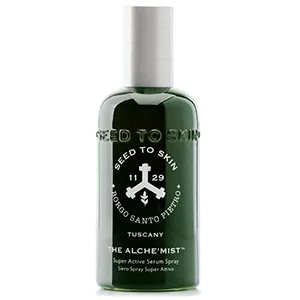
Seed to Skin The Alche’Mist

Seed to Skin The Alche’Mist

Efficacy100/100IrritancyHigh

Works for

Anti-aging
Niacinamide, Retinyl palmitate + 2 more
Works well
What the product description says
“provide anti-bacterial and anti-fungal benefits while being antimicrobial and significantly reducing the signs of ageing.”
Source: Seed to Skin Tuscany

This product can help reduce and prevent fine lines and wrinkles, improve skin elasticity and firmness because it contains niacinamide.

These ingredients in the product can also be helpful, even though there is less evidence for their effectiveness: retinyl palmitate.

Keep in mind that it typically takes at least 6 weeks to notice any results because the changes that are needed to improve fine lines and elasticity happen in the deeper layers of the skin. No topical anti-aging product can “erase” wrinkles or fully reverse signs of aging.

NiacinamideKey activeEffect: HighIs proven to be effective in reducing blemishes, evening out skin tone and helping to improve lines and wrinkles. It helps the skin to repair sun damage, calm down inflammation and keep maintain good levels of moisture. The concentration of about 2% is effective for supporting the skin barrier and evening out the skin tone. Concentration of 4-6% is better for helping with acne and balancing the sebum production~5–7.5%
Retinyl palmitateKey activeEffect: MediumThree steps removed from the active form of vitamin A - retinoic acid. To have an effect in the skin, it first needs to be converted twice to become the retinoic acid. This means it is less potent than retinol, but could also be less irritating. Once converted to the retinoic acid in the skin, it helps against all signs of aging, improves skin cell turnover and helps fight blemishes and clogged pores. However, in many cosmetic formulations, it is used in a concentration that is too low to have the full effect~0.6–1.35%
Hyaluronic acidEffect: LowOne of the best moisturizing ingredients. Attracts water into the upper layer of the skin. Naturally present in skin. Typically has large molecule size unless advertised otherwise on the product label. Helps support skin's barrier function and may help to reduce inflammation~2.7–4%
Sodium ascorbyl phosphateEffect: Low, below effective doseA stable derivative of vitamin C. It is oil-soluble which means it is more likely to penetrate the skin compared to the pure form of vitamin C (which is water-soluble), but it is less bio-available and is way less effective in stimulating collagen and reducing wrinkles compared to the pure form of vitamin C (L-ascorbic acid) and its other derivatives (for example, magnesium ascorbyl phosphate). At the same time, this vitamin C derivative has been shown in studies to be effective in reducing acne, blemishes and clogged pores. It is less irritating then the pure form of vitamin C~0.5–1.15%
Moisturizing
Side benefit the brand mentions · Niacinamide, Panthenol + 6 more
Works well
What the product description says
“Hyaluronic Acid very low molecular weight 5000 D, Thermal Plankton, Marine Plankton, Vitamin A, B3, B5, C, E and F. Essential oils.”
Source: N/A

This product contains good ingredients to attract water to the upper layer of the skin. These ingredients are called "humectants": glycerin, hyaluronic acid.

When humectants are on the surface of the skin, they “pull in” the moisture from the outside environment, or from within deeper layers of the skin. If the air is dry, humectants can speed up the moisture loss from the skin. This is why it is a good idea to use another product on top of this one to help "seal in" the moisture (look for ingredients like dimethicone, squalane, oils and butters).

The following ingredients in this product are especially good for supporting the skin barrier and helping with the hydration level: niacinamide, panthenol

NiacinamideHeroEffect: HighIs proven to be effective in reducing blemishes, evening out skin tone and helping to improve lines and wrinkles. It helps the skin to repair sun damage, calm down inflammation and keep maintain good levels of moisture. The concentration of about 2% is effective for supporting the skin barrier and evening out the skin tone. Concentration of 4-6% is better for helping with acne and balancing the sebum production~5–7.5%
PanthenolHero· HumectantEffect: HighHelps attract water to the upper layer of the skin and can help improve skin barrier function~1.9–2.9%
GlycerinKey active· HumectantEffect: HighOne of the best moisturizing ingredients. Naturally present in skin. It attracts water to the upper layer of the skin working as a humectant~3.4–5.1%
Hyaluronic acidKey active· HumectantEffect: HighOne of the best moisturizing ingredients. Attracts water into the upper layer of the skin. Naturally present in skin. Typically has large molecule size unless advertised otherwise on the product label. Helps support skin's barrier function and may help to reduce inflammation~2.7–4%
Plankton extractKey activeEffect: MediumCan help attract water to the upper layer of the skin~1.6–2.4%
Glyceryl linolenateKey active· EmollientEffect: MediumHelps soften the upper layer of the skin~1–1.5%
Sorbitol· HumectantEffect: LowHelps attract water to the upper layer of the skin and improves the product texture~0.35–0.85%
LecithinEffect: Low, below effective doseUsed mostly for creating emulsions - helping oil and water mix together. Helps soften the upper layer of the skin~0.35–0.8%
Anti-blemish
Side benefit · Niacinamide, Retinyl palmitate + 1 more
Works well

This product can help reduce breakouts and clogged pores because it contains the following ingredient: niacinamide. This ingredient is used for treating acne and can have a noticeable effect.

The following ingredient (ingredients) in this product might be helpful, but there is no evidence to confirm that it actually works: retinyl palmitate

NiacinamideHeroEffect: HighIs proven to be effective in reducing blemishes, evening out skin tone and helping to improve lines and wrinkles. It helps the skin to repair sun damage, calm down inflammation and keep maintain good levels of moisture. The concentration of about 2% is effective for supporting the skin barrier and evening out the skin tone. Concentration of 4-6% is better for helping with acne and balancing the sebum production~5–7.5%
Retinyl palmitateKey activeEffect: MediumThree steps removed from the active form of vitamin A - retinoic acid. To have an effect in the skin, it first needs to be converted twice to become the retinoic acid. This means it is less potent than retinol, but could also be less irritating. Once converted to the retinoic acid in the skin, it helps against all signs of aging, improves skin cell turnover and helps fight blemishes and clogged pores. However, in many cosmetic formulations, it is used in a concentration that is too low to have the full effect~0.6–1.35%
Sodium ascorbyl phosphateUnder-dosedA stable derivative of vitamin C. It is oil-soluble which means it is more likely to penetrate the skin compared to the pure form of vitamin C (which is water-soluble), but it is less bio-available and is way less effective in stimulating collagen and reducing wrinkles compared to the pure form of vitamin C (L-ascorbic acid) and its other derivatives (for example, magnesium ascorbyl phosphate). At the same time, this vitamin C derivative has been shown in studies to be effective in reducing acne, blemishes and clogged pores. It is less irritating then the pure form of vitamin C~0.5–1.15%
Evens skin tone
Side benefit · Niacinamide, Retinyl palmitate
Works well

This product can help reduce hypepigmentation and even out the skin tone because it contains the following effective ingredients: niacinamide

The following ingredient (ingredients) in this product might be helpful, but there is no evidence to confirm that it actually can help even out the skin tone: retinyl palmitate.

Keep in mind that you would need to apply any topical skincare targetted at hypigmentation consistently for a couple of months to get a result. No topical skincare product can help get rid of hyperpigmentation (including post-acne marks and age spots) instantly.

NiacinamideKey activeEffect: HighIs proven to be effective in reducing blemishes, evening out skin tone and helping to improve lines and wrinkles. It helps the skin to repair sun damage, calm down inflammation and keep maintain good levels of moisture. The concentration of about 2% is effective for supporting the skin barrier and evening out the skin tone. Concentration of 4-6% is better for helping with acne and balancing the sebum production~5–7.5%
Retinyl palmitateKey activeEffect: MediumThree steps removed from the active form of vitamin A - retinoic acid. To have an effect in the skin, it first needs to be converted twice to become the retinoic acid. This means it is less potent than retinol, but could also be less irritating. Once converted to the retinoic acid in the skin, it helps against all signs of aging, improves skin cell turnover and helps fight blemishes and clogged pores. However, in many cosmetic formulations, it is used in a concentration that is too low to have the full effect~0.6–1.35%

Can it cause trouble?

Irritancy
10 strong irritants: Retinyl palmitate, Santalum austrocaledonicum wood oil + 8 more — patch-test recommended
High risk
We flagged 19 ingredients with irritancy potential. Severity depends on your sensitivity threshold; the table lists the worst offenders first.
IngredientFunctionIrritationEst. amount
Retinyl palmitateThree steps removed from the active form of vitamin A - retinoic acid. To have an effect in the skin, it first needs to be converted twice to become the retinoic acid. This means it is less potent than retinol, but could also be less irritating. Once converted to the retinoic acid in the skin, it helps against all signs of aging, improves skin cell turnover and helps fight blemishes and clogged pores. However, in many cosmetic formulations, it is used in a concentration that is too low to have the full effectHigh~0.6–1.35%est.
Santalum austrocaledonicum wood oilUsed as a fragrance. Can be irritatingHigh~0.4–0.9%est.
Rosa damascena flower extractUsed as a fragrance. Can be irritatingHigh~0.4–0.9%est.
Citrus aurantium bergamia fruit oilA plant oil with a high content of volatile compounds that can irritate the skin and lead to allergic reactions. Can lead to photosensitivityHigh~0.35–0.85%est.
LimoneneA common frangrance that can easily irritate skin, especially if exposed to air, light or heatHigh~0.15–0.5%est.
CitronellolA fragrance. Can be irritatingHigh~0.1–0.4%est.
GeraniolA fragrance. Can be irritatingHigh~0.1–0.3%est.
LinaloolA fragrance. Can be irritatingHigh~0.1–0.3%est.
CitralA fragrance with a lemon scent. A likely irritantHigh~0.05–0.25%est.
EugenolA fragrance. Is a likely irritantHigh~0.05–0.2%est.
Benzyl alcoholA preservative. Can be used to mask unpleasant smell. Can be irritatingHigh~0.05–0.2%est.
Olea europaea leaf extractA plant extract that might have some anti-oxidant and anti-inflammatory properties but evidence for effectiveness in skin is missingMedium~22–33%est.
Plankton extractCan help attract water to the upper layer of the skinMedium~1.6–2.4%est.
Tocopheryl acetateA more stable but less bio-available form of vitamin E compared to Tocopherol. Might help moisturize and protect the skin from free radicals, but mostly used in low concentrations to stabilize other ingredients.Medium~1.2–1.8%est.
Glyceryl linoleateHelps oil and water mix togetherMedium~1.2–1.8%est.
Sodium ascorbyl phosphateA stable derivative of vitamin C. It is oil-soluble which means it is more likely to penetrate the skin compared to the pure form of vitamin C (which is water-soluble), but it is less bio-available and is way less effective in stimulating collagen and reducing wrinkles compared to the pure form of vitamin C (L-ascorbic acid) and its other derivatives (for example, magnesium ascorbyl phosphate). At the same time, this vitamin C derivative has been shown in studies to be effective in reducing acne, blemishes and clogged pores. It is less irritating then the pure form of vitamin CMedium~0.5–1.15%est.
Sodium levulinateA preservativeMedium~0.2–0.7%est.
Sodium dehydroacetateA preservativeMedium~0.3–0.6%est.
Potassium sorbateA preservativeMedium~0.15–0.6%est.
Comedogenic
1 ingredient rated 2 or more on the 0–5 pore-clogging scale
1 flagged
These ingredients have a comedogenic rating of 2 or more on a 0–5 scale; the table shows each one's rating. In leave-on products they can clog pores in acne-prone skin.
IngredientFunctionRatingEst. amount
Plankton extractCan help attract water to the upper layer of the skin3/5~1.6–2.4%est.

User reviews

Would you recommend?
No community reviews yet.

Be the first — your take helps the next person decide.

Ingredients

Filter by role to see what each ingredient is doing.

Olea europaea leaf extract~22–33%
Irritant · medium
Irritation risk
Medium
Works for
Anti-oxidation

A plant extract that might have some anti-oxidant and anti-inflammatory properties but evidence for effectiveness in skin is missing

More about Olea europaea leaf extract
Water~12–18%
Formula
Irritation risk
Low

Plain old water

More about Water
Niacinamide~5–7.5%
Hero · Moisturizing, Anti-blemish
Irritation risk
Low
Works for
Anti-agingAnti-blemishEvens skin toneMoisturizingReduces irritationAnti-inflammatoryAntibacterialReduces redness

Is proven to be effective in reducing blemishes, evening out skin tone and helping to improve lines and wrinkles. It helps the skin to repair sun damage, calm down inflammation and keep maintain good levels of moisture. The concentration of about 2% is effective for supporting the skin barrier and evening out the skin tone. Concentration of 4-6% is better for helping with acne and balancing the sebum production

More about Niacinamide
Glycerin~3.4–5.1%
Key active
Irritation risk
Low
Works for
Moisturizing

One of the best moisturizing ingredients. Naturally present in skin. It attracts water to the upper layer of the skin working as a humectant

More about Glycerin
Hyaluronic acid~2.7–4%
Key active
Irritation risk
Low
Works for
MoisturizingAnti-inflammatoryAnti-aging

One of the best moisturizing ingredients. Attracts water into the upper layer of the skin. Naturally present in skin. Typically has large molecule size unless advertised otherwise on the product label. Helps support skin's barrier function and may help to reduce inflammation

More about Hyaluronic acid
Panthenol~1.9–2.9%
Hero · Moisturizing
Irritation risk
Low
Works for
Reduces rednessMoisturizingReduces irritation

Helps attract water to the upper layer of the skin and can help improve skin barrier function

More about Panthenol
Plankton extract~1.6–2.4%
Key activeComedogenic 3/5Irritant · medium
Irritation risk
Medium
Comedogenicity
3/5
Works for
Moisturizing

Can help attract water to the upper layer of the skin

More about Plankton extract
Tocopheryl acetate~1.2–1.8%
Irritant · medium
Irritation risk
Medium
Works for
Anti-oxidation

A more stable but less bio-available form of vitamin E compared to Tocopherol. Might help moisturize and protect the skin from free radicals, but mostly used in low concentrations to stabilize other ingredients.

More about Tocopheryl acetate
Glyceryl linoleate~1.2–1.8%
Irritant · medium
Irritation risk
Medium
Works for
Cleansing

Helps oil and water mix together

More about Glyceryl linoleate
Glyceryl linolenate~1–1.5%
Key active
Irritation risk
Low
Works for
Moisturizing

Helps soften the upper layer of the skin

More about Glyceryl linolenate
Retinyl palmitate~0.6–1.35%
Key activeIrritant · high
Irritation risk
High
Works for
Anti-blemishAnti-agingEvens skin toneExfoliation

Three steps removed from the active form of vitamin A - retinoic acid. To have an effect in the skin, it first needs to be converted twice to become the retinoic acid. This means it is less potent than retinol, but could also be less irritating. Once converted to the retinoic acid in the skin, it helps against all signs of aging, improves skin cell turnover and helps fight blemishes and clogged pores. However, in many cosmetic formulations, it is used in a concentration that is too low to have the full effect

More about Retinyl palmitate
Sodium ascorbyl phosphate~0.5–1.15%
Under-dosedIrritant · medium
Irritation risk
Medium
Works for
Anti-blemishAnti-oxidationAnti-aging

A stable derivative of vitamin C. It is oil-soluble which means it is more likely to penetrate the skin compared to the pure form of vitamin C (which is water-soluble), but it is less bio-available and is way less effective in stimulating collagen and reducing wrinkles compared to the pure form of vitamin C (L-ascorbic acid) and its other derivatives (for example, magnesium ascorbyl phosphate). At the same time, this vitamin C derivative has been shown in studies to be effective in reducing acne, blemishes and clogged pores. It is less irritating then the pure form of vitamin C

More about Sodium ascorbyl phosphate
Pogostemon cablin leaf extract~0.45–1%
Formula
Santalum austrocaledonicum wood oil~0.4–0.9%
Irritant · high
Irritation risk
High

Used as a fragrance. Can be irritating

More about Santalum austrocaledonicum wood oil
Rosa damascena flower extract~0.4–0.9%
Irritant · high
Irritation risk
High

Used as a fragrance. Can be irritating

More about Rosa damascena flower extract
Citrus aurantium bergamia fruit oil~0.35–0.85%
Irritant · high
Irritation risk
High

A plant oil with a high content of volatile compounds that can irritate the skin and lead to allergic reactions. Can lead to photosensitivity

More about Citrus aurantium bergamia fruit oil
Sorbitol~0.35–0.85%
Formula
Irritation risk
Low
Works for
Moisturizing

Helps attract water to the upper layer of the skin and improves the product texture

More about Sorbitol
Xanthan gum~0.35–0.8%
Formula
Irritation risk
Low
Works for
Cleansing

Used to create a thicker product consistency

More about Xanthan gum
Lecithin~0.35–0.8%
Formula
Irritation risk
Low
Works for
CleansingMoisturizing

Used mostly for creating emulsions - helping oil and water mix together. Helps soften the upper layer of the skin

More about Lecithin
Sodium levulinate~0.2–0.7%
Irritant · medium
Irritation risk
Medium

A preservative

More about Sodium levulinate
Sodium dehydroacetate~0.3–0.6%
Irritant · medium
Irritation risk
Medium

A preservative

More about Sodium dehydroacetate
Potassium sorbate~0.15–0.6%
Irritant · medium
Irritation risk
Medium

A preservative

More about Potassium sorbate
Limonene~0.15–0.5%
Irritant · high
Irritation risk
High

A common frangrance that can easily irritate skin, especially if exposed to air, light or heat

More about Limonene
Citronellol~0.1–0.4%
Irritant · high
Irritation risk
High

A fragrance. Can be irritating

More about Citronellol
Geraniol~0.1–0.3%
Irritant · high
Irritation risk
High

A fragrance. Can be irritating

More about Geraniol
Linalool~0.1–0.3%
Irritant · high
Irritation risk
High

A fragrance. Can be irritating

More about Linalool
Citral~0.05–0.25%
Irritant · high
Irritation risk
High

A fragrance with a lemon scent. A likely irritant

More about Citral
Eugenol~0.05–0.2%
Irritant · high
Irritation risk
High

A fragrance. Is a likely irritant

More about Eugenol
Benzyl alcohol~0.05–0.2%
Irritant · high
Irritation risk
High

A preservative. Can be used to mask unpleasant smell. Can be irritating

More about Benzyl alcohol
Ingredient list view

Olea europaea leaf extract, Water, Niacinamide, Glycerin, Hyaluronic acid, Panthenol, Plankton extract, Tocopheryl acetate, Glyceryl linoleate, Glyceryl linolenate, Retinyl palmitate, Sodium ascorbyl phosphate, Pogostemon cablin leaf extract, Santalum austrocaledonicum wood oil, Rosa damascena flower extract, Citrus aurantium bergamia fruit oil, Sorbitol, Xanthan gum, Lecithin, Sodium levulinate, Sodium dehydroacetate, Potassium sorbate, Limonene, Citronellol, Geraniol, Linalool, Citral, Eugenol, Benzyl alcohol

Compare prices

Retailers ranked by price — lowest first.

🌐 Seed to Skin Tuscany (IT)
$240.00
Buy

Affiliate links · As an Amazon Associate, WIMJ earns from qualifying purchases.

Worth comparing, line by line.

Match % combines shared ingredients, the first five ingredients, shared actives and hero ingredients, irritancy (lower counts in the alternative's favour), texture and body area. Only products in the same routine step are compared.

Side-by-side comparison of this product against its closest alternatives
Seed to SkinThe Alche’MistYOUR PRODUCTArenciaRice Mucin Glow Serum 30TIRTIRCollagen Core Glow EssenceVitaminSea.beautySea Kale & Hyaluronic Acid Complex Rejuvenating Skin Serum
Match—94%93%92%
Price—$16.83$15.60—
Shared key ingredients—5 of 54 of 55 of 5
Key difference—RetinalAdenosineAgran Oil
Irritancy High Medium Medium Medium
Drying alcohol————
View product Shop Shop Shop

More alternatives: REVOLUTION SKINCARE Hydra Bright Dewy Face MistM-61 Hydraboost Face Mist

Cheaper alternatives? See how this stacks up against similar formulas.
We compare ingredient profiles across our catalog — pick the closest match for your budget.
Open dupe finder

Sources cited in this review

Every concentration estimate and effectiveness label is anchored to one of these 20 studies and safety reviews.

  1. 1
  2. 2
  3. 3
  4. 4
  5. 5
  6. 6
Seed to Skin The Alche’Mist
Seed to SkinThe Alche’Mist

Affiliate links · As an Amazon Associate, WIMJ earns from qualifying purchases.

As an Amazon Associate, WIMJ earns from qualifying purchases.