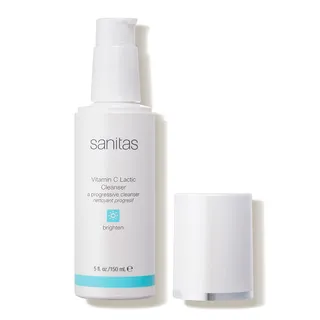
Sanitas Skincare Vitamin C Lactic Cleanser
Works for
CleansingCoco-betaine, Decyl glucoside + 3 moreCan be harsh
“Vitamin C Lactic Cleanser”
This product works by removing dirt and oil from the surface of the skin.
The following cleansing agents are typically mild, but still can cause an irritation or allergy for some people coco-betaine, decyl glucoside.
Keep in mind that cleansing can disrupt the skin barrier, and most people do not need to cleanse their skin more than once per day.
ExfoliationLactic acid ~1–1.5%, below the ~2% it needsUnder-dosed
“An exfoliating cleanser that brightens skin and provides anti-aging benefits.”
This product does not contain effective exfoliating ingredients. It might be able to deliver physical exfoliation, that is scrub off some of the dead cells on the surface of the skin. We do not recommend physical exfoliation, because it is not uniform (some bits of skin can get exfoliated too much while others not at all). It can also traumatize the skin and aggrevate acne and other skin conditions.
Can it cause trouble?
Irritancy2 strong irritants: Santalum album extract, Citrus limon peel oilMedium risk
ComedogenicClean of flagged comedogenic ingredientsNone flagged
User reviews
Be the first — your take helps the next person decide.
Ingredients
Filter by role to see what each ingredient is doing.
Water~40–60%
Coco-betaine~7.9–11.8%
- Irritation risk
- High
Helps oil and water mix together and works as a cleansing agent. Can be allergenic
More about Coco-betaineDecyl glucoside~4.6–6.8%
- Irritation risk
- High
Helps oil and water mix together. Can be irritating
More about Decyl glucosidePolysorbate 80~2.5–3.8%
Glycerin~2.2–3.3%
- Irritation risk
- Low
One of the best moisturizing ingredients. Naturally present in skin. It attracts water to the upper layer of the skin working as a humectant
More about GlycerinSodium pca~1.7–2.5%
- Irritation risk
- Low
Naturally present in skin and helps to attract water to its upper layer
More about Sodium pcaGalactoarabinan~1.4–2.1%
- Irritation risk
- Medium
Helps attract water to the upper layer of the skin
More about GalactoarabinanAscorbyl glucoside~1.2–1.9%
- Irritation risk
- Medium
A vitamin C derivative that is more stable but less potent than pure form of vitamin C. Has a potential to boost collagen production, nutralise free radicals and reduce hyperpigmentation, but the required concentration is likely to be much higher than for the pure form of vitamin C, limiting the ingredient's effectiveness in products
More about Ascorbyl glucosideLactic acid~1–1.5%
- Irritation risk
- Medium
An exfoliating and moisturizing alpha-hydroxy acid (AHA). Typically causes less irritation than other AHAs, for example, glycolic acid. At high concentrations (about 15%), lactic acid can help reduce lines and wrinkles. Recent studies show that lactic acid can support the "good" bacteria living on skin's surface (healthy skin microbiome)
More about Lactic acidSantalum album extract~0.55–1.35%
Phellodendron amurense bark extract~0.5–1.2%
- Irritation risk
- Medium
A plant extract that might have an anti-inflammatory effect
More about Phellodendron amurense bark extractSodium hyaluronate~0.4–0.95%
- Irritation risk
- Low
One of the best moisturizing ingredients. Attracts water into the upper layer of the skin
More about Sodium hyaluronateHordeum distichon extract~0.35–0.85%
- Irritation risk
- Low
Phospholipids~0.3–0.75%
- Irritation risk
- Low
Emollients that are naturaly present in skin. In addition, they help water and oil mix together in the product
More about PhospholipidsSodium lauroyl lactylate~0.15–0.7%
- Irritation risk
- Medium
Helps water and oil mix together
More about Sodium lauroyl lactylateCitrus limon peel oil~0.1–0.45%
Phenoxyethanol~0.1–0.4%
- Irritation risk
- Low
A preservative. It helps prevent bacterial growth in cosmetic products
More about PhenoxyethanolCaprylyl glycol~0.1–0.35%
- Irritation risk
- Medium
Helps preserve products and creates a nice product texture
More about Caprylyl glycolEthylhexylglycerin~0.05–0.2%
Hexylene glycol~0.05–0.15%
- Irritation risk
- Medium
Helps create a more spreadable product texture
More about Hexylene glycolIngredient list view
Water, Coco-betaine, Decyl glucoside, Polysorbate 80, Glycerin, Sodium pca, Galactoarabinan, Ascorbyl glucoside, Lactic acid, Santalum album extract, Phellodendron amurense bark extract, Sodium hyaluronate, Hordeum distichon extract, Phospholipids, Sodium lauroyl lactylate, Citrus limon peel oil, Phenoxyethanol, Caprylyl glycol, Ethylhexylglycerin, Hexylene glycol
Compare prices
Retailers ranked by price — lowest first.


Worth comparing, line by line.
Match % combines shared ingredients, the first five ingredients, shared actives and hero ingredients, irritancy (lower counts in the alternative's favour), texture and body area. Only products in the same routine step are compared.
| Sanitas SkincareVitamin C Lactic CleanserYOUR PRODUCT | OlivalAmino Gel | CeraVeGel Moussant Anti-Imperfections | EucerinUrea Plus Shower Foam | |
|---|---|---|---|---|
| Match | — | 51% | 50% | 47% |
| Price | $35.00 | — | — | $10.57−$24.43 |
| Shared key ingredients | — | 3 of 11 | 4 of 11 | 4 of 11 |
| Key difference | — | Betaine | Salicylic Acid | Urea |
| Irritancy | Medium | Low | Low | Medium |
| Drying alcohol | — | — | — | — |
| View product | Shop | Shop | Shop |


More alternatives: Skinstitut L-Lactic Cleanser 4%Ode to Self Savant Cream Cleanser
Sources cited in this review
Every concentration estimate and effectiveness label is anchored to one of these 10 studies and safety reviews.
- 1
- 2
- 3The Roles of Vitamin C in Skin Healthncbi.nlm.nih.gov
- 4
- 5Epidermal and dermal effects of topical lactic acidncbi.nlm.nih.gov
- 6Dual Effects of Alpha-Hydroxy Acids on the Skinpdfs.semanticscholar.org

Affiliate links · As an Amazon Associate, WIMJ earns from qualifying purchases.