Works for
1 of 1 advertised claim delivered
MoisturizingButyrospermum parkii butter, Caprylic/capric triglyceride + 6 moreGood evidence
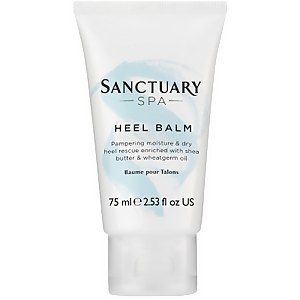
“A boost of shea butter and wheatgerm oil offers long-lasting moisture and softness, making the cream ideal for people prone to rough foot skin.”
This product can help improve hydration of the skin with the two types of ingredients.
The first type is called “humectants”:
these ingredients help attract water.
When humectants are on the surface of the skin, they “pull in” the moisture from the outside environment, or from
within deeper layers of the skin. The following ingredients in this product do the job:
glycerin.
This product also contains ingredients called “occlusives”. They help reduce the speed with which our skin loses moisture to the outside environment. These ingredients also help soften the upper layer of the skin, so it feels less tight and nicer to the touch. The following ingredients in this product do the job: butyrospermum parkii butter, caprylic/capric triglyceride.
Can it cause trouble?
Irritancy5 strong irritants: Rosa moschata seed oil, Melaleuca alternifolia leaf oil + 3 more — patch-test recommendedHigh risk
Comedogenic4 ingredients rated 2 or more on the 0–5 pore-clogging scale4 flagged
User reviews
Be the first — your take helps the next person decide.
Ingredients
Filter by role to see what each ingredient is doing.
Water~40–60%
Glycerin~4.2–6.2%
- Irritation risk
- Low
One of the best moisturizing ingredients. Naturally present in skin. It attracts water to the upper layer of the skin working as a humectant
More about GlycerinCetearyl alcohol~3.2–4.8%
- Irritation risk
- Low
- Comedogenicity
- 2/5
A non-drying alcohol. Works as an emollient. Helps water and oil mix together and creates a nice product texture
More about Cetearyl alcoholPalmitic acid~2.4–3.6%
- Irritation risk
- Low
An emollient that is naturally present in skin and helps soften it
More about Palmitic acidStearic acid~2.1–3.1%
- Irritation risk
- Low
Helps oil and water mix together and works as an emollient
More about Stearic acidButyrospermum parkii butter~1.7–2.6%
- Irritation risk
- Low
- Comedogenicity
- 3/5
A great moisturising ingredient that softens the skin and reduces water loss from its upper layer. It also can be helpful in protecting skin from free radicals
More about Butyrospermum parkii butterCaprylic/capric triglyceride~1.4–2.1%
- Irritation risk
- Medium
A good mix of fatty acids that forms a protective layer on the skin. Improves the shelf life of products. Derived from coconut and glycerin
More about Caprylic/capric triglycerideGlyceryl stearate se~1.2–1.7%
- Irritation risk
- Low
- Comedogenicity
- 2/5
Used to stabilize the product formulations and works as an emollient
More about Glyceryl stearate seRosa moschata seed oil~0.95–1.45%
- Irritation risk
- High
Phenoxyethanol~0.5–1%
- Irritation risk
- Low
A preservative. It helps prevent bacterial growth in cosmetic products
More about PhenoxyethanolTocopheryl acetate~0.5–1.1%
- Irritation risk
- Medium
A more stable but less bio-available form of vitamin E compared to Tocopherol. Might help moisturize and protect the skin from free radicals, but mostly used in low concentrations to stabilize other ingredients.
More about Tocopheryl acetateChlorphenesin~0.16–0.32%
Sodium stearoyl glutamate~0.4–0.9%
- Irritation risk
- Medium
Helps oil and water mix together
More about Sodium stearoyl glutamateCetearyl glucoside~0.2–0.8%
- Irritation risk
- Medium
Helps water and oil in the product mix well together and improves product texture
More about Cetearyl glucosideMelaleuca alternifolia leaf oil~0.15–0.6%
- Irritation risk
- High
An essential oil that can be irritating. Has some anti-bacterial properties
More about Melaleuca alternifolia leaf oilLavandula angustifolia oil~0.15–0.55%
- Irritation risk
- High
An essential oil. Potential allergen and can be irritating. It has some anti-bacterial properties
More about Lavandula angustifolia oilTriticum vulgare germ oil~0.15–0.6%
- Irritation risk
- Low
- Comedogenicity
- 3/5
A good emoillient. Contains vitamin E which can help neutralise free radicals, however the oil is unstable. Avoid if you have gluten or wheat sensitivity (including food allergies).
More about Triticum vulgare germ oilDisodium edta~0.1–0.35%
Sodium hydroxide~0.05–0.3%
Ascorbyl palmitate~0.05–0.15%
- Irritation risk
- Medium
Being a lipid soluble form of vitamin C, it is more stable and can penetrate the skin better than L-Ascorbic acid. It is effective in protecting the skin from free radicals, as well as evening the skin tone, but is less effective in stimulating collagen production compared to L-Ascorbic acid.
More about Ascorbyl palmitateLinalool~0.05–0.1%
Limonene~0.01–0.1%
- Irritation risk
- High
A common frangrance that can easily irritate skin, especially if exposed to air, light or heat
More about LimoneneIngredient list view
Water, Glycerin, Cetearyl alcohol, Palmitic acid, Stearic acid, Butyrospermum parkii butter, Caprylic/capric triglyceride, Glyceryl stearate se, Rosa moschata seed oil, Phenoxyethanol, Tocopheryl acetate, Chlorphenesin, Sodium stearoyl glutamate, Cetearyl glucoside, Melaleuca alternifolia leaf oil, Lavandula angustifolia oil, Triticum vulgare germ oil, Disodium edta, Sodium hydroxide, Ascorbyl palmitate, Linalool, Limonene
Compare prices
Retailers ranked by price — lowest first.

Sources cited in this review
Every concentration estimate and effectiveness label is anchored to one of these 1 studies and safety reviews.
- 1

Affiliate links · As an Amazon Associate, WIMJ earns from qualifying purchases.