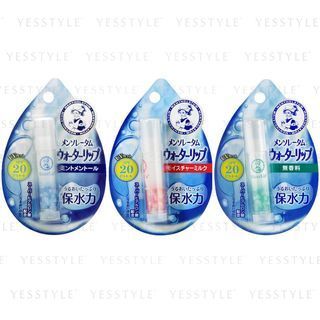
Rohto Mentholatum Water Lip Balm SPF 20 PA++ - 3 Types
Works for
1 of 2 advertised claims delivered
Sun protectionSPF 20 · 3 UV filters · Broad spectrumWeak protectionSPF under 30
This product offers broad spectrum sun protection, but it is weak. We recommend to use a broad spectrum sunscreen with at least SPF 30.
MoisturizingLanolin, Paraffinum liquidum + 14 moreStrong evidence
“Combining the moisturizing power of super hyaluronic acid and collagen, this lip balm keeps lips feeling fresh and plump while also protecting it from UV rays.”
This product can help improve hydration of the skin with the two types of ingredients.
The first type is called “humectants”:
these ingredients help attract water.
When humectants are on the surface of the skin, they “pull in” the moisture from the outside environment, or from
within deeper layers of the skin. The following ingredients in this product do the job:
hyaluronic acid, sodium acetylated hyaluronate.
This product also contains ingredients called “occlusives”. They help reduce the speed with which our skin loses moisture to the outside environment. These ingredients also help soften the upper layer of the skin, so it feels less tight and nicer to the touch. The following ingredients in this product do the job: dimethicone, squalane.
The following ingredients in this product are especially good for supporting the skin barrier and helping with the hydration level: lanolin, paraffinum liquidum
Can it cause trouble?
Irritancy2 strong irritants: Parfum, MentholMedium risk
ComedogenicClean of flagged comedogenic ingredientsNone flagged
User reviews
Be the first — your take helps the next person decide.
Ingredients
Filter by role to see what each ingredient is doing.
Dipropylene glycol~26–32%
- Irritation risk
- Low
Helps to dissolve other ingredients in a formulation. Slows down the rate of product drying
More about Dipropylene glycolWater~13–16%
Ethyl caprate~5.9–7.2%
- Irritation risk
- Low
Hydrogenated polyisobutene~4.4–5.4%
- Irritation risk
- Low
Used to improve the product consistency and soften the upper layer of the skin
More about Hydrogenated polyisobuteneIsotridecyl isononanoate~3.1–3.8%
- Irritation risk
- Low
Polyethylene~2.5–3.1%
Elaeis guineensis oil~1.9–2.4%
- Irritation risk
- Low
Helps soften the upper layer of the skin
More about Elaeis guineensis oilTitanium dioxide~2.1–2.5%
- Irritation risk
- Low
Works as a UV filter when used in high concentrations. It is photostable and is effective mostly against the UVB light, with some protection in the UVA range. In small concentrations, used for its ability to improve the color of cosmetic products. Is usually well tolerated by the skin
More about Titanium dioxideSoluble collagen~1.5–1.9%
- Irritation risk
- Low
A typically plant-derived compound that is supposed mimic human collagen. Cannot penetrate the skin barrier so is not particularly useful in skincare products beyond attracting water to the upper layer of the skin
More about Soluble collagenAloe vera leaf extract~1.3–1.5%
- Irritation risk
- Low
Lanolin~1.1–1.3%
- Irritation risk
- Low
Sebum of wool-bearing animals (most commonly sheep). Helps soften the upper layer of the skin and reduce the skin water loss. In rare cases could be an allergen. Not suitable for vegans
More about LanolinParfum~0.75–1.15%
- Irritation risk
- High
An aromatic blend of unspecified and possibly irritating ingredients
More about ParfumPolyethylene~1.1–1.3%
Squalane~0.75–1.15%
- Irritation risk
- Low
An oil naturally present in skin. Works as an emollient to soften the skin and form a protective layer on its surface without a greasy feeling.
More about SqualanePolyglyceryl-4 oleate~0.7–1.05%
- Irritation risk
- Medium
Helps oil and water mix together
More about Polyglyceryl-4 oleateDimethicone~0.75–1.1%
- Irritation risk
- Low
A silicone that helps to reduce water loss from the surface of the skin. Can temporarily "fill in" lines and wrinkles, absorb oil, and create a nice product finish
More about DimethiconeWater~0.65–0.95%
Ci 14700~0.6–0.95%
Petrolatum~0.6–0.9%
- Irritation risk
- Low
One of the most effective and the most studied occlusive ingredients that creates a protective layer on top of the skin preventing moisture loss
More about PetrolatumHoney~0.5–0.75%
- Irritation risk
- Low
Helps attract water to the skin and might have some anti-bacterial properties. Can be an allergen
More about HoneyLanolin~0.6–0.85%
- Irritation risk
- Low
Sebum of wool-bearing animals (most commonly sheep). Helps soften the upper layer of the skin and reduce the skin water loss. In rare cases could be an allergen. Not suitable for vegans
More about LanolinAloe vera leaf extract~0.45–0.7%
- Irritation risk
- Low
Ethylhexyl methoxycinnamate~0.65–0.95%
- Irritation risk
- High
Octinoxate. When used in higher concentrations, works as a sunscreen protecting the skin from UVB rays. When used in lower concentration, helps to preserve the product formulation. Is shown to be harmful to coral reefs - consider avoiding bathing in coral reef areas when wearing a product with this ingredient. It can be irritating
More about Ethylhexyl methoxycinnamateGlyceryl oleate~0.5–0.75%
- Irritation risk
- High
Helps oil and water mix together. Can be irritating
More about Glyceryl oleatePetrolatum~0.55–0.8%
- Irritation risk
- Low
One of the most effective and the most studied occlusive ingredients that creates a protective layer on top of the skin preventing moisture loss
More about PetrolatumSodium hyaluronate~0.5–0.7%
- Irritation risk
- Low
One of the best moisturizing ingredients. Attracts water into the upper layer of the skin
More about Sodium hyaluronateAlumina~0.65–0.95%
- Irritation risk
- Low
The same compound that is used safely in dental implants and bone cements. In cosmetics, it is used to improve the consistency of products
More about AluminaMica~0.55–0.8%
- Irritation risk
- Low
Creates an illusion of smoother and more radiant skin tone. Adds shimmer to the skin by reflecting light
More about MicaDiphenylsiloxy phenyl trimethicone~0.5–0.7%
- Irritation risk
- Low
Help improve the product's texture
More about Diphenylsiloxy phenyl trimethiconeButyl methoxydibenzoylmethane~0.65–0.95%
- Irritation risk
- Medium
Avobenzone. An organic, or so-called "chemical" UV filter. Protects against both UVA and UVB rays. Needs to be combined with other filters in a formulation to be stable.
More about Butyl methoxydibenzoylmethaneButylene glycol~0.5–0.7%
- Irritation risk
- Low
Used to create a nice product texture and help delivery of other ingredients. Might be somewhat helpful in attracting water to the upper layer of the skin
More about Butylene glycolDiisostearyl malate~0.5–0.8%
- Irritation risk
- Medium
Helps to soften the upper layer of the skin
More about Diisostearyl malateMicrocrystalline wax~0.5–0.8%
Paraffinum liquidum~0.5–0.8%
- Irritation risk
- Low
Mineral oil. One of the most effective and well studied occlusive and emollient moisturizing ingredients. Helps reduce moisture loss in skin and repair skin barrier function
More about Paraffinum liquidumWhey~0.45–0.7%
- Irritation risk
- Low
Milk~0.5–0.7%
Ethylhexyl methoxycinnamate~0.65–0.95%
- Irritation risk
- High
Octinoxate. When used in higher concentrations, works as a sunscreen protecting the skin from UVB rays. When used in lower concentration, helps to preserve the product formulation. Is shown to be harmful to coral reefs - consider avoiding bathing in coral reef areas when wearing a product with this ingredient. It can be irritating
More about Ethylhexyl methoxycinnamateHoney~0.45–0.7%
- Irritation risk
- Low
Helps attract water to the skin and might have some anti-bacterial properties. Can be an allergen
More about HoneyMenthol~0.45–0.7%
- Irritation risk
- High
Polyglyceryl-6 polyricinoleate~0.5–0.75%
- Irritation risk
- Medium
Helps oil and water mix together
More about Polyglyceryl-6 polyricinoleate2-hexanol~0.45–0.7%
- Irritation risk
- Low
Tocopheryl acetate~0.5–0.7%
- Irritation risk
- Medium
A more stable but less bio-available form of vitamin E compared to Tocopherol. Might help moisturize and protect the skin from free radicals, but mostly used in low concentrations to stabilize other ingredients.
More about Tocopheryl acetateSoluble collagen~0.5–0.75%
- Irritation risk
- Low
A typically plant-derived compound that is supposed mimic human collagen. Cannot penetrate the skin barrier so is not particularly useful in skincare products beyond attracting water to the upper layer of the skin
More about Soluble collagenGold~0.4–0.6%
Mica~0.45–0.7%
- Irritation risk
- Low
Creates an illusion of smoother and more radiant skin tone. Adds shimmer to the skin by reflecting light
More about MicaParaffinum liquidum~0.45–0.65%
- Irritation risk
- Low
Mineral oil. One of the most effective and well studied occlusive and emollient moisturizing ingredients. Helps reduce moisture loss in skin and repair skin barrier function
More about Paraffinum liquidumWhey~0.35–0.65%
- Irritation risk
- Low
Milk~0.35–0.65%
Polyglyceryl-4 oleate~0.4–0.65%
- Irritation risk
- Medium
Helps oil and water mix together
More about Polyglyceryl-4 oleateCi 15850~0.35–0.6%
Sodium acetylated hyaluronate~0.3–0.55%
- Irritation risk
- Low
A type of hyaluronic acid that works as an excellent moisturizer by attracting water into the upper layer of the skin. Is typically feels less sticky on the skin compared to the usual hyaluronic acid
More about Sodium acetylated hyaluronateHyaluronic acid~0.2–0.4%
- Irritation risk
- Low
One of the best moisturizing ingredients. Attracts water into the upper layer of the skin. Naturally present in skin. Typically has large molecule size unless advertised otherwise on the product label. Helps support skin's barrier function and may help to reduce inflammation
More about Hyaluronic acidMicrocrystalline wax~0.2–0.4%
Sodium hyaluronate~0.2–0.35%
- Irritation risk
- Low
One of the best moisturizing ingredients. Attracts water into the upper layer of the skin
More about Sodium hyaluronateHyaluronic acid~0.15–0.25%
- Irritation risk
- Low
One of the best moisturizing ingredients. Attracts water into the upper layer of the skin. Naturally present in skin. Typically has large molecule size unless advertised otherwise on the product label. Helps support skin's barrier function and may help to reduce inflammation
More about Hyaluronic acidElaeis guineensis oil~0.2–0.4%
- Irritation risk
- Low
Helps soften the upper layer of the skin
More about Elaeis guineensis oilIngredient list view
Dipropylene glycol, Water, Unknown, Ethyl caprate, Unknown, Hydrogenated polyisobutene, Isotridecyl isononanoate, Polyethylene, Elaeis guineensis oil, Titanium dioxide, Soluble collagen, Aloe vera leaf extract, Lanolin, Parfum, Polyethylene, Squalane, Polyglyceryl-4 oleate, Dimethicone, Water, Ci 14700, Unknown, Petrolatum, Honey, Lanolin, Aloe vera leaf extract, Ethylhexyl methoxycinnamate, Unknown, Glyceryl oleate, Petrolatum, Sodium hyaluronate, Alumina, Mica, Diphenylsiloxy phenyl trimethicone, Butyl methoxydibenzoylmethane, Butylene glycol, Diisostearyl malate, Microcrystalline wax, Paraffinum liquidum, Whey, Milk, Ethylhexyl methoxycinnamate, Honey, Menthol, Polyglyceryl-6 polyricinoleate, 2-hexanol, Tocopheryl acetate, Soluble collagen, Unknown, Gold, Mica, Paraffinum liquidum, Whey, Milk, Polyglyceryl-4 oleate, Ci 15850, Sodium acetylated hyaluronate, Hyaluronic acid, Microcrystalline wax, Sodium hyaluronate, Hyaluronic acid, Elaeis guineensis oil
Compare prices
Retailers ranked by price — lowest first.

Affiliate links · prices updated regularly
Product summary
"Rohto Mentholatum - Water Lip Balm SPF 20 PA++ - 3 Types" offers broad spectrum protection. It means that it protects from both UVA and UVB rays (you can remember UVB as "burning" sunlight - they cause sunburn. You can remember UVA rays as "aging" - they do not lead to sunburn, but they cause photodamage and contribute to early signs of skin aging and hyperpigmentation). On the negative side, the SPF of this lip product is not high enough. We recommend to use a sunscreen with at least SPF 30 daily.
Sunscreen filters
This is a "mixed" sunscreen in the sense that it uses both mineral and organic (so-called "chemical") sun filters. Here are the organic filters this product uses: avobenzone and octinoxate. As for the mineral filters, this sunscreen uses titanium dioxide.
Irritation risk
This formulation includes some common irritants, including ingredients that do not provide a benefit for the skin. We assess the overall irritancy of this lip product to be medium. For a detailed overview of all potential irritants: click here
You can see the detailed formula review with the breakdown of all actives in the product and the full ingredient list with estimated concentrations in the tables below.
Price
The product retails for 4.50$ in the United States.
For a detailed price comparison: click here.
Sources cited in this review
Every concentration estimate and effectiveness label is anchored to one of these 14 studies and safety reviews.
- 1
- 2
- 3
- 4
- 5
- 6Final Report on the Safety Assessment of Dimethicone Copolyoljournals.sagepub.com

Affiliate links · As an Amazon Associate, WIMJ earns from qualifying purchases.