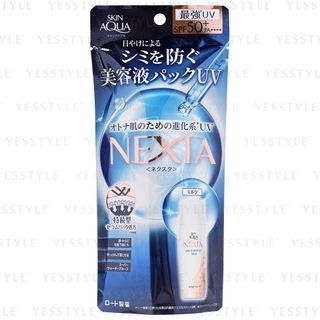
Rohto Mentholatum Skin Aqua Nexta Shield Serum UV Milk SPF 50+ PA++++
Works for
0 of 1 advertised claim delivered
Sun protectionSPF 50 · 4 UV filters · Broad spectrumWeak protectionLow filter dose
This product can be considered "reef safe" because it does not contain the UV filters (oxybenzone and octinoxate) that can be harmful to coral reefs when present in the water in high concentrations.
MoisturizingNot advertised by the brand · Sodium hyaluronate, Dilinoleic acid + 9 moreGood evidence
This product can help improve hydration of the skin with the two types of ingredients.
The first type is called “humectants”:
these ingredients help attract water.
When humectants are on the surface of the skin, they “pull in” the moisture from the outside environment, or from
within deeper layers of the skin. The following ingredients in this product do the job:
glycerin, sodium hyaluronate.
This product also contains ingredients called “occlusives”. They help reduce the speed with which our skin loses moisture to the outside environment. These ingredients also help soften the upper layer of the skin, so it feels less tight and nicer to the touch. The following ingredients in this product do the job: dimethicone, dilinoleic acid.
Can it cause trouble?
Irritancy5 strong irritants: Alcohol, Phenol + 3 more — patch-test recommendedHigh risk
ComedogenicClean of flagged comedogenic ingredientsNone flagged
User reviews
Be the first — your take helps the next person decide.
Ingredients
Filter by role to see what each ingredient is doing.
Water~45–55%
Isononyl isononanoate~5.7–7%
- Irritation risk
- Low
Forms a protective film on the surface of the skin to prevent moisture loss. Gives a velvety feel to products while reducing tackiness
More about Isononyl isononanoateDiethylhexyl succinate~4.3–5.3%
- Irritation risk
- Low
Helps soften the upper layer of the skin and create a nice product texture
More about Diethylhexyl succinateAlcohol~3–3.7%
- Irritation risk
- High
Can be drying and contribute to skin irritation. Used in formulars to dissolve other ingredients, create a thinner product consistency or for its antibacterial properties
More about AlcoholTriethylhexyl trimellitate~2.4–2.9%
- Irritation risk
- Low
Zinc oxide~2.7–3.3%
- Irritation risk
- Low
A broad spectrum sunblock (protects from both UVA and UVB rays). Is suitable for most sensitive skins. In small concentrations, can be used as a colorant
More about Zinc oxideButylene glycol~1.6–2%
- Irritation risk
- Low
Used to create a nice product texture and help delivery of other ingredients. Might be somewhat helpful in attracting water to the upper layer of the skin
More about Butylene glycolDimethicone~1.5–1.8%
- Irritation risk
- Low
A silicone that helps to reduce water loss from the surface of the skin. Can temporarily "fill in" lines and wrinkles, absorb oil, and create a nice product finish
More about DimethiconeTitanium dioxide~1.5–1.8%
- Irritation risk
- Low
Works as a UV filter when used in high concentrations. It is photostable and is effective mostly against the UVB light, with some protection in the UVA range. In small concentrations, used for its ability to improve the color of cosmetic products. Is usually well tolerated by the skin
More about Titanium dioxideSilica~1.1–1.3%
Methyl trimethicone~0.55–0.8%
- Irritation risk
- Low
A type of silicone that helps create a silky product finish and dissolve other ingredients
More about Methyl trimethiconeGlycerin~0.5–0.75%
- Irritation risk
- Low
One of the best moisturizing ingredients. Naturally present in skin. It attracts water to the upper layer of the skin working as a humectant
More about GlycerinMethylene bis-benzotriazolyl tetramethylbutylphenol~0.6–0.9%
- Irritation risk
- Medium
Tinosorb M. A UV filter. Is effective against both UVA and UVB rays. It also provides some protection against visible light. It is photostable and can also be used to improve photostability of other sunscreen ingredients. Its physical properties help to create lightweight sunscreen formulations. It can leave a slight white cast. Unfortunately, it is not approved by the FDA (US) yet
More about Methylene bis-benzotriazolyl tetramethylbutylphenolPhenol~0.3–0.6%
- Irritation risk
- High
A harsh exfoliant and preservative. It is banned from using in cosmetics in the EU
More about PhenolEthylhexyl triazone~0.5–0.75%
- Irritation risk
- Medium
Uvinul T. A UV filter. Effective against UVB rays. It is photostable. Can increase water resistance properties of the sunscreen. Unfortunately, not approved by the FDA (US) yet
More about Ethylhexyl triazoneGeranium robertianum extract~0.25–0.5%
- Irritation risk
- Low
Citrus reticulata extract~0.25–0.5%
- Irritation risk
- High
Citrus aurantium dulcis peel extract~0.2–0.4%
Sodium hyaluronate~0.2–0.4%
- Irritation risk
- Low
One of the best moisturizing ingredients. Attracts water into the upper layer of the skin
More about Sodium hyaluronateMagnesium ascorbyl phosphate~0.2–0.35%
- Irritation risk
- Medium
A derivative of vitamin C that is more stable, but less bioavailable than the pure form of vitamin C. It does not penetrate the skin well, but has been shown to convert to pure vitamin C once in skin. It can be helpful in stimulating collagen production and lightening the skin tone, but the required concentration is likely to be very high
More about Magnesium ascorbyl phosphateLactobacillus/pear juice ferment filtrate~0.15–0.3%
- Irritation risk
- Low
Tocopherol~0.2–0.35%
- Irritation risk
- Low
Pure form of vitamin E. Can help moisturise and protect the skin from free radicals. Often used to help stabilise other ingredients or the formula itself
More about TocopherolDiisostearyl malate~0.2–0.35%
- Irritation risk
- Medium
Helps to soften the upper layer of the skin
More about Diisostearyl malatePotassium hydroxide~0.15–0.3%
Isostearic acid~0.25–0.5%
- Irritation risk
- Low
Used to create a nice product texture
More about Isostearic acidDilinoleic acid~0.2–0.35%
Stearic acid~0.3–0.55%
- Irritation risk
- Low
Helps oil and water mix together and works as an emollient
More about Stearic acidPolyglyceryl-10 polyhydroxystearate~0.2–0.4%
Disteardimonium hectorite~0.2–0.35%
- Irritation risk
- Low
A type of clay that is used to thicken the product consistency
More about Disteardimonium hectoriteMica~0.2–0.35%
- Irritation risk
- Low
Creates an illusion of smoother and more radiant skin tone. Adds shimmer to the skin by reflecting light
More about MicaDecyl glucoside~0.25–0.45%
- Irritation risk
- High
Helps oil and water mix together. Can be irritating
More about Decyl glucosideHydrated silica~0.25–0.5%
Disodium edta~0.15–0.25%
Hydrogen dimethicone~0.15–0.25%
- Irritation risk
- Low
Helps the function of sunscreen and pigment ingredients in the formulation
More about Hydrogen dimethiconePropylene glycol~0.1–0.2%
- Irritation risk
- High
Helps oil and water mix together and can enhance the penetration of other ingredients into the skin. It can be irritating
More about Propylene glycolXanthan gum~0.1–0.2%
- Irritation risk
- Low
Used to create a thicker product consistency
More about Xanthan gumTriethoxycaprylylsilane~0.1–0.15%
- Irritation risk
- Low
A type of silicone that helps oil and water mix well together. Helps to disperse other ingredients, e.g. pigments, evenly in a formulation
More about TriethoxycaprylylsilaneTin oxide~0.15–0.25%
- Irritation risk
- Low
A colorant that can add a pearl-like appearance to the formulation
More about Tin oxideParfum~0.01–0.05%
- Irritation risk
- High
An aromatic blend of unspecified and possibly irritating ingredients
More about ParfumIngredient list view
Water, Isononyl isononanoate, Diethylhexyl succinate, Alcohol, Triethylhexyl trimellitate, Zinc oxide, Butylene glycol, Dimethicone, Titanium dioxide, Silica, Methyl trimethicone, Glycerin, Methylene bis-benzotriazolyl tetramethylbutylphenol, Phenol, Ethylhexyl triazone, Unknown, Geranium robertianum extract, Citrus reticulata extract, Citrus aurantium dulcis peel extract, Sodium hyaluronate, Magnesium ascorbyl phosphate, Lactobacillus/pear juice ferment filtrate, Tocopherol, Diisostearyl malate, Potassium hydroxide, Isostearic acid, Dilinoleic acid, Unknown, Stearic acid, Polyglyceryl-10 polyhydroxystearate, Unknown, Disteardimonium hectorite, Mica, Decyl glucoside, Hydrated silica, Disodium edta, Hydrogen dimethicone, Propylene glycol, Xanthan gum, Triethoxycaprylylsilane, Tin oxide, Parfum
Compare prices
Retailers ranked by price — lowest first.

Affiliate links · prices updated regularly
Product summary
"Rohto Mentholatum - Skin Aqua Nexta Shield Serum UV Milk SPF 50+ PA++++" is using UV filters in a relatively low concentration. Because of this, it might not be able to provide reliable sun protection.
As a plus, this sunscreen uses some of the new generation UV filters (Tinosorb M). These filters are more stable and more gentle on the skin.
Because it includes good moisturizing ingredients, it can also work as a hydrating day cream.
Sunscreen filters
This is a "mixed" sunscreen in the sense that it uses both mineral and organic (so-called "chemical") sun filters. The organic filters in the product are: uvinul t and tinosorb m. As for the mineral filters, this sunscreen uses both titanium dioxide and zinc oxide.
Irritation risk
There are quite a few common irritants in this product, including ingredients without particular skin benefits. We would not recommend it for sensitive skin. We assess the overall irritancy of this sunscreen to be high. For a detailed overview of all potential irritants: click here
You can see the detailed formula review with the breakdown of all actives in the product and the full ingredient list with estimated concentrations in the tables below.
Price
The product retails for 16.65$ in the United States.
For a detailed price comparison: click here.
Sources cited in this review
Every concentration estimate and effectiveness label is anchored to one of these 19 studies and safety reviews.
- 1A review of inorganic UV filters zinc oxide and titanium dioxideonlinelibrary.wiley.com
- 2
- 3
- 4
- 5
- 6

Affiliate links · As an Amazon Associate, WIMJ earns from qualifying purchases.