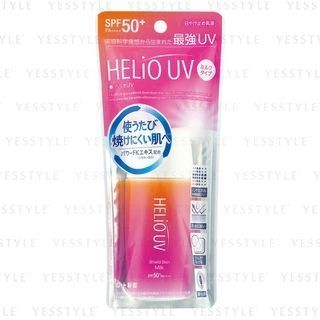
Rohto Mentholatum Helio White UV Shield Skin Milk SPF 50+ PA++++
Works for
1 of 1 advertised claim delivered
Sun protectionSPF 50 · 2 UV filtersBroad spectrum
This product offers a good level of protection against both UVB and UVA rays.
It is a mineral sunscreen. In other words, it contains non-organic UV filters. It will probably not sting your eyes but might leave a white cast.
This product can be considered "reef safe" because it does not contain the UV filters (oxybenzone and octinoxate) that can be harmful to coral reefs when present in the water in high concentrations.
Evens skin toneNot advertised by the brand · 1 ingredient credited for this claimStrong support
This product offers broad spectrum sun protection. It means that it can prevent hyperpigmentation and help keep the skin tone even (sun damage is the main factor causing age spots, darkening of post-acne marks and other discolorations).
Anti-agingNot advertised by the brand · 3 ingredients credited for this claimStrong support
This product can help prevent early signs of skin aging because it offers a good level of broad spectrum sun protection. Sun damage is the main cause of premature skin aging, and protecting your skin from the sun is the best anti-aging strategy.
MoisturizingNot advertised by the brand · 12 ingredients credited for this claimGood support
This product can help improve hydration of the skin with the two types of ingredients.
The first type is called “humectants”:
these ingredients help attract water.
When humectants are on the surface of the skin, they “pull in” the moisture from the outside environment, or from
within deeper layers of the skin. The following ingredients in this product do the job:
glycerin, hyaluronic acid.
This product also contains ingredients called “occlusives”. They help reduce the speed with which our skin loses moisture to the outside environment. These ingredients also help soften the upper layer of the skin, so it feels less tight and nicer to the touch. The following ingredients in this product do the job: dimethicone, cyclopentasiloxane.
Can it cause trouble?
Irritancy1 strong irritant: ParfumMedium risk
Comedogenic1 ingredient rated 2 or more on the 0–5 pore-clogging scale1 flagged
User reviews
Be the first — your take helps the next person decide.
Ingredients
Filter by role to see what each ingredient is doing.
Cyclopentasiloxane~23–35%
- Irritation risk
- Low
A silicone that helps improve the product texture and spreadability. Can absorb oil creating a short-term mattifying effect on the skin
More about CyclopentasiloxaneZinc oxide~10–15%
- Irritation risk
- Low
A broad spectrum sunblock (protects from both UVA and UVB rays). Is suitable for most sensitive skins. In small concentrations, can be used as a colorant
More about Zinc oxideWater~5.1–7.7%
Butylene glycol~3.4–5.1%
- Irritation risk
- Low
Used to create a nice product texture and help delivery of other ingredients. Might be somewhat helpful in attracting water to the upper layer of the skin
More about Butylene glycolGlycerin~2.8–4.2%
- Irritation risk
- Low
One of the best moisturizing ingredients. Naturally present in skin. It attracts water to the upper layer of the skin working as a humectant
More about GlycerinIsostearyl isostearate~2.4–3.6%
- Irritation risk
- Medium
- Comedogenicity
- 3/5
Helps soften the upper layer of the skin and improve the product texture. It can be comedogenic
More about Isostearyl isostearateTitanium dioxide~2.5–3.7%
- Irritation risk
- Low
Works as a UV filter when used in high concentrations. It is photostable and is effective mostly against the UVB light, with some protection in the UVA range. In small concentrations, used for its ability to improve the color of cosmetic products. Is usually well tolerated by the skin
More about Titanium dioxideTriethylhexanoin~1.7–2.5%
- Irritation risk
- Medium
Helps soften the upper layer of the skin
More about TriethylhexanoinLauroyl lysine~1.4–2.1%
- Irritation risk
- Low
Helps soften the upper layer of the skin and creates a nice product texture
More about Lauroyl lysineDiphenylsiloxy phenyl trimethicone~1.1–1.7%
- Irritation risk
- Low
Help improve the product's texture
More about Diphenylsiloxy phenyl trimethiconeLauryl peg-9 polydimethylsiloxyethyl dimethicone~0.95–1.45%
- Irritation risk
- Low
A type of silicone that helps to soften upper layer of the skin and create a nice product texture
More about Lauryl peg-9 polydimethylsiloxyethyl dimethiconePeg-9 polydimethylsiloxyethyl dimethicone~0.9–1.3%
- Irritation risk
- Medium
A type of silicone that helps water and oil mix together
More about Peg-9 polydimethylsiloxyethyl dimethiconePeg-9 dimethicone~0.85–1.25%
- Irritation risk
- Low
Dimethicone~0.9–1.35%
- Irritation risk
- Low
A silicone that helps to reduce water loss from the surface of the skin. Can temporarily "fill in" lines and wrinkles, absorb oil, and create a nice product finish
More about DimethiconeHydrated silica~0.95–1.4%
Hydrogen dimethicone~0.85–1.25%
- Irritation risk
- Low
Helps the function of sunscreen and pigment ingredients in the formulation
More about Hydrogen dimethiconePotassium hydroxide~0.5–1.15%
Triethoxysilylethyl polydimethylsiloxyethyl dimethicone~0.45–1.05%
- Irritation risk
- Low
Acrylates/dimethicone copolymer~0.45–1.05%
- Irritation risk
- Medium
Used to stabilize product formulation, help create an even product layer over skin (for example, in sunscreen), evenly disperse pigements and create a nice product consistency
More about Acrylates/dimethicone copolymerMica~0.4–0.95%
- Irritation risk
- Low
Creates an illusion of smoother and more radiant skin tone. Adds shimmer to the skin by reflecting light
More about MicaIsostearic acid~0.4–1%
- Irritation risk
- Low
Used to create a nice product texture
More about Isostearic acidDextrin~0.3–0.75%
- Irritation risk
- Low
A sugar that is used to stabilize the product formulation. Can help attract water to the upper layer of the skin
More about DextrinMagnesium ascorbyl phosphate~0.2–0.75%
- Irritation risk
- Medium
A derivative of vitamin C that is more stable, but less bioavailable than the pure form of vitamin C. It does not penetrate the skin well, but has been shown to convert to pure vitamin C once in skin. It can be helpful in stimulating collagen production and lightening the skin tone, but the required concentration is likely to be very high
More about Magnesium ascorbyl phosphateTocopherol~0.15–0.55%
- Irritation risk
- Low
Pure form of vitamin E. Can help moisturise and protect the skin from free radicals. Often used to help stabilise other ingredients or the formula itself
More about TocopherolSodium hyaluronate~0.1–0.45%
- Irritation risk
- Low
One of the best moisturizing ingredients. Attracts water into the upper layer of the skin
More about Sodium hyaluronateHyaluronic acid~0.1–0.3%
- Irritation risk
- Low
One of the best moisturizing ingredients. Attracts water into the upper layer of the skin. Naturally present in skin. Typically has large molecule size unless advertised otherwise on the product label. Helps support skin's barrier function and may help to reduce inflammation
More about Hyaluronic acidVaccinium myrtillus leaf extract~0.05–0.2%
- Irritation risk
- Low
Parfum~0.01–0.1%
- Irritation risk
- High
An aromatic blend of unspecified and possibly irritating ingredients
More about ParfumIngredient list view
Cyclopentasiloxane, Zinc oxide, Water, Butylene glycol, Glycerin, Isostearyl isostearate, Titanium dioxide, Triethylhexanoin, Lauroyl lysine, Diphenylsiloxy phenyl trimethicone, Lauryl peg-9 polydimethylsiloxyethyl dimethicone, Peg-9 polydimethylsiloxyethyl dimethicone, Peg-9 dimethicone, Dimethicone, Hydrated silica, Hydrogen dimethicone, Unknown, Potassium hydroxide, Triethoxysilylethyl polydimethylsiloxyethyl dimethicone, Acrylates/dimethicone copolymer, Mica, Isostearic acid, Dextrin, Magnesium ascorbyl phosphate, Tocopherol, Sodium hyaluronate, Hyaluronic acid, Unknown, Vaccinium myrtillus leaf extract, Parfum
Compare prices
Retailers ranked by price — lowest first.

Affiliate links · prices updated regularly
Product summary
We believe that "Rohto Mentholatum - Helio White UV Shield Skin Milk SPF 50+ PA++++" can provide reliable sun protection based on the ingredients listed. It can protect from both UVA and UVB rays. This is great news because not all sunscreens with SPF ratings give UVA protection. (UVA rays do not cause sunburn, but still damage our skin and lead to early aging).
It contains good moisturizing ingredients and can double as a hydrating day cream. Like all broad-spectrum sunscreens, this product helps prevent early signs of aging.
Sunscreen filters
This sunscreen is a mineral sunscreen. It uses titanium dioxide and zinc oxide for sun protection. Both titanium dioxide and zinc oxide almost never irritate even the most sensitive skin and eyes, but can leave a white cast.
Irritation risk
This formulation includes some common irritants, including ingredients that do not provide a benefit for the skin. We assess the overall irritancy of it to be medium. For a detailed overview of all potential irritants: click here
You can see the detailed formula review with the breakdown of all actives in the product and the full ingredient list with estimated concentrations in the tables below.
Price
The product retails for 28.99$ in the United States.
For a detailed price comparison: click here.
Sources cited in this review
Every concentration estimate and effectiveness label is anchored to one of these 17 studies and safety reviews.
- 1A review of inorganic UV filters zinc oxide and titanium dioxideonlinelibrary.wiley.com
- 2
- 3
- 4
- 5
- 6

Affiliate links · As an Amazon Associate, WIMJ earns from qualifying purchases.