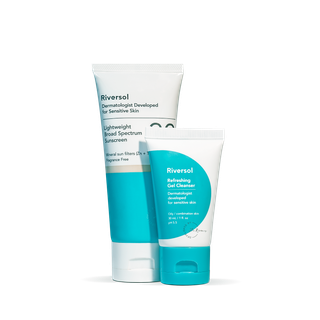
Riversol Travel Ready Cleanser and SPF 30 Sunscreen
Works for
2 of 2 advertised claims delivered
Sun protectionSPF 30 · 3 UV filtersBroad spectrum
This product offers a good level of protection against both UVB and UVA rays.
This sunscreen uses organic (so-called "chemical") sunscreen filters. Organic, or "chemical" filters usually provide reliable sun protection and rarely leave a white cast. Sunscreens with organic filters can sting eyes.
This product can be considered "reef safe" because it does not contain the UV filters (oxybenzone and octinoxate) that can be harmful to coral reefs when present in the water in high concentrations.
Evens skin toneSalicylic acid, Aminopropyl ascorbyl phosphateStrong evidence
“Broad spectrum UVA / UVB Sun protection Evens skin tone”
This product offers broad spectrum sun protection. It means that it can prevent hyperpigmentation and help keep the skin tone even (sun damage is the main factor causing age spots, darkening of post-acne marks and other discolorations).
Anti-blemishNot advertised by the brand · Salicylic acid, Allantoin + 2 moreStrong evidence
This product can help reduce breakouts and clogged pores because it contains the following ingredient: salicylic acid. This ingredient is used for treating acne and can have a noticeable effect.
Anti-agingNot advertised by the brand · Tocopherol, Aloe barbadensis leaf juice + 1 moreStrong evidence
This product can help prevent early signs of skin aging because it offers a good level of broad spectrum sun protection. Sun damage is the main cause of premature skin aging, and protecting your skin from the sun is the best anti-aging strategy.
ExfoliationNot advertised by the brand · Salicylic acid, AllantoinStrong evidence
This product can help exfoliate the skin. In other words, it helps break down the bonds between dead cells on the surface of the skin and speed up the skin turnover. Skin often appears softer and brighter after exfoliation, but overdoing it can result in disrupted skin barrier. The following ingredient is doing the exfoliating job in this product: salicylic acid.
MoisturizingNot advertised by the brand · Vitis vinifera seed oil, Glycerin + 12 moreGood evidence
This product can help improve hydration of the skin with the two types of ingredients.
The first type is called “humectants”:
these ingredients help attract water.
When humectants are on the surface of the skin, they “pull in” the moisture from the outside environment, or from
within deeper layers of the skin. The following ingredients in this product do the job:
allantoin, glycerin.
This product also contains ingredients called “occlusives”. They help reduce the speed with which our skin loses moisture to the outside environment. These ingredients also help soften the upper layer of the skin, so it feels less tight and nicer to the touch. The following ingredients in this product do the job: caprylic/capric triglyceride, simmondsia chinensis seed oil.
Can it cause trouble?
Irritancy1 strong irritant: Benzophenone-4Medium risk
Comedogenic3 ingredients rated 2 or more on the 0–5 pore-clogging scale3 flagged

User reviews
Be the first — your take helps the next person decide.
Ingredients
Filter by role to see what each ingredient is doing.
Zinc oxide10%
- Irritation risk
- Low
A broad spectrum sunblock (protects from both UVA and UVB rays). Is suitable for most sensitive skins. In small concentrations, can be used as a colorant
More about Zinc oxideTitanium dioxide6%
- Irritation risk
- Low
Works as a UV filter when used in high concentrations. It is photostable and is effective mostly against the UVB light, with some protection in the UVA range. In small concentrations, used for its ability to improve the color of cosmetic products. Is usually well tolerated by the skin
More about Titanium dioxideWater~40–60%
Propylene glycol~6.1–9.1%
- Irritation risk
- High
Helps oil and water mix together and can enhance the penetration of other ingredients into the skin. It can be irritating
More about Propylene glycolCaprylic/capric triglyceride~4.4–6.5%
- Irritation risk
- Medium
A good mix of fatty acids that forms a protective layer on the skin. Improves the shelf life of products. Derived from coconut and glycerin
More about Caprylic/capric triglycerideStearic acid~2.9–4.4%
- Irritation risk
- Low
Helps oil and water mix together and works as an emollient
More about Stearic acidGlyceryl stearate~2.7–4.1%
- Irritation risk
- Low
An emollient that softens the skin and forms a protective layer on its surface. Helps water and oil mix together
More about Glyceryl stearatePeg-100 stearate~2.3–3.4%
- Irritation risk
- Low
Helps oil and water mix togehter and creates a nice product texture
More about Peg-100 stearateCetearyl alcohol~2–3%
- Irritation risk
- Low
- Comedogenicity
- 2/5
A non-drying alcohol. Works as an emollient. Helps water and oil mix together and creates a nice product texture
More about Cetearyl alcoholCaprylyl glycol~1.7–2.5%
- Irritation risk
- Medium
Helps preserve products and creates a nice product texture
More about Caprylyl glycolPhenoxyethanol~0.5–1%
- Irritation risk
- Low
A preservative. It helps prevent bacterial growth in cosmetic products
More about PhenoxyethanolXanthan gum~1.2–1.7%
- Irritation risk
- Low
Used to create a thicker product consistency
More about Xanthan gumPotassium sorbate~0.3–0.6%
Pvm/ma decadiene crosspolymer~0.95–1.4%
- Irritation risk
- Low
Polysorbate 80~0.9–1.35%
Allantoin~0.8–1.25%
- Irritation risk
- Low
Helps calm down inflammation in skin and can help reduce itching. Helps to repair the skin barrier and keep skin hydrated
More about AllantoinAlcohol denat.~0.8–1.2%
- Irritation risk
- High
Produces temporary toning effect. Can help dissolve other ingredients or preserve products
More about Alcohol denat.Hinokitiol~0.8–1.2%
- Irritation risk
- Low
Benzophenone-4~0.95–1.4%
- Irritation risk
- High
Sulisobenzone. A UV filter. Is typically used to improve the product stability under exposure to UV light. It is effective against both UVA and UVB rays. It can be used is larger concentrations as a sun protection ingredient for the skin, but can be irritating
More about Benzophenone-4Citric acid~0.55–1.3%
- Irritation risk
- Medium
Can work as an exfoliant but is typically used to adjust the product pH
More about Citric acidSodium hydroxide~0.55–1.25%
Water~0.5–1.15%
Glycerin~0.5–1.2%
- Irritation risk
- Low
One of the best moisturizing ingredients. Naturally present in skin. It attracts water to the upper layer of the skin working as a humectant
More about GlycerinSodium c14-16 olefin sulfonate~0.5–1.2%
- Irritation risk
- High
Helps oil and water mix together and used as a cleansing agent. Can be irritating and is better avoided for sensitive skin
More about Sodium c14-16 olefin sulfonateCocamidopropyl betaine~1.1–1.7%
- Irritation risk
- High
Helps water and oil mix together. Used as a cleansing ingredient. Could be an allergen
More about Cocamidopropyl betaineCaprylyl glycol~0.5–1.15%
- Irritation risk
- Medium
Helps preserve products and creates a nice product texture
More about Caprylyl glycolPhenoxyethanol~0.5–1%
- Irritation risk
- Low
A preservative. It helps prevent bacterial growth in cosmetic products
More about PhenoxyethanolHydroxyethylcellulose~0.5–1.1%
- Irritation risk
- Low
Used to thicken product formulations and create gel-like textures
More about HydroxyethylcellulosePvm/ma decadiene crosspolymer~0.5–1.1%
- Irritation risk
- Low
Sodium hydroxide~0.45–1.1%
Xanthan gum~0.45–1.1%
- Irritation risk
- Low
Used to create a thicker product consistency
More about Xanthan gumPotassium sorbate~0.3–0.6%
Tetrasodium edta~0.45–1.05%
Alcohol denat.~0.45–1.1%
- Irritation risk
- High
Produces temporary toning effect. Can help dissolve other ingredients or preserve products
More about Alcohol denat.Allantoin~0.45–1.05%
- Irritation risk
- Low
Helps calm down inflammation in skin and can help reduce itching. Helps to repair the skin barrier and keep skin hydrated
More about AllantoinSodium citrate~0.45–1.05%
- Irritation risk
- Medium
Helps to control the skin's pH level. Maintains the skin's natural film of amino-lactic acids and oils. Helps to preserve products
More about Sodium citrateBenzophenone-4~0.6–1.35%
- Irritation risk
- High
Sulisobenzone. A UV filter. Is typically used to improve the product stability under exposure to UV light. It is effective against both UVA and UVB rays. It can be used is larger concentrations as a sun protection ingredient for the skin, but can be irritating
More about Benzophenone-4Hinokitiol~0.45–1.1%
- Irritation risk
- Low
Citric acid~0.45–1.1%
- Irritation risk
- Medium
Can work as an exfoliant but is typically used to adjust the product pH
More about Citric acidWater~0.45–1.1%
Aloe barbadensis leaf juice~0.45–1.1%
- Irritation risk
- Medium
Traditionally used to treat sunburns, dermatitis and inflammation, but evidence for its effectiveness is lacking. The extract can contain humectants that help attract water into the skin
More about Aloe barbadensis leaf juiceVitis vinifera seed oil~0.5–1.15%
- Irritation risk
- Medium
A great emollient that can also have anti-oxidant properties
More about Vitis vinifera seed oilGlycerin~0.5–1.15%
- Irritation risk
- Low
One of the best moisturizing ingredients. Naturally present in skin. It attracts water to the upper layer of the skin working as a humectant
More about GlycerinOryza sativa bran oil~0.5–1.15%
- Irritation risk
- Low
Helps soften the upper layer of the skin and might have some anti-oxidant properties
More about Oryza sativa bran oilCaprylic/capric triglyceride~0.5–1.2%
- Irritation risk
- Medium
A good mix of fatty acids that forms a protective layer on the skin. Improves the shelf life of products. Derived from coconut and glycerin
More about Caprylic/capric triglycerideCetearyl olivate~0.5–1.1%
Sorbitan olivate~0.5–1.1%
Benzyl alcohol~0.45–1%
- Irritation risk
- High
A preservative. Can be used to mask unpleasant smell. Can be irritating
More about Benzyl alcoholSalicylic acid~0.45–1.05%
- Irritation risk
- High
Used for skin exfoliation. It has an anti-inflammatory and anti-bacterial effect, helps to unclog pores, prevent blemishes and speed up healing of the existing ones. Sometimes referred to as a BHA (beta-hydroxy acid)
More about Salicylic acidGlycerin~0.5–1.15%
- Irritation risk
- Low
One of the best moisturizing ingredients. Naturally present in skin. It attracts water to the upper layer of the skin working as a humectant
More about GlycerinSorbic acid~0.3–0.6%
Cetearyl alcohol~0.5–1.15%
- Irritation risk
- Low
- Comedogenicity
- 2/5
A non-drying alcohol. Works as an emollient. Helps water and oil mix together and creates a nice product texture
More about Cetearyl alcoholCitric acid~0.45–1.05%
- Irritation risk
- Medium
Can work as an exfoliant but is typically used to adjust the product pH
More about Citric acidSimmondsia chinensis seed oil~0.5–1.15%
- Irritation risk
- Medium
Softens the upper layer of skin and helps restore the healthy skin barrier. Has shown to help calm down inflammation in skin. It is a stable oil, meaning that it retains its properties even when exposed to air.
More about Simmondsia chinensis seed oilGlyceryl isostearate~0.5–1.15%
Polyhydroxystearic acid~0.45–1.1%
- Irritation risk
- Medium
Used to create a thicker product consistency and stabilize the formulation
More about Polyhydroxystearic acidHippophae rhamnoides seed oil~0.45–1%
- Irritation risk
- Low
Mica~0.35–0.85%
- Irritation risk
- Low
Creates an illusion of smoother and more radiant skin tone. Adds shimmer to the skin by reflecting light
More about MicaMauritia flexuosa fruit oil~0.35–0.85%
- Irritation risk
- Medium
Helps soften the upper layer of the skin
More about Mauritia flexuosa fruit oilAluminum hydroxide~0.4–0.9%
- Irritation risk
- Low
Is used to add opaque (non-transparent) appearance to formulations. Can be used to coat other ingredients for even dispersion. This is a different ingredient compared to the ones used in antipersperants (aluminium chloride and aluminium chlorohydrate)
More about Aluminum hydroxideLauric acid~0.4–0.95%
- Irritation risk
- Medium
- Comedogenicity
- 3/5
Helps water and oil mix together. Has anti-bacterial properties that might be helpful in preventing blemishes
More about Lauric acidTapioca starch~0.35–0.8%
Ci 77492~0.3–0.75%
Potassium sorbate~0.3–0.6%
Alcohol~0.2–0.75%
- Irritation risk
- High
Can be drying and contribute to skin irritation. Used in formulars to dissolve other ingredients, create a thinner product consistency or for its antibacterial properties
More about AlcoholAminopropyl ascorbyl phosphate~0.15–0.65%
- Irritation risk
- Medium
A more stable but less potent derivative of vitamin C. It can help neautralize free radicals and even out the skin tone if used in high enough concentration (required levels are likely to be much higher than for pure vitamin C, and solid studies are lacking at the moment)
More about Aminopropyl ascorbyl phosphateDisodium lauriminodipropionate~0.2–0.7%
Tocopherol~0.15–0.55%
- Irritation risk
- Low
Pure form of vitamin E. Can help moisturise and protect the skin from free radicals. Often used to help stabilise other ingredients or the formula itself
More about TocopherolXanthan gum~0.1–0.5%
- Irritation risk
- Low
Used to create a thicker product consistency
More about Xanthan gumCi 77491~0.1–0.45%
- Irritation risk
- Low
A red colorant made of iron oxide. Typically is not irritating
More about Ci 77491Ci 77499~0.1–0.3%
Hinokitiol~0.1–0.3%
- Irritation risk
- Low
Ingredient list view
Zinc oxide, Titanium dioxide, Water, Propylene glycol, Caprylic/capric triglyceride, Stearic acid, Glyceryl stearate, Peg-100 stearate, Cetearyl alcohol, Caprylyl glycol, Phenoxyethanol, Xanthan gum, Potassium sorbate, Pvm/ma decadiene crosspolymer, Polysorbate 80, Allantoin, Alcohol denat., Hinokitiol, Benzophenone-4, Citric acid, Sodium hydroxide, Water, Glycerin, Sodium c14-16 olefin sulfonate, Cocamidopropyl betaine, Caprylyl glycol, Phenoxyethanol, Hydroxyethylcellulose, Pvm/ma decadiene crosspolymer, Sodium hydroxide, Xanthan gum, Potassium sorbate, Tetrasodium edta, Alcohol denat., Allantoin, Sodium citrate, Benzophenone-4, Hinokitiol, Citric acid, Water, Aloe barbadensis leaf juice, Vitis vinifera seed oil, Glycerin, Oryza sativa bran oil, Caprylic/capric triglyceride, Cetearyl olivate, Sorbitan olivate, Benzyl alcohol, Salicylic acid, Glycerin, Sorbic acid, Cetearyl alcohol, Citric acid, Simmondsia chinensis seed oil, Glyceryl isostearate, Polyhydroxystearic acid, Hippophae rhamnoides seed oil, Mica, Unknown, Mauritia flexuosa fruit oil, Aluminum hydroxide, Lauric acid, Tapioca starch, Ci 77492, Potassium sorbate, Alcohol, Aminopropyl ascorbyl phosphate, Disodium lauriminodipropionate, Tocopherol, Xanthan gum, Ci 77491, Ci 77499, Hinokitiol
Compare prices
Retailers ranked by price — lowest first.
Worth comparing, line by line.
Match % combines shared ingredients, the first five ingredients, shared actives and hero ingredients, irritancy (lower counts in the alternative's favour), texture and body area. Only products in the same routine step are compared.
| RiversolTravel Ready Cleanser and SPF 30 SunscreenYOUR PRODUCT | ConsonantThe Perfect Sunscreen | SkinCeuticalsPhysical UV Defense SPF 30 Mineral sunscreen for sensitive skin | Derma ENatural Mineral Facial Sunscreen, SPF 30 | |
|---|---|---|---|---|
| Match | — | 88% | 82% | 80% |
| Price | — | $34.30 | $34.99 | $26.36 |
| Shared key ingredients | — | 9 of 11 | 3 of 11 | 3 of 11 |
| Key difference | — | Ginkgo Biloba Leaf Extract | Artemia Extract | Sodium Ascorbyl Phosphate |
| Irritancy | Medium | Medium | Low | Low |
| SPF | SPF 30 | SPF 30 | SPF 30 | SPF 30 |
| Drying alcohol | Contains drying alcohol | Contains drying alcohol | — | — |
| View product | Shop | Shop | Shop |


Product summary
Based on the ingredient list, we assess that "Riversol - Travel Ready Cleanser and SPF 30 Sunscreen" can provide reliable sun protection. It can protect from both UVA and UVB rays. This is great news because not all sunscreens with SPF ratings give UVA protection. (UVA rays do not cause sunburn, but still damage our skin and lead to early aging).
It should also be hydrating enough to use without an additional moisturizer during the day. Like all broad-spectrum sunscreens, this product helps prevent early signs of aging.
Sunscreen filters
This is a "mixed" sunscreen in the sense that it uses both mineral and organic (so-called "chemical") sun filters. Here are the organic filters this product uses: benzophenone-4. As for the mineral filters, this sunscreen uses both titanium dioxide and zinc oxide.
Irritation risk
It contains a bunch of common irritants, including ingredients that do not provide any known benefit for the skin. It might not be the best choice if your skin is sensitive. We assess the overall irritancy of this product to be medium. For a detailed overview of all potential irritants: click here
You can see the detailed formula review with the breakdown of all actives in the product and the full ingredient list with estimated concentrations in the tables below.
Sources cited in this review
Every concentration estimate and effectiveness label is anchored to one of these 21 studies and safety reviews.
- 1A review of inorganic UV filters zinc oxide and titanium dioxideonlinelibrary.wiley.com
- 2
- 3
- 4
- 5
- 6Surfactants and experimental irritant contact dermatitisncbi.nlm.nih.gov

Affiliate links · As an Amazon Associate, WIMJ earns from qualifying purchases.