Works for
Anti-blemishSalicylic acid, NiacinamideWorks well
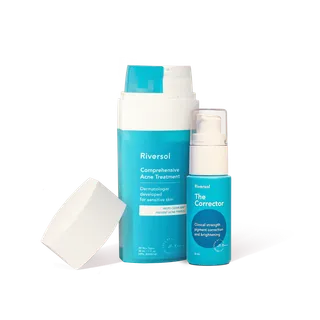
“Riversol Comprehensive Acne Treatment paired with the Corrector to unclog pores, lighten post-acne spots, and keep breakouts at bay.”
This product can help reduce breakouts and clogged pores because it contains the following ingredient: salicylic acid. This ingredient is used for treating acne and can have a noticeable effect.
Evens skin toneTranexamic acid, Phenylethyl resorcinol + 3 moreWorks well
“Riversol Comprehensive Acne Treatment paired with the Corrector to unclog pores, lighten post-acne spots, and keep breakouts at bay.”
This product can help reduce hypepigmentation and even out the skin tone because it contains the following effective ingredients: salicylic acid, tranexamic acid
The following ingredient (ingredients) in this product might be helpful, but there is no evidence to confirm that it actually can help even out the skin tone: phenylethyl resorcinol.
Keep in mind that you would need to apply any topical skincare targetted at hypigmentation consistently for a couple of months to get a result. No topical skincare product can help get rid of hyperpigmentation (including post-acne marks and age spots) instantly.
ExfoliationSide benefit · Salicylic acid, Lactic acidWorks well
This product can help exfoliate the skin. In other words, it helps break down the bonds between dead cells on the surface of the skin and speed up the skin turnover. Skin often appears softer and brighter after exfoliation, but overdoing it can result in disrupted skin barrier. The following ingredient is doing the exfoliating job in this product: salicylic acid.
MoisturizingSide benefit · Tetrapeptide-30, Tranexamic acid + 11 moreWorks well
This product can help improve hydration of the skin with the two types of ingredients.
The first type is called “humectants”:
these ingredients help attract water.
When humectants are on the surface of the skin, they “pull in” the moisture from the outside environment, or from
within deeper layers of the skin. The following ingredients in this product do the job:
fructose, glycerin.
This product also contains ingredients called “occlusives”. They help reduce the speed with which our skin loses moisture to the outside environment. These ingredients also help soften the upper layer of the skin, so it feels less tight and nicer to the touch. The following ingredients in this product do the job: caprylic/capric triglyceride, caprylyl glycol.
The following ingredients in this product are especially good for supporting the skin barrier and helping with the hydration level: tetrapeptide-30
Anti-oxidationSide benefit · Disodium lauriminodipropionate tocopheryl phosphatesWorks well
This product contains antioxidants (disodium lauriminodipropionate tocopheryl phosphates) that can help neutralize free radicals in skin. By doing so, they can lessen the damage the skin gets from the UV light (sun).
Anti-agingSide benefit · Tetrapeptide-30, Niacinamide + 1 moreMay help
This product contains tetrapeptide-30. There is some human evidence that this ingredient helps reduce and prevent fine lines and wrinkles and improve skin elasticity and firmness, though it is smaller or less consistent than the evidence for the best anti-aging ingredients.
Can it cause trouble?
Irritancy1 strong irritant: Alcohol denat.Medium risk
ComedogenicClean of flagged comedogenic ingredientsNone flagged

User reviews
Be the first — your take helps the next person decide.
Ingredients
Filter by role to see what each ingredient is doing.
Salicylic acid~1.25–2.5%
- Irritation risk
- High
Used for skin exfoliation. It has an anti-inflammatory and anti-bacterial effect, helps to unclog pores, prevent blemishes and speed up healing of the existing ones. Sometimes referred to as a BHA (beta-hydroxy acid)
More about Salicylic acidWater~11–17%
Tranexamic acid~5–7.6%
- Irritation risk
- Low
An amino acid that is effective in reducing hyperpigmentation and evening out the skin tone. It can also help in skin barrier recovery. It is used to treat melasma, especially with injections and when taken orally
More about Tranexamic acidGlycerin~3.2–4.8%
- Irritation risk
- Low
One of the best moisturizing ingredients. Naturally present in skin. It attracts water to the upper layer of the skin working as a humectant
More about GlycerinButylene glycol~2.6–3.9%
- Irritation risk
- Low
Used to create a nice product texture and help delivery of other ingredients. Might be somewhat helpful in attracting water to the upper layer of the skin
More about Butylene glycolCaprylic/capric triglyceride~2.3–3.5%
- Irritation risk
- Medium
A good mix of fatty acids that forms a protective layer on the skin. Improves the shelf life of products. Derived from coconut and glycerin
More about Caprylic/capric triglyceridePropylene glycol alginate~1.7–2.6%
- Irritation risk
- Low
Peg-40 hydrogenated castor oil~1.5–2.3%
- Irritation risk
- Medium
Helps oil and water mix together
More about Peg-40 hydrogenated castor oilAcrylates/c10-30 alkyl acrylate crosspolymer~1.5–2.2%
- Irritation risk
- Medium
Maintains the texture of skincare products. Allows the product to spread evenly. Helps oil and water mix together
More about Acrylates/c10-30 alkyl acrylate crosspolymerDisodium lauriminodipropionate tocopheryl phosphates~1.1–1.7%
- Irritation risk
- Low
A form of Vitamin E. In concentrations 1-3%, it can help neutralize free radicals in skin and support photodamage repair
More about Disodium lauriminodipropionate tocopheryl phosphatesSodium lactate~0.9–1.3%
- Irritation risk
- Medium
Helps attract water to the upper layer of the skin. Is often used to adjust the pH level of the product
More about Sodium lactateSodium pca~0.55–1.3%
- Irritation risk
- Low
Naturally present in skin and helps to attract water to its upper layer
More about Sodium pcaGlycine~0.5–1.15%
- Irritation risk
- Low
Helps to attract water to the upper layer of the skin and can help restore the skin barrier function
More about GlycineFructose~0.4–1%
- Irritation risk
- Low
Helps attract water to the upper layer of the skin
More about FructosePhenylethyl resorcinol~0.4–1%
- Irritation risk
- High
Might help reduce hyperpigmentation in skin and help neutralize free radicals
More about Phenylethyl resorcinolNiacinamide~0.4–0.95%
- Irritation risk
- Low
Is proven to be effective in reducing blemishes, evening out skin tone and helping to improve lines and wrinkles. It helps the skin to repair sun damage, calm down inflammation and keep maintain good levels of moisture. The concentration of about 2% is effective for supporting the skin barrier and evening out the skin tone. Concentration of 4-6% is better for helping with acne and balancing the sebum production
More about NiacinamideHinokitiol~0.35–0.85%
- Irritation risk
- Low
Tetrapeptide-30~0.35–0.8%
Alcohol denat.~0.3–0.7%
- Irritation risk
- High
Produces temporary toning effect. Can help dissolve other ingredients or preserve products
More about Alcohol denat.Phenoxyethanol~0.15–0.65%
- Irritation risk
- Low
A preservative. It helps prevent bacterial growth in cosmetic products
More about PhenoxyethanolCaprylyl glycol~0.2–0.7%
- Irritation risk
- Medium
Helps preserve products and creates a nice product texture
More about Caprylyl glycolInositol~0.15–0.55%
Sodium citrate~0.1–0.45%
- Irritation risk
- Medium
Helps to control the skin's pH level. Maintains the skin's natural film of amino-lactic acids and oils. Helps to preserve products
More about Sodium citrateSodium benzoate~0.1–0.3%
Sorbic acid~0.05–0.3%
Sodium polyacrylate~0.2–0.7%
- Irritation risk
- Low
Used to create a gel-like product texture, as well as to stabilize emulsions
More about Sodium polyacrylateLactic acid~0.05–0.25%
- Irritation risk
- Medium
An exfoliating and moisturizing alpha-hydroxy acid (AHA). Typically causes less irritation than other AHAs, for example, glycolic acid. At high concentrations (about 15%), lactic acid can help reduce lines and wrinkles. Recent studies show that lactic acid can support the "good" bacteria living on skin's surface (healthy skin microbiome)
More about Lactic acidSodium hydroxide~0.05–0.2%
Citric acid~0.01–0.1%
- Irritation risk
- Medium
Can work as an exfoliant but is typically used to adjust the product pH
More about Citric acidIngredient list view
Salicylic acid, Water, Tranexamic acid, Glycerin, Butylene glycol, Caprylic/capric triglyceride, Propylene glycol alginate, Peg-40 hydrogenated castor oil, Acrylates/c10-30 alkyl acrylate crosspolymer, Disodium lauriminodipropionate tocopheryl phosphates, Sodium lactate, Sodium pca, Glycine, Fructose, Phenylethyl resorcinol, Niacinamide, Hinokitiol, Tetrapeptide-30, Alcohol denat., Phenoxyethanol, Caprylyl glycol, Inositol, Sodium citrate, Sodium benzoate, Sorbic acid, Sodium polyacrylate, Lactic acid, Sodium hydroxide, Citric acid
Compare prices
Retailers ranked by price — lowest first.
Worth comparing, line by line.
Match % combines shared ingredients, the first five ingredients, shared actives and hero ingredients, irritancy (lower counts in the alternative's favour), texture and body area. Only products in the same routine step are compared.
| RiversolAcne Treatment + CorrectorYOUR PRODUCT | TulaAcne Clearing + Tone Correcting Gel | Emma STreatment Niacinamide Formula | Versed SkinJust Breathe Clarifying Serum | |
|---|---|---|---|---|
| Match | — | 79% | 76% | 76% |
| Price | — | — | — | $13.98 |
| Shared key ingredients | — | 6 of 14 | 3 of 14 | 3 of 14 |
| Key difference | — | Azelaic Acid | Dimethicone | Panthenol |
| Irritancy | Medium | Low | Low | Low |
| Drying alcohol | Contains drying alcohol | — | — | — |
| View product | Shop | Shop | Shop |


More alternatives: Horace Sérum Acide Salicylique 2 % + Niacinamide 3 %Skinfix Acne+ 2% BHA Spot Treatment
Sources cited in this review
Every concentration estimate and effectiveness label is anchored to one of these 16 studies and safety reviews.
- 1Salicylic acid as a peeling agent: a comprehensive reviewncbi.nlm.nih.gov
- 2Beta Hydroxy Acidsfda.gov
- 3A review of toxicity from topical salicylic acid preparationssciencedirect.com
- 4
- 5Effect of tranexamic acid on melasma: a clinical trial with histological evaluationonlinelibrary.wiley.com
- 6Tranexamic acid accelerates skin barrier recovery and upregulates occludin in damaged skinonlinelibrary.wiley.com

Affiliate links · As an Amazon Associate, WIMJ earns from qualifying purchases.