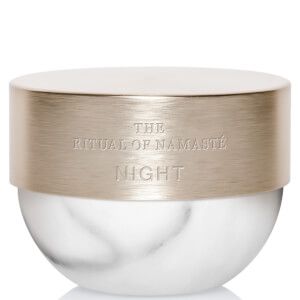
RITUALS The Ritual of Namaste Active Firming Night Cream
Works for
1 of 2 advertised claims delivered
Moisturizing18 ingredients credited for this claimGood support
“The rich day cream helps to firm and hydrate the skin to give the appearance of a smoother, lifted complexion.”
This product can help improve hydration of the skin with the two types of ingredients.
The first type is called “humectants”:
these ingredients help attract water.
When humectants are on the surface of the skin, they “pull in” the moisture from the outside environment, or from
within deeper layers of the skin. The following ingredients in this product do the job:
glycerin, sodium hyaluronate.
This product also contains ingredients called “occlusives”. They help reduce the speed with which our skin loses moisture to the outside environment. These ingredients also help soften the upper layer of the skin, so it feels less tight and nicer to the touch. The following ingredients in this product do the job: helianthus annuus seed oil, squalane.
Anti-aging4 ingredients credited for this claimLimited support
“The luxurious anti-ageing moisturiser also contains Holy Lotus, a symbol of beauty and wisdom that works to soothe and care for the skin.”
This product does not contain ingredients that are able to reduce fine lines and wrinkles or help with skin elasticity, but it can improve the look of the skin temporarily through moisturization. Well-moisturized skin might also be able to repair the sun damage better.These ingredients - magnesium palmitoyl glutamate, palmitoyl proline - could be helpful for preventing or repairing signs of aging in theory, but there is no evidence that it actually works.
Can it cause trouble?
Irritancy1 strong irritant: ParfumMedium risk
Comedogenic2 ingredients rated 2 or more on the 0–5 pore-clogging scale2 flagged
User reviews
Be the first — your take helps the next person decide.
Ingredients
Filter by role to see what each ingredient is doing.
Water~45–55%
Glycerin~4.4–5.4%
- Irritation risk
- Low
One of the best moisturizing ingredients. Naturally present in skin. It attracts water to the upper layer of the skin working as a humectant
More about GlycerinCocoglycerides~3.5–4.3%
- Irritation risk
- High
Help soften the upper layer of the skin and make it easier for oil and water mix together. Recently, a rising number of allergic reactions to cocoglycerides and other coconut-derived surfactants has been reported. As there is a significant overlap between frequent irritants and allergens, we flag this ingredient for attention of those with very sensitive, reactive skin
More about CocoglyceridesDecyl cocoate~3.1–3.8%
- Irritation risk
- Low
Distarch phosphate~2.3–2.8%
- Irritation risk
- Low
Isoamyl laurate~2–2.4%
- Irritation risk
- Medium
Helps stabilize emulsions and create a nice product texture
More about Isoamyl lauratePersea gratissima oil~1.7–2%
- Irritation risk
- Medium
An emollient that helps soften the skin and could be helpful in repairing its barrier function
More about Persea gratissima oilSesamum indicum seed oil~1.5–1.8%
- Irritation risk
- Low
A good moisturizing plant oil. Due to the high linoleic acid content, it helps soften the upper layer of the skin, reduce water loss and support skin barrier function
More about Sesamum indicum seed oilTheobroma cacao seed butter~1.2–1.5%
- Irritation risk
- Low
- Comedogenicity
- 3/5
Helps soften the upper layer of the skin and can be helpful in restoring the skin barrier function. Might have some anti-oxidant effect
More about Theobroma cacao seed butterBehenyl alcohol~1–1.3%
- Irritation risk
- Low
Non-drying alcohol that helps water and oil mix together. Also serves as an emollient
More about Behenyl alcoholC10-18 triglycerides~0.7–1.1%
- Irritation risk
- Low
Helps soften the skin and attract water to its upper layer. Helps create nice product texture
More about C10-18 triglyceridesSimmondsia chinensis seed oil~0.65–0.95%
- Irritation risk
- Medium
Softens the upper layer of skin and helps restore the healthy skin barrier. Has shown to help calm down inflammation in skin. It is a stable oil, meaning that it retains its properties even when exposed to air.
More about Simmondsia chinensis seed oilCetearyl alcohol~0.6–0.95%
- Irritation risk
- Low
- Comedogenicity
- 2/5
A non-drying alcohol. Works as an emollient. Helps water and oil mix together and creates a nice product texture
More about Cetearyl alcoholCamellia oleifera seed oil~0.5–0.8%
- Irritation risk
- Medium
An emollient that does not leave a greasy finish
More about Camellia oleifera seed oilSqualane~0.5–0.75%
- Irritation risk
- Low
An oil naturally present in skin. Works as an emollient to soften the skin and form a protective layer on its surface without a greasy feeling.
More about SqualaneSodium stearoyl glutamate~0.5–0.75%
- Irritation risk
- Medium
Helps oil and water mix together
More about Sodium stearoyl glutamateParfum~0.35–0.65%
- Irritation risk
- High
An aromatic blend of unspecified and possibly irritating ingredients
More about ParfumMedicago sativa extract~0.35–0.6%
- Irritation risk
- Medium
A plant extract that might help neutralize free radicals in skin
More about Medicago sativa extractNelumbo nucifera leaf cell extract~0.3–0.6%
- Irritation risk
- Low
Centella asiatica extract~0.35–0.65%
- Irritation risk
- Medium
A plant extract that has been shown to be able to reduce inflammation in skin, support restoration of skin barrier function, as well as support collagen production. Contains active compounds called centelloids: asiaticoside, madecasosside, asiatic acid and madecassic acid. Might be helpful in preventing stretch marks. It can be itself be irritating though.
More about Centella asiatica extractCistus incanus flower/leaf/stem extract~0.25–0.5%
- Irritation risk
- Low
Gynostemma pentaphyllum leaf/stem extract~0.3–0.55%
- Irritation risk
- Low
Sodium hyaluronate~0.25–0.45%
- Irritation risk
- Low
One of the best moisturizing ingredients. Attracts water into the upper layer of the skin
More about Sodium hyaluronateHelianthus annuus seed oil~0.3–0.55%
- Irritation risk
- Low
A great emollient due to its high linoleic acid content. One of the most effective plant oils in helping skin hydration and repairing skin barrier function
More about Helianthus annuus seed oilBisabolol~0.2–0.4%
- Irritation risk
- Low
An active component of chamomile plant that historically has been used to calm down irritated skin. A recent study shows that bisabolol indeed can have some anti-inflammatory effect on skin, even though conclusive data is lacking. Bisabolol has a sweet floral scent and can be added to products for its aromatic properties
More about BisabololPalmitoyl proline~0.25–0.45%
- Irritation risk
- Low
An amino-acid that helps attract watet to the upper layer of the skin and might have some anti-aging properties
More about Palmitoyl prolineGlutamine~0.25–0.45%
- Irritation risk
- Low
Glyceryl stearate~0.3–0.55%
- Irritation risk
- Low
An emollient that softens the skin and forms a protective layer on its surface. Helps water and oil mix together
More about Glyceryl stearateMagnesium palmitoyl glutamate~0.25–0.45%
- Irritation risk
- Low
An amino acid that helps attract water to the upper layer of the skin. Might be helpful against lines and wrinkles, but evidence of effectiveness is lacking
More about Magnesium palmitoyl glutamatePotassium cetyl phosphate~0.3–0.5%
- Irritation risk
- Medium
Helps oil and water mix together
More about Potassium cetyl phosphateSodium palmitoyl sarcosinate~0.3–0.6%
- Irritation risk
- Medium
Helps water and oil mix together
More about Sodium palmitoyl sarcosinateCetearyl glucoside~0.25–0.5%
- Irritation risk
- Medium
Helps water and oil in the product mix well together and improves product texture
More about Cetearyl glucosideAcacia senegal gum~0.25–0.45%
- Irritation risk
- Medium
Helps mask the small of other ingredients and improve the product texture
More about Acacia senegal gumXanthan gum~0.25–0.45%
- Irritation risk
- Low
Used to create a thicker product consistency
More about Xanthan gumDecyl glucoside~0.3–0.55%
- Irritation risk
- High
Helps oil and water mix together. Can be irritating
More about Decyl glucosideTocopherol~0.25–0.4%
- Irritation risk
- Low
Pure form of vitamin E. Can help moisturise and protect the skin from free radicals. Often used to help stabilise other ingredients or the formula itself
More about TocopherolPhenethyl alcohol~0.25–0.4%
Citric acid~0.2–0.35%
- Irritation risk
- Medium
Can work as an exfoliant but is typically used to adjust the product pH
More about Citric acidPhytic acid~0.2–0.4%
- Irritation risk
- Medium
An alpha-hydroxy acid (AHA), but is mostly used to stabilize product formulations in cosmetics
More about Phytic acidSodium hydroxide~0.15–0.3%
Benzoic acid~0.15–0.25%
Dehydroacetic acid~0.15–0.25%
Potassium sorbate~0.15–0.3%
Sodium benzoate~0.15–0.25%
Benzyl alcohol~0.1–0.2%
- Irritation risk
- High
A preservative. Can be used to mask unpleasant smell. Can be irritating
More about Benzyl alcoholIngredient list view
Water, Glycerin, Cocoglycerides, Decyl cocoate, Distarch phosphate, Isoamyl laurate, Persea gratissima oil, Sesamum indicum seed oil, Theobroma cacao seed butter, Behenyl alcohol, C10-18 triglycerides, Simmondsia chinensis seed oil, Cetearyl alcohol, Camellia oleifera seed oil, Squalane, Sodium stearoyl glutamate, Parfum, Medicago sativa extract, Nelumbo nucifera leaf cell extract, Centella asiatica extract, Cistus incanus flower/leaf/stem extract, Gynostemma pentaphyllum leaf/stem extract, Sodium hyaluronate, Helianthus annuus seed oil, Bisabolol, Palmitoyl proline, Glutamine, Glyceryl stearate, Magnesium palmitoyl glutamate, Potassium cetyl phosphate, Sodium palmitoyl sarcosinate, Cetearyl glucoside, Acacia senegal gum, Xanthan gum, Decyl glucoside, Tocopherol, Phenethyl alcohol, Citric acid, Phytic acid, Sodium hydroxide, Benzoic acid, Dehydroacetic acid, Potassium sorbate, Sodium benzoate, Benzyl alcohol
Compare prices
Retailers ranked by price — lowest first.
Affiliate links · prices updated regularly · As an Amazon Associate, WIMJ earns from qualifying purchases.
Sources cited in this review
Every concentration estimate and effectiveness label is anchored to one of these 28 studies and safety reviews.
- 1
- 2
- 3Triglyceride composition of Sesamum indicum seed oilonlinelibrary.wiley.com
- 4
- 5
- 6

Affiliate links · As an Amazon Associate, WIMJ earns from qualifying purchases.