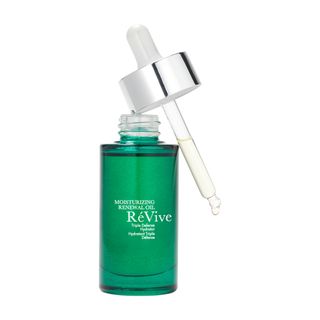
RéVive Moisturizing Renewal Oil Triple Defense Hydrator
Works for
2 of 2 advertised claims delivered
MoisturizingOligopeptide-24, Helianthus annuus extract + 17 moreStrong evidence
“Moisturizing Renewal Oil Triple Defense Hydrator”
This product can help improve hydration of the skin with the two types of ingredients.
The first type is called “humectants”:
these ingredients help attract water.
When humectants are on the surface of the skin, they “pull in” the moisture from the outside environment, or from
within deeper layers of the skin. The following ingredients in this product do the job:
glycerin.
This product also contains ingredients called “occlusives”. They help reduce the speed with which our skin loses moisture to the outside environment. These ingredients also help soften the upper layer of the skin, so it feels less tight and nicer to the touch. The following ingredients in this product do the job: caprylic/capric triglyceride, helianthus annuus seed oil.
The following ingredients in this product are especially good for supporting the skin barrier and helping with the hydration level: oligopeptide-24
Anti-agingOligopeptide-24, Limnanthes alba seed oil + 4 moreModerate evidence
“Plus, our signature Bio-Renewal Peptide renews the skin day and night for a smoother, nourished, and more youthful-looking complexion.”
This product contains oligopeptide-24. This ingredient might be able to help reduce and prevent fine lines and wrinkles, improve skin elasticity and firmness, but there is not enough evidence that it actually works.
Can it cause trouble?
Irritancy7 strong irritants: Rosmarinus officinalis leaf extract, Parfum + 5 more — patch-test recommendedHigh risk
Comedogenic2 ingredients rated 2 or more on the 0–5 pore-clogging scale2 flagged
User reviews
Be the first — your take helps the next person decide.
Ingredients
Filter by role to see what each ingredient is doing.
Prunus amygdalus dulcis oil~24–37%
- Irritation risk
- Low
An emollient that softens the skin
More about Prunus amygdalus dulcis oilCoco-caprylate~5.2–7.8%
- Irritation risk
- Medium
An emollient that softens skin and creates a nice product texture
More about Coco-caprylateCaprylic/capric triglyceride~4.9–7.4%
- Irritation risk
- Medium
A good mix of fatty acids that forms a protective layer on the skin. Improves the shelf life of products. Derived from coconut and glycerin
More about Caprylic/capric triglycerideSqualane~3.8–5.7%
- Irritation risk
- Low
An oil naturally present in skin. Works as an emollient to soften the skin and form a protective layer on its surface without a greasy feeling.
More about SqualaneLimnanthes alba seed oil~2.7–4.1%
- Irritation risk
- Low
This oil's cmposition is closest to rapeseed oil. It is a very stable oil and serves as an emoillient
More about Limnanthes alba seed oilJojoba oil/macadamia seed oil esters~2–3%
- Irritation risk
- Low
Vitis vinifera seed oil~1.6–2.5%
- Irritation risk
- Medium
A great emollient that can also have anti-oxidant properties
More about Vitis vinifera seed oilRosa canina seed oil~1.3–2%
- Irritation risk
- Medium
A plant oil that helps soften the upper layer of the skin. It might have anti-oxidant properties. Might help reduce inflammation in skin and help against blemishes
More about Rosa canina seed oilOenothera biennis oil~1.1–1.6%
- Irritation risk
- Medium
Helps soften the upper layer of the skin and can support skin barrier function
More about Oenothera biennis oilOligopeptide-24~0.85–1.25%
- Irritation risk
- Low
A type of peptide. Peptides are excellent moisturizers and might be able support collagen production reducing fine lines and wrinkles
More about Oligopeptide-24Oryza sativa bran extract~0.5–1.15%
Glycine soja oil~0.45–1.05%
- Irritation risk
- Medium
- Comedogenicity
- 2/5
A good emollient that helps soften the skin and helps repair its barrier function. It can clog pores if used in high concentrations.
More about Glycine soja oilOleic/linoleic/linolenic polyglycerides~0.45–1%
- Irritation risk
- Low
Helps soften the upper layer of the skin
More about Oleic/linoleic/linolenic polyglyceridesTocopherol~0.35–0.8%
- Irritation risk
- Low
Pure form of vitamin E. Can help moisturise and protect the skin from free radicals. Often used to help stabilise other ingredients or the formula itself
More about TocopherolTetrahexyldecyl ascorbate~0.35–0.75%
- Irritation risk
- Medium
Being a lipid soluble form of vitamin C, it is more stable than ascorbic acid, but still degrades quickly and needs to be stabilized in a formulation with another ingredient. It is claimed to penetrate skin better than pure vitamin C and have the the similar benefits, but solid studies of its effectiveness are lacking. Is likely to require a higher concentration in a product than pure vitamin C to be effective. It might be able to help reduce pore clogging.
More about Tetrahexyldecyl ascorbateOryza sativa germ extract~0.4–0.9%
- Irritation risk
- Low
Oryza sativa extract~0.35–0.75%
- Irritation risk
- Low
A grain extract that helps to create a thicker product consistency. It might have some anti-oxidant properties and help attract water to the upper layer of the skin
More about Oryza sativa extractPhytosteryl macadamiate~0.35–0.8%
- Irritation risk
- Low
Helps soften the upper layer of the skin
More about Phytosteryl macadamiateGlycerin~0.2–0.75%
- Irritation risk
- Low
One of the best moisturizing ingredients. Naturally present in skin. It attracts water to the upper layer of the skin working as a humectant
More about GlycerinRosmarinus officinalis leaf extract~0.15–0.6%
- Irritation risk
- High
Can be helpful in reducing inflammation in skin, including inflamed acne. It can be irritating
More about Rosmarinus officinalis leaf extractPhytosterols~0.3–0.7%
- Irritation risk
- Medium
Lipids that work as an emollient and can be helpful in repairing skin barrier function
More about PhytosterolsHelianthus annuus seed oil~0.2–0.75%
- Irritation risk
- Low
A great emollient due to its high linoleic acid content. One of the most effective plant oils in helping skin hydration and repairing skin barrier function
More about Helianthus annuus seed oilCamellia sinensis leaf extract~0.15–0.65%
- Irritation risk
- Low
Can contain potent anti-oxidant compounds (abbreviated ECG, GCG, EGC, and EGCG) that might help protect the skin from free radicals. Can help calm down inflammation and has some anti-bacterial properties. Unfortunately, these antioxidants are unstable and lose their effectiveness very quickly in products. The concentration of the antioxidant compounds in the extract also tends to be low to be effective in topical formulation
More about Camellia sinensis leaf extractCurcuma longa root extract~0.15–0.55%
- Irritation risk
- High
A plant extract that can contain an active compound curcumin, that may have some anti-inflammatory properties when applied to the skin, but solid research is lacking and the typical concentration used in skincare products is too low. Can be an irritant
More about Curcuma longa root extractHydrogenated lecithin~0.15–0.6%
- Irritation risk
- Low
Helps to retain moisture by creating a protective barrier on the skin. Rich in fatty acids. Improves product texture and helps with the penetration of other ingredients.
More about Hydrogenated lecithinPolyglyceryl-3 diisostearate~0.15–0.65%
- Irritation risk
- Medium
- Comedogenicity
- 3/5
Helps oil and water mix together
More about Polyglyceryl-3 diisostearateParfum~0.15–0.5%
- Irritation risk
- High
An aromatic blend of unspecified and possibly irritating ingredients
More about ParfumSodium oleate~0.45–1.1%
- Irritation risk
- Medium
Helps oil and water mix together and create a thicker product consistency
More about Sodium oleateHelianthus annuus extract~0.2–0.75%
- Irritation risk
- Low
Helps soften the upper layer of the skin
More about Helianthus annuus extractWater~0.15–0.55%
Phenoxyethanol~0.1–0.45%
- Irritation risk
- Low
A preservative. It helps prevent bacterial growth in cosmetic products
More about PhenoxyethanolDisodium edta~0.1–0.4%
Citronellol~0.05–0.3%
Geraniol~0.05–0.3%
Hexyl cinnamal~0.05–0.25%
Limonene~0.05–0.15%
- Irritation risk
- High
A common frangrance that can easily irritate skin, especially if exposed to air, light or heat
More about LimoneneLinalool~0.05–0.15%
Ingredient list view
Prunus amygdalus dulcis oil, Coco-caprylate, Caprylic/capric triglyceride, Squalane, Limnanthes alba seed oil, Jojoba oil/macadamia seed oil esters, Vitis vinifera seed oil, Rosa canina seed oil, Oenothera biennis oil, Oligopeptide-24, Oryza sativa bran extract, Glycine soja oil, Oleic/linoleic/linolenic polyglycerides, Tocopherol, Tetrahexyldecyl ascorbate, Oryza sativa germ extract, Oryza sativa extract, Phytosteryl macadamiate, Glycerin, Rosmarinus officinalis leaf extract, Phytosterols, Helianthus annuus seed oil, Camellia sinensis leaf extract, Curcuma longa root extract, Hydrogenated lecithin, Polyglyceryl-3 diisostearate, Parfum, Sodium oleate, Helianthus annuus extract, Water, Phenoxyethanol, Disodium edta, Citronellol, Geraniol, Hexyl cinnamal, Limonene, Linalool
Compare prices
Retailers ranked by price — lowest first.


Product summary
Based on the ingredients included, "RéVive - Moisturizing Renewal Oil Triple Defense Hydrator" works well for moisturizing the skin. As we expect from a proper moisturizer, the formula includes a combo of effective humectants and emollients. These are the two different types of ingredients that are essential for improving the skin hydration and supporting a healthy skin barrier. Humectants in this product (glycerin) help to increase the water content in the upper layer of the skin. (These ingredients do so by "capturing" water molecules from the outside air or from within the deeper layers of the skin). Emollients in this formulation (glycine soja oil, helianthus annuus extract, limnanthes alba seed oil, oenothera biennis oil and phytosterols) help to reduce the moisture loss from the skin. They also soften the skin surface and relieve the feeling of dryness and tightness.
Ingredient callouts
- We like that this moisturizer contains peptides (oligopeptide-24 0.85% - 1.25%). There are many different kind of Peptides and they are naturally present in our skin. They all are a combination of aminoacids. Some of them work as natural antibiotics, promote wound-healing and production of collagen. The science is still not settled on how effective Peptides are in skincare, but it is very likely that they have a benefit. Peptides might help restore the skin barrier and fight the signs of aging. At the very least, Peptides work as humectants: they attract water to the upper layer of the skin and improve its hydration.
Irritation risk
There are quite a few common irritants in this product, including ingredients without particular skin benefits. We would not recommend it for sensitive skin. We assess the overall irritancy of this moisturizer to be high. For a detailed overview of all potential irritants: click here
You can see the detailed formula review with the breakdown of all actives in the product and the full ingredient list with estimated concentrations in the tables below.
Price
The product retails for 195.00$ in the United States and from 140.00£ up to 1032.00£ in the United Kingdom.
For a detailed price comparison: click here.
Sources cited in this review
Every concentration estimate and effectiveness label is anchored to one of these 21 studies and safety reviews.
- 1
- 2Nutrient composition of rose (Rosa canina L.) seed and oilsncbi.nlm.nih.gov
- 3
- 4
- 5Vitamin E in dermatologyncbi.nlm.nih.gov
- 6Vitamin E and Skin Healthlpi.oregonstate.edu

Affiliate links · As an Amazon Associate, WIMJ earns from qualifying purchases.