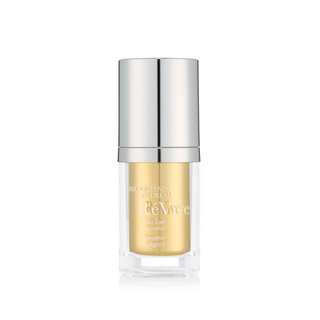
RéVive Brightening Eye Cream / Under Eye Illuminator
Works for
1 of 2 advertised claims delivered
Moisturizing14 ingredients credited for this claimStrong support
“Brightening Eye Cream”
This product can help improve hydration of the skin with the two types of ingredients.
The first type is called “humectants”:
these ingredients help attract water.
When humectants are on the surface of the skin, they “pull in” the moisture from the outside environment, or from
within deeper layers of the skin. The following ingredients in this product do the job:
glycerin, sodium hyaluronate.
This product also contains ingredients called “occlusives”. They help reduce the speed with which our skin loses moisture to the outside environment. These ingredients also help soften the upper layer of the skin, so it feels less tight and nicer to the touch. The following ingredients in this product do the job: ceramide np, cetearyl alcohol.
The following ingredients in this product are especially good for supporting the skin barrier and helping with the hydration level: ceramide np, hexapeptide-9
Evens skin tone2 ingredients credited for this claimWeak support
“reduce visible dark circles and discoloration”
Effective ingredients missing or their concentration is too low
Anti-agingNot advertised by the brand · 3 ingredients credited for this claimModerate support
This product contains hexapeptide-9. This ingredient might be able to help reduce and prevent fine lines and wrinkles, improve skin elasticity and firmness, but there is not enough evidence that it actually works.
Can it cause trouble?
Irritancy12 flagged ingredientsMedium risk
Comedogenic2 ingredients rated 2 or more on the 0–5 pore-clogging scale2 flagged


User reviews
Be the first — your take helps the next person decide.
Ingredients
Filter by role to see what each ingredient is doing.
Water~45–55%
Propanediol~4.8–5.9%
- Irritation risk
- Low
Acts as a solvent for other ingredients. Speeds up the absorption of other ingredients into the skin
More about PropanediolC13-15 alkane~4.7–5.7%
Glycerin~3.3–4%
- Irritation risk
- Low
One of the best moisturizing ingredients. Naturally present in skin. It attracts water to the upper layer of the skin working as a humectant
More about GlycerinTetrahexyldecyl ascorbate~2.5–3.1%
- Irritation risk
- Medium
Being a lipid soluble form of vitamin C, it is more stable than ascorbic acid, but still degrades quickly and needs to be stabilized in a formulation with another ingredient. It is claimed to penetrate skin better than pure vitamin C and have the the similar benefits, but solid studies of its effectiveness are lacking. Is likely to require a higher concentration in a product than pure vitamin C to be effective. It might be able to help reduce pore clogging.
More about Tetrahexyldecyl ascorbateStearic acid~2.3–2.8%
- Irritation risk
- Low
Helps oil and water mix together and works as an emollient
More about Stearic acidBehenyl alcohol~1.9–2.3%
- Irritation risk
- Low
Non-drying alcohol that helps water and oil mix together. Also serves as an emollient
More about Behenyl alcoholCetearyl alcohol~1.6–2%
- Irritation risk
- Low
- Comedogenicity
- 2/5
A non-drying alcohol. Works as an emollient. Helps water and oil mix together and creates a nice product texture
More about Cetearyl alcoholSucrose distearate~1.4–1.7%
Butylene glycol~1.1–1.3%
- Irritation risk
- Low
Used to create a nice product texture and help delivery of other ingredients. Might be somewhat helpful in attracting water to the upper layer of the skin
More about Butylene glycolBehenic acid~1–1.3%
Hexapeptide-9~0.65–0.95%
- Irritation risk
- Low
A type of peptide. Peptides are excellent moisturizers and might be able support collagen production reducing fine lines and wrinkles
More about Hexapeptide-9Niacinamide~0.6–0.9%
- Irritation risk
- Low
Is proven to be effective in reducing blemishes, evening out skin tone and helping to improve lines and wrinkles. It helps the skin to repair sun damage, calm down inflammation and keep maintain good levels of moisture. The concentration of about 2% is effective for supporting the skin barrier and evening out the skin tone. Concentration of 4-6% is better for helping with acne and balancing the sebum production
More about NiacinamideZingiber zerumbet extract~0.6–0.9%
- Irritation risk
- Low
Caffeine~0.55–0.8%
- Irritation risk
- Medium
Might be helpful in neutralizing free radicals. Can have a dehydration effect that might somewhat decrease the look of puffy eyes
More about CaffeineCeramide np~0.55–0.85%
- Irritation risk
- Low
A type of lipid similar to ceramides naturally present in skin. Helps to soften the upper layer of the skin and supports the skin barrier function to keep it hydrated. Can help to prevent inflammation in skin
More about Ceramide npSodium hyaluronate~0.5–0.75%
- Irritation risk
- Low
One of the best moisturizing ingredients. Attracts water into the upper layer of the skin
More about Sodium hyaluronatePhenoxyethanol~0.5–0.75%
- Irritation risk
- Low
A preservative. It helps prevent bacterial growth in cosmetic products
More about PhenoxyethanolPolyglyceryl-10 laurate~0.45–0.7%
- Irritation risk
- Medium
Helps water and oil mix together
More about Polyglyceryl-10 laurateAmmonium acryloyldimethyltaurate/vp copolymer~0.45–0.65%
- Irritation risk
- Low
Increases thickness of a product. Texture enhancer for oil-in-water emulsions
More about Ammonium acryloyldimethyltaurate/vp copolymerBatyl alcohol~0.45–0.7%
- Irritation risk
- Low
Non-drying alcohol. Used to stabilize other ingredients and is an emollient
More about Batyl alcoholHydroxyacetophenone~0.4–0.6%
Tocopheryl acetate~0.35–0.65%
- Irritation risk
- Medium
A more stable but less bio-available form of vitamin E compared to Tocopherol. Might help moisturize and protect the skin from free radicals, but mostly used in low concentrations to stabilize other ingredients.
More about Tocopheryl acetatePhytosteryl isostearate~0.35–0.65%
- Irritation risk
- Low
Hydrogenated lecithin~0.4–0.6%
- Irritation risk
- Low
Helps to retain moisture by creating a protective barrier on the skin. Rich in fatty acids. Improves product texture and helps with the penetration of other ingredients.
More about Hydrogenated lecithinCarbomer~0.35–0.65%
- Irritation risk
- Low
Helps create a thicker or gel-like product texture. It is not a surfactant but can be used in gentle cleansing formulations
More about CarbomerPolyglyceryl-10 myristate~0.35–0.65%
- Irritation risk
- Low
Caprylic/capric triglyceride~0.45–0.65%
- Irritation risk
- Medium
A good mix of fatty acids that forms a protective layer on the skin. Improves the shelf life of products. Derived from coconut and glycerin
More about Caprylic/capric triglycerideGlyceryl stearate~0.45–0.65%
- Irritation risk
- Low
An emollient that softens the skin and forms a protective layer on its surface. Helps water and oil mix together
More about Glyceryl stearateSodium hydroxide~0.35–0.6%
Xanthan gum~0.35–0.65%
- Irritation risk
- Low
Used to create a thicker product consistency
More about Xanthan gumSodium phytate~0.35–0.6%
Ethylhexyl palmitate~0.4–0.6%
- Irritation risk
- Low
- Comedogenicity
- 3/5
An emollient that helps soften the skin and create a nice product texture
More about Ethylhexyl palmitateEthylhexylglycerin~0.3–0.6%
Citric acid~0.3–0.55%
- Irritation risk
- Medium
Can work as an exfoliant but is typically used to adjust the product pH
More about Citric acidSilica dimethyl silylate~0.35–0.6%
Sodium citrate~0.25–0.5%
- Irritation risk
- Medium
Helps to control the skin's pH level. Maintains the skin's natural film of amino-lactic acids and oils. Helps to preserve products
More about Sodium citrateCaprylyl glycol~0.3–0.5%
- Irritation risk
- Medium
Helps preserve products and creates a nice product texture
More about Caprylyl glycolHexylene glycol~0.2–0.4%
- Irritation risk
- Medium
Helps create a more spreadable product texture
More about Hexylene glycolMica~0.25–0.4%
- Irritation risk
- Low
Creates an illusion of smoother and more radiant skin tone. Adds shimmer to the skin by reflecting light
More about MicaIron oxides~0.2–0.35%
- Irritation risk
- Low
An umbrella term for the following three colorants: CI 77491, CI 77492, CI 77499. They might be able to offer some protection against visible light, but the degree of the protection is not clear
More about Iron oxidesIron oxides~0.15–0.3%
- Irritation risk
- Low
An umbrella term for the following three colorants: CI 77491, CI 77492, CI 77499. They might be able to offer some protection against visible light, but the degree of the protection is not clear
More about Iron oxidesIron oxides~0.1–0.25%
- Irritation risk
- Low
An umbrella term for the following three colorants: CI 77491, CI 77492, CI 77499. They might be able to offer some protection against visible light, but the degree of the protection is not clear
More about Iron oxidesTitanium dioxide~0.15–0.3%
- Irritation risk
- Low
Works as a UV filter when used in high concentrations. It is photostable and is effective mostly against the UVB light, with some protection in the UVA range. In small concentrations, used for its ability to improve the color of cosmetic products. Is usually well tolerated by the skin
More about Titanium dioxideIngredient list view
Water, Propanediol, C13-15 alkane, Glycerin, Tetrahexyldecyl ascorbate, Stearic acid, Behenyl alcohol, Cetearyl alcohol, Sucrose distearate, Butylene glycol, Behenic acid, Hexapeptide-9, Niacinamide, Zingiber zerumbet extract, Caffeine, Ceramide np, Sodium hyaluronate, Phenoxyethanol, Polyglyceryl-10 laurate, Ammonium acryloyldimethyltaurate/vp copolymer, Batyl alcohol, Hydroxyacetophenone, Tocopheryl acetate, Phytosteryl isostearate, Hydrogenated lecithin, Carbomer, Polyglyceryl-10 myristate, Caprylic/capric triglyceride, Glyceryl stearate, Sodium hydroxide, Xanthan gum, Sodium phytate, Ethylhexyl palmitate, Ethylhexylglycerin, Citric acid, Silica dimethyl silylate, Sodium citrate, Caprylyl glycol, Hexylene glycol, Mica, Iron oxides, Iron oxides, Iron oxides, Titanium dioxide
Compare prices
Retailers ranked by price — lowest first.

Affiliate links · prices updated regularly
Worth comparing, line by line.
Match % combines shared ingredients, the first five ingredients, shared actives and hero ingredients, irritancy (lower counts in the alternative's favour), texture and body area. Only products in the same routine step are compared.
| RéViveBrightening Eye Cream / Under Eye IlluminatorYOUR PRODUCT | NEOGEN X SUR.MEDICV.Biome Advanced Eye Cream | CeraVeSkin Renewing Eye Cream | Beyou CosmeticsCaffeine Eye Cream | |
|---|---|---|---|---|
| Match | — | 84% | 84% | 81% |
| Price | $195.00 | $25.16−$169.84 | $15.12−$179.88 | $18.99−$176.01 |
| Shared key ingredients | — | 6 of 9 | 6 of 9 | 6 of 9 |
| Key difference | — | Copper Tripeptide-1 | Palmitoyl Tetrapeptide-7 | Adenosine |
| Irritancy | Medium | Medium | Low | Low |
| Drying alcohol | — | — | — | — |
| View product | Shop | Shop | Shop |

Sources cited in this review
Every concentration estimate and effectiveness label is anchored to one of these 10 studies and safety reviews.
- 1
- 2
- 3
- 4
- 5
- 6

Affiliate links · As an Amazon Associate, WIMJ earns from qualifying purchases.