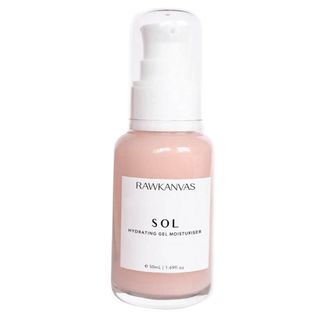
RAWKANVAS Sol: Hydrating Gel Moisturiser
Works for
2 of 2 advertised claims delivered
Anti-aging5 ingredients credited for this claimModerate support
“Minimise and control excess shine and oil without overdrying for a matte finish, strengthen the skins' protective barrier to avoid dehydration and dryness, increase skin cell production for a more youthful appearance, deeply deliver and lock in much-needed moisture to plump skin, and protect skin against environmental aggressors too.”
This product contains ubiquinone. This ingredient help neutralize free radicals in skin. By doing so, they might be able to prevent early signs of aging (like fine lines and wrinkles), at least to some extent. These ingredients will not be able to "reverse" signs of aging.
Moisturizing14 ingredients credited for this claimGood support
“Hydrating Gel Moisturiser”
This product can help improve hydration of the skin with the two types of ingredients.
The first type is called “humectants”:
these ingredients help attract water.
When humectants are on the surface of the skin, they “pull in” the moisture from the outside environment, or from
within deeper layers of the skin. The following ingredients in this product do the job:
betaine, glycerin.
This product also contains ingredients called “occlusives”. They help reduce the speed with which our skin loses moisture to the outside environment. These ingredients also help soften the upper layer of the skin, so it feels less tight and nicer to the touch. The following ingredients in this product do the job: chondrus crispus extract, simmondsia chinensis seed oil.
Anti-oxidationNot advertised by the brand · 7 ingredients credited for this claimStrong support
This product contains antioxidants (ubiquinone) that can help neutralize free radicals in skin. By doing so, they can lessen the damage the skin gets from the UV light (sun).
Can it cause trouble?
Irritancy2 strong irritants: Sodium anisate, Rosa damascena flower oilMedium risk
Comedogenic1 ingredient rated 2 or more on the 0–5 pore-clogging scale1 flagged
User reviews
Be the first — your take helps the next person decide.
Ingredients
Filter by role to see what each ingredient is doing.
Aloe barbadensis leaf juice~23–34%
- Irritation risk
- Medium
Traditionally used to treat sunburns, dermatitis and inflammation, but evidence for its effectiveness is lacking. The extract can contain humectants that help attract water into the skin
More about Aloe barbadensis leaf juiceGlycerin~3.1–4.6%
- Irritation risk
- Low
One of the best moisturizing ingredients. Naturally present in skin. It attracts water to the upper layer of the skin working as a humectant
More about GlycerinSimmondsia chinensis seed oil~4.4–6.6%
- Irritation risk
- Medium
Softens the upper layer of skin and helps restore the healthy skin barrier. Has shown to help calm down inflammation in skin. It is a stable oil, meaning that it retains its properties even when exposed to air.
More about Simmondsia chinensis seed oilRosa canina fruit oil~3.6–5.3%
- Irritation risk
- Medium
A great emollient. Contains vitamin E (tocopherol) which may give it some anti-oxidant properties. Can contain volatile compounds and can be irritating
More about Rosa canina fruit oilAvena sativa kernel flour~2.7–4.1%
- Irritation risk
- Low
A type of colloidal oatmeal. Can contain potent antioxidants and anti-inflammatory compounds. Is effective in supporting skin barrier
More about Avena sativa kernel flourBisabolol~1.8–2.7%
- Irritation risk
- Low
An active component of chamomile plant that historically has been used to calm down irritated skin. A recent study shows that bisabolol indeed can have some anti-inflammatory effect on skin, even though conclusive data is lacking. Bisabolol has a sweet floral scent and can be added to products for its aromatic properties
More about BisabololPunica granatum pericarp extract~1.4–2.1%
- Irritation risk
- Low
Glycyrrhiza glabra root extract~1.1–1.6%
- Irritation risk
- Medium
A plant extract that can help lighten the skin and calm down inflammation. Might be helpful in neutralizing free radicals
More about Glycyrrhiza glabra root extractCitrullus lanatus fruit extract~1–1.5%
- Irritation risk
- Medium
A plant extract that can contain an antioxidant compound
More about Citrullus lanatus fruit extractSodium levulinate~0.85–1.25%
Sodium anisate~0.5–1.2%
Cellulose gum~0.5–1.15%
- Irritation risk
- Low
Used to create thicker product consistency and stabilize emulsions
More about Cellulose gumChondrus crispus extract~0.4–0.95%
- Irritation risk
- Low
- Comedogenicity
- 3/5
Red algae extract that helps attract water to the upper layer of the skin and create a nicer product consistency
More about Chondrus crispus extractCeratonia siliqua gum~0.45–1.05%
- Irritation risk
- Medium
Used to stabilize product formulations and create thicker consistency
More about Ceratonia siliqua gumSucrose~0.3–0.7%
- Irritation risk
- Low
Can help attract water to the upper layer of the skin. In crystal form, it can work as a gentle exfoliant, gentler than the salt scrub. Helps stabilize the emulsion
More about SucroseBetaine~0.3–0.7%
- Irritation risk
- Low
Helps attract water to the upper layer of the skin and improves the product texture
More about BetaineSodium hyaluronate~0.2–0.75%
- Irritation risk
- Low
One of the best moisturizing ingredients. Attracts water into the upper layer of the skin
More about Sodium hyaluronateHyaluronic acid~0.15–0.7%
- Irritation risk
- Low
One of the best moisturizing ingredients. Attracts water into the upper layer of the skin. Naturally present in skin. Typically has large molecule size unless advertised otherwise on the product label. Helps support skin's barrier function and may help to reduce inflammation
More about Hyaluronic acidTocopherol~0.15–0.6%
- Irritation risk
- Low
Pure form of vitamin E. Can help moisturise and protect the skin from free radicals. Often used to help stabilise other ingredients or the formula itself
More about TocopherolHibiscus abelmoschus seed oil~0.1–0.5%
- Irritation risk
- Low
Rosa damascena flower oil~0.15–0.6%
- Irritation risk
- High
Used as a fragrance. Can be irritating
More about Rosa damascena flower oilUbiquinone~0.1–0.45%
- Irritation risk
- Low
Coenzyme Q10. It helps neutralize free radicals in skin, improves skin hydration and might be helpful agains fine lines and wrinkles. It can be an allergen
More about UbiquinoneLactic acid~0.1–0.4%
- Irritation risk
- Medium
An exfoliating and moisturizing alpha-hydroxy acid (AHA). Typically causes less irritation than other AHAs, for example, glycolic acid. At high concentrations (about 15%), lactic acid can help reduce lines and wrinkles. Recent studies show that lactic acid can support the "good" bacteria living on skin's surface (healthy skin microbiome)
More about Lactic acidBeta vulgaris root extract~0.1–0.35%
- Irritation risk
- Medium
A plant extract that might have some antioxidant properties, but mostly used in cosmetics for its color
More about Beta vulgaris root extractIngredient list view
Aloe barbadensis leaf juice, Glycerin, Simmondsia chinensis seed oil, Rosa canina fruit oil, Avena sativa kernel flour, Bisabolol, Punica granatum pericarp extract, Glycyrrhiza glabra root extract, Citrullus lanatus fruit extract, Sodium levulinate, Sodium anisate, Cellulose gum, Chondrus crispus extract, Ceratonia siliqua gum, Sucrose, Betaine, Sodium hyaluronate, Hyaluronic acid, Tocopherol, Hibiscus abelmoschus seed oil, Rosa damascena flower oil, Unknown, Ubiquinone, Lactic acid, Beta vulgaris root extract
Compare prices
Retailers ranked by price — lowest first.

Sources cited in this review
Every concentration estimate and effectiveness label is anchored to one of these 13 studies and safety reviews.
- 1
- 2
- 3Analyzing Lycopene Content in Fruitssciencedirect.com
- 4
- 5Hyaluronic acid: A key molecule in skin agingncbi.nlm.nih.gov
- 6

Affiliate links · As an Amazon Associate, WIMJ earns from qualifying purchases.