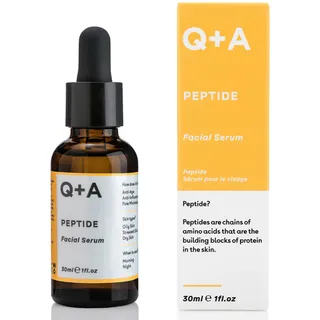
Works for
MoisturizingTripeptide-29, Betaine + 8 moreWorks well
“This formula is supported by Vitamin C and Hyaluronic Acid; two important hydrators, the former regarded for brightening skin tone.”
This product contains good ingredients to attract water to the upper layer of the skin. These ingredients are called "humectants": betaine, glycerin.
When humectants are on the surface of the skin, they “pull in” the moisture from the outside environment, or from within deeper layers of the skin. If the air is dry, humectants can speed up the moisture loss from the skin. This is why it is a good idea to use another product on top of this one to help "seal in" the moisture (look for ingredients like dimethicone, squalane, oils and butters).
The following ingredients in this product are especially good for supporting the skin barrier and helping with the hydration level: tripeptide-29
Anti-agingSide benefit the brand mentions · Tripeptide-29, Sodium ascorbyl phosphate + 1 moreMay help
“This serum contains a Pure Peptide which helps boost collagen levels in the skin.”
This product contains tripeptide-29. There is some human evidence that this ingredient helps reduce and prevent fine lines and wrinkles and improve skin elasticity and firmness, though it is smaller or less consistent than the evidence for the best anti-aging ingredients.
Can it cause trouble?
Irritancy2 strong irritants: Lonicera caprifolium extract, Sodium anisateMedium risk
ComedogenicClean of flagged comedogenic ingredientsNone flagged

User reviews
Be the first — your take helps the next person decide.
Ingredients
Filter by role to see what each ingredient is doing.
Water~40–60%
Propylene glycol~4.8–7.2%
- Irritation risk
- High
Helps oil and water mix together and can enhance the penetration of other ingredients into the skin. It can be irritating
More about Propylene glycolBetaine~3.7–5.6%
- Irritation risk
- Low
Helps attract water to the upper layer of the skin and improves the product texture
More about BetainePentylene glycol~2.9–4.4%
- Irritation risk
- Medium
Used to preserve products, dissolve other ingredients and create a nice product texture
More about Pentylene glycolXanthan gum~2.1–3.1%
- Irritation risk
- Low
Used to create a thicker product consistency
More about Xanthan gumAloe barbadensis leaf juice powder~1.7–2.6%
- Irritation risk
- Medium
Traditionally used to treat sunburns, dermatitis and inflammation, but evidence for its effectiveness is lacking. The extract can contain humectants that help attract water into the skin
More about Aloe barbadensis leaf juice powderSodium phytate~1.4–2.1%
Glycerin~1.3–1.9%
- Irritation risk
- Low
One of the best moisturizing ingredients. Naturally present in skin. It attracts water to the upper layer of the skin working as a humectant
More about GlycerinLonicera caprifolium extract~1–1.5%
- Irritation risk
- High
Biosaccharide gum-2~0.6–1.4%
- Irritation risk
- Low
Lonicera japonica flower extract~0.5–1.1%
- Irritation risk
- High
A plant extract that might help neutralize free radicals in skin. Can contain volalite oils and be irritating
More about Lonicera japonica flower extractSodium levulinate~0.4–0.95%
Tripeptide-29~0.35–0.75%
Sodium hyaluronate~0.2–0.7%
- Irritation risk
- Low
One of the best moisturizing ingredients. Attracts water into the upper layer of the skin
More about Sodium hyaluronateSodium ascorbyl phosphate~0.15–0.6%
- Irritation risk
- Medium
A stable derivative of vitamin C. It is oil-soluble which means it is more likely to penetrate the skin compared to the pure form of vitamin C (which is water-soluble), but it is less bio-available and is way less effective in stimulating collagen and reducing wrinkles compared to the pure form of vitamin C (L-ascorbic acid) and its other derivatives (for example, magnesium ascorbyl phosphate). At the same time, this vitamin C derivative has been shown in studies to be effective in reducing acne, blemishes and clogged pores. It is less irritating then the pure form of vitamin C
More about Sodium ascorbyl phosphateMagnesium pca~0.1–0.45%
- Irritation risk
- Low
Helps attract water to the upper layer of the skin
More about Magnesium pcaLactic acid~0.1–0.35%
- Irritation risk
- Medium
An exfoliating and moisturizing alpha-hydroxy acid (AHA). Typically causes less irritation than other AHAs, for example, glycolic acid. At high concentrations (about 15%), lactic acid can help reduce lines and wrinkles. Recent studies show that lactic acid can support the "good" bacteria living on skin's surface (healthy skin microbiome)
More about Lactic acidGlyceryl caprylate~0.1–0.35%
- Irritation risk
- Low
An emollient that can also help water and oil mix together, as well as prevent bacteria growth in products
More about Glyceryl caprylateCocoyl proline~0.05–0.15%
- Irritation risk
- Low
Sodium anisate~0.05–0.1%
Leuconostoc/radish root ferment filtrate~0.01–0.05%
- Irritation risk
- Medium
A preservative that comes from radishes fermented by a bacteria. New research suggests that the preservation properties in the ingredient come from an ammonium salt that is not present naturally in radish root but used in its cultivation. Is problematic because the exact amount of the preservative agents is difficult to determine
More about Leuconostoc/radish root ferment filtrateCitric acid~0.01–0.05%
- Irritation risk
- Medium
Can work as an exfoliant but is typically used to adjust the product pH
More about Citric acidIngredient list view
Water, Propylene glycol, Betaine, Pentylene glycol, Xanthan gum, Aloe barbadensis leaf juice powder, Sodium phytate, Glycerin, Lonicera caprifolium extract, Biosaccharide gum-2, Lonicera japonica flower extract, Sodium levulinate, Tripeptide-29, Sodium hyaluronate, Sodium ascorbyl phosphate, Magnesium pca, Lactic acid, Glyceryl caprylate, Cocoyl proline, Sodium anisate, Leuconostoc/radish root ferment filtrate, Citric acid
Compare prices
Retailers ranked by price — lowest first.
Affiliate links · As an Amazon Associate, WIMJ earns from qualifying purchases.
Worth comparing, line by line.
Match % combines shared ingredients, the first five ingredients, shared actives and hero ingredients, irritancy (lower counts in the alternative's favour), texture and body area. Only products in the same routine step are compared.
| Q+APeptide Facial SerumYOUR PRODUCT | Etude HouseVegan Collagen Booster Serum | NIODCAIS3)COPPER AMINO ISOLATE SERUM 3 1:1 | Thesera7.2 Revital Cell Ampoule THESERA | |
|---|---|---|---|---|
| Match | — | 56% | 55% | 53% |
| Price | — | $38.00 | $68.78 | — |
| Shared key ingredients | — | 3 of 5 | 2 of 5 | 3 of 5 |
| Key difference | — | Palmitoyl Tripeptide-37 | Acetyl Tetrapeptide-2 | Tripeptide-1 |
| Irritancy | Medium | Medium | Low | Medium |
| Drying alcohol | — | — | — | — |
| View product | Shop | Shop | Shop |


More alternatives: The Potions Booster; Peptide AmpouleNakery Collagen Defense + 25% Vitamin C Complex Serum
Sources cited in this review
Every concentration estimate and effectiveness label is anchored to one of these 17 studies and safety reviews.
- 1Surfactants and experimental irritant contact dermatitisncbi.nlm.nih.gov
- 2Propylene Glycolpubmed.ncbi.nlm.nih.gov
- 3Skin-sensitizing and irritant properties of propylene glycolonlinelibrary.wiley.com
- 4
- 5
- 6

Affiliate links · As an Amazon Associate, WIMJ earns from qualifying purchases.