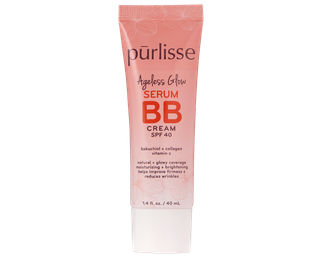
Purlisse Ageless Glow Serum BB Cream SPF 40
Works for
3 of 3 advertised claims delivered
Sun protectionSPF 40 · 3 UV filtersBroad spectrum
This product offers a good level of protection against both UVB and UVA rays.
This sunscreen uses organic (so-called "chemical") sunscreen filters. Organic, or "chemical" filters usually provide reliable sun protection and rarely leave a white cast. Sunscreens with organic filters can sting eyes.
This product can be considered "reef safe" because it does not contain the UV filters (oxybenzone and octinoxate) that can be harmful to coral reefs when present in the water in high concentrations.
Evens skin tone2 ingredients credited for this claimStrong support
“Vitamin C is known to reduce hyperpigmentation and protect skin from damaging free radicals.”
This product offers broad spectrum sun protection. It means that it can prevent hyperpigmentation and help keep the skin tone even (sun damage is the main factor causing age spots, darkening of post-acne marks and other discolorations).
Anti-aging4 ingredients credited for this claimStrong support
“Bakuchiol plant based retinol alternative is a concentrated antioxidant that can reduce discoloration, reduce the appearance of fine lines and wrinkles and firm the skin.”
This product can help reduce and prevent fine lines and wrinkles, improve skin elasticity and firmness because it contains adenosine, bakuchiol.
Keep in mind that it typically takes at least 6 weeks to notice any results because the changes that are needed to improve fine lines and elasticity happen in the deeper layers of the skin. No topical anti-aging product can “erase” wrinkles or fully reverse signs of aging.
This product can also help prevent early signs of skin aging because it offers a good level of broad spectrum sun protection. Sun damage is the main cause of premature skin aging, and protecting your skin from the sun is the best anti-aging strategy.
Anti-oxidationNot advertised by the brand · 8 ingredients credited for this claimStrong support
This product contains antioxidants (bakuchiol) that can help neutralize free radicals in skin. By doing so, they can lessen the damage the skin gets from the UV light (sun).
The following ingredients - arbutin, cornus officinalis fruit extract also can have an antioxidant effect, but there is less evidence to confirm their effectiveness in skin.
MoisturizingNot advertised by the brand · 11 ingredients credited for this claimGood support
This product contains good ingredients to attract water to the upper layer of the skin. These ingredients are called "humectants": hyaluronic acid, butylene glycol.
When humectants are on the surface of the skin, they “pull in” the moisture from the outside environment, or from within deeper layers of the skin. If the air is dry, humectants can speed up the moisture loss from the skin. This is why it is a good idea to use another product on top of this one to help "seal in" the moisture (look for ingredients like dimethicone, squalane, oils and butters).
Anti-blemishNot advertised by the brand · 1 ingredient credited for this claimGood support
This product might be able to help reduce blemishes and clogged pores because it contains bakuchiol.
Can it cause trouble?
Irritancy12 strong irritants: Sorbitan sesquioleate, Citrus aurantium bergamia fruit oil + 10 more — patch-test recommendedHigh risk
ComedogenicClean of flagged comedogenic ingredientsNone flagged


User reviews
Ingredients
Filter by role to see what each ingredient is doing.
Bakuchiol~26–31%
- Irritation risk
- Medium
A plant extract that is, though different in chemical structure, acts similar to retinoids. First studies show that it can help reduce fine lines and wrinkles, improve skin tone, reduce clogged pores and blemishes, and reduce inflammation. There is no conclusive evidence that bakuchiol is as effective as retinol however. The study that directly compared retinol with bakuchiol used bakuchiol applied twice daily compared to once per day for the retinol. According to this study, bakuchiol is less irritating than retinol. Bakuchiol is extracted from seeds of Babchi plant. Other parts of the plant contain coumarins that could cause allergic and irritant reactions. These compounds should be removed in the extraction process when bakuchiol is produced, but it is a good idea to be cautious and stay away from products that include the Babchi plant extracts other than purified bakuchiol to avoid irritation
More about BakuchiolUnspecified form of vitamin c~11–13%
- Irritation risk
- Low
Hyaluronic acid~5.3–6.5%
- Irritation risk
- Low
One of the best moisturizing ingredients. Attracts water into the upper layer of the skin. Naturally present in skin. Typically has large molecule size unless advertised otherwise on the product label. Helps support skin's barrier function and may help to reduce inflammation
More about Hyaluronic acidWater~4.3–5.2%
Homosalate~4–4.9%
- Irritation risk
- Medium
A weak sunscreen that offers some protection against the sun rays that cause sunburn (UVB), but does not offer meaningful protection against protect against the most aging sun rays (UVA). It loses its effectiveness quickly when exposed to sunlight. It is an organic, or so called "chemical" sunscreen. When used in low concentrations, helps to stabilize the product formulation
More about HomosalateIsotridecyl isononanoate~2.6–3.2%
- Irritation risk
- Low
Zinc oxide~2.6–3.2%
- Irritation risk
- Low
A broad spectrum sunblock (protects from both UVA and UVB rays). Is suitable for most sensitive skins. In small concentrations, can be used as a colorant
More about Zinc oxideDiphenylsiloxy phenyl trimethicone~1.6–2%
- Irritation risk
- Low
Help improve the product's texture
More about Diphenylsiloxy phenyl trimethiconeTitanium dioxide~1.5–1.8%
- Irritation risk
- Low
Works as a UV filter when used in high concentrations. It is photostable and is effective mostly against the UVB light, with some protection in the UVA range. In small concentrations, used for its ability to improve the color of cosmetic products. Is usually well tolerated by the skin
More about Titanium dioxideCi 77492~0.75–1.1%
Butylene glycol~0.7–1.05%
- Irritation risk
- Low
Used to create a nice product texture and help delivery of other ingredients. Might be somewhat helpful in attracting water to the upper layer of the skin
More about Butylene glycolCetyl peg/ppg-10/1 dimethicone~0.6–0.85%
- Irritation risk
- Low
A type of silicone that helps water and oil mix together. Can help to soften upper layer of the skin
More about Cetyl peg/ppg-10/1 dimethiconePropylene glycol dicaprylate/dicaprate~0.65–0.95%
- Irritation risk
- Low
Caprylic/capric triglyceride~0.6–0.9%
- Irritation risk
- Medium
A good mix of fatty acids that forms a protective layer on the skin. Improves the shelf life of products. Derived from coconut and glycerin
More about Caprylic/capric triglycerideSorbitan sesquioleate~0.5–0.75%
- Irritation risk
- High
Used to help oil and water mix together. Can be irritating
More about Sorbitan sesquioleateArbutin~0.45–0.65%
- Irritation risk
- Medium
Beta-arbutin. Can help to reduce hyperpigmentation and has an anti-oxidant effect when used in high enough concentration. Is less effective compared to alpha-arbutin
More about ArbutinSynthetic beeswax~0.5–0.75%
- Irritation risk
- Low
Helps soften the upper layer of the skin
More about Synthetic beeswaxCi 77491~0.45–0.65%
- Irritation risk
- Low
A red colorant made of iron oxide. Typically is not irritating
More about Ci 77491Ci 77499~0.4–0.6%
Sodium chloride~0.5–0.75%
- Irritation risk
- Low
Used to stabilize mixtures of oil and water, and create thicker, gel-like product textures
More about Sodium chlorideTribehenin~0.45–0.7%
- Irritation risk
- Low
Used to create a thicker product consistency and soften the upper layer of the skin
More about TribeheninPolyglyceryl-3 polyricinoleate~0.45–0.7%
- Irritation risk
- Medium
Helps oil and water mix together
More about Polyglyceryl-3 polyricinoleateStearalkonium hectorite~0.45–0.65%
Phenoxyethanol~0.4–0.6%
- Irritation risk
- Low
A preservative. It helps prevent bacterial growth in cosmetic products
More about PhenoxyethanolSorbitan isostearate~0.4–0.6%
- Irritation risk
- Low
Helps oil and water mix together
More about Sorbitan isostearateXanthan gum~0.45–0.65%
- Irritation risk
- Low
Used to create a thicker product consistency
More about Xanthan gumEthylhexylglycerin~0.3–0.55%
Adenosine~0.3–0.55%
- Irritation risk
- Low
Might help improve cell turnover and reduce inflammation in skin. One study shows that the ingredients might be able to help reduce dynamic wrinkles (for example, in the corners of the eyes or on the forehead)
More about AdenosineOlea europaea fruit oil~0.4–0.6%
- Irritation risk
- Medium
An emollient that helps soften the skin but is not effective for restoring its barrier function. Might be helpful to calm down inflammation
More about Olea europaea fruit oilCitrus aurantium bergamia fruit oil~0.25–0.5%
- Irritation risk
- High
A plant oil with a high content of volatile compounds that can irritate the skin and lead to allergic reactions. Can lead to photosensitivity
More about Citrus aurantium bergamia fruit oilLavandula angustifolia oil~0.3–0.6%
- Irritation risk
- High
An essential oil. Potential allergen and can be irritating. It has some anti-bacterial properties
More about Lavandula angustifolia oilCananga odorata flower oil~0.25–0.5%
Citrus aurantium dulcis oil~0.3–0.55%
- Irritation risk
- High
Used as a fragrance. It can be irritating and cause photosensitivity
More about Citrus aurantium dulcis oilCymbopogon martini oil~0.25–0.5%
- Irritation risk
- High
Aromatic plant oil used in cosmetics as a fragrance. A likely irritant
More about Cymbopogon martini oilPelargonium graveolens flower oil~0.35–0.65%
- Irritation risk
- High
An essential oil. Can be irritating. Can become an allergen with oxidation
More about Pelargonium graveolens flower oilTriethoxycaprylylsilane~0.3–0.6%
- Irritation risk
- Low
A type of silicone that helps oil and water mix well together. Helps to disperse other ingredients, e.g. pigments, evenly in a formulation
More about TriethoxycaprylylsilaneMichelia alba flower oil~0.3–0.6%
- Irritation risk
- High
A plant essential oil. Used as a fragrance. Can be irritating
More about Michelia alba flower oilEugenia caryophyllus leaf oil~0.25–0.45%
- Irritation risk
- High
An essential oil. Used as a fragrance. Can be irritating and sensitizing
More about Eugenia caryophyllus leaf oilEucalyptus globulus leaf oil~0.25–0.45%
- Irritation risk
- High
An essential oil that can be very irritating. Has some anti-bacterial properties
More about Eucalyptus globulus leaf oilTocopherol~0.35–0.65%
- Irritation risk
- Low
Pure form of vitamin E. Can help moisturise and protect the skin from free radicals. Often used to help stabilise other ingredients or the formula itself
More about TocopherolJasminum officinale oil~0.25–0.45%
- Irritation risk
- Low
1,2-hexanediol~0.25–0.45%
Bacillus ferment~0.3–0.5%
- Irritation risk
- Low
A product of bacterial fermentation. Can help attract water to the upper layer of the skin
More about Bacillus fermentCornus officinalis fruit extract~0.25–0.45%
- Irritation risk
- High
A plant extract that contains anti-oxidants. It might help to neutralize free radicals in skin. Can be used to help preserve the product formulation
More about Cornus officinalis fruit extractCrataegus oxyacantha fruit extract~0.2–0.35%
- Irritation risk
- Low
Gardenia jasminoides fruit extract~0.15–0.3%
- Irritation risk
- Low
Lycium chinense fruit extract~0.15–0.3%
- Irritation risk
- Low
Schisandra chinensis fruit extract~0.2–0.35%
- Irritation risk
- Medium
A berry extract that might help neutralize free radicals on the surface of the skin
More about Schisandra chinensis fruit extractLinalool~0.15–0.25%
Limonene~0.15–0.25%
- Irritation risk
- High
A common frangrance that can easily irritate skin, especially if exposed to air, light or heat
More about LimoneneIngredient list view
Bakuchiol, Unspecified form of vitamin c, Hyaluronic acid, Water, Homosalate, Isotridecyl isononanoate, Zinc oxide, Diphenylsiloxy phenyl trimethicone, Titanium dioxide, Ci 77492, Butylene glycol, Cetyl peg/ppg-10/1 dimethicone, Propylene glycol dicaprylate/dicaprate, Caprylic/capric triglyceride, Sorbitan sesquioleate, Arbutin, Synthetic beeswax, Ci 77491, Ci 77499, Sodium chloride, Tribehenin, Polyglyceryl-3 polyricinoleate, Stearalkonium hectorite, Phenoxyethanol, Sorbitan isostearate, Xanthan gum, Ethylhexylglycerin, Adenosine, Olea europaea fruit oil, Citrus aurantium bergamia fruit oil, Lavandula angustifolia oil, Cananga odorata flower oil, Citrus aurantium dulcis oil, Cymbopogon martini oil, Pelargonium graveolens flower oil, Triethoxycaprylylsilane, Michelia alba flower oil, Eugenia caryophyllus leaf oil, Eucalyptus globulus leaf oil, Tocopherol, Jasminum officinale oil, 1,2-hexanediol, Bacillus ferment, Cornus officinalis fruit extract, Crataegus oxyacantha fruit extract, Gardenia jasminoides fruit extract, Lycium chinense fruit extract, Schisandra chinensis fruit extract, Linalool, Limonene
Compare prices
Retailers ranked by price — lowest first.

Worth comparing, line by line.
Match % combines shared ingredients, the first five ingredients, shared actives and hero ingredients, irritancy (lower counts in the alternative's favour), texture and body area. Only products in the same routine step are compared.
| PurlisseAgeless Glow Serum BB Cream SPF 40YOUR PRODUCT | TONYMOLYRetinol Red Radiance Sun Essence | NiveaCellular Lift Day spf 30 with Bakuchiol | Kri SkincareSPF30 Mineral Sunscreen | |
|---|---|---|---|---|
| Match | — | 73% | 68% | 67% |
| Price | $39.00 | $29.20−$9.80 | $14.71−$24.29 | $7.93−$31.07 |
| Shared key ingredients | — | 5 of 12 | 1 of 12 | 2 of 12 |
| Key difference | — | Hexapeptide-2 | Avobenzone | — |
| Irritancy | High | High | Medium | Low |
| SPF | SPF 40 | SPF 50 | SPF 30 | SPF 30 |
| Drying alcohol | — | — | — | — |
| View product | Shop | Shop | Shop |


Product summary
The ingredient list suggests that "Purlisse - Ageless Glow Serum BB Cream SPF 40" can provide reliable sun protection. We love that it can protect from both UVA and UVB rays (not all sunscreens with SPF ratings give UVA protection. UVA rays do not cause sunburn, but still damage our skin and lead to early aging).
It also works as a moisturizer, so you do not have to use an additional hydrating product. This product prevents early signs of aging by protecting against sun damage (all broad spectrum sunscreens do that).
Sunscreen filters
This sunscreen uses a mixture of both mineral and organic (so-called "chemical") UV filters. Here are the organic filters this product uses: homosalate. As for the mineral filters, this sunscreen uses both titanium dioxide and zinc oxide.
Irritation risk
This product contains a bunch of common irritants, including ingredients that do not provide any known benefit for the skin. It might not be the best choice if your skin is sensitive. We assess the overall irritancy of this sunscreen to be high. For a detailed overview of all potential irritants: click here
You can see the detailed formula review with the breakdown of all actives in the product and the full ingredient list with estimated concentrations in the tables below.
What our users say
Based on 1 review 100% recommend this product- When it comes to comedogenicity, the reviewer found that it does not clog pores.
- As for the white cast, it did not leave a noticeable white residue for the reviewer.
- When it comes to using this sunscreen under makeup, the user found that it pills under a foundation.
Price
The product retails for 39.00$ in the United States.
For a detailed price comparison: click here.
Sources cited in this review
Every concentration estimate and effectiveness label is anchored to one of these 25 studies and safety reviews.
- 1Bakuchiol in the Management of Acne-affected Skinresearchgate.net
- 2
- 3
- 4Efficacy of a New Topical Nano-hyaluronic Acid in Humansncbi.nlm.nih.gov
- 5Physiochemical properties and application of hyaluronic acid: a systematic reviewonlinelibrary.wiley.com
- 6

Affiliate links · As an Amazon Associate, WIMJ earns from qualifying purchases.