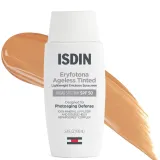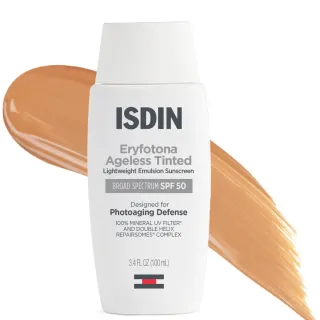
ISDIN Eryfotona Ageless Mineral Broad-Spectrum Tinted Face Sunscreen SPF 50

ISDIN Eryfotona Ageless Mineral Broad-Spectrum Tinted Face Sunscreen SPF 50

SPF 50Efficacy60/100IrritancyMedium·2 UV filters
Edit

Works for

2 of 3 advertised claims delivered

Sun protection
SPF 50 · 2 UV filters · Partial spectrum
Weak protection
SPF 50Partial spectrumChemical filtersTinted

This product does not offer good protection against UVA rays.

This product can be considered "reef safe" because it does not contain the UV filters (oxybenzone and octinoxate) that can be harmful to coral reefs when present in the water in high concentrations.

UV spectrum
UVB290–320 nmUVA II320–340 nmUVA I340–400 nm
Butyloctyl Salicylate
Titanium Dioxide
FilterCoverageWhat it doesEst. amount
Butyloctyl SalicylateUVBA synthetic ester of salicylic acid that is used to help disperse pigments and boost effectiveness of sunscreen ingredients. It is able to absorb UV light (working as an organic, or chemical filter), but is not approved as a sunscreen ingredient on its own~0.5–0.75%
Titanium Dioxide Mineral UVBUVA2 Photo-stable Works as a UV filter when used in high concentrations. It is photostable and is effective mostly against the UVB light, with some protection in the UVA range. In small concentrations, used for its ability to improve the color of cosmetic products. Is usually well tolerated by the skin16.1%
~ marks concentrations estimated from label position and typical use levels
Reef-safe
No oxybenzone or octinoxate — the two filters banned in Hawaii, Florida Keys and Aruba.
Moisturizing
Palmitoyl tripeptide-38, Dimethicone + 14 more
Strong evidence
What the product description says
“This unique product helps repair existing sun damage and support skin longevity, with all-day hydration.”
Source: Dermstore

This product can help improve hydration of the skin with the two types of ingredients.

The first type is called “humectants”:
these ingredients help attract water. When humectants are on the surface of the skin, they “pull in” the moisture from the outside environment, or from within deeper layers of the skin. The following ingredients in this product do the job: glycerin, sodium hyaluronate.

This product also contains ingredients called “occlusives”. They help reduce the speed with which our skin loses moisture to the outside environment. These ingredients also help soften the upper layer of the skin, so it feels less tight and nicer to the touch. The following ingredients in this product do the job: caprylic/capric triglyceride, dimethicone.

The following ingredients in this product are especially good for supporting the skin barrier and helping with the hydration level: palmitoyl tripeptide-38

DimethiconeKey active· Emollient, OcclusiveEffect: HighA silicone that helps to reduce water loss from the surface of the skin. Can temporarily "fill in" lines and wrinkles, absorb oil, and create a nice product finish~5.9–7.2%
GlycerinKey active· HumectantEffect: HighOne of the best moisturizing ingredients. Naturally present in skin. It attracts water to the upper layer of the skin working as a humectant~0.6–0.9%
Palmitoyl tripeptide-38HeroEffect: HighA type of peptide. Peptides are excellent moisturizers and might be able support collagen production reducing fine lines and wrinkles~0.05–0.1%
Peg-10 dimethiconeKey active· Emollient, OcclusiveEffect: HighA silicone that works to soften the upper layer of the skin and reduce its water loss~0.35–0.6%
Polyglyceryl-2 dipolyhydroxystearateKey activeEffect: HighHelps to soften the upper layer of the skin~1–1.2%
Sodium hyaluronateKey active· HumectantEffect: HighOne of the best moisturizing ingredients. Attracts water into the upper layer of the skin~0.25–0.45%
Caprylic/capric triglycerideKey active· Emollient, OcclusiveEffect: HighA good mix of fatty acids that forms a protective layer on the skin. Improves the shelf life of products. Derived from coconut and glycerin~0.7–1.05%
Plankton extractKey activeEffect: MediumCan help attract water to the upper layer of the skin~0.15–0.3%
C15-19 alkaneEffect: LowHelps soften the upper layer of the skin and create a nice product texture~3.6–4.4%
Dibutyl adipate· EmollientEffect: LowHelps soften the upper layer of the skin and create a nice product consistency~1.8–2.2%
Caprylyl glycol· Humectant, EmollientEffect: LowHelps preserve products and creates a nice product texture~0.45–0.65%
Dicaprylyl carbonate· EmollientEffect: LowHelps products spread more easily and works as an emollient to soften skin~2.6–3.1%
Hydroxypropyl cyclodextrin· EmollientEffect: LowUsed to stabilize product formulations and help soften the upper layer of the skin~0.25–0.5%
Propylene carbonateEffect: LowIs used to dissolve other ingredients and create nice product texture~0.25–0.5%
LecithinEffect: Low, below effective doseUsed mostly for creating emulsions - helping oil and water mix together. Helps soften the upper layer of the skin~0.25–0.45%
TocopherolEffect: Low, below effective dosePure form of vitamin E. Can help moisturise and protect the skin from free radicals. Often used to help stabilise other ingredients or the formula itself~0.05–0.15%
Anti-aging
Bakuchiol, Palmitoyl tripeptide-38 + 1 more
Strong evidence
What the product description says
“Repairs - Addresses previous sun damage in the skin to help reduce the appearance of fine lines and wrinkles.”
Source: Dermstore

This product can help reduce and prevent fine lines and wrinkles, improve skin elasticity and firmness because it contains bakuchiol.

These ingredients in the product can also be helpful, even though there is less evidence for their effectiveness: palmitoyl tripeptide-38.

Keep in mind that it typically takes at least 6 weeks to notice any results because the changes that are needed to improve fine lines and elasticity happen in the deeper layers of the skin. No topical anti-aging product can “erase” wrinkles or fully reverse signs of aging.

BakuchiolKey activeEffect: HighA plant extract that is, though different in chemical structure, acts similar to retinoids. First studies show that it can help reduce fine lines and wrinkles, improve skin tone, reduce clogged pores and blemishes, and reduce inflammation. There is no conclusive evidence that bakuchiol is as effective as retinol however. The study that directly compared retinol with bakuchiol used bakuchiol applied twice daily compared to once per day for the retinol. According to this study, bakuchiol is less irritating than retinol. Bakuchiol is extracted from seeds of Babchi plant. Other parts of the plant contain coumarins that could cause allergic and irritant reactions. These compounds should be removed in the extraction process when bakuchiol is produced, but it is a good idea to be cautious and stay away from products that include the Babchi plant extracts other than purified bakuchiol to avoid irritation~0.45–0.7%
Palmitoyl tripeptide-38Key activeEffect: MediumA type of peptide. Peptides are excellent moisturizers and might be able support collagen production reducing fine lines and wrinkles~0.05–0.1%
TocopherolEffect: Low, below effective dosePure form of vitamin E. Can help moisturise and protect the skin from free radicals. Often used to help stabilise other ingredients or the formula itself~0.05–0.15%
Evens skin tone
Not advertised by the brand · Bakuchiol
Strong evidence

This product can help reduce hypepigmentation and even out the skin tone because it contains the following effective ingredients: bakuchiol

Keep in mind that you would need to apply any topical skincare targetted at hypigmentation consistently for a couple of months to get a result. No topical skincare product can help get rid of hyperpigmentation (including post-acne marks and age spots) instantly.

This product can also help with skin tone because it offers sun protection. Sun damage is the main factor causing age spots, darkening of post-acne marks and other discolorations. This is why sun protection is the best strategy for maintaining an even skin tone. We, however, do not recommend using this product as a sunscreen because the protection it offers is not strong enough).

BakuchiolKey activeEffect: HighA plant extract that is, though different in chemical structure, acts similar to retinoids. First studies show that it can help reduce fine lines and wrinkles, improve skin tone, reduce clogged pores and blemishes, and reduce inflammation. There is no conclusive evidence that bakuchiol is as effective as retinol however. The study that directly compared retinol with bakuchiol used bakuchiol applied twice daily compared to once per day for the retinol. According to this study, bakuchiol is less irritating than retinol. Bakuchiol is extracted from seeds of Babchi plant. Other parts of the plant contain coumarins that could cause allergic and irritant reactions. These compounds should be removed in the extraction process when bakuchiol is produced, but it is a good idea to be cautious and stay away from products that include the Babchi plant extracts other than purified bakuchiol to avoid irritation~0.45–0.7%
Anti-oxidation
Not advertised by the brand · Bakuchiol, Tocopheryl acetate + 1 more
Strong evidence

This product contains antioxidants (bakuchiol) that can help neutralize free radicals in skin. By doing so, they can lessen the damage the skin gets from the UV light (sun).

BakuchiolKey activeEffect: HighA plant extract that is, though different in chemical structure, acts similar to retinoids. First studies show that it can help reduce fine lines and wrinkles, improve skin tone, reduce clogged pores and blemishes, and reduce inflammation. There is no conclusive evidence that bakuchiol is as effective as retinol however. The study that directly compared retinol with bakuchiol used bakuchiol applied twice daily compared to once per day for the retinol. According to this study, bakuchiol is less irritating than retinol. Bakuchiol is extracted from seeds of Babchi plant. Other parts of the plant contain coumarins that could cause allergic and irritant reactions. These compounds should be removed in the extraction process when bakuchiol is produced, but it is a good idea to be cautious and stay away from products that include the Babchi plant extracts other than purified bakuchiol to avoid irritation~0.45–0.7%
TocopherolUnder-dosedEffect: HighPure form of vitamin E. Can help moisturise and protect the skin from free radicals. Often used to help stabilise other ingredients or the formula itself~0.05–0.15%
Tocopheryl acetateEffect: Low, below effective doseA more stable but less bio-available form of vitamin E compared to Tocopherol. Might help moisturize and protect the skin from free radicals, but mostly used in low concentrations to stabilize other ingredients.~0.3–0.55%
Anti-blemish
Not advertised by the brand · Bakuchiol
Good evidence

This product might be able to help reduce blemishes and clogged pores because it contains bakuchiol.

BakuchiolKey activeEffect: HighA plant extract that is, though different in chemical structure, acts similar to retinoids. First studies show that it can help reduce fine lines and wrinkles, improve skin tone, reduce clogged pores and blemishes, and reduce inflammation. There is no conclusive evidence that bakuchiol is as effective as retinol however. The study that directly compared retinol with bakuchiol used bakuchiol applied twice daily compared to once per day for the retinol. According to this study, bakuchiol is less irritating than retinol. Bakuchiol is extracted from seeds of Babchi plant. Other parts of the plant contain coumarins that could cause allergic and irritant reactions. These compounds should be removed in the extraction process when bakuchiol is produced, but it is a good idea to be cautious and stay away from products that include the Babchi plant extracts other than purified bakuchiol to avoid irritation~0.45–0.7%

Can it cause trouble?

Irritancy
1 strong irritant: Parfum
Medium risk
We flagged 14 ingredients with irritancy potential. Severity depends on your sensitivity threshold; the table lists the worst offenders first.
IngredientFunctionIrritationEst. amount
Alcohol denat.Produces temporary toning effect. Can help dissolve other ingredients or preserve productsHigh~1.5–1.8%est.
ParfumAn aromatic blend of unspecified and possibly irritating ingredientsHigh~0.25–0.5%est.
Phenethyl alcoholA fragrance. Can be irritatingHigh~0.1–0.2%est.
Peg-30 dipolyhydroxystearateHelps oil and water mix togetherMedium~1.3–1.5%est.
Caprylic/capric triglycerideA good mix of fatty acids that forms a protective layer on the skin. Improves the shelf life of products. Derived from coconut and glycerinMedium~0.7–1.05%est.
Butyloctyl salicylateA synthetic ester of salicylic acid that is used to help disperse pigments and boost effectiveness of sunscreen ingredients. It is able to absorb UV light (working as an organic, or chemical filter), but is not approved as a sunscreen ingredient on its ownMedium~0.5–0.75%est.
Vp/eicosene copolymerUsed to improve the product adherence to the skin, for example, to pro-long the protective effect of sunscreens. Can be irritating to very sensitive skinMedium~0.5–0.75%est.
1,2-hexanediolA preservativeMedium~0.45–0.65%est.
BakuchiolA plant extract that is, though different in chemical structure, acts similar to retinoids. First studies show that it can help reduce fine lines and wrinkles, improve skin tone, reduce clogged pores and blemishes, and reduce inflammation. There is no conclusive evidence that bakuchiol is as effective as retinol however. The study that directly compared retinol with bakuchiol used bakuchiol applied twice daily compared to once per day for the retinol. According to this study, bakuchiol is less irritating than retinol. Bakuchiol is extracted from seeds of Babchi plant. Other parts of the plant contain coumarins that could cause allergic and irritant reactions. These compounds should be removed in the extraction process when bakuchiol is produced, but it is a good idea to be cautious and stay away from products that include the Babchi plant extracts other than purified bakuchiol to avoid irritationMedium~0.45–0.7%est.
Caprylyl glycolHelps preserve products and creates a nice product textureMedium~0.45–0.65%est.
Tocopheryl acetateA more stable but less bio-available form of vitamin E compared to Tocopherol. Might help moisturize and protect the skin from free radicals, but mostly used in low concentrations to stabilize other ingredients.Medium~0.3–0.55%est.
Hydroxypropyl cyclodextrinUsed to stabilize product formulations and help soften the upper layer of the skinMedium~0.25–0.5%est.
Plankton extractCan help attract water to the upper layer of the skinMedium~0.15–0.3%est.
HydroxyacetophenoneUsed to increase effectiveness of preservativesMedium~0.1–0.25%est.
Comedogenic
1 ingredient rated 2 or more on the 0–5 pore-clogging scale
1 flagged
These ingredients have a comedogenic rating of 2 or more on a 0–5 scale; the table shows each one's rating. In leave-on products they can clog pores in acne-prone skin.
IngredientFunctionRatingEst. amount
Plankton extractCan help attract water to the upper layer of the skin3/5~0.15–0.3%est.
Edit

User reviews

Would you recommend?
No community reviews yet.

Be the first — your take helps the next person decide.

Write a review · ~30s

Ingredients

Filter by role to see what each ingredient is doing.

Titanium dioxide16.1%
UV filterKey active
Irritation risk
Low
Works for
Sun protection

Works as a UV filter when used in high concentrations. It is photostable and is effective mostly against the UVB light, with some protection in the UVA range. In small concentrations, used for its ability to improve the color of cosmetic products. Is usually well tolerated by the skin

More about Titanium dioxide
Water~45–55%
Formula
Irritation risk
Low

Plain old water

More about Water
Propylene glycol dicaprylate/dicaprate~5.6–6.8%
Formula
Dimethicone~5.9–7.2%
Key active
Irritation risk
Low
Works for
MoisturizingMattifying

A silicone that helps to reduce water loss from the surface of the skin. Can temporarily "fill in" lines and wrinkles, absorb oil, and create a nice product finish

More about Dimethicone
C15-19 alkane~3.6–4.4%
Formula
Irritation risk
Low
Works for
Moisturizing

Helps soften the upper layer of the skin and create a nice product texture

More about C15-19 alkane
Dicaprylyl carbonate~2.6–3.1%
Formula
Irritation risk
Low
Works for
Moisturizing

Helps products spread more easily and works as an emollient to soften skin

More about Dicaprylyl carbonate
Silica~2.1–2.6%
Formula
Irritation risk
Low

Used to absorb oil and can temporarily mattify skin

More about Silica
Dibutyl adipate~1.8–2.2%
Formula
Irritation risk
Low
Works for
Moisturizing

Helps soften the upper layer of the skin and create a nice product consistency

More about Dibutyl adipate
Alcohol denat.~1.5–1.8%
Irritant · high
Irritation risk
High

Produces temporary toning effect. Can help dissolve other ingredients or preserve products

More about Alcohol denat.
Peg-30 dipolyhydroxystearate~1.3–1.5%
Irritant · medium
Irritation risk
Medium
Works for
Cleansing

Helps oil and water mix together

More about Peg-30 dipolyhydroxystearate
Polyglyceryl-2 dipolyhydroxystearate~1–1.2%
Key active
Irritation risk
Low
Works for
Moisturizing

Helps to soften the upper layer of the skin

More about Polyglyceryl-2 dipolyhydroxystearate
Iron oxides~0.75–1.1%
Formula
Irritation risk
Low
Works for
Sun protection

An umbrella term for the following three colorants: CI 77491, CI 77492, CI 77499. They might be able to offer some protection against visible light, but the degree of the protection is not clear

More about Iron oxides
Caprylic/capric triglyceride~0.7–1.05%
Key activeIrritant · medium
Irritation risk
Medium
Works for
Moisturizing

A good mix of fatty acids that forms a protective layer on the skin. Improves the shelf life of products. Derived from coconut and glycerin

More about Caprylic/capric triglyceride
Glycerin~0.6–0.9%
Key active
Irritation risk
Low
Works for
Moisturizing

One of the best moisturizing ingredients. Naturally present in skin. It attracts water to the upper layer of the skin working as a humectant

More about Glycerin
Butyloctyl salicylate~0.5–0.75%
UV filterKey activeIrritant · medium
Irritation risk
Medium
Works for
Sun protection

A synthetic ester of salicylic acid that is used to help disperse pigments and boost effectiveness of sunscreen ingredients. It is able to absorb UV light (working as an organic, or chemical filter), but is not approved as a sunscreen ingredient on its own

More about Butyloctyl salicylate
Magnesium sulfate~0.5–0.75%
Formula
Irritation risk
Low

Used to create a thicker product consistency

More about Magnesium sulfate
Vp/eicosene copolymer~0.5–0.75%
Irritant · medium
Irritation risk
Medium
Works for
Sun protection

Used to improve the product adherence to the skin, for example, to pro-long the protective effect of sunscreens. Can be irritating to very sensitive skin

More about Vp/eicosene copolymer
1,2-hexanediol~0.45–0.65%
Irritant · medium
Irritation risk
Medium

A preservative

More about 1,2-hexanediol
Bakuchiol~0.45–0.7%
Key activeIrritant · medium
Irritation risk
Medium
Works for
Anti-oxidationAnti-agingEvens skin toneAnti-blemishAnti-inflammatory

A plant extract that is, though different in chemical structure, acts similar to retinoids. First studies show that it can help reduce fine lines and wrinkles, improve skin tone, reduce clogged pores and blemishes, and reduce inflammation. There is no conclusive evidence that bakuchiol is as effective as retinol however. The study that directly compared retinol with bakuchiol used bakuchiol applied twice daily compared to once per day for the retinol. According to this study, bakuchiol is less irritating than retinol. Bakuchiol is extracted from seeds of Babchi plant. Other parts of the plant contain coumarins that could cause allergic and irritant reactions. These compounds should be removed in the extraction process when bakuchiol is produced, but it is a good idea to be cautious and stay away from products that include the Babchi plant extracts other than purified bakuchiol to avoid irritation

More about Bakuchiol
Caprylyl glycol~0.45–0.65%
Irritant · medium
Irritation risk
Medium
Works for
Moisturizing

Helps preserve products and creates a nice product texture

More about Caprylyl glycol
Parfum~0.25–0.5%
Irritant · high
Irritation risk
High

An aromatic blend of unspecified and possibly irritating ingredients

More about Parfum
Disteardimonium hectorite~0.3–0.55%
Formula
Irritation risk
Low

A type of clay that is used to thicken the product consistency

More about Disteardimonium hectorite
Tocopheryl acetate~0.3–0.55%
Irritant · medium
Irritation risk
Medium
Works for
Anti-oxidation

A more stable but less bio-available form of vitamin E compared to Tocopherol. Might help moisturize and protect the skin from free radicals, but mostly used in low concentrations to stabilize other ingredients.

More about Tocopheryl acetate
Dimethicone/vinyl dimethicone crosspolymer~0.25–0.45%
Formula
Irritation risk
Low

Used to stabilize product formulations and create a nice product texture

More about Dimethicone/vinyl dimethicone crosspolymer
Sodium hyaluronate~0.25–0.45%
Key active
Irritation risk
Low
Works for
Moisturizing

One of the best moisturizing ingredients. Attracts water into the upper layer of the skin

More about Sodium hyaluronate
Propylene carbonate~0.25–0.5%
Formula
Irritation risk
Low
Works for
Moisturizing

Is used to dissolve other ingredients and create nice product texture

More about Propylene carbonate
Peg-10 dimethicone~0.35–0.6%
Key active
Irritation risk
Low
Works for
Moisturizing

A silicone that works to soften the upper layer of the skin and reduce its water loss

More about Peg-10 dimethicone
Tetrasodium glutamate diacetate~0.2–0.4%
Formula
Irritation risk
Low

Helps stabilize the product formulation

More about Tetrasodium glutamate diacetate
Triethoxycaprylylsilane~0.2–0.35%
Formula
Irritation risk
Low

A type of silicone that helps oil and water mix well together. Helps to disperse other ingredients, e.g. pigments, evenly in a formulation

More about Triethoxycaprylylsilane
Hydroxypropyl cyclodextrin~0.25–0.5%
Irritant · medium
Irritation risk
Medium
Works for
Moisturizing

Used to stabilize product formulations and help soften the upper layer of the skin

More about Hydroxypropyl cyclodextrin
Lecithin~0.25–0.45%
Formula
Irritation risk
Low
Works for
CleansingMoisturizing

Used mostly for creating emulsions - helping oil and water mix together. Helps soften the upper layer of the skin

More about Lecithin
Plankton extract~0.15–0.3%
Key activeComedogenic 3/5Irritant · medium
Irritation risk
Medium
Comedogenicity
3/5
Works for
Moisturizing

Can help attract water to the upper layer of the skin

More about Plankton extract
Hydroxyacetophenone~0.1–0.25%
Irritant · medium
Irritation risk
Medium

Used to increase effectiveness of preservatives

More about Hydroxyacetophenone
Phenethyl alcohol~0.1–0.2%
Irritant · high
Irritation risk
High

A fragrance. Can be irritating

More about Phenethyl alcohol
Tocopherol~0.05–0.15%
Under-dosed
Irritation risk
Low
Works for
Anti-oxidationAnti-agingAnti-inflammatoryMoisturizing

Pure form of vitamin E. Can help moisturise and protect the skin from free radicals. Often used to help stabilise other ingredients or the formula itself

More about Tocopherol
Palmitoyl tripeptide-38~0.05–0.1%
Hero · Moisturizing
Irritation risk
Low
Works for
MoisturizingAnti-aging

A type of peptide. Peptides are excellent moisturizers and might be able support collagen production reducing fine lines and wrinkles

More about Palmitoyl tripeptide-38
Ingredient list view

Titanium dioxide, Water, Propylene glycol dicaprylate/dicaprate, Dimethicone, C15-19 alkane, Dicaprylyl carbonate, Silica, Dibutyl adipate, Alcohol denat., Peg-30 dipolyhydroxystearate, Polyglyceryl-2 dipolyhydroxystearate, Iron oxides, Caprylic/capric triglyceride, Glycerin, Butyloctyl salicylate, Magnesium sulfate, Vp/eicosene copolymer, 1,2-hexanediol, Bakuchiol, Caprylyl glycol, Parfum, Disteardimonium hectorite, Tocopheryl acetate, Dimethicone/vinyl dimethicone crosspolymer, Sodium hyaluronate, Propylene carbonate, Peg-10 dimethicone, Tetrasodium glutamate diacetate, Triethoxycaprylylsilane, Hydroxypropyl cyclodextrin, Lecithin, Plankton extract, Hydroxyacetophenone, Phenethyl alcohol, Tocopherol, Palmitoyl tripeptide-38

Compare prices

Retailers ranked by price — lowest first.

Dermstore
$50.00
Buy
Dermstore
$78.00
Buy

Affiliate links · prices updated regularly

Worth comparing, line by line.

Match % combines shared ingredients, the first five ingredients, shared actives and hero ingredients, irritancy (lower counts in the alternative's favour), texture and body area. Only products in the same routine step are compared.

Side-by-side comparison of this product against its closest alternatives
ISDINEryfotona Ageless Mineral Broad-Spectrum Tinted Face Sunscreen SPF 50YOUR PRODUCTKri SkincareSPF30 Mineral SunscreenNiveaCellular Lift Day spf 30 with BakuchiolSupergoop!Daily Dose Bioretinol + Mineral SPF 40 with Bakuchiol
Match—66%65%60%
Price$50.00$10.69−$39.31——
Shared key ingredients—1 of 103 of 104 of 10
Key difference—Zinc OxideAvobenzoneCamellia Sinensis Leaf Extract
Irritancy Medium Low Medium Low
SPFSPF 50SPF 30SPF 30SPF 40
Drying alcohol Contains drying alcohol ———
View product Shop Shop Shop
Cheaper alternatives? See how this stacks up against similar formulas.
We compare ingredient profiles across our catalog — pick the closest match for your budget.
Open dupe finder

Sources cited in this review

Every concentration estimate and effectiveness label is anchored to one of these 15 studies and safety reviews.

  1. 1
  2. 2
  3. 3
  4. 4
  5. 5
  6. 6
ISDIN Eryfotona Ageless Mineral Broad-Spectrum Tinted Face Sunscreen SPF 50
ISDINEryfotona Ageless Mineral Broad-Spectrum Tinted Face Sunscreen SPF 50

Affiliate links · As an Amazon Associate, WIMJ earns from qualifying purchases.

As an Amazon Associate, WIMJ earns from qualifying purchases.