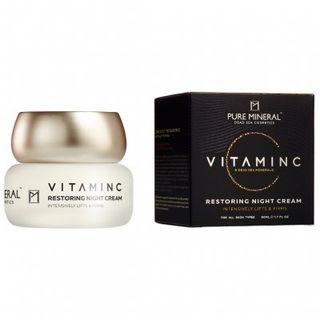
Pure Mineral Vitamin C Restoring Night cream

Pure Mineral Vitamin C Restoring Night cream

Efficacy75/100IrritancyHigh
Edit

Works for

1 of 2 advertised claims delivered

Moisturizing
18 ingredients credited for this claim
Strong support
What the product description says
“Vitamin C Restoring Night cream”
From product name

This product can help improve hydration of the skin with the two types of ingredients.

The first type is called “humectants”:
these ingredients help attract water. When humectants are on the surface of the skin, they “pull in” the moisture from the outside environment, or from within deeper layers of the skin. The following ingredients in this product do the job: sodium hyaluronate, glycine soja protein.

This product also contains ingredients called “occlusives”. They help reduce the speed with which our skin loses moisture to the outside environment. These ingredients also help soften the upper layer of the skin, so it feels less tight and nicer to the touch. The following ingredients in this product do the job: caprylic/capric triglyceride, helianthus annuus seed oil.

The following ingredients in this product are especially good for supporting the skin barrier and helping with the hydration level: panthenol

Persea gratissima oilKey activeEffect: HighAn emollient that helps soften the skin and could be helpful in repairing its barrier function~1.4–1.8%
Helianthus annuus seed oilKey activeEffect: HighA great emollient due to its high linoleic acid content. One of the most effective plant oils in helping skin hydration and repairing skin barrier function~0.2–0.4%
Isopropyl myristateKey activeEffect: HighAn emollient that helps soften the skin. Could be comedogenic~3.1–3.8%
Sodium hyaluronateKey activeEffect: HighOne of the best moisturizing ingredients. Attracts water into the upper layer of the skin~1.1–1.4%
PanthenolHeroEffect: HighHelps attract water to the upper layer of the skin and can help improve skin barrier function~0.2–0.4%
Caprylic/capric triglycerideKey activeEffect: HighA good mix of fatty acids that forms a protective layer on the skin. Improves the shelf life of products. Derived from coconut and glycerin~2–2.4%
Cetyl alcoholKey activeEffect: MediumA non-drying alcohol that works to soften the skin and stabilize product formulations helping oil and water mix together~3.6–4.4%
Glyceryl stearate seKey activeEffect: MediumUsed to stabilize the product formulations and works as an emollient~5.1–6.2%
Glycine soja proteinKey activeEffect: MediumA plant extract that helps to attract water to the upper layer of the skin and soften it. It might be helpful in neutralizing free radicals. It might be somewhat helpful for evening out the skin tone. It might be able to support elastin production but solid research is lacking~0.25–0.45%
PhospholipidsKey activeEffect: MediumEmollients that are naturaly present in skin. In addition, they help water and oil mix together in the product~0.2–0.4%
Prunus amygdalus dulcis oilKey activeEffect: MediumAn emollient that softens the skin~0.45–0.7%
CollagenKey activeEffect: MediumCannot penetrate the skin barrier so is not particularly useful in skincare products~0.8–1.15%
Caprylyl glycolEffect: LowHelps preserve products and creates a nice product texture~0.25–0.5%
Butyrospermum parkii butterUnder-dosedEffect: HighA great moisturising ingredient that softens the skin and reduces water loss from its upper layer. It also can be helpful in protecting skin from free radicals~0.7–1.05%
Ascorbyl tetraisopalmitateEffect: Low, below effective doseA vitamin C derivative. Studies show that is might be effective in reducing hyperpigmentation, but there are no studies confirming that it is effectively converted into the bioavailable form of Vitamin C in skin. It is not clear how this derivative compares in effectiveness to the topical application of bioavailable form of vitamin C (L-ascorbic acid)~0.35–0.65%
Aloe barbadensis leaf extractEffect: Low, below effective doseTraditionally used to treat sunburns, dermatitis and inflammation, but evidence for its effectiveness is lacking. The extract can contain humectants that help attract water into the skin~0.25–0.4%
TocopherolEffect: Low, below effective dosePure form of vitamin E. Can help moisturise and protect the skin from free radicals. Often used to help stabilise other ingredients or the formula itself~0.2–0.4%
Camellia sinensis leaf extractEffect: Low, below effective doseCan contain potent anti-oxidant compounds (abbreviated ECG, GCG, EGC, and EGCG) that might help protect the skin from free radicals. Can help calm down inflammation and has some anti-bacterial properties. Unfortunately, these antioxidants are unstable and lose their effectiveness very quickly in products. The concentration of the antioxidant compounds in the extract also tends to be low to be effective in topical formulation~0.4–0.6%
Anti-aging
7 ingredients credited for this claim
Limited support
What the product description says
“For all skin types Formulated with Dead Sea minerals & Vitamin C Lifts & firms This Restoring Night cream is enriched with vitamin C to restore and replenish your skin while you sleep.”
Source: Feelunique

This product does not contain ingredients that are able to reduce fine lines and wrinkles or help with skin elasticity, but it can improve the look of the skin temporarily through moisturization. Well-moisturized skin might also be able to repair the sun damage better.This ingredient - glycine soja protein - could be helpful for preventing or repairing signs of aging in theory, but there is no evidence that it actually works.

Glycine soja proteinEffect: LowA plant extract that helps to attract water to the upper layer of the skin and soften it. It might be helpful in neutralizing free radicals. It might be somewhat helpful for evening out the skin tone. It might be able to support elastin production but solid research is lacking~0.25–0.45%
Prunus amygdalus dulcis oilEffect: LowAn emollient that softens the skin~0.45–0.7%
Ascorbyl tetraisopalmitateUnder-dosedEffect: MediumA vitamin C derivative. Studies show that is might be effective in reducing hyperpigmentation, but there are no studies confirming that it is effectively converted into the bioavailable form of Vitamin C in skin. It is not clear how this derivative compares in effectiveness to the topical application of bioavailable form of vitamin C (L-ascorbic acid)~0.35–0.65%
Retinyl palmitateUnder-dosedEffect: MediumThree steps removed from the active form of vitamin A - retinoic acid. To have an effect in the skin, it first needs to be converted twice to become the retinoic acid. This means it is less potent than retinol, but could also be less irritating. Once converted to the retinoic acid in the skin, it helps against all signs of aging, improves skin cell turnover and helps fight blemishes and clogged pores. However, in many cosmetic formulations, it is used in a concentration that is too low to have the full effect~0.1–0.2%
Butyrospermum parkii butterEffect: Low, below effective doseA great moisturising ingredient that softens the skin and reduces water loss from its upper layer. It also can be helpful in protecting skin from free radicals~0.7–1.05%
Camellia sinensis leaf extractEffect: Low, below effective doseCan contain potent anti-oxidant compounds (abbreviated ECG, GCG, EGC, and EGCG) that might help protect the skin from free radicals. Can help calm down inflammation and has some anti-bacterial properties. Unfortunately, these antioxidants are unstable and lose their effectiveness very quickly in products. The concentration of the antioxidant compounds in the extract also tends to be low to be effective in topical formulation~0.4–0.6%
TocopherolEffect: Low, below effective dosePure form of vitamin E. Can help moisturise and protect the skin from free radicals. Often used to help stabilise other ingredients or the formula itself~0.2–0.4%

Can it cause trouble?

Irritancy
3 strong irritants: Parfum, Retinyl palmitate + 1 more — patch-test recommended
High risk
We flagged 16 ingredients with irritancy potential. Severity depends on your sensitivity threshold; the table lists the worst offenders first.
IngredientFunctionIrritationEst. amount
Benzyl alcoholA preservative. Can be used to mask unpleasant smell. Can be irritatingHigh~0.2–0.4%est.
ParfumAn aromatic blend of unspecified and possibly irritating ingredientsHigh~0.2–0.35%est.
Chamomilla recutita flower extractPlant extract that can have healing and anti-inflammatory properties. It is a potential allergen and can be irritatingHigh~0.15–0.25%est.
Retinyl palmitateThree steps removed from the active form of vitamin A - retinoic acid. To have an effect in the skin, it first needs to be converted twice to become the retinoic acid. This means it is less potent than retinol, but could also be less irritating. Once converted to the retinoic acid in the skin, it helps against all signs of aging, improves skin cell turnover and helps fight blemishes and clogged pores. However, in many cosmetic formulations, it is used in a concentration that is too low to have the full effectHigh~0.1–0.2%est.
Citrus limon fruit extractUsed as a fragrance. Can be irritating and cause photosensitivityHigh~0.05–0.1%est.
Caprylic/capric triglycerideA good mix of fatty acids that forms a protective layer on the skin. Improves the shelf life of products. Derived from coconut and glycerinMedium~2–2.4%est.
Persea gratissima oilAn emollient that helps soften the skin and could be helpful in repairing its barrier functionMedium~1.4–1.8%est.
Cucumis sativus extract—Medium~0.45–0.7%est.
Ascorbyl tetraisopalmitateA vitamin C derivative. Studies show that is might be effective in reducing hyperpigmentation, but there are no studies confirming that it is effectively converted into the bioavailable form of Vitamin C in skin. It is not clear how this derivative compares in effectiveness to the topical application of bioavailable form of vitamin C (L-ascorbic acid)Medium~0.35–0.65%est.
Benzoic acidA preservativeMedium~0.25–0.5%est.
Sorbic acidA preservativeMedium~0.3–0.5%est.
Dehydroacetic acidA preservativeMedium~0.25–0.45%est.
Caprylyl glycolHelps preserve products and creates a nice product textureMedium~0.25–0.5%est.
Maris salUsed to thicken the product formulation and might help to add minerals to the surface of the skin. It is used in scrubs as a physical exfoliant. Can increase sensitivity to other ingredients if left on the skin or used in high concentrationMedium~0.2–0.4%est.
Potassium sorbateA preservativeMedium~0.25–0.4%est.
Aloe barbadensis leaf extractTraditionally used to treat sunburns, dermatitis and inflammation, but evidence for its effectiveness is lacking. The extract can contain humectants that help attract water into the skinMedium~0.25–0.4%est.
Comedogenic
3 ingredients rated 2 or more on the 0–5 pore-clogging scale
3 flagged
These ingredients have a comedogenic rating of 2 or more on a 0–5 scale; the table shows each one's rating. In leave-on products they can clog pores in acne-prone skin.
IngredientFunctionRatingEst. amount
Isopropyl myristateAn emollient that helps soften the skin. Could be comedogenic3/5~3.1–3.8%est.
Butyrospermum parkii butterA great moisturising ingredient that softens the skin and reduces water loss from its upper layer. It also can be helpful in protecting skin from free radicals3/5~0.7–1.05%est.
Glyceryl stearate seUsed to stabilize the product formulations and works as an emollient2/5~5.1–6.2%est.
Edit

User reviews

Would you recommend?
No community reviews yet.

Be the first — your take helps the next person decide.

Write a review · ~30s

Ingredients

Filter by role to see what each ingredient is doing.

Water~45–55%
Formula
Irritation risk
Low

Plain old water

More about Water
Glyceryl stearate se~5.1–6.2%
Key activeComedogenic 2/5
Irritation risk
Low
Comedogenicity
2/5
Works for
CleansingMoisturizing

Used to stabilize the product formulations and works as an emollient

More about Glyceryl stearate se
Cetyl alcohol~3.6–4.4%
Key active
Irritation risk
Low
Works for
CleansingMoisturizing

A non-drying alcohol that works to soften the skin and stabilize product formulations helping oil and water mix together

More about Cetyl alcohol
Isopropyl myristate~3.1–3.8%
Key activeComedogenic 3/5
Irritation risk
Low
Comedogenicity
3/5
Works for
Moisturizing

An emollient that helps soften the skin. Could be comedogenic

More about Isopropyl myristate
Kaolin~2.4–3%
Formula
Irritation risk
Low
Works for
MattifyingAnti-blemish

A type of clay that consists mainly of aluminum silicate. Helps absorb oil and creates a thicker product consistency. Can be used to add a white color

More about Kaolin
Caprylic/capric triglyceride~2–2.4%
Key activeIrritant · medium
Irritation risk
Medium
Works for
Moisturizing

A good mix of fatty acids that forms a protective layer on the skin. Improves the shelf life of products. Derived from coconut and glycerin

More about Caprylic/capric triglyceride
Olive oil polyglyceryl-6 esters~1.6–2%
Formula
Irritation risk
Low
Works for
Cleansing
More about Olive oil polyglyceryl-6 esters
Persea gratissima oil~1.4–1.8%
Key activeIrritant · medium
Irritation risk
Medium
Works for
Moisturizing

An emollient that helps soften the skin and could be helpful in repairing its barrier function

More about Persea gratissima oil
Sodium hyaluronate~1.1–1.4%
Key active
Irritation risk
Low
Works for
Moisturizing

One of the best moisturizing ingredients. Attracts water into the upper layer of the skin

More about Sodium hyaluronate
Hydrogenated
Not recognized
Collagen~0.8–1.15%
Key active
Irritation risk
Low
Works for
Moisturizing

Cannot penetrate the skin barrier so is not particularly useful in skincare products

More about Collagen
Butyrospermum parkii butter~0.7–1.05%
Under-dosedComedogenic 3/5
Irritation risk
Low
Comedogenicity
3/5
Works for
MoisturizingAnti-oxidationAnti-aging

A great moisturising ingredient that softens the skin and reduces water loss from its upper layer. It also can be helpful in protecting skin from free radicals

More about Butyrospermum parkii butter
Isopentyldiol~0.55–0.8%
Formula
Irritation risk
Low

Helps dissolve other ingredients in a formulation

More about Isopentyldiol
Pelargonium extract
Not recognized
Cucumis sativus extract~0.45–0.7%
Irritant · medium
Prunus amygdalus dulcis oil~0.45–0.7%
Key active
Irritation risk
Low
Works for
MoisturizingAnti-oxidationAnti-aging

An emollient that softens the skin

More about Prunus amygdalus dulcis oil
Camellia sinensis leaf extract~0.4–0.6%
Formula
Irritation risk
Low
Works for
AntibacterialAnti-oxidationAnti-agingAnti-blemishMoisturizingEvens skin tone

Can contain potent anti-oxidant compounds (abbreviated ECG, GCG, EGC, and EGCG) that might help protect the skin from free radicals. Can help calm down inflammation and has some anti-bacterial properties. Unfortunately, these antioxidants are unstable and lose their effectiveness very quickly in products. The concentration of the antioxidant compounds in the extract also tends to be low to be effective in topical formulation

More about Camellia sinensis leaf extract
Carbomer~0.35–0.65%
Formula
Irritation risk
Low
Works for
Cleansing

Helps create a thicker or gel-like product texture. It is not a surfactant but can be used in gentle cleansing formulations

More about Carbomer
Ascorbyl tetraisopalmitate~0.35–0.65%
Under-dosedIrritant · medium
Irritation risk
Medium
Works for
Anti-oxidationEvens skin toneAnti-agingMoisturizing

A vitamin C derivative. Studies show that is might be effective in reducing hyperpigmentation, but there are no studies confirming that it is effectively converted into the bioavailable form of Vitamin C in skin. It is not clear how this derivative compares in effectiveness to the topical application of bioavailable form of vitamin C (L-ascorbic acid)

More about Ascorbyl tetraisopalmitate
Benzoic acid~0.25–0.5%
Irritant · medium
Irritation risk
Medium

A preservative

More about Benzoic acid
Sorbic acid~0.3–0.5%
Irritant · medium
Irritation risk
Medium

A preservative

More about Sorbic acid
Dehydroacetic acid~0.25–0.45%
Irritant · medium
Irritation risk
Medium

A preservative

More about Dehydroacetic acid
Caprylyl glycol~0.25–0.5%
Irritant · medium
Irritation risk
Medium
Works for
Moisturizing

Helps preserve products and creates a nice product texture

More about Caprylyl glycol
Benzyl alcohol~0.2–0.4%
Irritant · high
Irritation risk
High

A preservative. Can be used to mask unpleasant smell. Can be irritating

More about Benzyl alcohol
Maris sal~0.2–0.4%
Irritant · medium
Irritation risk
Medium
Works for
Exfoliation

Used to thicken the product formulation and might help to add minerals to the surface of the skin. It is used in scrubs as a physical exfoliant. Can increase sensitivity to other ingredients if left on the skin or used in high concentration

More about Maris sal
Hydrogenated
Not recognized
Glycine soja protein~0.25–0.45%
Key active
Irritation risk
Low
Works for
CleansingMoisturizingEvens skin toneAnti-agingAnti-oxidation

A plant extract that helps to attract water to the upper layer of the skin and soften it. It might be helpful in neutralizing free radicals. It might be somewhat helpful for evening out the skin tone. It might be able to support elastin production but solid research is lacking

More about Glycine soja protein
Xanthan gum~0.2–0.4%
Formula
Irritation risk
Low
Works for
Cleansing

Used to create a thicker product consistency

More about Xanthan gum
Panthenol~0.2–0.4%
Hero · Moisturizing
Irritation risk
Low
Works for
Reduces rednessMoisturizingReduces irritation

Helps attract water to the upper layer of the skin and can help improve skin barrier function

More about Panthenol
Potassium sorbate~0.25–0.4%
Irritant · medium
Irritation risk
Medium

A preservative

More about Potassium sorbate
Tocopherol~0.2–0.4%
Formula
Irritation risk
Low
Works for
Anti-oxidationAnti-agingAnti-inflammatoryMoisturizing

Pure form of vitamin E. Can help moisturise and protect the skin from free radicals. Often used to help stabilise other ingredients or the formula itself

More about Tocopherol
Parfum~0.2–0.35%
Irritant · high
Irritation risk
High

An aromatic blend of unspecified and possibly irritating ingredients

More about Parfum
Phospholipids~0.2–0.4%
Key active
Irritation risk
Low
Works for
Moisturizing

Emollients that are naturaly present in skin. In addition, they help water and oil mix together in the product

More about Phospholipids
Helianthus annuus seed oil~0.2–0.4%
Key active
Irritation risk
Low
Works for
Moisturizing

A great emollient due to its high linoleic acid content. One of the most effective plant oils in helping skin hydration and repairing skin barrier function

More about Helianthus annuus seed oil
Aloe barbadensis leaf extract~0.25–0.4%
Irritant · medium
Irritation risk
Medium
Works for
Moisturizing

Traditionally used to treat sunburns, dermatitis and inflammation, but evidence for its effectiveness is lacking. The extract can contain humectants that help attract water into the skin

More about Aloe barbadensis leaf extract
Chamomilla recutita flower extract~0.15–0.25%
Irritant · high
Irritation risk
High
Works for
Anti-inflammatory

Plant extract that can have healing and anti-inflammatory properties. It is a potential allergen and can be irritating

More about Chamomilla recutita flower extract
Retinyl palmitate~0.1–0.2%
Under-dosedIrritant · high
Irritation risk
High
Works for
Anti-agingAnti-blemishEvens skin toneExfoliation

Three steps removed from the active form of vitamin A - retinoic acid. To have an effect in the skin, it first needs to be converted twice to become the retinoic acid. This means it is less potent than retinol, but could also be less irritating. Once converted to the retinoic acid in the skin, it helps against all signs of aging, improves skin cell turnover and helps fight blemishes and clogged pores. However, in many cosmetic formulations, it is used in a concentration that is too low to have the full effect

More about Retinyl palmitate
Titanium dioxide~0.1–0.2%
Formula
Irritation risk
Low
Works for
Sun protection

Works as a UV filter when used in high concentrations. It is photostable and is effective mostly against the UVB light, with some protection in the UVA range. In small concentrations, used for its ability to improve the color of cosmetic products. Is usually well tolerated by the skin

More about Titanium dioxide
Maris sal~0.1–0.15%
Irritant · medium
Irritation risk
Medium
Works for
Exfoliation

Used to thicken the product formulation and might help to add minerals to the surface of the skin. It is used in scrubs as a physical exfoliant. Can increase sensitivity to other ingredients if left on the skin or used in high concentration

More about Maris sal
Citrus limon fruit extract~0.05–0.1%
Irritant · high
Irritation risk
High

Used as a fragrance. Can be irritating and cause photosensitivity

More about Citrus limon fruit extract
Ingredient list view

Water, Glyceryl stearate se, Cetyl alcohol, Isopropyl myristate, Kaolin, Caprylic/capric triglyceride, Olive oil polyglyceryl-6 esters, Persea gratissima oil, Sodium hyaluronate, Unknown, Collagen, Butyrospermum parkii butter, Isopentyldiol, Unknown, Cucumis sativus extract, Prunus amygdalus dulcis oil, Camellia sinensis leaf extract, Carbomer, Ascorbyl tetraisopalmitate, Benzoic acid, Sorbic acid, Dehydroacetic acid, Caprylyl glycol, Benzyl alcohol, Maris sal, Unknown, Glycine soja protein, Xanthan gum, Panthenol, Potassium sorbate, Tocopherol, Parfum, Phospholipids, Helianthus annuus seed oil, Aloe barbadensis leaf extract, Chamomilla recutita flower extract, Retinyl palmitate, Titanium dioxide, Maris sal, Citrus limon fruit extract

Compare prices

Retailers ranked by price — lowest first.

No pricing data available yet for this product.

Worth comparing, line by line.

Match % combines shared ingredients, the first five ingredients, shared actives and hero ingredients, irritancy (lower counts in the alternative's favour), texture and body area. Only products in the same routine step are compared.

Side-by-side comparison of this product against its closest alternatives
Pure MineralVitamin C Restoring Night creamYOUR PRODUCTManufakturaAnti-Pollution Night Face Cream with DaisyAugustinus BaderDiscovery Size The Cream The CreamDerma EVitamin C Moisturizer
Match—61%60%60%
Price$38.34—$44.82+$6.48$16.50−$21.84
Shared key ingredients—7 of 119 of 116 of 11
Key difference—NiacinamideCeramide NpSodium Ascorbyl Phosphate
Irritancy High Medium Medium Medium
Drying alcohol—— Contains drying alcohol —
View product Shop Shop Shop
Cheaper alternatives? See how this stacks up against similar formulas.
We compare ingredient profiles across our catalog — pick the closest match for your budget.
Open dupe finder

Sources cited in this review

Every concentration estimate and effectiveness label is anchored to one of these 19 studies and safety reviews.

  1. 1
  2. 2
  3. 3
  4. 4
  5. 5
  6. 6
Pure Mineral Vitamin C Restoring Night cream
Pure MineralVitamin C Restoring Night cream

Affiliate links · As an Amazon Associate, WIMJ earns from qualifying purchases.

As an Amazon Associate, WIMJ earns from qualifying purchases.