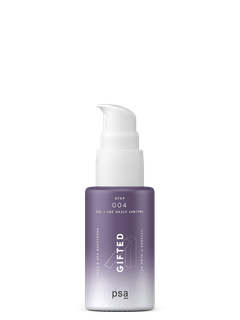
psa GIFTED Acai & Sea Buckthorn Vitamin C Glow Oil
Works for
2 of 3 advertised claims delivered
Moisturizing10 ingredients credited for this claimGood support
“Free radicals don't stand a chance, and dehydration and dullness will be things of the past.”
This product can help improve hydration of the skin with the two types of ingredients.
The first type is called “humectants”:
these ingredients help attract water.
When humectants are on the surface of the skin, they “pull in” the moisture from the outside environment, or from
within deeper layers of the skin. The following ingredients in this product do the job:
glycerin, caprylyl glycol.
This product also contains ingredients called “occlusives”. They help reduce the speed with which our skin loses moisture to the outside environment. These ingredients also help soften the upper layer of the skin, so it feels less tight and nicer to the touch. The following ingredients in this product do the job: helianthus annuus seed oil, squalane.
Anti-aging4 ingredients credited for this claimModerate support
“It will keep your skin glowing and hydrated, while providing antioxidant protection to reduce the appearance of fine lines, uneven skin tone, and premature ageing.”
This product contains centella asiatica leaf extract. This ingredient might be able to help reduce and prevent fine lines and wrinkles, improve skin elasticity and firmness, but there is not enough evidence that it actually works.
Evens skin tone2 ingredients credited for this claimLimited support
“It will keep your skin glowing and hydrated, while providing antioxidant protection to reduce the appearance of fine lines, uneven skin tone, and premature ageing.”
This product contains ingredients (glycyrrhiza glabra root extract) that could help reduce hyperpigmentation (for example, post-acne marks or age spots) in theory, but there is not enough evidence that they actually work.
Anti-oxidationNot advertised by the brand · 11 ingredients credited for this claimStrong support
This product contains antioxidants (ubiquinone) that can help neutralize free radicals in skin. By doing so, they can lessen the damage the skin gets from the UV light (sun).
The following ingredients - rubus idaeus seed oil also can have an antioxidant effect, but there is less evidence to confirm their effectiveness in skin.
Can it cause trouble?
Irritancy11 flagged ingredientsLow risk
ComedogenicClean of flagged comedogenic ingredientsNone flagged
User reviews
Be the first — your take helps the next person decide.
Ingredients
Filter by role to see what each ingredient is doing.
Carthamus tinctorius seed oil~23–34%
- Irritation risk
- Low
An emollient that helps soften the skin and might help calm down inflammation
More about Carthamus tinctorius seed oilHelianthus annuus seed oil~5.5–8.3%
- Irritation risk
- Low
A great emollient due to its high linoleic acid content. One of the most effective plant oils in helping skin hydration and repairing skin barrier function
More about Helianthus annuus seed oilVitis vinifera seed oil~4.5–6.7%
- Irritation risk
- Medium
A great emollient that can also have anti-oxidant properties
More about Vitis vinifera seed oilSqualane~3.9–5.9%
- Irritation risk
- Low
An oil naturally present in skin. Works as an emollient to soften the skin and form a protective layer on its surface without a greasy feeling.
More about SqualaneEuterpe oleracea fruit oil~2.8–4.2%
- Irritation risk
- Medium
A plant oil that might help neutralize free radicals, but evidence of effectiveness in skin is lacking
More about Euterpe oleracea fruit oilHippophae rhamnoides fruit oil~2.1–3.2%
- Irritation risk
- High
A plant oil that might somewhat help to neutralize free radicals. It could be irritating
More about Hippophae rhamnoides fruit oilTetrahexyldecyl ascorbate~1.5–2.3%
- Irritation risk
- Medium
Being a lipid soluble form of vitamin C, it is more stable than ascorbic acid, but still degrades quickly and needs to be stabilized in a formulation with another ingredient. It is claimed to penetrate skin better than pure vitamin C and have the the similar benefits, but solid studies of its effectiveness are lacking. Is likely to require a higher concentration in a product than pure vitamin C to be effective. It might be able to help reduce pore clogging.
More about Tetrahexyldecyl ascorbateTocopheryl acetate~1.2–1.8%
- Irritation risk
- Medium
A more stable but less bio-available form of vitamin E compared to Tocopherol. Might help moisturize and protect the skin from free radicals, but mostly used in low concentrations to stabilize other ingredients.
More about Tocopheryl acetateDimethyl isosorbide~1–1.5%
- Irritation risk
- Low
Used to dissolve other ingredients in a product and can enhance their ability to penetrate the skin
More about Dimethyl isosorbideRubus idaeus seed oil~0.9–1.35%
- Irritation risk
- Medium
A plant oil that might be able to help neutralize free radicals in skin
More about Rubus idaeus seed oilLeuconostoc/radish root ferment filtrate~0.5–1.1%
- Irritation risk
- Medium
A preservative that comes from radishes fermented by a bacteria. New research suggests that the preservation properties in the ingredient come from an ammonium salt that is not present naturally in radish root but used in its cultivation. Is problematic because the exact amount of the preservative agents is difficult to determine
More about Leuconostoc/radish root ferment filtrateWater~0.45–1%
Caprylyl glycol~0.45–1.1%
- Irritation risk
- Medium
Helps preserve products and creates a nice product texture
More about Caprylyl glycolUbiquinone~0.35–0.75%
- Irritation risk
- Low
Coenzyme Q10. It helps neutralize free radicals in skin, improves skin hydration and might be helpful agains fine lines and wrinkles. It can be an allergen
More about UbiquinoneTocopherol~0.15–0.7%
- Irritation risk
- Low
Pure form of vitamin E. Can help moisturise and protect the skin from free radicals. Often used to help stabilise other ingredients or the formula itself
More about TocopherolCentella asiatica leaf extract~0.15–0.55%
- Irritation risk
- Medium
A plant extract that has been shown to be able to reduce inflammation in skin, support restoration of skin barrier function, as well as support collagen production. It can be irritating to sensitive skin. Might be helpful in preventing stretch marks. It could, however, itself be irritating.
More about Centella asiatica leaf extractGlycyrrhiza glabra root extract~0.15–0.6%
- Irritation risk
- Medium
A plant extract that can help lighten the skin and calm down inflammation. Might be helpful in neutralizing free radicals
More about Glycyrrhiza glabra root extractGlycerin~0.1–0.3%
- Irritation risk
- Low
One of the best moisturizing ingredients. Naturally present in skin. It attracts water to the upper layer of the skin working as a humectant
More about GlycerinPhenoxyethanol~0.05–0.25%
- Irritation risk
- Low
A preservative. It helps prevent bacterial growth in cosmetic products
More about PhenoxyethanolHippophae rhamnoides oil~0.1–0.45%
- Irritation risk
- High
A good emollient. Contains various ingredients including vitamins and fatty acids that could work in the skin to neutralize free radicals and minimize moisture loss - if enough of these compounds is able to penetrate the skin in an active form.
More about Hippophae rhamnoides oilIngredient list view
Carthamus tinctorius seed oil, Helianthus annuus seed oil, Vitis vinifera seed oil, Squalane, Euterpe oleracea fruit oil, Hippophae rhamnoides fruit oil, Tetrahexyldecyl ascorbate, Tocopheryl acetate, Dimethyl isosorbide, Rubus idaeus seed oil, Leuconostoc/radish root ferment filtrate, Water, Caprylyl glycol, Ubiquinone, Tocopherol, Centella asiatica leaf extract, Glycyrrhiza glabra root extract, Glycerin, Phenoxyethanol, Hippophae rhamnoides oil
Compare prices
Retailers ranked by price — lowest first.
Affiliate links · prices updated regularly · As an Amazon Associate, WIMJ earns from qualifying purchases.
Worth comparing, line by line.
Match % combines shared ingredients, the first five ingredients, shared actives and hero ingredients, irritancy (lower counts in the alternative's favour), texture and body area. Only products in the same routine step are compared.
| psaGIFTED Acai & Sea Buckthorn Vitamin C Glow OilYOUR PRODUCT | M-61Vitablast C Face Oil | |
|---|---|---|
| Match | — | 52% |
| Price | $58.17 | $39.00−$19.17 |
| Shared key ingredients | — | 3 of 10 |
| Key difference | — | — |
| Irritancy | Low | Low |
| Drying alcohol | — | — |
| View product | Shop |

Sources cited in this review
Every concentration estimate and effectiveness label is anchored to one of these 13 studies and safety reviews.
- 1
- 2
- 3Effect of topically applied lipids on surfactant-irritated skinonlinelibrary.wiley.com
- 4
- 5
- 6

Affiliate links · As an Amazon Associate, WIMJ earns from qualifying purchases.