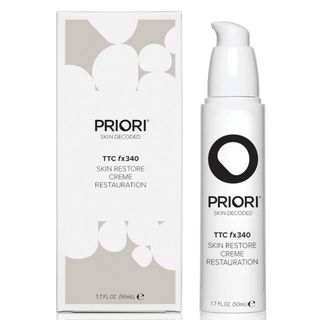
PRIORI Skincare TTC fx340 Skin Restore Crème

PRIORI Skincare TTC fx340 Skin Restore Crème

Efficacy66/100IrritancyMedium
Edit

Works for

2 of 3 advertised claims delivered

Anti-aging
Vitis vinifera seed extract, Tetrahydrodemethoxydiferuloylmethane + 7 more
Moderate evidence
What the product description says
“Rich in antioxidants, and all-natural, this lightweight 24-hour crème adapts to all skin types, throughout the day and night, as it works to protect from environmental elements while restoring and rejuvenating dehydrated skin and associated fine lines.”
Source: Skinstore

This product contains vitis vinifera seed extract. This ingredient might be able to help reduce and prevent fine lines and wrinkles, improve skin elasticity and firmness, but there is not enough evidence that it actually works.

Vitis vinifera seed extractKey activeEffect: MediumA plant extract that contains resveratrol and other anti-oxidant compounds that can help neutralize free radicals, reduce inflammation in skin and even out its tone. Can be also used to stabilize the product formulation~0.2–0.35%
TetrahydrodemethoxydiferuloylmethaneEffect: LowAn anti-oxidant derived from curcumin (naturally present in tumeric). Is a part of the tetrahydrocurcuminoids complex (THC). The complex might be helpful in neutralizing free radicals in skin and possibly help even out the skin tone. Can be irritating~0.35–0.65%
TetrahydrobisdemethoxydiferuloylmethaneEffect: LowAn anti-oxidant derived from curcumin (naturally present in tumeric). It might be helpful in neutralizing free radicals in skin and possibly help even out the skin tone. Can be irritating~0.3–0.55%
TetrahydrodiferuloylmethaneEffect: LowAn anti-oxidant derived from curcumin (naturally present in tumeric). Is a part of the tetrahydrocurcuminoids complex (THC). The complex might be helpful in neutralizing free radicals in skin and possibly help even out the skin tone. Can be irritating~0.4–0.6%
Retinyl palmitateUnder-dosedEffect: MediumThree steps removed from the active form of vitamin A - retinoic acid. To have an effect in the skin, it first needs to be converted twice to become the retinoic acid. This means it is less potent than retinol, but could also be less irritating. Once converted to the retinoic acid in the skin, it helps against all signs of aging, improves skin cell turnover and helps fight blemishes and clogged pores. However, in many cosmetic formulations, it is used in a concentration that is too low to have the full effect~0.15–0.25%
Lactic acidUnder-dosedEffect: MediumAn exfoliating and moisturizing alpha-hydroxy acid (AHA). Typically causes less irritation than other AHAs, for example, glycolic acid. At high concentrations (about 15%), lactic acid can help reduce lines and wrinkles. Recent studies show that lactic acid can support the "good" bacteria living on skin's surface (healthy skin microbiome)~0.1–0.2%
Camellia sinensis leaf extractEffect: Low, below effective doseCan contain potent anti-oxidant compounds (abbreviated ECG, GCG, EGC, and EGCG) that might help protect the skin from free radicals. Can help calm down inflammation and has some anti-bacterial properties. Unfortunately, these antioxidants are unstable and lose their effectiveness very quickly in products. The concentration of the antioxidant compounds in the extract also tends to be low to be effective in topical formulation~0.25–0.45%
Butyrospermum parkii butterEffect: Low, below effective doseA great moisturising ingredient that softens the skin and reduces water loss from its upper layer. It also can be helpful in protecting skin from free radicals~0.5–0.75%
Ascorbyl palmitateEffect: Low, below effective doseBeing a lipid soluble form of vitamin C, it is more stable and can penetrate the skin better than L-Ascorbic acid. It is effective in protecting the skin from free radicals, as well as evening the skin tone, but is less effective in stimulating collagen production compared to L-Ascorbic acid.~0.15–0.3%
Moisturizing
Cera alba, Glycerin + 13 more
Good evidence
What the product description says
“Rich in antioxidants, and all-natural, this lightweight 24-hour crème adapts to all skin types, throughout the day and night, as it works to protect from environmental elements while restoring and rejuvenating dehydrated skin and associated fine lines.”
Source: Skinstore

This product can help improve hydration of the skin with the two types of ingredients.

The first type is called “humectants”:
these ingredients help attract water. When humectants are on the surface of the skin, they “pull in” the moisture from the outside environment, or from within deeper layers of the skin. The following ingredients in this product do the job: glycerin.

This product also contains ingredients called “occlusives”. They help reduce the speed with which our skin loses moisture to the outside environment. These ingredients also help soften the upper layer of the skin, so it feels less tight and nicer to the touch. The following ingredients in this product do the job: cera alba, helianthus annuus seed oil.

Cera albaKey active· Emollient, OcclusiveEffect: HighForms a protective barrier that holds water and keeps dry skin hydrated. Keeps an emulsion from separating into its oil and liquid components, and increases the thickness of a product. Can be an allergen~2.9–3.5%
GlycerinKey active· HumectantEffect: HighOne of the best moisturizing ingredients. Naturally present in skin. It attracts water to the upper layer of the skin working as a humectant~3.7–4.5%
Argania spinosa kernel oilKey active· EmollientEffect: HighAn emollient that helps soften the upper layer of the skin. Might have some weak anti-oxidant properties~2.4–2.9%
Saccharomyces fermentKey activeEffect: HighA product of yeast fermentation. Helps attract water to the upper layer of the skin~1.4–1.8%
Helianthus annuus seed oilKey active· Emollient, OcclusiveEffect: HighA great emollient due to its high linoleic acid content. One of the most effective plant oils in helping skin hydration and repairing skin barrier function~5.5–6.8%
Persea gratissima oilKey active· EmollientEffect: HighAn emollient that helps soften the skin and could be helpful in repairing its barrier function~2–2.4%
Cetearyl alcoholKey active· EmollientEffect: MediumA non-drying alcohol. Works as an emollient. Helps water and oil mix together and creates a nice product texture~1.3–1.6%
PhospholipidsKey activeEffect: MediumEmollients that are naturaly present in skin. In addition, they help water and oil mix together in the product~0.2–0.35%
Stearic acid· EmollientEffect: LowHelps oil and water mix together and works as an emollient~1.7–2.1%
Dicaprylyl ether· EmollientEffect: LowHelps soften the upper layer of the skin while creating a non-greasy feel on the skin. Helps to dissolve other ingredients~1–1.2%
Lactic acidUnder-dosedEffect: HighAn exfoliating and moisturizing alpha-hydroxy acid (AHA). Typically causes less irritation than other AHAs, for example, glycolic acid. At high concentrations (about 15%), lactic acid can help reduce lines and wrinkles. Recent studies show that lactic acid can support the "good" bacteria living on skin's surface (healthy skin microbiome)~0.1–0.2%
Caprylic/capric triglycerideUnder-dosedEffect: HighA good mix of fatty acids that forms a protective layer on the skin. Improves the shelf life of products. Derived from coconut and glycerin~0.55–0.8%
Butyrospermum parkii butterUnder-dosedEffect: HighA great moisturising ingredient that softens the skin and reduces water loss from its upper layer. It also can be helpful in protecting skin from free radicals~0.5–0.75%
Aloe barbadensis leaf extractEffect: Low, below effective doseTraditionally used to treat sunburns, dermatitis and inflammation, but evidence for its effectiveness is lacking. The extract can contain humectants that help attract water into the skin~0.35–0.6%
Camellia sinensis leaf extractEffect: Low, below effective doseCan contain potent anti-oxidant compounds (abbreviated ECG, GCG, EGC, and EGCG) that might help protect the skin from free radicals. Can help calm down inflammation and has some anti-bacterial properties. Unfortunately, these antioxidants are unstable and lose their effectiveness very quickly in products. The concentration of the antioxidant compounds in the extract also tends to be low to be effective in topical formulation~0.25–0.45%
Evens skin tone
Tetrahydrodemethoxydiferuloylmethane, Glycyrrhiza glabra root extract + 6 more
Limited evidence
What the product description says
“All Priori TTC products feature an exclusive, highly potent natural compound of 3 kinds of colorless turmeric root PLUS green tea, grape seed and licorice for a powerful multifunctional adaptive action: antioxidant, brightening and anti-inflammatory.”
Source: Skinstore

This product contains ingredients (glycyrrhiza glabra root extract, punica granatum extract, tetrahydrobisdemethoxydiferuloylmethane, tetrahydrodemethoxydiferuloylmethane, tetrahydrodiferuloylmethane) that could help reduce hyperpigmentation (for example, post-acne marks or age spots) in theory, but there is not enough evidence that they actually work.

TetrahydrodemethoxydiferuloylmethaneEffect: LowAn anti-oxidant derived from curcumin (naturally present in tumeric). Is a part of the tetrahydrocurcuminoids complex (THC). The complex might be helpful in neutralizing free radicals in skin and possibly help even out the skin tone. Can be irritating~0.35–0.65%
Glycyrrhiza glabra root extractEffect: LowA plant extract that can help lighten the skin and calm down inflammation. Might be helpful in neutralizing free radicals~0.15–0.3%
Punica granatum extractEffect: LowA plant extract that can help neutralize free radicals in skin and even out the skin tone, but is typically used in products in a concentration that is too low to be effective~0.25–0.45%
TetrahydrodiferuloylmethaneEffect: LowAn anti-oxidant derived from curcumin (naturally present in tumeric). Is a part of the tetrahydrocurcuminoids complex (THC). The complex might be helpful in neutralizing free radicals in skin and possibly help even out the skin tone. Can be irritating~0.4–0.6%
TetrahydrobisdemethoxydiferuloylmethaneEffect: LowAn anti-oxidant derived from curcumin (naturally present in tumeric). It might be helpful in neutralizing free radicals in skin and possibly help even out the skin tone. Can be irritating~0.3–0.55%
Lactic acidUnder-dosedEffect: HighAn exfoliating and moisturizing alpha-hydroxy acid (AHA). Typically causes less irritation than other AHAs, for example, glycolic acid. At high concentrations (about 15%), lactic acid can help reduce lines and wrinkles. Recent studies show that lactic acid can support the "good" bacteria living on skin's surface (healthy skin microbiome)~0.1–0.2%
Retinyl palmitateUnder-dosedEffect: MediumThree steps removed from the active form of vitamin A - retinoic acid. To have an effect in the skin, it first needs to be converted twice to become the retinoic acid. This means it is less potent than retinol, but could also be less irritating. Once converted to the retinoic acid in the skin, it helps against all signs of aging, improves skin cell turnover and helps fight blemishes and clogged pores. However, in many cosmetic formulations, it is used in a concentration that is too low to have the full effect~0.15–0.25%
Camellia sinensis leaf extractEffect: Low, below effective doseCan contain potent anti-oxidant compounds (abbreviated ECG, GCG, EGC, and EGCG) that might help protect the skin from free radicals. Can help calm down inflammation and has some anti-bacterial properties. Unfortunately, these antioxidants are unstable and lose their effectiveness very quickly in products. The concentration of the antioxidant compounds in the extract also tends to be low to be effective in topical formulation~0.25–0.45%
Anti-oxidation
Not advertised by the brand · Vitis vinifera seed extract, Punica granatum extract + 9 more
Strong evidence

This product contains antioxidants (vitis vinifera seed extract) that can help neutralize free radicals in skin. By doing so, they can lessen the damage the skin gets from the UV light (sun).

The following ingredients - punica granatum extract, tetrahydrobisdemethoxydiferuloylmethane, tetrahydrodemethoxydiferuloylmethane, tetrahydrodiferuloylmethane also can have an antioxidant effect, but there is less evidence to confirm their effectiveness in skin.

Vitis vinifera seed extractKey activeEffect: HighA plant extract that contains resveratrol and other anti-oxidant compounds that can help neutralize free radicals, reduce inflammation in skin and even out its tone. Can be also used to stabilize the product formulation~0.2–0.35%
Punica granatum extractKey activeEffect: MediumA plant extract that can help neutralize free radicals in skin and even out the skin tone, but is typically used in products in a concentration that is too low to be effective~0.25–0.45%
TetrahydrodiferuloylmethaneKey activeEffect: MediumAn anti-oxidant derived from curcumin (naturally present in tumeric). Is a part of the tetrahydrocurcuminoids complex (THC). The complex might be helpful in neutralizing free radicals in skin and possibly help even out the skin tone. Can be irritating~0.4–0.6%
TetrahydrodemethoxydiferuloylmethaneKey activeEffect: MediumAn anti-oxidant derived from curcumin (naturally present in tumeric). Is a part of the tetrahydrocurcuminoids complex (THC). The complex might be helpful in neutralizing free radicals in skin and possibly help even out the skin tone. Can be irritating~0.35–0.65%
TetrahydrobisdemethoxydiferuloylmethaneKey activeEffect: MediumAn anti-oxidant derived from curcumin (naturally present in tumeric). It might be helpful in neutralizing free radicals in skin and possibly help even out the skin tone. Can be irritating~0.3–0.55%
Glycyrrhiza glabra root extractEffect: LowA plant extract that can help lighten the skin and calm down inflammation. Might be helpful in neutralizing free radicals~0.15–0.3%
Argania spinosa kernel oilEffect: LowAn emollient that helps soften the upper layer of the skin. Might have some weak anti-oxidant properties~2.4–2.9%
Camellia sinensis leaf extractUnder-dosedEffect: MediumCan contain potent anti-oxidant compounds (abbreviated ECG, GCG, EGC, and EGCG) that might help protect the skin from free radicals. Can help calm down inflammation and has some anti-bacterial properties. Unfortunately, these antioxidants are unstable and lose their effectiveness very quickly in products. The concentration of the antioxidant compounds in the extract also tends to be low to be effective in topical formulation~0.25–0.45%
Tocopheryl acetateEffect: Low, below effective doseA more stable but less bio-available form of vitamin E compared to Tocopherol. Might help moisturize and protect the skin from free radicals, but mostly used in low concentrations to stabilize other ingredients.~0.15–0.3%
Butyrospermum parkii butterEffect: Low, below effective doseA great moisturising ingredient that softens the skin and reduces water loss from its upper layer. It also can be helpful in protecting skin from free radicals~0.5–0.75%
Ascorbyl palmitateEffect: Low, below effective doseBeing a lipid soluble form of vitamin C, it is more stable and can penetrate the skin better than L-Ascorbic acid. It is effective in protecting the skin from free radicals, as well as evening the skin tone, but is less effective in stimulating collagen production compared to L-Ascorbic acid.~0.15–0.3%

Can it cause trouble?

Irritancy
2 strong irritants: Citrus grandis fruit extract, Retinyl palmitate
Medium risk
We flagged 19 ingredients with irritancy potential. Severity depends on your sensitivity threshold; the table lists the worst offenders first.
IngredientFunctionIrritationEst. amount
TetrahydrodiferuloylmethaneAn anti-oxidant derived from curcumin (naturally present in tumeric). Is a part of the tetrahydrocurcuminoids complex (THC). The complex might be helpful in neutralizing free radicals in skin and possibly help even out the skin tone. Can be irritatingHigh~0.4–0.6%est.
TetrahydrodemethoxydiferuloylmethaneAn anti-oxidant derived from curcumin (naturally present in tumeric). Is a part of the tetrahydrocurcuminoids complex (THC). The complex might be helpful in neutralizing free radicals in skin and possibly help even out the skin tone. Can be irritatingHigh~0.35–0.65%est.
TetrahydrobisdemethoxydiferuloylmethaneAn anti-oxidant derived from curcumin (naturally present in tumeric). It might be helpful in neutralizing free radicals in skin and possibly help even out the skin tone. Can be irritatingHigh~0.3–0.55%est.
Citrus grandis fruit extract—High~0.2–0.35%est.
Retinyl palmitateThree steps removed from the active form of vitamin A - retinoic acid. To have an effect in the skin, it first needs to be converted twice to become the retinoic acid. This means it is less potent than retinol, but could also be less irritating. Once converted to the retinoic acid in the skin, it helps against all signs of aging, improves skin cell turnover and helps fight blemishes and clogged pores. However, in many cosmetic formulations, it is used in a concentration that is too low to have the full effectHigh~0.15–0.25%est.
Cera albaForms a protective barrier that holds water and keeps dry skin hydrated. Keeps an emulsion from separating into its oil and liquid components, and increases the thickness of a product. Can be an allergenMedium~2.9–3.5%est.
Argania spinosa kernel oilAn emollient that helps soften the upper layer of the skin. Might have some weak anti-oxidant propertiesMedium~2.4–2.9%est.
Persea gratissima oilAn emollient that helps soften the skin and could be helpful in repairing its barrier functionMedium~2–2.4%est.
Caprylic/capric triglycerideA good mix of fatty acids that forms a protective layer on the skin. Improves the shelf life of products. Derived from coconut and glycerinMedium~0.55–0.8%est.
Hydroxypropyl starch phosphateHelps oil and water mix together and used to stabilize product formulationsMedium~0.45–0.65%est.
Aloe barbadensis leaf extractTraditionally used to treat sunburns, dermatitis and inflammation, but evidence for its effectiveness is lacking. The extract can contain humectants that help attract water into the skinMedium~0.35–0.6%est.
Punica granatum extractA plant extract that can help neutralize free radicals in skin and even out the skin tone, but is typically used in products in a concentration that is too low to be effectiveMedium~0.25–0.45%est.
Leuconostoc/radish root ferment filtrateA preservative that comes from radishes fermented by a bacteria. New research suggests that the preservation properties in the ingredient come from an ammonium salt that is not present naturally in radish root but used in its cultivation. Is problematic because the exact amount of the preservative agents is difficult to determineMedium~0.2–0.35%est.
Glycyrrhiza glabra root extractA plant extract that can help lighten the skin and calm down inflammation. Might be helpful in neutralizing free radicalsMedium~0.15–0.3%est.
Polysorbate 60Helps oil and water mix togetherMedium~0.2–0.35%est.
Ascorbyl palmitateBeing a lipid soluble form of vitamin C, it is more stable and can penetrate the skin better than L-Ascorbic acid. It is effective in protecting the skin from free radicals, as well as evening the skin tone, but is less effective in stimulating collagen production compared to L-Ascorbic acid.Medium~0.15–0.3%est.
Tocopheryl acetateA more stable but less bio-available form of vitamin E compared to Tocopherol. Might help moisturize and protect the skin from free radicals, but mostly used in low concentrations to stabilize other ingredients.Medium~0.15–0.3%est.
Lactic acidAn exfoliating and moisturizing alpha-hydroxy acid (AHA). Typically causes less irritation than other AHAs, for example, glycolic acid. At high concentrations (about 15%), lactic acid can help reduce lines and wrinkles. Recent studies show that lactic acid can support the "good" bacteria living on skin's surface (healthy skin microbiome)Medium~0.1–0.2%est.
Potassium sorbateA preservativeMedium~0.1–0.2%est.
Comedogenic
2 ingredients rated 2 or more on the 0–5 pore-clogging scale
2 flagged
These ingredients have a comedogenic rating of 2 or more on a 0–5 scale; the table shows each one's rating. In leave-on products they can clog pores in acne-prone skin.
IngredientFunctionRatingEst. amount
Butyrospermum parkii butterA great moisturising ingredient that softens the skin and reduces water loss from its upper layer. It also can be helpful in protecting skin from free radicals3/5~0.5–0.75%est.
Cetearyl alcoholA non-drying alcohol. Works as an emollient. Helps water and oil mix together and creates a nice product texture2/5~1.3–1.6%est.
Edit

User reviews

Would you recommend?
No community reviews yet.

Be the first — your take helps the next person decide.

Write a review · ~30s

Ingredients

Filter by role to see what each ingredient is doing.

Water~45–55%
Formula
Irritation risk
Low

Plain old water

More about Water
Helianthus annuus seed oil~5.5–6.8%
Key active
Irritation risk
Low
Works for
Moisturizing

A great emollient due to its high linoleic acid content. One of the most effective plant oils in helping skin hydration and repairing skin barrier function

More about Helianthus annuus seed oil
Glycerin~3.7–4.5%
Key active
Irritation risk
Low
Works for
Moisturizing

One of the best moisturizing ingredients. Naturally present in skin. It attracts water to the upper layer of the skin working as a humectant

More about Glycerin
Cera alba~2.9–3.5%
Key activeIrritant · medium
Irritation risk
Medium
Works for
MoisturizingCleansing

Forms a protective barrier that holds water and keeps dry skin hydrated. Keeps an emulsion from separating into its oil and liquid components, and increases the thickness of a product. Can be an allergen

More about Cera alba
Argania spinosa kernel oil~2.4–2.9%
Key activeIrritant · medium
Irritation risk
Medium
Works for
MoisturizingAnti-oxidation

An emollient that helps soften the upper layer of the skin. Might have some weak anti-oxidant properties

More about Argania spinosa kernel oil
Persea gratissima oil~2–2.4%
Key activeIrritant · medium
Irritation risk
Medium
Works for
Moisturizing

An emollient that helps soften the skin and could be helpful in repairing its barrier function

More about Persea gratissima oil
Stearic acid~1.7–2.1%
Formula
Irritation risk
Low
Works for
CleansingMoisturizing

Helps oil and water mix together and works as an emollient

More about Stearic acid
Saccharomyces ferment~1.4–1.8%
Key active
Irritation risk
Low
Works for
Moisturizing

A product of yeast fermentation. Helps attract water to the upper layer of the skin

More about Saccharomyces ferment
Cetearyl alcohol~1.3–1.6%
Key activeComedogenic 2/5
Irritation risk
Low
Comedogenicity
2/5
Works for
CleansingMoisturizing

A non-drying alcohol. Works as an emollient. Helps water and oil mix together and creates a nice product texture

More about Cetearyl alcohol
Dicaprylyl ether~1–1.2%
Formula
Irritation risk
Low
Works for
Moisturizing

Helps soften the upper layer of the skin while creating a non-greasy feel on the skin. Helps to dissolve other ingredients

More about Dicaprylyl ether
Propanediol~0.7–1.05%
Formula
Irritation risk
Low

Acts as a solvent for other ingredients. Speeds up the absorption of other ingredients into the skin

More about Propanediol
Silica~0.9–1.1%
Formula
Irritation risk
Low

Used to absorb oil and can temporarily mattify skin

More about Silica
Caprylic/capric triglyceride~0.55–0.8%
Under-dosedIrritant · medium
Irritation risk
Medium
Works for
Moisturizing

A good mix of fatty acids that forms a protective layer on the skin. Improves the shelf life of products. Derived from coconut and glycerin

More about Caprylic/capric triglyceride
Butyrospermum parkii butter~0.5–0.75%
Under-dosedComedogenic 3/5
Irritation risk
Low
Comedogenicity
3/5
Works for
MoisturizingAnti-agingAnti-oxidation

A great moisturising ingredient that softens the skin and reduces water loss from its upper layer. It also can be helpful in protecting skin from free radicals

More about Butyrospermum parkii butter
Hydroxypropyl starch phosphate~0.45–0.65%
Irritant · medium
Irritation risk
Medium

Helps oil and water mix together and used to stabilize product formulations

More about Hydroxypropyl starch phosphate
Tetrahydrodiferuloylmethane~0.4–0.6%
Key activeIrritant · high
Irritation risk
High
Works for
Anti-oxidationEvens skin toneAnti-aging

An anti-oxidant derived from curcumin (naturally present in tumeric). Is a part of the tetrahydrocurcuminoids complex (THC). The complex might be helpful in neutralizing free radicals in skin and possibly help even out the skin tone. Can be irritating

More about Tetrahydrodiferuloylmethane
Tetrahydrodemethoxydiferuloylmethane~0.35–0.65%
Key activeIrritant · high
Irritation risk
High
Works for
Anti-oxidationEvens skin toneAnti-aging

An anti-oxidant derived from curcumin (naturally present in tumeric). Is a part of the tetrahydrocurcuminoids complex (THC). The complex might be helpful in neutralizing free radicals in skin and possibly help even out the skin tone. Can be irritating

More about Tetrahydrodemethoxydiferuloylmethane
Tetrahydrobisdemethoxydiferuloylmethane~0.3–0.55%
Key activeIrritant · high
Irritation risk
High
Works for
Anti-oxidationEvens skin toneAnti-aging

An anti-oxidant derived from curcumin (naturally present in tumeric). It might be helpful in neutralizing free radicals in skin and possibly help even out the skin tone. Can be irritating

More about Tetrahydrobisdemethoxydiferuloylmethane
Aloe barbadensis leaf extract~0.35–0.6%
Irritant · medium
Irritation risk
Medium
Works for
Moisturizing

Traditionally used to treat sunburns, dermatitis and inflammation, but evidence for its effectiveness is lacking. The extract can contain humectants that help attract water into the skin

More about Aloe barbadensis leaf extract
Punica granatum extract~0.25–0.45%
Key activeIrritant · medium
Irritation risk
Medium
Works for
Anti-oxidationEvens skin tone

A plant extract that can help neutralize free radicals in skin and even out the skin tone, but is typically used in products in a concentration that is too low to be effective

More about Punica granatum extract
Citrus grandis fruit extract~0.2–0.35%
Irritant · high
Camellia sinensis leaf extract~0.25–0.45%
Under-dosed
Irritation risk
Low
Works for
Anti-oxidationAntibacterialAnti-agingMoisturizingAnti-blemishEvens skin tone

Can contain potent anti-oxidant compounds (abbreviated ECG, GCG, EGC, and EGCG) that might help protect the skin from free radicals. Can help calm down inflammation and has some anti-bacterial properties. Unfortunately, these antioxidants are unstable and lose their effectiveness very quickly in products. The concentration of the antioxidant compounds in the extract also tends to be low to be effective in topical formulation

More about Camellia sinensis leaf extract
Leuconostoc/radish root ferment filtrate~0.2–0.35%
Irritant · medium
Irritation risk
Medium

A preservative that comes from radishes fermented by a bacteria. New research suggests that the preservation properties in the ingredient come from an ammonium salt that is not present naturally in radish root but used in its cultivation. Is problematic because the exact amount of the preservative agents is difficult to determine

More about Leuconostoc/radish root ferment filtrate
Glycyrrhiza glabra root extract~0.15–0.3%
Irritant · medium
Irritation risk
Medium
Works for
Reduces rednessEvens skin toneAnti-oxidationAnti-inflammatoryAntibacterial

A plant extract that can help lighten the skin and calm down inflammation. Might be helpful in neutralizing free radicals

More about Glycyrrhiza glabra root extract
Vitis vinifera seed extract~0.2–0.35%
Key active
Irritation risk
Low
Works for
Anti-oxidationAnti-inflammatoryAnti-agingAntibacterial

A plant extract that contains resveratrol and other anti-oxidant compounds that can help neutralize free radicals, reduce inflammation in skin and even out its tone. Can be also used to stabilize the product formulation

More about Vitis vinifera seed extract
Polysorbate 60~0.2–0.35%
Irritant · medium
Irritation risk
Medium
Works for
Cleansing

Helps oil and water mix together

More about Polysorbate 60
Sucrose stearate~0.2–0.4%
Formula
Irritation risk
Low
Works for
Cleansing

Helps water and oil mix together

More about Sucrose stearate
Xanthan gum~0.2–0.35%
Formula
Irritation risk
Low
Works for
Cleansing

Used to create a thicker product consistency

More about Xanthan gum
Phospholipids~0.2–0.35%
Key active
Irritation risk
Low
Works for
Moisturizing

Emollients that are naturaly present in skin. In addition, they help water and oil mix together in the product

More about Phospholipids
Ascorbyl palmitate~0.15–0.3%
Irritant · medium
Irritation risk
Medium
Works for
Anti-agingAnti-oxidation

Being a lipid soluble form of vitamin C, it is more stable and can penetrate the skin better than L-Ascorbic acid. It is effective in protecting the skin from free radicals, as well as evening the skin tone, but is less effective in stimulating collagen production compared to L-Ascorbic acid.

More about Ascorbyl palmitate
Beta-carotene~0.15–0.3%
Formula
Irritation risk
Low

A colorant adding orange or bright yellow color

More about Beta-carotene
Retinyl palmitate~0.15–0.25%
Under-dosedIrritant · high
Irritation risk
High
Works for
Evens skin toneAnti-blemishAnti-agingExfoliation

Three steps removed from the active form of vitamin A - retinoic acid. To have an effect in the skin, it first needs to be converted twice to become the retinoic acid. This means it is less potent than retinol, but could also be less irritating. Once converted to the retinoic acid in the skin, it helps against all signs of aging, improves skin cell turnover and helps fight blemishes and clogged pores. However, in many cosmetic formulations, it is used in a concentration that is too low to have the full effect

More about Retinyl palmitate
Tocopheryl acetate~0.15–0.3%
Irritant · medium
Irritation risk
Medium
Works for
Anti-oxidation

A more stable but less bio-available form of vitamin E compared to Tocopherol. Might help moisturize and protect the skin from free radicals, but mostly used in low concentrations to stabilize other ingredients.

More about Tocopheryl acetate
Lactic acid~0.1–0.2%
Under-dosedIrritant · medium
Irritation risk
Medium
Works for
ExfoliationEvens skin toneMoisturizingAnti-aging

An exfoliating and moisturizing alpha-hydroxy acid (AHA). Typically causes less irritation than other AHAs, for example, glycolic acid. At high concentrations (about 15%), lactic acid can help reduce lines and wrinkles. Recent studies show that lactic acid can support the "good" bacteria living on skin's surface (healthy skin microbiome)

More about Lactic acid
Sodium benzoate~0.1–0.2%
Formula
Irritation risk
Low

A preservative

More about Sodium benzoate
Potassium sorbate~0.1–0.2%
Irritant · medium
Irritation risk
Medium

A preservative

More about Potassium sorbate
Ingredient list view

Water, Helianthus annuus seed oil, Glycerin, Cera alba, Argania spinosa kernel oil, Persea gratissima oil, Stearic acid, Saccharomyces ferment, Cetearyl alcohol, Dicaprylyl ether, Propanediol, Silica, Caprylic/capric triglyceride, Butyrospermum parkii butter, Hydroxypropyl starch phosphate, Tetrahydrodiferuloylmethane, Tetrahydrodemethoxydiferuloylmethane, Tetrahydrobisdemethoxydiferuloylmethane, Aloe barbadensis leaf extract, Punica granatum extract, Citrus grandis fruit extract, Camellia sinensis leaf extract, Leuconostoc/radish root ferment filtrate, Glycyrrhiza glabra root extract, Vitis vinifera seed extract, Polysorbate 60, Sucrose stearate, Xanthan gum, Phospholipids, Ascorbyl palmitate, Beta-carotene, Retinyl palmitate, Tocopheryl acetate, Lactic acid, Sodium benzoate, Potassium sorbate

Compare prices

Retailers ranked by price — lowest first.

No pricing data available yet for this product.
Cheaper alternatives? Browse formulas in the same category.
We compare ingredient profiles across our catalog — pick the closest match for your budget.
Open dupe finder

Sources cited in this review

Every concentration estimate and effectiveness label is anchored to one of these 18 studies and safety reviews.

  1. 1
  2. 2
  3. 3
  4. 4
  5. 5
  6. 6
PRIORI Skincare TTC fx340 Skin Restore Crème
PRIORI SkincareTTC fx340 Skin Restore Crème

Affiliate links · As an Amazon Associate, WIMJ earns from qualifying purchases.

As an Amazon Associate, WIMJ earns from qualifying purchases.