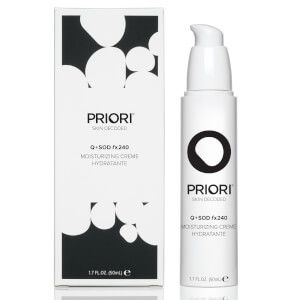
PRIORI Skincare Q+SOD fx240 Moisturising Crème
Works for
3 of 3 advertised claims delivered
Anti-aging5 ingredients credited for this claimStrong support
“This 24 hour advanced, adaptive moisturizing crème features Retinol for skin resurfacing and a sophisticated antioxidant protection complex that results in visible results.”
This product can help reduce and prevent fine lines and wrinkles, improve skin elasticity and firmness because it contains retinol.
Keep in mind that it typically takes at least 6 weeks to notice any results because the changes that are needed to improve fine lines and elasticity happen in the deeper layers of the skin. No topical anti-aging product can “erase” wrinkles or fully reverse signs of aging.
Exfoliation3 ingredients credited for this claimStrong support
“15% Lactic Acid gently exfoliates skin and boosts the production of Hyaluronic Acid and collagen for firmer and hydrated skin.”
This product can help exfoliate the skin. In other words, it helps break down the bonds between dead cells on the surface of the skin and speed up the skin turnover. Skin often appears softer and brighter after exfoliation, but overdoing it can result in disrupted skin barrier. The following ingredient is doing the exfoliating job in this product: retinol.
Moisturizing19 ingredients credited for this claimStrong support
“Q+SOD fx240 Moisturising Crème”
This product can help improve hydration of the skin with the two types of ingredients.
The first type is called “humectants”:
these ingredients help attract water.
When humectants are on the surface of the skin, they “pull in” the moisture from the outside environment, or from
within deeper layers of the skin. The following ingredients in this product do the job:
glycerin, sodium hyaluronate.
This product also contains ingredients called “occlusives”. They help reduce the speed with which our skin loses moisture to the outside environment. These ingredients also help soften the upper layer of the skin, so it feels less tight and nicer to the touch. The following ingredients in this product do the job: caprylic/capric triglyceride, chondrus crispus extract.
The following ingredients in this product are especially good for supporting the skin barrier and helping with the hydration level: urea
Anti-blemishNot advertised by the brand · 1 ingredient credited for this claimStrong support
This product can help reduce breakouts and clogged pores because it contains the following ingredient: retinol. This ingredient is used for treating acne and can have a noticeable effect.
Anti-oxidationNot advertised by the brand · 4 ingredients credited for this claimStrong support
This product contains antioxidants (retinol, superoxide dismutase, ubiquinone) that can help neutralize free radicals in skin. By doing so, they can lessen the damage the skin gets from the UV light (sun).
Evens skin toneNot advertised by the brand · 3 ingredients credited for this claimStrong support
This product can help reduce hypepigmentation and even out the skin tone because it contains the following effective ingredients: retinol.
The following ingredient (ingredients) in this product might be helpful, but there is no evidence to confirm that it actually can help even out the skin tone: glycine soja protein.
Keep in mind that you would need to apply any topical skincare targetted at hypigmentation consistently for a couple of months to get a result. No topical skincare product can help get rid of hyperpigmentation (including post-acne marks and age spots) instantly.
Can it cause trouble?
Irritancy1 strong irritant: RetinolMedium risk
Comedogenic3 ingredients rated 2 or more on the 0–5 pore-clogging scale3 flagged


User reviews
Be the first — your take helps the next person decide.
Ingredients
Filter by role to see what each ingredient is doing.
Water~45–55%
Sodium lactate~7.4–9.1%
- Irritation risk
- Medium
Helps attract water to the upper layer of the skin. Is often used to adjust the pH level of the product
More about Sodium lactateBis-hydroxyethoxypropyl dimethicone~4.8–5.9%
- Irritation risk
- Low
Caprylic/capric triglyceride~3.3–4.1%
- Irritation risk
- Medium
A good mix of fatty acids that forms a protective layer on the skin. Improves the shelf life of products. Derived from coconut and glycerin
More about Caprylic/capric triglycerideGlycerin~2.5–3%
- Irritation risk
- Low
One of the best moisturizing ingredients. Naturally present in skin. It attracts water to the upper layer of the skin working as a humectant
More about GlycerinIsopropyl lauroyl sarcosinate~2–2.5%
- Irritation risk
- Medium
Helps soften the upper layer of the skin and create a nice product consistency
More about Isopropyl lauroyl sarcosinateLactic acid~1.7–2%
- Irritation risk
- Medium
An exfoliating and moisturizing alpha-hydroxy acid (AHA). Typically causes less irritation than other AHAs, for example, glycolic acid. At high concentrations (about 15%), lactic acid can help reduce lines and wrinkles. Recent studies show that lactic acid can support the "good" bacteria living on skin's surface (healthy skin microbiome)
More about Lactic acidCetearyl alcohol~1.5–1.9%
- Irritation risk
- Low
- Comedogenicity
- 2/5
A non-drying alcohol. Works as an emollient. Helps water and oil mix together and creates a nice product texture
More about Cetearyl alcoholUbiquinone~1.2–1.4%
- Irritation risk
- Low
Coenzyme Q10. It helps neutralize free radicals in skin, improves skin hydration and might be helpful agains fine lines and wrinkles. It can be an allergen
More about UbiquinoneSuperoxide dismutase~1–1.2%
- Irritation risk
- Low
An antioxidant enzyme that is naturally present in skin. It can help support skin barrier function and reduce inflammation in skin. It is used in topical medications for inflammatory skin conditions including atopic dermatitis (eczema) and psoriasis. There are three types of natural Superoxide Dismutase in human skin. The compound used in topical treatments and cosmetics are mimics of typically one of these natural variants
More about Superoxide dismutaseRetinol~0.7–1.1%
- Irritation risk
- High
Two steps removed from the active form of vitamin A - retinoic acid. Once converted to the retinoic acid in the skin, retinol is proven to be effective against all signs of aging. It improves skin cell turnover, helps fight blemishes and clogged pores, can regulate excess oil production and even skin tone. It can, however, be quite irritating
More about RetinolGlycine soja protein~0.65–1%
- Irritation risk
- Low
A plant extract that helps to attract water to the upper layer of the skin and soften it. It might be helpful in neutralizing free radicals. It might be somewhat helpful for evening out the skin tone. It might be able to support elastin production but solid research is lacking
More about Glycine soja proteinChondrus crispus extract~0.6–0.9%
- Irritation risk
- Low
- Comedogenicity
- 3/5
Red algae extract that helps attract water to the upper layer of the skin and create a nicer product consistency
More about Chondrus crispus extractCetearyl olivate~0.55–0.85%
Sorbitan olivate~0.55–0.8%
Glyceryl stearate~0.55–0.85%
- Irritation risk
- Low
An emollient that softens the skin and forms a protective layer on its surface. Helps water and oil mix together
More about Glyceryl stearatePeg-100 stearate~0.7–1%
- Irritation risk
- Low
Helps oil and water mix togehter and creates a nice product texture
More about Peg-100 stearateMagnesium aluminum silicate~0.5–0.7%
- Irritation risk
- Low
Might be helpful in restoring skin barrier function and, when combined with zinc carbonate and malonic acid, reducing fine lines and wrinkles by stimulating elastin production. Also helps stabilize the product formulation
More about Magnesium aluminum silicateSteareth-100~0.45–0.65%
Cetearyl glucoside~0.45–0.65%
- Irritation risk
- Medium
Helps water and oil in the product mix well together and improves product texture
More about Cetearyl glucosideAcrylamide/sodium acryloyldimethyltaurate copolymer~0.35–0.65%
- Irritation risk
- Low
Helps water and oil mix together and create gel-like textures
More about Acrylamide/sodium acryloyldimethyltaurate copolymerSodium pca~0.35–0.6%
- Irritation risk
- Low
Naturally present in skin and helps to attract water to its upper layer
More about Sodium pcaUrea~0.3–0.6%
- Irritation risk
- Low
Naturally present in skin (urea makes up about 7% of natural moisturizing factors in skin). Attracts water to the upper layer of the skin. Also has a positive effect on the skin barrier beyond the humectant action. Can enhance penetration of other ingredients. Is an exfoliating ingredient when used in high concentrations
More about UreaHydroxyethylcellulose~0.35–0.65%
- Irritation risk
- Low
Used to thicken product formulations and create gel-like textures
More about HydroxyethylcelluloseIsohexadecane~0.55–0.85%
- Irritation risk
- Low
Improves the texture of the product and helps soften the skin. Helps oil and water mix together and can be used as a cleansing agent
More about IsohexadecaneDisodium edta~0.3–0.6%
Polysorbate 20~0.35–0.65%
Trehalose~0.3–0.6%
- Irritation risk
- Low
A sugar that attracts water to the upper layer of the skin
More about TrehalosePhenoxyethanol~0.35–0.6%
- Irritation risk
- Low
A preservative. It helps prevent bacterial growth in cosmetic products
More about PhenoxyethanolEthylhexylglycerin~0.3–0.6%
Hexylene glycol~0.3–0.55%
- Irritation risk
- Medium
Helps create a more spreadable product texture
More about Hexylene glycolPolysorbate 80~0.3–0.6%
Caprylyl glycol~0.3–0.6%
- Irritation risk
- Medium
Helps preserve products and creates a nice product texture
More about Caprylyl glycolXanthan gum~0.3–0.55%
- Irritation risk
- Low
Used to create a thicker product consistency
More about Xanthan gumPolyquaternium-51~0.3–0.55%
- Irritation risk
- Low
An emollient that helps create a nice silky finish on the skin
More about Polyquaternium-51Pvm/ma copolymer~0.25–0.5%
- Irritation risk
- Low
Sodium polyacrylate~0.25–0.5%
- Irritation risk
- Low
Used to create a gel-like product texture, as well as to stabilize emulsions
More about Sodium polyacrylateTriacetin~0.2–0.4%
Sorbitan oleate~0.2–0.35%
- Irritation risk
- Medium
- Comedogenicity
- 2/5
Helps oil and water mix together
More about Sorbitan oleateSodium hyaluronate~0.15–0.25%
- Irritation risk
- Low
One of the best moisturizing ingredients. Attracts water into the upper layer of the skin
More about Sodium hyaluronateSodium dextran sulfate~0.15–0.3%
- Irritation risk
- Low
Sodium benzoate~0.15–0.25%
Glucose~0.1–0.15%
- Irritation risk
- Low
Helps attract water to the upper layer of the skin. Could be helpful in restoring the skin barrier function
More about GlucosePotassium sorbate~0.15–0.25%
Ingredient list view
Water, Sodium lactate, Bis-hydroxyethoxypropyl dimethicone, Caprylic/capric triglyceride, Glycerin, Isopropyl lauroyl sarcosinate, Lactic acid, Cetearyl alcohol, Ubiquinone, Superoxide dismutase, Retinol, Glycine soja protein, Chondrus crispus extract, Cetearyl olivate, Sorbitan olivate, Glyceryl stearate, Peg-100 stearate, Magnesium aluminum silicate, Steareth-100, Cetearyl glucoside, Acrylamide/sodium acryloyldimethyltaurate copolymer, Sodium pca, Urea, Hydroxyethylcellulose, Isohexadecane, Disodium edta, Polysorbate 20, Trehalose, Phenoxyethanol, Ethylhexylglycerin, Hexylene glycol, Polysorbate 80, Caprylyl glycol, Xanthan gum, Polyquaternium-51, Pvm/ma copolymer, Sodium polyacrylate, Triacetin, Sorbitan oleate, Sodium hyaluronate, Sodium dextran sulfate, Sodium benzoate, Glucose, Potassium sorbate
Compare prices
Retailers ranked by price — lowest first.

Worth comparing, line by line.
Match % combines shared ingredients, the first five ingredients, shared actives and hero ingredients, irritancy (lower counts in the alternative's favour), texture and body area. Only products in the same routine step are compared.
| PRIORI SkincareQ+SOD fx240 Moisturising CrèmeYOUR PRODUCT | RoC SkincareRETINOL CORREXION Deep Wrinkle Rich Cream | BiopelleEmepelle Night Cream | Elizabeth GrantWonder Effect Advanced Retinol Night Cream | |
|---|---|---|---|---|
| Match | — | 78% | 75% | 73% |
| Price | $128.02 | — | $195.00+$66.98 | $50.95−$77.07 |
| Shared key ingredients | — | 6 of 13 | 4 of 13 | 6 of 13 |
| Key difference | — | Phytosphingosine | Niacinamide | Palmitoyl Tetrapeptide-7 |
| Irritancy | Medium | Medium | Low | Medium |
| Drying alcohol | — | — | — | — |
| View product | Shop | Shop | Shop |


Product summary
Based on the ingredient list, "PRIORI Skincare - Q+SOD fx240 Moisturising Crème" can work well for skin moisturization. This moisturizer uses a good combo of humectants and emollients. These both types of ingredients are essentials for improving the skin hydration and keeping the skin barrier healthy. Humectants in this product (urea, glycerin, sodium hyaluronate, sodium lactate and sodium pca) help to increase the water content in the upper layer of the skin. (These ingredients do so by "capturing" water molecules from the outside air or from within the deeper layers of the skin). Emollients in this formulation (caprylic/capric triglyceride, chondrus crispus extract, cetearyl alcohol, glycine soja protein and isopropyl lauroyl sarcosinate) help to reduce the moisture loss from the skin. They also soften the skin surface and relieve the feeling of dryness and tightness.
Ingredient callouts
- this moisturizer contains an effective form of retinoids (vitamin A): retinol 0.70% - 1.10%. Retinoids are potent multitasking actives. They work to improve and prevent early signs of aging, reduce hyperpigmentation (age spots and post-acne marks), and prevent inflamed blemishes and clogged pores. The downside of retinoids is that they can be irritating. If you are not already using a retinoid in your routine, it is best to start slowly and apply the retinoid product only a few times per week. If your skin tolerates it well, you can gradually increase the frequency to daily. Because of the irritation risk of retinoids, we recommend to have another, retinoid-free moisturizer in your routine to use on the alternative days or when your skin feels dry.
Irritation risk
This moisturizer contains some common irritants, including those without a benefit for the skin. We assess the overall irritancy of this moisturizer to be medium. For a detailed overview of all potential irritants: click here
You can see the detailed formula review with the breakdown of all actives in the product and the full ingredient list with estimated concentrations in the tables below.
Price
The product retails for 138.00$ in the United States, from 65.52CA$ up to 138.00CA$ in Canada and at around 96.12£ in the United Kingdom.
For a detailed price comparison: click here.
Sources cited in this review
Every concentration estimate and effectiveness label is anchored to one of these 23 studies and safety reviews.
- 1
- 2Epidermal and dermal effects of topical lactic acidncbi.nlm.nih.gov
- 3Dual Effects of Alpha-Hydroxy Acids on the Skinpdfs.semanticscholar.org
- 4
- 5
- 6

Affiliate links · As an Amazon Associate, WIMJ earns from qualifying purchases.