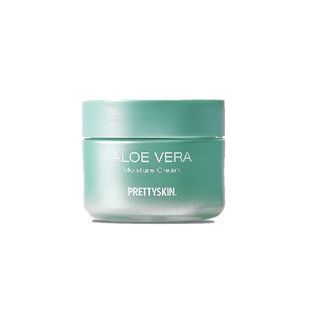
Pretty skin Aloe Vera Moisture Cream
Works for
2 of 2 advertised claims delivered
Moisturizing23 ingredients credited for this claimGood support
“Aloe Vera Moisture Cream”
This product can help improve hydration of the skin with the two types of ingredients.
The first type is called “humectants”:
these ingredients help attract water.
When humectants are on the surface of the skin, they “pull in” the moisture from the outside environment, or from
within deeper layers of the skin. The following ingredients in this product do the job:
glycerin, hyaluronic acid.
This product also contains ingredients called “occlusives”. They help reduce the speed with which our skin loses moisture to the outside environment. These ingredients also help soften the upper layer of the skin, so it feels less tight and nicer to the touch. The following ingredients in this product do the job: caprylic/capric triglyceride, dimethicone.
Anti-aging3 ingredients credited for this claimModerate support
“Features Green Tea Extract that helps soothe, protect the skin from external irritations and reduce the appearance of wrinkles.”
This product contains centella asiatica extract. This ingredient might be able to help reduce and prevent fine lines and wrinkles, improve skin elasticity and firmness, but there is not enough evidence that it actually works.
Anti-oxidationNot advertised by the brand · 3 ingredients credited for this claimModerate support
This product contains antioxidants (centella asiatica extract) that might be able to help neutralize free radicals in skin to lessen the damage it gets from the UV light (sun). There is not enough evidence to confirm their effectiveness in skin though.
Can it cause trouble?
Irritancy1 strong irritant: ParfumMedium risk
Comedogenic2 ingredients rated 2 or more on the 0–5 pore-clogging scale2 flagged
User reviews
Be the first — your take helps the next person decide.
Ingredients
Filter by role to see what each ingredient is doing.
Water~45–55%
Propanediol~4.5–5.5%
- Irritation risk
- Low
Acts as a solvent for other ingredients. Speeds up the absorption of other ingredients into the skin
More about PropanediolPentaerythrityl tetraethylhexanoate~3.8–4.7%
- Irritation risk
- Low
Used to create a nice product consistency while softening the upper layer of the skin
More about Pentaerythrityl tetraethylhexanoate1,2-hexanediol~2.1–2.6%
Cetyl alcohol~2.1–2.6%
- Irritation risk
- Low
A non-drying alcohol that works to soften the skin and stabilize product formulations helping oil and water mix together
More about Cetyl alcoholDimethicone~1.8–2.2%
- Irritation risk
- Low
A silicone that helps to reduce water loss from the surface of the skin. Can temporarily "fill in" lines and wrinkles, absorb oil, and create a nice product finish
More about DimethiconeGlyceryl stearate~1.5–1.8%
- Irritation risk
- Low
An emollient that softens the skin and forms a protective layer on its surface. Helps water and oil mix together
More about Glyceryl stearateCyclopentasiloxane~1.3–1.6%
- Irritation risk
- Low
A silicone that helps improve the product texture and spreadability. Can absorb oil creating a short-term mattifying effect on the skin
More about CyclopentasiloxaneCaprylic/capric triglyceride~1.1–1.3%
- Irritation risk
- Medium
A good mix of fatty acids that forms a protective layer on the skin. Improves the shelf life of products. Derived from coconut and glycerin
More about Caprylic/capric triglycerideButyrospermum parkii butter~0.9–1.1%
- Irritation risk
- Low
- Comedogenicity
- 3/5
A great moisturising ingredient that softens the skin and reduces water loss from its upper layer. It also can be helpful in protecting skin from free radicals
More about Butyrospermum parkii butterCentella asiatica extract~0.6–0.9%
- Irritation risk
- Medium
A plant extract that has been shown to be able to reduce inflammation in skin, support restoration of skin barrier function, as well as support collagen production. Contains active compounds called centelloids: asiaticoside, madecasosside, asiatic acid and madecassic acid. Might be helpful in preventing stretch marks. It can be itself be irritating though.
More about Centella asiatica extractAloe barbadensis leaf extract~0.55–0.85%
- Irritation risk
- Medium
Traditionally used to treat sunburns, dermatitis and inflammation, but evidence for its effectiveness is lacking. The extract can contain humectants that help attract water into the skin
More about Aloe barbadensis leaf extractCyclohexasiloxane~0.5–0.75%
- Irritation risk
- Low
A silicone that serves as an emollient. Helps create a nice non-greasy feels
More about CyclohexasiloxaneCetearyl olivate~0.45–0.7%
Hydrogenated polyisobutene~0.45–0.65%
- Irritation risk
- Low
Used to improve the product consistency and soften the upper layer of the skin
More about Hydrogenated polyisobuteneCetearyl alcohol~0.45–0.7%
- Irritation risk
- Low
- Comedogenicity
- 2/5
A non-drying alcohol. Works as an emollient. Helps water and oil mix together and creates a nice product texture
More about Cetearyl alcoholStearyl alcohol~0.45–0.7%
- Irritation risk
- Low
An emollient that helps soften the skin
More about Stearyl alcoholSorbitan olivate~0.35–0.6%
Benzyl glycol~0.3–0.55%
- Irritation risk
- Medium
Helps dissolve other ingredients and preserve products
More about Benzyl glycolTrehalose~0.25–0.5%
- Irritation risk
- Low
A sugar that attracts water to the upper layer of the skin
More about TrehaloseMyristyl alcohol~0.3–0.5%
- Irritation risk
- High
Helps to stabilize the product formulation while softening the upper layer of the skin. Can be irritating
More about Myristyl alcoholPolyacrylate-13~0.3–0.55%
- Irritation risk
- Low
Used to create a thicker product consistency and stabilize the product formulation
More about Polyacrylate-13Ethylhexylglycerin~0.25–0.4%
Allantoin~0.2–0.35%
- Irritation risk
- Low
Helps calm down inflammation in skin and can help reduce itching. Helps to repair the skin barrier and keep skin hydrated
More about AllantoinPolyisobutene~0.25–0.5%
Lauryl alcohol~0.25–0.5%
Tocopheryl acetate~0.25–0.45%
- Irritation risk
- Medium
A more stable but less bio-available form of vitamin E compared to Tocopherol. Might help moisturize and protect the skin from free radicals, but mostly used in low concentrations to stabilize other ingredients.
More about Tocopheryl acetateButylene glycol~0.2–0.4%
- Irritation risk
- Low
Used to create a nice product texture and help delivery of other ingredients. Might be somewhat helpful in attracting water to the upper layer of the skin
More about Butylene glycolSorbitan isostearate~0.25–0.45%
- Irritation risk
- Low
Helps oil and water mix together
More about Sorbitan isostearateHydrolyzed glycosaminoglycans~0.2–0.4%
- Irritation risk
- Low
Long sugars that help attract water to the upper layer of the skin
More about Hydrolyzed glycosaminoglycansGlycerin~0.25–0.45%
- Irritation risk
- Low
One of the best moisturizing ingredients. Naturally present in skin. It attracts water to the upper layer of the skin working as a humectant
More about GlycerinSodium hyaluronate~0.2–0.4%
- Irritation risk
- Low
One of the best moisturizing ingredients. Attracts water into the upper layer of the skin
More about Sodium hyaluronateSodium hyaluronate crosspolymer~0.2–0.4%
- Irritation risk
- Medium
Attracts water into the upper layer of the skin
More about Sodium hyaluronate crosspolymerHydrolyzed hyaluronic acid~0.2–0.35%
- Irritation risk
- Low
One of the best moisturizing ingredients. Attracts water into the upper layer of the skin. A version of it is naturally present in skin
More about Hydrolyzed hyaluronic acidHydroxypropyltrimonium hyaluronate~0.2–0.4%
- Irritation risk
- Low
Hyaluronic acid~0.2–0.35%
- Irritation risk
- Low
One of the best moisturizing ingredients. Attracts water into the upper layer of the skin. Naturally present in skin. Typically has large molecule size unless advertised otherwise on the product label. Helps support skin's barrier function and may help to reduce inflammation
More about Hyaluronic acidSodium acetylated hyaluronate~0.15–0.3%
- Irritation risk
- Low
A type of hyaluronic acid that works as an excellent moisturizer by attracting water into the upper layer of the skin. Is typically feels less sticky on the skin compared to the usual hyaluronic acid
More about Sodium acetylated hyaluronateHydroxyethyl acrylate/sodium acryloyldimethyl taurate copolymer~0.15–0.3%
- Irritation risk
- Medium
A gelling agent that thickens the product consistency and leaves the skin with a velvety finish
More about Hydroxyethyl acrylate/sodium acryloyldimethyl taurate copolymerDimethicone/vinyl dimethicone crosspolymer~0.15–0.25%
- Irritation risk
- Low
Used to stabilize product formulations and create a nice product texture
More about Dimethicone/vinyl dimethicone crosspolymerAcrylates/c10-30 alkyl acrylate crosspolymer~0.1–0.25%
- Irritation risk
- Medium
Maintains the texture of skincare products. Allows the product to spread evenly. Helps oil and water mix together
More about Acrylates/c10-30 alkyl acrylate crosspolymerPeg-100 stearate~0.2–0.35%
- Irritation risk
- Low
Helps oil and water mix togehter and creates a nice product texture
More about Peg-100 stearatePolysorbate 60~0.1–0.2%
Polysorbate 20~0.1–0.2%
Triethanolamine~0.1–0.15%
- Irritation risk
- Medium
Used to adjust pH of the product and can help improve the product's smell
More about TriethanolamineDisodium edta~0.01–0.05%
Parfum~0.01–0.05%
- Irritation risk
- High
An aromatic blend of unspecified and possibly irritating ingredients
More about ParfumIngredient list view
Water, Propanediol, Pentaerythrityl tetraethylhexanoate, 1,2-hexanediol, Cetyl alcohol, Dimethicone, Glyceryl stearate, Cyclopentasiloxane, Caprylic/capric triglyceride, Butyrospermum parkii butter, Centella asiatica extract, Aloe barbadensis leaf extract, Cyclohexasiloxane, Cetearyl olivate, Hydrogenated polyisobutene, Cetearyl alcohol, Stearyl alcohol, Sorbitan olivate, Benzyl glycol, Trehalose, Myristyl alcohol, Polyacrylate-13, Ethylhexylglycerin, Allantoin, Polyisobutene, Lauryl alcohol, Tocopheryl acetate, Butylene glycol, Sorbitan isostearate, Hydrolyzed glycosaminoglycans, Glycerin, Sodium hyaluronate, Sodium hyaluronate crosspolymer, Hydrolyzed hyaluronic acid, Hydroxypropyltrimonium hyaluronate, Hyaluronic acid, Sodium acetylated hyaluronate, Hydroxyethyl acrylate/sodium acryloyldimethyl taurate copolymer, Dimethicone/vinyl dimethicone crosspolymer, Acrylates/c10-30 alkyl acrylate crosspolymer, Peg-100 stearate, Polysorbate 60, Polysorbate 20, Triethanolamine, Disodium edta, Parfum
Compare prices
Retailers ranked by price — lowest first.

Affiliate links · prices updated regularly
Sources cited in this review
Every concentration estimate and effectiveness label is anchored to one of these 22 studies and safety reviews.
- 1Safety Assessment of Pentaerythrityl Tetraesters as Used in Cosmeticsjournals.sagepub.com
- 2
- 3
- 4Final Report on the Safety Assessment of Dimethicone Copolyoljournals.sagepub.com
- 5
- 6Centella asiatica in cosmetologyncbi.nlm.nih.gov

Affiliate links · As an Amazon Associate, WIMJ earns from qualifying purchases.