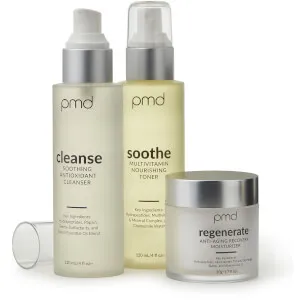
PMD Personal Microderm Daily Cell Regeneration System
Works for
CleansingSodium methyl cocoyl taurate, Sodium lauroamphoacetate + 9 moreCan be harsh
“Soothing Antioxidant Cleanser (4 oz.): breaks down dirt and oils from within pores without stripping away moisture”
This product works by removing dirt and oil from the surface of the skin.
The following cleansing agents are typically mild, but still can cause an irritation or allergy for some people cocamidopropyl betaine, sodium methyl cocoyl taurate.
Keep in mind that cleansing can disrupt the skin barrier, and most people do not need to cleanse their skin more than once per day.
Can it cause trouble?
Irritancy3 strong irritants: Artemisia vulgaris extract, Retinyl palmitate + 1 more — patch-test recommendedHigh risk
Comedogenic8 ingredients rated 2 or more on the 0–5 pore-clogging scale8 flagged
User reviews
Be the first — your take helps the next person decide.
Ingredients
Filter by role to see what each ingredient is doing.
Water~45–55%
Sodium methyl cocoyl taurate~9.5–11.6%
- Irritation risk
- High
Helps oil and water mix together. Can be used as cleansing agent
More about Sodium methyl cocoyl taurateSodium lauroamphoacetate~5.7–7%
Cocamidopropyl betaine~4.3–5.2%
- Irritation risk
- High
Helps water and oil mix together. Used as a cleansing ingredient. Could be an allergen
More about Cocamidopropyl betaineZanthoxylum bungeanum fruit extract~2.2–2.7%
- Irritation risk
- High
Pepper extract. Might help neutralize free radicals in skin
More about Zanthoxylum bungeanum fruit extractSea water~1.8–2.2%
- Irritation risk
- Low
Dissolves other ingredients. It does not have additional skin benefits compared to plain water
More about Sea waterCucurbita pepo seed extract~1.5–1.9%
- Irritation risk
- Low
Algae extract~1.5–1.8%
- Irritation risk
- Low
- Comedogenicity
- 3/5
Plant extract that helps the skin to attract water and make it more smooth for touch. Also shows promise of anti-aging properties, but research is not extensive yet
More about Algae extractArtemisia vulgaris extract~1.1–1.3%
- Irritation risk
- High
A plant extract that might have some anti-inflammatory and anti-oxidant properties. It can be irritating
More about Artemisia vulgaris extractBisabolol~0.7–1.1%
- Irritation risk
- Low
An active component of chamomile plant that historically has been used to calm down irritated skin. A recent study shows that bisabolol indeed can have some anti-inflammatory effect on skin, even though conclusive data is lacking. Bisabolol has a sweet floral scent and can be added to products for its aromatic properties
More about BisabololDipotassium glycyrrhizate~0.6–0.9%
- Irritation risk
- Low
A salt derived from licorice. Works as an emollient to soften the upper layer of the skin and can help calm down inflammation. Might be helpful for skin lightening
More about Dipotassium glycyrrhizateCorallina officinalis extract~0.5–0.75%
- Irritation risk
- Low
- Comedogenicity
- 3/5
Red algae extract that helps attract water to the upper layer of the skin and might contain antioxidants
More about Corallina officinalis extractAloe barbadensis leaf juice~0.45–0.65%
- Irritation risk
- Medium
Traditionally used to treat sunburns, dermatitis and inflammation, but evidence for its effectiveness is lacking. The extract can contain humectants that help attract water into the skin
More about Aloe barbadensis leaf juicePanthenyl triacetate~0.4–0.65%
- Irritation risk
- Low
A stable oil-soluble derivative of vitamin B5. It can help support skin barrier and reduce inflammation in skin
More about Panthenyl triacetateErgothioneine~0.35–0.65%
- Irritation risk
- Low
Can help neutralize free radicals in skin. Preliminary studies show that it can be more effective than coenzyme Q10 but studies on effective concentration for topical applications are lacking
More about ErgothioneineTocopheryl acetate~0.35–0.65%
- Irritation risk
- Medium
A more stable but less bio-available form of vitamin E compared to Tocopherol. Might help moisturize and protect the skin from free radicals, but mostly used in low concentrations to stabilize other ingredients.
More about Tocopheryl acetateStearyl glycyrrhetinate~0.3–0.6%
- Irritation risk
- Medium
A fatty acid derived from licorice. Works as an emollient and can help calm down inflammation
More about Stearyl glycyrrhetinateTetrahexyldecyl ascorbate~0.3–0.55%
- Irritation risk
- Medium
Being a lipid soluble form of vitamin C, it is more stable than ascorbic acid, but still degrades quickly and needs to be stabilized in a formulation with another ingredient. It is claimed to penetrate skin better than pure vitamin C and have the the similar benefits, but solid studies of its effectiveness are lacking. Is likely to require a higher concentration in a product than pure vitamin C to be effective. It might be able to help reduce pore clogging.
More about Tetrahexyldecyl ascorbateRetinyl palmitate~0.25–0.5%
- Irritation risk
- High
Three steps removed from the active form of vitamin A - retinoic acid. To have an effect in the skin, it first needs to be converted twice to become the retinoic acid. This means it is less potent than retinol, but could also be less irritating. Once converted to the retinoic acid in the skin, it helps against all signs of aging, improves skin cell turnover and helps fight blemishes and clogged pores. However, in many cosmetic formulations, it is used in a concentration that is too low to have the full effect
More about Retinyl palmitateAcrylates/c10-30 alkyl acrylate crosspolymer~0.25–0.5%
- Irritation risk
- Medium
Maintains the texture of skincare products. Allows the product to spread evenly. Helps oil and water mix together
More about Acrylates/c10-30 alkyl acrylate crosspolymerPeg-150 pentaerythrityl tetrastearate~0.25–0.5%
- Irritation risk
- Medium
Helps oil and water mix together
More about Peg-150 pentaerythrityl tetrastearateDisodium edta~0.25–0.45%
Caprylyl glycol~0.25–0.45%
- Irritation risk
- Medium
Helps preserve products and creates a nice product texture
More about Caprylyl glycolEthylhexylglycerin~0.2–0.4%
Hexylene glycol~0.2–0.4%
- Irritation risk
- Medium
Helps create a more spreadable product texture
More about Hexylene glycolPhenoxyethanol~0.2–0.4%
- Irritation risk
- Low
A preservative. It helps prevent bacterial growth in cosmetic products
More about PhenoxyethanolWater~0.2–0.4%
Butylene glycol~0.2–0.4%
- Irritation risk
- Low
Used to create a nice product texture and help delivery of other ingredients. Might be somewhat helpful in attracting water to the upper layer of the skin
More about Butylene glycolGlycerin~0.25–0.45%
- Irritation risk
- Low
One of the best moisturizing ingredients. Naturally present in skin. It attracts water to the upper layer of the skin working as a humectant
More about GlycerinPeg-40 hydrogenated castor oil~0.25–0.45%
- Irritation risk
- Medium
Helps oil and water mix together
More about Peg-40 hydrogenated castor oilAlgae extract~0.25–0.5%
- Irritation risk
- Low
- Comedogenicity
- 3/5
Plant extract that helps the skin to attract water and make it more smooth for touch. Also shows promise of anti-aging properties, but research is not extensive yet
More about Algae extractArtemisia vulgaris extract~0.2–0.35%
- Irritation risk
- High
A plant extract that might have some anti-inflammatory and anti-oxidant properties. It can be irritating
More about Artemisia vulgaris extractZanthoxylum bungeanum fruit extract~0.2–0.35%
- Irritation risk
- High
Pepper extract. Might help neutralize free radicals in skin
More about Zanthoxylum bungeanum fruit extractSea water~0.2–0.4%
- Irritation risk
- Low
Dissolves other ingredients. It does not have additional skin benefits compared to plain water
More about Sea waterCucurbita pepo seed extract~0.2–0.35%
- Irritation risk
- Low
Allantoin~0.2–0.35%
- Irritation risk
- Low
Helps calm down inflammation in skin and can help reduce itching. Helps to repair the skin barrier and keep skin hydrated
More about AllantoinBisabolol~0.2–0.35%
- Irritation risk
- Low
An active component of chamomile plant that historically has been used to calm down irritated skin. A recent study shows that bisabolol indeed can have some anti-inflammatory effect on skin, even though conclusive data is lacking. Bisabolol has a sweet floral scent and can be added to products for its aromatic properties
More about BisabololCorallina officinalis extract~0.2–0.35%
- Irritation risk
- Low
- Comedogenicity
- 3/5
Red algae extract that helps attract water to the upper layer of the skin and might contain antioxidants
More about Corallina officinalis extractDipotassium glycyrrhizate~0.2–0.35%
- Irritation risk
- Low
A salt derived from licorice. Works as an emollient to soften the upper layer of the skin and can help calm down inflammation. Might be helpful for skin lightening
More about Dipotassium glycyrrhizateAloe barbadensis leaf juice~0.2–0.4%
- Irritation risk
- Medium
Traditionally used to treat sunburns, dermatitis and inflammation, but evidence for its effectiveness is lacking. The extract can contain humectants that help attract water into the skin
More about Aloe barbadensis leaf juiceChamomilla recutita flower extract~0.2–0.35%
- Irritation risk
- High
Plant extract that can have healing and anti-inflammatory properties. It is a potential allergen and can be irritating
More about Chamomilla recutita flower extractGinkgo biloba leaf extract~0.2–0.35%
- Irritation risk
- High
A plant extract that might help neutralize free radicals and reduce inflammation in skin. It can be irritating
More about Ginkgo biloba leaf extractVitis vinifera seed extract~0.25–0.45%
- Irritation risk
- Low
A plant extract that contains resveratrol and other anti-oxidant compounds that can help neutralize free radicals, reduce inflammation in skin and even out its tone. Can be also used to stabilize the product formulation
More about Vitis vinifera seed extractCamellia sinensis leaf extract~0.25–0.4%
- Irritation risk
- Low
Can contain potent anti-oxidant compounds (abbreviated ECG, GCG, EGC, and EGCG) that might help protect the skin from free radicals. Can help calm down inflammation and has some anti-bacterial properties. Unfortunately, these antioxidants are unstable and lose their effectiveness very quickly in products. The concentration of the antioxidant compounds in the extract also tends to be low to be effective in topical formulation
More about Camellia sinensis leaf extractRetinyl palmitate~0.2–0.35%
- Irritation risk
- High
Three steps removed from the active form of vitamin A - retinoic acid. To have an effect in the skin, it first needs to be converted twice to become the retinoic acid. This means it is less potent than retinol, but could also be less irritating. Once converted to the retinoic acid in the skin, it helps against all signs of aging, improves skin cell turnover and helps fight blemishes and clogged pores. However, in many cosmetic formulations, it is used in a concentration that is too low to have the full effect
More about Retinyl palmitateDisodium edta~0.25–0.45%
Caprylyl glycol~0.25–0.5%
- Irritation risk
- Medium
Helps preserve products and creates a nice product texture
More about Caprylyl glycolEthylhexylglycerin~0.25–0.45%
Hexylene glycol~0.25–0.45%
- Irritation risk
- Medium
Helps create a more spreadable product texture
More about Hexylene glycolChlorphenesin~0.16–0.32%
Water~0.25–0.45%
Cetearyl alcohol~0.3–0.55%
- Irritation risk
- Low
- Comedogenicity
- 2/5
A non-drying alcohol. Works as an emollient. Helps water and oil mix together and creates a nice product texture
More about Cetearyl alcoholIsopentyldiol~0.25–0.45%
Glyceryl stearate~0.3–0.55%
- Irritation risk
- Low
An emollient that softens the skin and forms a protective layer on its surface. Helps water and oil mix together
More about Glyceryl stearateHordeum distichon extract~0.25–0.45%
- Irritation risk
- Low
Butyrospermum parkii butter~0.3–0.55%
- Irritation risk
- Low
- Comedogenicity
- 3/5
A great moisturising ingredient that softens the skin and reduces water loss from its upper layer. It also can be helpful in protecting skin from free radicals
More about Butyrospermum parkii butterPropanediol~0.25–0.5%
- Irritation risk
- Low
Acts as a solvent for other ingredients. Speeds up the absorption of other ingredients into the skin
More about PropanediolSea water~0.25–0.45%
- Irritation risk
- Low
Dissolves other ingredients. It does not have additional skin benefits compared to plain water
More about Sea waterGlycerin~0.3–0.5%
- Irritation risk
- Low
One of the best moisturizing ingredients. Naturally present in skin. It attracts water to the upper layer of the skin working as a humectant
More about GlycerinCyclopentasiloxane~0.3–0.5%
- Irritation risk
- Low
A silicone that helps improve the product texture and spreadability. Can absorb oil creating a short-term mattifying effect on the skin
More about CyclopentasiloxaneEthylene/acrylic acid copolymer~0.2–0.4%
- Irritation risk
- Low
Zanthoxylum bungeanum fruit extract~0.25–0.45%
- Irritation risk
- High
Pepper extract. Might help neutralize free radicals in skin
More about Zanthoxylum bungeanum fruit extractAnogeissus leiocarpus bark extract~0.25–0.45%
- Irritation risk
- High
A tree bark extract that has antibacterial properties and might have an anti-oxidant effect. Its effectiveness in skin has not been studied
More about Anogeissus leiocarpus bark extractCucurbita pepo seed extract~0.25–0.45%
- Irritation risk
- Low
Opuntia ficus-indica stem extract~0.25–0.45%
- Irritation risk
- Low
Corallina officinalis extract~0.25–0.45%
- Irritation risk
- Low
- Comedogenicity
- 3/5
Red algae extract that helps attract water to the upper layer of the skin and might contain antioxidants
More about Corallina officinalis extractBisabolol~0.2–0.4%
- Irritation risk
- Low
An active component of chamomile plant that historically has been used to calm down irritated skin. A recent study shows that bisabolol indeed can have some anti-inflammatory effect on skin, even though conclusive data is lacking. Bisabolol has a sweet floral scent and can be added to products for its aromatic properties
More about BisabololAlgae extract~0.3–0.55%
- Irritation risk
- Low
- Comedogenicity
- 3/5
Plant extract that helps the skin to attract water and make it more smooth for touch. Also shows promise of anti-aging properties, but research is not extensive yet
More about Algae extractArtemisia vulgaris extract~0.25–0.45%
- Irritation risk
- High
A plant extract that might have some anti-inflammatory and anti-oxidant properties. It can be irritating
More about Artemisia vulgaris extractPhellodendron amurense bark extract~0.25–0.45%
- Irritation risk
- Medium
A plant extract that might have an anti-inflammatory effect
More about Phellodendron amurense bark extractSantalum album extract~0.25–0.5%
Mangifera indica seed butter~0.25–0.45%
- Irritation risk
- Low
Helps to soften the upper layer of the skin and might have some anti-oxidant effect
More about Mangifera indica seed butterStearyl glycyrrhetinate~0.25–0.45%
- Irritation risk
- Medium
A fatty acid derived from licorice. Works as an emollient and can help calm down inflammation
More about Stearyl glycyrrhetinateDipotassium glycyrrhizate~0.25–0.45%
- Irritation risk
- Low
A salt derived from licorice. Works as an emollient to soften the upper layer of the skin and can help calm down inflammation. Might be helpful for skin lightening
More about Dipotassium glycyrrhizateErgothioneine~0.25–0.45%
- Irritation risk
- Low
Can help neutralize free radicals in skin. Preliminary studies show that it can be more effective than coenzyme Q10 but studies on effective concentration for topical applications are lacking
More about ErgothioneineTetrahexyldecyl ascorbate~0.25–0.45%
- Irritation risk
- Medium
Being a lipid soluble form of vitamin C, it is more stable than ascorbic acid, but still degrades quickly and needs to be stabilized in a formulation with another ingredient. It is claimed to penetrate skin better than pure vitamin C and have the the similar benefits, but solid studies of its effectiveness are lacking. Is likely to require a higher concentration in a product than pure vitamin C to be effective. It might be able to help reduce pore clogging.
More about Tetrahexyldecyl ascorbateTocopheryl acetate~0.25–0.5%
- Irritation risk
- Medium
A more stable but less bio-available form of vitamin E compared to Tocopherol. Might help moisturize and protect the skin from free radicals, but mostly used in low concentrations to stabilize other ingredients.
More about Tocopheryl acetateGlycine soja sterols~0.3–0.5%
- Irritation risk
- Low
An emollient that helps soften the skin
More about Glycine soja sterolsLinoleic acid~0.4–0.6%
- Irritation risk
- Low
An excellent emollient. Helps soften the skin, restore its barrier function, and can help to calm down inflammation. It can be helpful to prevent blemishes and clogged pores
More about Linoleic acidPanthenyl triacetate~0.25–0.45%
- Irritation risk
- Low
A stable oil-soluble derivative of vitamin B5. It can help support skin barrier and reduce inflammation in skin
More about Panthenyl triacetateRetinyl palmitate~0.25–0.45%
- Irritation risk
- High
Three steps removed from the active form of vitamin A - retinoic acid. To have an effect in the skin, it first needs to be converted twice to become the retinoic acid. This means it is less potent than retinol, but could also be less irritating. Once converted to the retinoic acid in the skin, it helps against all signs of aging, improves skin cell turnover and helps fight blemishes and clogged pores. However, in many cosmetic formulations, it is used in a concentration that is too low to have the full effect
More about Retinyl palmitateAloe barbadensis leaf juice~0.25–0.5%
- Irritation risk
- Medium
Traditionally used to treat sunburns, dermatitis and inflammation, but evidence for its effectiveness is lacking. The extract can contain humectants that help attract water into the skin
More about Aloe barbadensis leaf juiceCamellia sinensis leaf extract~0.25–0.5%
- Irritation risk
- Low
Can contain potent anti-oxidant compounds (abbreviated ECG, GCG, EGC, and EGCG) that might help protect the skin from free radicals. Can help calm down inflammation and has some anti-bacterial properties. Unfortunately, these antioxidants are unstable and lose their effectiveness very quickly in products. The concentration of the antioxidant compounds in the extract also tends to be low to be effective in topical formulation
More about Camellia sinensis leaf extractHydroxypropyl cyclodextrin~0.25–0.5%
- Irritation risk
- Medium
Used to stabilize product formulations and help soften the upper layer of the skin
More about Hydroxypropyl cyclodextrinPhospholipids~0.25–0.45%
- Irritation risk
- Low
Emollients that are naturaly present in skin. In addition, they help water and oil mix together in the product
More about PhospholipidsXanthan gum~0.25–0.45%
- Irritation risk
- Low
Used to create a thicker product consistency
More about Xanthan gumBehenyl alcohol~0.25–0.45%
- Irritation risk
- Low
Non-drying alcohol that helps water and oil mix together. Also serves as an emollient
More about Behenyl alcoholSodium stearoyl lactylate~0.2–0.35%
- Irritation risk
- Medium
Helps oil and water mix together
More about Sodium stearoyl lactylatePhytosteryl isostearate~0.15–0.3%
- Irritation risk
- Low
C30-45 alkyl cetearyl dimethicone crosspolymer~0.2–0.35%
- Irritation risk
- Low
Helps to create a nice silky product texture
More about C30-45 alkyl cetearyl dimethicone crosspolymerCaprylic/capric triglyceride~0.15–0.3%
- Irritation risk
- Medium
A good mix of fatty acids that forms a protective layer on the skin. Improves the shelf life of products. Derived from coconut and glycerin
More about Caprylic/capric triglycerideEthylhexylglycerin~0.1–0.2%
Caprylyl glycol~0.15–0.25%
- Irritation risk
- Medium
Helps preserve products and creates a nice product texture
More about Caprylyl glycolHexylene glycol~0.05–0.1%
- Irritation risk
- Medium
Helps create a more spreadable product texture
More about Hexylene glycolPhenoxyethanol~0.1–0.2%
- Irritation risk
- Low
A preservative. It helps prevent bacterial growth in cosmetic products
More about PhenoxyethanolIngredient list view
Water, Sodium methyl cocoyl taurate, Sodium lauroamphoacetate, Cocamidopropyl betaine, Zanthoxylum bungeanum fruit extract, Sea water, Cucurbita pepo seed extract, Algae extract, Artemisia vulgaris extract, Bisabolol, Dipotassium glycyrrhizate, Corallina officinalis extract, Aloe barbadensis leaf juice, Panthenyl triacetate, Ergothioneine, Tocopheryl acetate, Stearyl glycyrrhetinate, Tetrahexyldecyl ascorbate, Retinyl palmitate, Acrylates/c10-30 alkyl acrylate crosspolymer, Peg-150 pentaerythrityl tetrastearate, Disodium edta, Caprylyl glycol, Ethylhexylglycerin, Hexylene glycol, Phenoxyethanol, Water, Butylene glycol, Glycerin, Peg-40 hydrogenated castor oil, Algae extract, Artemisia vulgaris extract, Zanthoxylum bungeanum fruit extract, Sea water, Cucurbita pepo seed extract, Allantoin, Bisabolol, Corallina officinalis extract, Dipotassium glycyrrhizate, Aloe barbadensis leaf juice, Chamomilla recutita flower extract, Ginkgo biloba leaf extract, Vitis vinifera seed extract, Camellia sinensis leaf extract, Retinyl palmitate, Disodium edta, Caprylyl glycol, Ethylhexylglycerin, Hexylene glycol, Chlorphenesin, Water, Cetearyl alcohol, Isopentyldiol, Glyceryl stearate, Hordeum distichon extract, Butyrospermum parkii butter, Propanediol, Sea water, Glycerin, Cyclopentasiloxane, Ethylene/acrylic acid copolymer, Zanthoxylum bungeanum fruit extract, Anogeissus leiocarpus bark extract, Cucurbita pepo seed extract, Unknown, Opuntia ficus-indica stem extract, Corallina officinalis extract, Bisabolol, Algae extract, Artemisia vulgaris extract, Phellodendron amurense bark extract, Santalum album extract, Mangifera indica seed butter, Stearyl glycyrrhetinate, Dipotassium glycyrrhizate, Ergothioneine, Tetrahexyldecyl ascorbate, Tocopheryl acetate, Glycine soja sterols, Linoleic acid, Panthenyl triacetate, Retinyl palmitate, Aloe barbadensis leaf juice, Camellia sinensis leaf extract, Hydroxypropyl cyclodextrin, Phospholipids, Xanthan gum, Behenyl alcohol, Sodium stearoyl lactylate, Phytosteryl isostearate, C30-45 alkyl cetearyl dimethicone crosspolymer, Caprylic/capric triglyceride, Ethylhexylglycerin, Caprylyl glycol, Hexylene glycol, Phenoxyethanol
Compare prices
Retailers ranked by price — lowest first.

Worth comparing, line by line.
Match % combines shared ingredients, the first five ingredients, shared actives and hero ingredients, irritancy (lower counts in the alternative's favour), texture and body area. Only products in the same routine step are compared.
| PMDPersonal Microderm Daily Cell Regeneration SystemYOUR PRODUCT | Paula's choiceDefense Hydrating Gel-to-Cream Cleanser | SkinfixBarrier+ Foaming Oil Cleanser | CeraVeHydrating Foaming Oil Cleanser | |
|---|---|---|---|---|
| Match | — | 30% | 30% | 29% |
| Price | — | $27.58 | $27.58 | $11.01 |
| Shared key ingredients | — | 7 of 29 | 3 of 29 | 4 of 29 |
| Key difference | — | Lactic Acid | Gluconolactone | Ceramide Np |
| Irritancy | High | Medium | Medium | Low |
| Drying alcohol | — | — | — | — |
| View product | Shop | Shop | Shop |


More alternatives: Agency Cream Oil CleanserFace facts Ceramide Blemish Foaming Cleanser
Product summary
"PMD - Personal Microderm Daily Cell Regeneration System" is effective for: Anti-inflammatory and Moisturizing
This product could be helpful for: Anti-aging and Evens skin tone, but its actives are not the most effective or are not well-studied.
Ingredient callouts
- this product includes a form of Retinoids (vitamin A) - retinyl palmitate 0.25% - 0.45%, retinyl palmitate 0.20% - 0.35% and retinyl palmitate 0.25% - 0.50%, but this type of vitamin A is not very effective. It could in theory help with fine lines and wrinkles, but the effect is most likely minimal.
- Peptides (palmitoyl tripeptide-38 0.25% - 0.45%). There are many different kind of Peptides and they are naturally present in our skin. They all are a combination of aminoacids. Some of them work as natural antibiotics, promote wound-healing and production of collagen. The science is still not settled on how effective Peptides are in skincare, but it is very likely that they have a benefit. They might help restore the skin barrier and fight the signs of aging. At the very least, Peptides work as humectants: they attract water to the upper layer of the skin and improve its hydration.
- Humectants (algae extract 0.30% - 0.55%, glycerin 0.30% - 0.50%, glycerin 0.25% - 0.45%, algae extract 0.25% - 0.50% and algae extract 1.50% - 1.80%). These ingredients help attract water to the upper layer of the skin and improve the skin hydration.
Price
The product retails for 79.00$ in the United States and for 96.00CA$ in Canada.
For a detailed price comparison: click here.
Sources cited in this review
Every concentration estimate and effectiveness label is anchored to one of these 27 studies and safety reviews.
- 1
- 2
- 3
- 4
- 5
- 6

Affiliate links · As an Amazon Associate, WIMJ earns from qualifying purchases.