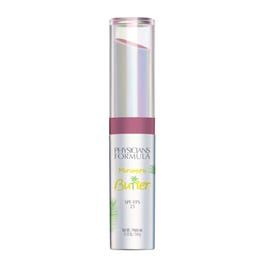
Physicians Formula Murumuru Butter Lip Cream, SPF 15, Mauvin to Brazil
Works for
1 of 2 advertised claims delivered
Sun protectionSPF 15 · 4 UV filters · Broad spectrumWeak protectionSPF under 30
This product offers broad spectrum sun protection, but it is weak. We recommend to use a broad spectrum sunscreen with at least SPF 30.
MoisturizingAstrocaryum murumuru seed butter, Caprylic/capric triglyceride + 8 moreGood evidence
“Packed with essential fatty acids and pro-vitamins that soften, condition and moisturize lips, leaving them silky soft.”
This product can help soften the skin and reduce its moisture loss with emollients and occlusives: caprylic/capric triglyceride, copernicia cerifera wax.
Keep in mind that this product does not contain effective ingredients to attract water to the upper layer of the skin. This is why an additional product with humectants like glycerin or hyaluronic acid can be helpful (apply it before this product for the best results).
Can it cause trouble?
Irritancy1 strong irritant: ParfumMedium risk
Comedogenic2 ingredients rated 2 or more on the 0–5 pore-clogging scale2 flagged
User reviews
Be the first — your take helps the next person decide.
Ingredients
Filter by role to see what each ingredient is doing.
Butyl methoxydibenzoylmethane~23–34%
- Irritation risk
- Medium
Avobenzone. An organic, or so-called "chemical" UV filter. Protects against both UVA and UVB rays. Needs to be combined with other filters in a formulation to be stable.
More about Butyl methoxydibenzoylmethaneEthylhexyl methoxycinnamate~5–7.5%
- Irritation risk
- High
Octinoxate. When used in higher concentrations, works as a sunscreen protecting the skin from UVB rays. When used in lower concentration, helps to preserve the product formulation. Is shown to be harmful to coral reefs - consider avoiding bathing in coral reef areas when wearing a product with this ingredient. It can be irritating
More about Ethylhexyl methoxycinnamateOctocrylene~4.6–7%
- Irritation risk
- Medium
A weak sunscreen that protects against the sun rays that cause sunburn (UVB) and is somewhat effective against the UVA rays. It is quite stable and can help stabilize other, more vulnerable, sunscreen ingredients like Avobenzone. It is an organic, or so called "chemical" sunscreen
More about OctocrylenePolybutene~3.6–5.4%
Simmondsia chinensis seed oil~2.9–4.4%
- Irritation risk
- Medium
Softens the upper layer of skin and helps restore the healthy skin barrier. Has shown to help calm down inflammation in skin. It is a stable oil, meaning that it retains its properties even when exposed to air.
More about Simmondsia chinensis seed oilDiisostearyl malate~2–3%
- Irritation risk
- Medium
Helps to soften the upper layer of the skin
More about Diisostearyl malatePolyethylene~1.7–2.5%
Tridecyl trimellitate~1.2–1.8%
- Irritation risk
- Medium
Used to create a thicker product consistency and soften the upper layer of the skin
More about Tridecyl trimellitateOctyldodecanol~0.95–1.45%
- Irritation risk
- Low
An emollient that helps to soften the skin and create a pleasant product texture and stabilize the formulation
More about OctyldodecanolPunica granatum sterols~0.6–1.35%
- Irritation risk
- Low
Isostearyl hydroxystearate~0.55–1.25%
- Irritation risk
- Low
Trimethylolpropane triisostearate~0.45–1.05%
- Irritation risk
- Low
Caprylic/capric triglyceride~0.4–1%
- Irritation risk
- Medium
A good mix of fatty acids that forms a protective layer on the skin. Improves the shelf life of products. Derived from coconut and glycerin
More about Caprylic/capric triglycerideEuphorbia cerifera wax~0.45–1.1%
- Irritation risk
- Low
Hydrogenated polycyclopentadiene~0.35–0.8%
- Irritation risk
- Low
Astrocaryum murumuru seed butter~0.35–0.8%
- Irritation risk
- Medium
Helps soften the upper layer of the skin. Could be comedogenic due to the myrisic acid content
More about Astrocaryum murumuru seed butterAstrocaryum tucuma seed butter~0.35–0.8%
- Irritation risk
- Low
Butyrospermum parkii butter~0.35–0.75%
- Irritation risk
- Low
- Comedogenicity
- 3/5
A great moisturising ingredient that softens the skin and reduces water loss from its upper layer. It also can be helpful in protecting skin from free radicals
More about Butyrospermum parkii butterTheobroma grandiflorum seed butter~0.15–0.6%
- Irritation risk
- Medium
Helps soften the upper layer of the skin and might as well help to attract moisture to its upper layer
More about Theobroma grandiflorum seed butterTriisostearyl citrate~0.2–0.7%
- Irritation risk
- Low
Phenoxyethanol~0.15–0.55%
- Irritation risk
- Low
A preservative. It helps prevent bacterial growth in cosmetic products
More about PhenoxyethanolParfum~0.1–0.45%
- Irritation risk
- High
An aromatic blend of unspecified and possibly irritating ingredients
More about ParfumStevia rebaudiana leaf/stem extract~0.1–0.5%
- Irritation risk
- Low
Tetrahexyldecyl ascorbate~0.15–0.7%
- Irritation risk
- Medium
Being a lipid soluble form of vitamin C, it is more stable than ascorbic acid, but still degrades quickly and needs to be stabilized in a formulation with another ingredient. It is claimed to penetrate skin better than pure vitamin C and have the the similar benefits, but solid studies of its effectiveness are lacking. Is likely to require a higher concentration in a product than pure vitamin C to be effective. It might be able to help reduce pore clogging.
More about Tetrahexyldecyl ascorbateTocopheryl acetate~0.15–0.7%
- Irritation risk
- Medium
A more stable but less bio-available form of vitamin E compared to Tocopherol. Might help moisturize and protect the skin from free radicals, but mostly used in low concentrations to stabilize other ingredients.
More about Tocopheryl acetateCopernicia cerifera wax~0.3–0.7%
- Irritation risk
- Low
Helps to soften the upper layer of the skin and create a nice product consistency
More about Copernicia cerifera waxTocopherol~0.15–0.65%
- Irritation risk
- Low
Pure form of vitamin E. Can help moisturise and protect the skin from free radicals. Often used to help stabilise other ingredients or the formula itself
More about TocopherolBht~0.15–0.6%
Blue 1 lake~0.15–0.6%
Ci 75470~0.15–0.55%
Iron oxides~0.15–0.5%
- Irritation risk
- Low
An umbrella term for the following three colorants: CI 77491, CI 77492, CI 77499. They might be able to offer some protection against visible light, but the degree of the protection is not clear
More about Iron oxidesCi 77742~0.1–0.5%
Mica~0.15–0.6%
- Irritation risk
- Low
Creates an illusion of smoother and more radiant skin tone. Adds shimmer to the skin by reflecting light
More about MicaCi 15850~0.1–0.4%
Ci 45410~0.1–0.35%
Titanium dioxide~0.1–0.3%
- Irritation risk
- Low
Works as a UV filter when used in high concentrations. It is photostable and is effective mostly against the UVB light, with some protection in the UVA range. In small concentrations, used for its ability to improve the color of cosmetic products. Is usually well tolerated by the skin
More about Titanium dioxideCi 19140~0.05–0.3%
Ingredient list view
Butyl methoxydibenzoylmethane, Ethylhexyl methoxycinnamate, Octocrylene, Polybutene, Simmondsia chinensis seed oil, Diisostearyl malate, Polyethylene, Tridecyl trimellitate, Octyldodecanol, Punica granatum sterols, Isostearyl hydroxystearate, Trimethylolpropane triisostearate, Caprylic/capric triglyceride, Euphorbia cerifera wax, Hydrogenated polycyclopentadiene, Astrocaryum murumuru seed butter, Astrocaryum tucuma seed butter, Butyrospermum parkii butter, Theobroma grandiflorum seed butter, Triisostearyl citrate, Phenoxyethanol, Parfum, Stevia rebaudiana leaf/stem extract, Tetrahexyldecyl ascorbate, Tocopheryl acetate, Copernicia cerifera wax, Tocopherol, Bht, Blue 1 lake, Ci 75470, Iron oxides, Ci 77742, Mica, Ci 15850, Ci 45410, Titanium dioxide, Ci 19140
Compare prices
Retailers ranked by price — lowest first.

Product summary
"Physicians Formula - Murumuru Butter Lip Cream, SPF 15, Mauvin to Brazil" "is a broad spectrum lip sunscreen meaning that it protects both from UVB rays (" burning "- they cause sunburn) and UVA rays (" aging "- they don't cause sunburn but lead to premature aging and pigmentation issues). However, this lip sunscreen does not offer enough sun protection. We recommend to use a sunscreen with at least SPF 30 daily.
Sunscreen filters
This is a" mixed "sunscreen in the sense that it uses both mineral and organic (so-called" chemical ") sun filters. The organic filters in the product are: avobenzone, octinoxate and octocrylene. As for the mineral filters, this sunscreen uses titanium dioxide.
Irritation risk
It contains a bunch of common irritants, including ingredients that do not provide any known benefit for the skin. It might not be the best choice if your skin is sensitive. We assess the overall irritancy of it to be medium. For a detailed overview of all potential irritants: click here
You can see the detailed formula review with the breakdown of all actives in the product and the full ingredient list with estimated concentrations in the tables below.
Price
The product retails from 7.37$ up to 12.00$ in the United States and for 6.88£ in the United Kingdom.
For a detailed price comparison: click here.
Sources cited in this review
Every concentration estimate and effectiveness label is anchored to one of these 9 studies and safety reviews.
- 1
- 2
- 3Advanced Skin Care – A Novel Ingredientncbi.nlm.nih.gov
- 4
- 5
- 6Vitamin E in dermatologyncbi.nlm.nih.gov

Affiliate links · As an Amazon Associate, WIMJ earns from qualifying purchases.