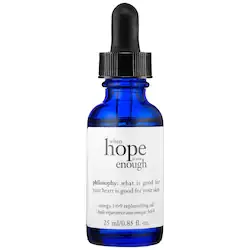
Philosophy When Hope Is Not Enough - Omega 3-6-9 Replenishing Oil
Works for
1 of 1 advertised claim delivered
Moisturizing13 ingredients credited for this claimGood support
“It helps improve suppleness and elasticity while boosting moisture retention.”
This product can help soften the skin and reduce its moisture loss with emollients and occlusives: helianthus annuus seed oil, borago officinalis seed oil.
Keep in mind that this product does not contain effective ingredients to attract water to the upper layer of the skin. This is why an additional product with humectants like glycerin or hyaluronic acid can be helpful (apply it before this product for the best results).
Anti-oxidationNot advertised by the brand · 5 ingredients credited for this claimStrong support
This product contains antioxidants (tocotrienols) that can help neutralize free radicals in skin. By doing so, they can lessen the damage the skin gets from the UV light (sun).
Anti-agingNot advertised by the brand · 5 ingredients credited for this claimModerate support
This product contains tocotrienols. This ingredient might be able to help reduce and prevent fine lines and wrinkles, improve skin elasticity and firmness, but there is not enough evidence that it actually works.
Anti-blemishNot advertised by the brand · 2 ingredients credited for this claimGood support
This product might be able to help reduce blemishes and clogged pores because it contains ethyl linoleate.
Can it cause trouble?
Irritancy14 strong irritants: Parfum, Retinyl palmitate + 12 more — patch-test recommendedHigh risk
ComedogenicClean of flagged comedogenic ingredientsNone flagged
User reviews
Be the first — your take helps the next person decide.
Ingredients
Filter by role to see what each ingredient is doing.
Cyclopentasiloxane~23–35%
- Irritation risk
- Low
A silicone that helps improve the product texture and spreadability. Can absorb oil creating a short-term mattifying effect on the skin
More about CyclopentasiloxanePrunus amygdalus dulcis oil~4.1–6.1%
- Irritation risk
- Low
An emollient that softens the skin
More about Prunus amygdalus dulcis oilHelianthus annuus seed oil~4.5–6.8%
- Irritation risk
- Low
A great emollient due to its high linoleic acid content. One of the most effective plant oils in helping skin hydration and repairing skin barrier function
More about Helianthus annuus seed oilIsononyl isononanoate~3.8–5.7%
- Irritation risk
- Low
Forms a protective film on the surface of the skin to prevent moisture loss. Gives a velvety feel to products while reducing tackiness
More about Isononyl isononanoateC12-15 alkyl benzoate~2.8–4.2%
- Irritation risk
- Low
Enhances the product texture and makes it more spreadable. Helps reduce water loss from the outer layer of skin. Extands the shelf life by preventing bacteria growth
More about C12-15 alkyl benzoateBorago officinalis seed oil~2.1–3.2%
- Irritation risk
- Low
A plant oil that is effective in reducing irritation in skin, restore the barrier function and support its hydration
More about Borago officinalis seed oilTetrahexyldecyl ascorbate~1.5–2.2%
- Irritation risk
- Medium
Being a lipid soluble form of vitamin C, it is more stable than ascorbic acid, but still degrades quickly and needs to be stabilized in a formulation with another ingredient. It is claimed to penetrate skin better than pure vitamin C and have the the similar benefits, but solid studies of its effectiveness are lacking. Is likely to require a higher concentration in a product than pure vitamin C to be effective. It might be able to help reduce pore clogging.
More about Tetrahexyldecyl ascorbateParfum~1.3–1.9%
- Irritation risk
- High
An aromatic blend of unspecified and possibly irritating ingredients
More about ParfumLinum usitatissimum seed oil~1.1–1.6%
Tocopherol~0.9–1.35%
- Irritation risk
- Low
Pure form of vitamin E. Can help moisturise and protect the skin from free radicals. Often used to help stabilise other ingredients or the formula itself
More about TocopherolTocotrienols~0.85–1.25%
- Irritation risk
- Low
A type of vitamin E that is more powerful in neutralizing free radicals compared to its other forms
More about TocotrienolsTriolein~0.45–1.1%
Trilinolein~0.45–1%
- Irritation risk
- Low
Retinyl palmitate~0.4–0.9%
- Irritation risk
- High
Three steps removed from the active form of vitamin A - retinoic acid. To have an effect in the skin, it first needs to be converted twice to become the retinoic acid. This means it is less potent than retinol, but could also be less irritating. Once converted to the retinoic acid in the skin, it helps against all signs of aging, improves skin cell turnover and helps fight blemishes and clogged pores. However, in many cosmetic formulations, it is used in a concentration that is too low to have the full effect
More about Retinyl palmitateLecithin~0.45–1.05%
- Irritation risk
- Low
Used mostly for creating emulsions - helping oil and water mix together. Helps soften the upper layer of the skin
More about LecithinArachidyl propionate~0.45–1%
- Irritation risk
- Low
Ethyl linoleate~0.4–0.95%
- Irritation risk
- Medium
Helps reduce acne and blemishes. Helps to soften the upper layer of the skin and reduce inflammation. Might be helpful in reducing hyperpigmentation and evening out the skin tone, but evidence of effectiveness in skin are lacking
More about Ethyl linoleateEthyl linolenate~0.4–0.95%
- Irritation risk
- Low
Ethyl oleate~0.35–0.85%
- Irritation risk
- Medium
Ethyl oleate is a long-chain fatty acid ethyl ester resulting from the formal condensation of the carboxy group of oleic acid with the hydroxy group of ethanol. It derives from an oleic acid. In skincare, it is used to soften the upper layer of the skin, improve the product texture and smell
More about Ethyl oleateOctyldodecanol~0.35–0.8%
- Irritation risk
- Low
An emollient that helps to soften the skin and create a pleasant product texture and stabilize the formulation
More about OctyldodecanolCitronellol~0.2–0.7%
Amyl cinnamal~0.15–0.7%
- Irritation risk
- High
Benzyl alcohol~0.15–0.6%
- Irritation risk
- High
A preservative. Can be used to mask unpleasant smell. Can be irritating
More about Benzyl alcoholBenzyl benzoate~0.15–0.6%
- Irritation risk
- High
Fragrance with sweet balsamic smell. Help to preserve products and dissolve other ingredients. Could trigger allergic reactions and be irritating
More about Benzyl benzoateBenzyl salicylate~0.15–0.6%
Butylphenyl methylpropional~0.15–0.55%
- Irritation risk
- High
A fragrance. Can trigger allergic reactions and be irritating
More about Butylphenyl methylpropionalEugenol~0.15–0.5%
Geraniol~0.1–0.5%
Hexyl cinnamal~0.1–0.45%
Hydroxycitronellal~0.1–0.4%
- Irritation risk
- High
A fragrance. A likely allergen and can be irritating
More about HydroxycitronellalHydroxyisohexyl 3-cyclohexene carboxaldehyde~0.1–0.4%
- Irritation risk
- High
A fragrance. Can be irritating
More about Hydroxyisohexyl 3-cyclohexene carboxaldehydeLimonene~0.1–0.4%
- Irritation risk
- High
A common frangrance that can easily irritate skin, especially if exposed to air, light or heat
More about LimoneneLinalool~0.1–0.35%
Bht~0.05–0.3%
Phenoxyethanol~0.1–0.35%
- Irritation risk
- Low
A preservative. It helps prevent bacterial growth in cosmetic products
More about PhenoxyethanolIngredient list view
Cyclopentasiloxane, Prunus amygdalus dulcis oil, Helianthus annuus seed oil, Isononyl isononanoate, C12-15 alkyl benzoate, Borago officinalis seed oil, Tetrahexyldecyl ascorbate, Parfum, Linum usitatissimum seed oil, Tocopherol, Tocotrienols, Triolein, Trilinolein, Retinyl palmitate, Lecithin, Arachidyl propionate, Ethyl linoleate, Ethyl linolenate, Ethyl oleate, Octyldodecanol, Citronellol, Amyl cinnamal, Benzyl alcohol, Benzyl benzoate, Benzyl salicylate, Butylphenyl methylpropional, Eugenol, Geraniol, Hexyl cinnamal, Hydroxycitronellal, Hydroxyisohexyl 3-cyclohexene carboxaldehyde, Limonene, Linalool, Bht, Phenoxyethanol
Compare prices
Retailers ranked by price — lowest first.
Worth comparing, line by line.
Match % combines shared ingredients, the first five ingredients, shared actives and hero ingredients, irritancy (lower counts in the alternative's favour), texture and body area. Only products in the same routine step are compared.
| PhilosophyWhen Hope Is Not Enough - Omega 3-6-9 Replenishing OilYOUR PRODUCT | Mount LaiBrightening Berry Vitamin C Facial Oil | |
|---|---|---|
| Match | — | 51% |
| Price | $83.29 | — |
| Shared key ingredients | — | 2 of 9 |
| Key difference | — | Cannabis Sativa Seed Oil |
| Irritancy | High | Medium |
| Drying alcohol | — | — |
| View product | Shop |

Sources cited in this review
Every concentration estimate and effectiveness label is anchored to one of these 19 studies and safety reviews.
- 1
- 2
- 3
- 4Effect of topically applied lipids on surfactant-irritated skinonlinelibrary.wiley.com
- 5
- 6

Affiliate links · As an Amazon Associate, WIMJ earns from qualifying purchases.