Works for:
based on ingredients and %- Anti-oxidation
- Anti-aging
- Moisturizing
- Evens skin tone
Can it cause trouble?
- Irritation risk: high
- Comedogenic risk ingredients: 2
Key actives
Anti-aging
What does the product description say?
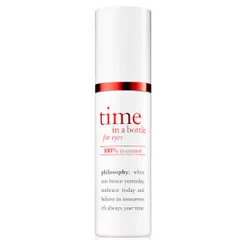
Turn back the clock with the Time in a Bottle Eye Serum from science-led wellbeing beauty brand, philosophy ; a breakthrough eye serum that diminishes the signs of visible ageing and energises the delicate eye area.
Source: Lookfantastic
This product can help reduce and prevent fine lines and wrinkles, improve skin elasticity and firmness because it contains adenosine.
These ingredients in the product can also be helpful, even though there is less evidence for their effectiveness: carnosine.
Keep in mind that it typically takes at least 6 weeks to notice any results because the changes that are needed to improve fine lines and elasticity happen in the deeper layers of the skin. No topical anti-aging product can “erase” wrinkles or fully reverse signs of aging.
Might help improve cell turnover and reduce inflammation in skin. One study shows that the ingredients might be able to help reduce dynamic wrinkles (for example, in the corners of the eyes or on the forehead)
A type of peptide. It attracts water to the upper layer of the skin. It can help neutralize free radicals in skin combatting the sun damage
A vitamin C derivative that is more stable but less potent than pure form of vitamin C. Can help neutralize free radicals and help reduce hyperpigmentation, but the required concentration is likely to be much higher than for the pure form of vitamin C, limiting the ingredient's effectiveness in products
Might be helpful in restoring skin barrier function and, when combined with zinc carbonate and malonic acid, reducing fine lines and wrinkles by stimulating elastin production. Also helps stabilize the product formulation
Can contain potent anti-oxidant compounds (abbreviated ECG, GCG, EGC, and EGCG) that might help protect the skin from free radicals. Can help calm down inflammation and has some anti-bacterial properties. Unfortunately, these antioxidants are unstable and lose their effectiveness very quickly in products. The concentration of the antioxidant compounds in the extract also tends to be low to be effective in topical formulation
The most well-researched antioxidant that works in skin. Helps neutralize free radicals supporting collagen production, helping to even out the skin tone and preventing early signs of aging
Three steps removed from the active form of vitamin A - retinoic acid. To have an effect in the skin, it first needs to be converted twice to become the retinoic acid. This means it is less potent than retinol, but could also be less irritating. Once converted to the retinoic acid in the skin, it helps against all signs of aging, improves skin cell turnover and helps fight blemishes and clogged pores. However, in many cosmetic formulations, it is used in a concentration that is too low to have the full effect
An exfoliating and moisturizing alpha-hydroxy acid (AHA). Typically causes less irritation than other AHAs, for example, glycolic acid. At high concentrations (about 15%), lactic acid can help reduce lines and wrinkles. Recent studies show that lactic acid can support the "good" bacteria living on skin's surface (healthy skin microbiome)
Pure form of vitamin E. Can help moisturise and protect the skin from free radicals. Often used to help stabilise other ingredients or the formula itself
Being a lipid soluble form of vitamin C, it is more stable and can penetrate the skin better than L-Ascorbic acid. It is effective in protecting the skin from free radicals, as well as evening the skin tone, but is less effective in stimulating collagen production compared to L-Ascorbic acid.
Anti-oxidation
This product contains antioxidants (carnosine) that can help neutralize free radicals in skin. By doing so, they can lessen the damage the skin gets from the UV light (sun).
The following ingredients - 3-o-ethyl ascorbic acid, camellia sinensis leaf extract, ginkgo biloba leaf extract also can have an antioxidant effect, but there is less evidence to confirm their effectiveness in skin.
A type of peptide. It attracts water to the upper layer of the skin. It can help neutralize free radicals in skin combatting the sun damage
Can contain potent anti-oxidant compounds (abbreviated ECG, GCG, EGC, and EGCG) that might help protect the skin from free radicals. Can help calm down inflammation and has some anti-bacterial properties. Unfortunately, these antioxidants are unstable and lose their effectiveness very quickly in products. The concentration of the antioxidant compounds in the extract also tends to be low to be effective in topical formulation
A vitamin C derivative that is more stable but less potent than pure form of vitamin C. Can help neutralize free radicals and help reduce hyperpigmentation, but the required concentration is likely to be much higher than for the pure form of vitamin C, limiting the ingredient's effectiveness in products
A plant extract that might help neutralize free radicals and reduce inflammation in skin. It can be irritating
Plant extract. Might have some anti-oxidant properties. Can be irritating
Might be helpful in neutralizing free radicals in skin
Consists of remains of dead bacteria cells. Is likely helpful in attracting water to the upper layer of the skin. Might be helpful in reducing inflammation and neutralizing free radicals in skin. It is claimed to be a "DNA repair enzyme"
A plant extract that might have anti-oxidant properties
Might help improve cell turnover and reduce inflammation in skin. One study shows that the ingredients might be able to help reduce dynamic wrinkles (for example, in the corners of the eyes or on the forehead)
Might be helpful in neutralizing free radicals. Can have a dehydration effect that might somewhat decrease the look of puffy eyes
A fruit extract that is used to add a fragrance to the product. It might have some antioxidant properties
Pure form of vitamin E. Can help moisturise and protect the skin from free radicals. Often used to help stabilise other ingredients or the formula itself
The most well-researched antioxidant that works in skin. Helps neutralize free radicals supporting collagen production, helping to even out the skin tone and preventing early signs of aging
Consists of remains of dead yeast bacteria cells. Helps to hydrate the skin and reduce irritation. Might has some anti-oxidant effect
Being a lipid soluble form of vitamin C, it is more stable and can penetrate the skin better than L-Ascorbic acid. It is effective in protecting the skin from free radicals, as well as evening the skin tone, but is less effective in stimulating collagen production compared to L-Ascorbic acid.
A grain extract that helps to create a thicker product consistency. It might have some anti-oxidant properties and help attract water to the upper layer of the skin
Evens skin tone
The following ingredient (ingredients) in this product might be helpful, but there is no evidence to confirm that it actually works: 3-o-ethyl ascorbic acid.
A vitamin C derivative that is more stable but less potent than pure form of vitamin C. Can help neutralize free radicals and help reduce hyperpigmentation, but the required concentration is likely to be much higher than for the pure form of vitamin C, limiting the ingredient's effectiveness in products
Can contain potent anti-oxidant compounds (abbreviated ECG, GCG, EGC, and EGCG) that might help protect the skin from free radicals. Can help calm down inflammation and has some anti-bacterial properties. Unfortunately, these antioxidants are unstable and lose their effectiveness very quickly in products. The concentration of the antioxidant compounds in the extract also tends to be low to be effective in topical formulation
The most well-researched antioxidant that works in skin. Helps neutralize free radicals supporting collagen production, helping to even out the skin tone and preventing early signs of aging
An exfoliating and moisturizing alpha-hydroxy acid (AHA). Typically causes less irritation than other AHAs, for example, glycolic acid. At high concentrations (about 15%), lactic acid can help reduce lines and wrinkles. Recent studies show that lactic acid can support the "good" bacteria living on skin's surface (healthy skin microbiome)
Three steps removed from the active form of vitamin A - retinoic acid. To have an effect in the skin, it first needs to be converted twice to become the retinoic acid. This means it is less potent than retinol, but could also be less irritating. Once converted to the retinoic acid in the skin, it helps against all signs of aging, improves skin cell turnover and helps fight blemishes and clogged pores. However, in many cosmetic formulations, it is used in a concentration that is too low to have the full effect
Consists of remains of dead yeast bacteria cells. Helps to hydrate the skin and reduce irritation. Might has some anti-oxidant effect
Moisturizing
This product can help improve hydration of the skin with the two types of ingredients.
The first type is called “humectants”:
these ingredients help attract water.
When humectants are on the surface of the skin, they “pull in” the moisture from the outside environment, or from
within deeper layers of the skin. The following ingredients in this product do the job:
carnosine, glycerin.
This product also contains ingredients called “occlusives”. They help reduce the speed with which our skin loses moisture to the outside environment. These ingredients also help soften the upper layer of the skin, so it feels less tight and nicer to the touch. The following ingredients in this product do the job: squalane, bis-peg-18 methyl ether dimethyl silane.
One of the best moisturizing ingredients. Naturally present in skin. It attracts water to the upper layer of the skin working as a humectant
A product of bacterial fermentation. Can help attract water to the upper layer of the skin
Consists of remains of dead bacteria cells. Is likely helpful in attracting water to the upper layer of the skin. Might be helpful in reducing inflammation and neutralizing free radicals in skin. It is claimed to be a "DNA repair enzyme"
A type of peptide. It attracts water to the upper layer of the skin. It can help neutralize free radicals in skin combatting the sun damage
An oil naturally present in skin. Works as an emollient to soften the skin and form a protective layer on its surface without a greasy feeling.
Might help improve cell turnover and reduce inflammation in skin. One study shows that the ingredients might be able to help reduce dynamic wrinkles (for example, in the corners of the eyes or on the forehead)
Can help attract water to the upper layer of the skin
Helps attract water to the upper layer of the skin. Could be helpful in restoring the skin barrier function
Helps preserve products and creates a nice product texture
Used to create a nice product consistency
Helps oil and water mix together and can enhance the penetration of other ingredients into the skin. It can be irritating
A type of silicone that helps soften the upper layer of the skin and create a nice product texture
Can contain potent anti-oxidant compounds (abbreviated ECG, GCG, EGC, and EGCG) that might help protect the skin from free radicals. Can help calm down inflammation and has some anti-bacterial properties. Unfortunately, these antioxidants are unstable and lose their effectiveness very quickly in products. The concentration of the antioxidant compounds in the extract also tends to be low to be effective in topical formulation
A good mix of fatty acids that forms a protective layer on the skin. Improves the shelf life of products. Derived from coconut and glycerin
An exfoliating and moisturizing alpha-hydroxy acid (AHA). Typically causes less irritation than other AHAs, for example, glycolic acid. At high concentrations (about 15%), lactic acid can help reduce lines and wrinkles. Recent studies show that lactic acid can support the "good" bacteria living on skin's surface (healthy skin microbiome)
Consists of remains of dead yeast bacteria cells. Helps to hydrate the skin and reduce irritation. Might has some anti-oxidant effect
Pure form of vitamin E. Can help moisturise and protect the skin from free radicals. Often used to help stabilise other ingredients or the formula itself
A grain extract that helps to create a thicker product consistency. It might have some anti-oxidant properties and help attract water to the upper layer of the skin
Used mostly for creating emulsions - helping oil and water mix together. Helps soften the upper layer of the skin
How honest is this product?
| Promise | Can it deliver? |
|---|---|
| Anti-aging | |
| Anti-oxidation |
Total Promises Fulfilled score: 100/100.
We receive a small commission for purchases made through these links at no cost for you. Thank you for your support! Learn more
Affiliate link · supports WIMJ at no cost to you
Potential irritants
Comedogenic ingredients
User reviews (0)
Averages from community submissions.
No reviews yet for this product.
Be the first to share your experience!
Tried this product?
Help capture what the ingredient list can't—texture, finish, pilling, scent, and more. Answer what you can, skip the rest.
Takes ~30 seconds.
Reviews are shown in aggregate. No personal details.
Key Actives
Can contain potent anti-oxidant compounds (abbreviated ECG, GCG, EGC, and EGCG) that might help protect the skin from free radicals. Can help calm down inflammation and has some anti-bacterial properties. Unfortunately, these antioxidants are unstable and lose their effectiveness very quickly in products. The concentration of the antioxidant compounds in the extract also tends to be low to be effective in topical formulation
A plant extract that might help neutralize free radicals and reduce inflammation in skin. It can be irritating
Pure form of vitamin E. Can help moisturise and protect the skin from free radicals. Often used to help stabilise other ingredients or the formula itself
An exfoliating and moisturizing alpha-hydroxy acid (AHA). Typically causes less irritation than other AHAs, for example, glycolic acid. At high concentrations (about 15%), lactic acid can help reduce lines and wrinkles. Recent studies show that lactic acid can support the "good" bacteria living on skin's surface (healthy skin microbiome)
Three steps removed from the active form of vitamin A - retinoic acid. To have an effect in the skin, it first needs to be converted twice to become the retinoic acid. This means it is less potent than retinol, but could also be less irritating. Once converted to the retinoic acid in the skin, it helps against all signs of aging, improves skin cell turnover and helps fight blemishes and clogged pores. However, in many cosmetic formulations, it is used in a concentration that is too low to have the full effect
A vitamin C derivative that is more stable but less potent than pure form of vitamin C. Can help neutralize free radicals and help reduce hyperpigmentation, but the required concentration is likely to be much higher than for the pure form of vitamin C, limiting the ingredient's effectiveness in products
Consists of remains of dead yeast bacteria cells. Helps to hydrate the skin and reduce irritation. Might has some anti-oxidant effect
A type of peptide. It attracts water to the upper layer of the skin. It can help neutralize free radicals in skin combatting the sun damage
Might help improve cell turnover and reduce inflammation in skin. One study shows that the ingredients might be able to help reduce dynamic wrinkles (for example, in the corners of the eyes or on the forehead)
Consists of remains of dead bacteria cells. Is likely helpful in attracting water to the upper layer of the skin. Might be helpful in reducing inflammation and neutralizing free radicals in skin. It is claimed to be a "DNA repair enzyme"
Might be helpful in neutralizing free radicals. Can have a dehydration effect that might somewhat decrease the look of puffy eyes
One of the best moisturizing ingredients. Naturally present in skin. It attracts water to the upper layer of the skin working as a humectant
Helps thicken the product consistency
Sulisobenzone. A UV filter. Is typically used to improve the product stability under exposure to UV light. It is effective against both UVA and UVB rays. It can be used is larger concentrations as a sun protection ingredient for the skin, but can be irritating
An oil naturally present in skin. Works as an emollient to soften the skin and form a protective layer on its surface without a greasy feeling.
A good mix of fatty acids that forms a protective layer on the skin. Improves the shelf life of products. Derived from coconut and glycerin
A product of bacterial fermentation. Can help attract water to the upper layer of the skin
Works as a UV filter when used in high concentrations. It is photostable and is effective mostly against the UVB light, with some protection in the UVA range. In small concentrations, used for its ability to improve the color of cosmetic products. Is usually well tolerated by the skin
Potential irritants
Sulisobenzone. A UV filter. Is typically used to improve the product stability under exposure to UV light. It is effective against both UVA and UVB rays. It can be used is larger concentrations as a sun protection ingredient for the skin, but can be irritating
A vitamin C derivative that is more stable but less potent than pure form of vitamin C. Can help neutralize free radicals and help reduce hyperpigmentation, but the required concentration is likely to be much higher than for the pure form of vitamin C, limiting the ingredient's effectiveness in products
Helps oil and water mix together and can enhance the penetration of other ingredients into the skin. It can be irritating
A plant extract that might help neutralize free radicals and reduce inflammation in skin. It can be irritating
Can be drying and contribute to skin irritation. Used in formulars to dissolve other ingredients, create a thinner product consistency or for its antibacterial properties
Plant extract. Might have some anti-oxidant properties. Can be irritating
A fruit extract that is used to add a fragrance to the product. It might have some antioxidant properties
The most well-researched antioxidant that works in skin. Helps neutralize free radicals supporting collagen production, helping to even out the skin tone and preventing early signs of aging
Three steps removed from the active form of vitamin A - retinoic acid. To have an effect in the skin, it first needs to be converted twice to become the retinoic acid. This means it is less potent than retinol, but could also be less irritating. Once converted to the retinoic acid in the skin, it helps against all signs of aging, improves skin cell turnover and helps fight blemishes and clogged pores. However, in many cosmetic formulations, it is used in a concentration that is too low to have the full effect
A gelling agent that thickens the product consistency and leaves the skin with a velvety finish
Helps to control the skin's pH level. Maintains the skin's natural film of amino-lactic acids and oils. Helps to preserve products
Can work as an exfoliant but is typically used to adjust the product pH
Might be helpful in neutralizing free radicals. Can have a dehydration effect that might somewhat decrease the look of puffy eyes
Helps preserve products and creates a nice product texture
A plant extract that might have anti-oxidant properties
A good mix of fatty acids that forms a protective layer on the skin. Improves the shelf life of products. Derived from coconut and glycerin
Maintains the texture of skincare products. Allows the product to spread evenly. Helps oil and water mix together
An exfoliating and moisturizing alpha-hydroxy acid (AHA). Typically causes less irritation than other AHAs, for example, glycolic acid. At high concentrations (about 15%), lactic acid can help reduce lines and wrinkles. Recent studies show that lactic acid can support the "good" bacteria living on skin's surface (healthy skin microbiome)
Being a lipid soluble form of vitamin C, it is more stable and can penetrate the skin better than L-Ascorbic acid. It is effective in protecting the skin from free radicals, as well as evening the skin tone, but is less effective in stimulating collagen production compared to L-Ascorbic acid.
Can help attract water to the upper layer of the skin
Comedogenic ingredients
Can help attract water to the upper layer of the skin
All ingredients
Acts as a solvent for other ingredients. Speeds up the absorption of other ingredients into the skin
A type of silicone that helps soften the upper layer of the skin and create a nice product texture
One of the best moisturizing ingredients. Naturally present in skin. It attracts water to the upper layer of the skin working as a humectant
Sulisobenzone. A UV filter. Is typically used to improve the product stability under exposure to UV light. It is effective against both UVA and UVB rays. It can be used is larger concentrations as a sun protection ingredient for the skin, but can be irritating
A gelling agent that thickens the product consistency and leaves the skin with a velvety finish
An oil naturally present in skin. Works as an emollient to soften the skin and form a protective layer on its surface without a greasy feeling.
A preservative. It helps prevent bacterial growth in cosmetic products
A vitamin C derivative that is more stable but less potent than pure form of vitamin C. Can help neutralize free radicals and help reduce hyperpigmentation, but the required concentration is likely to be much higher than for the pure form of vitamin C, limiting the ingredient's effectiveness in products
Helps oil and water mix together and can enhance the penetration of other ingredients into the skin. It can be irritating
Helps to control the skin's pH level. Maintains the skin's natural film of amino-lactic acids and oils. Helps to preserve products
Consists of remains of dead yeast bacteria cells. Helps to hydrate the skin and reduce irritation. Might has some anti-oxidant effect
Can work as an exfoliant but is typically used to adjust the product pH
Might be helpful in neutralizing free radicals. Can have a dehydration effect that might somewhat decrease the look of puffy eyes
Helps preserve products and creates a nice product texture
A plant extract that might have anti-oxidant properties
A type of peptide. It attracts water to the upper layer of the skin. It can help neutralize free radicals in skin combatting the sun damage
A grain extract that helps to create a thicker product consistency. It might have some anti-oxidant properties and help attract water to the upper layer of the skin
A good mix of fatty acids that forms a protective layer on the skin. Improves the shelf life of products. Derived from coconut and glycerin
Might help improve cell turnover and reduce inflammation in skin. One study shows that the ingredients might be able to help reduce dynamic wrinkles (for example, in the corners of the eyes or on the forehead)
A plant extract that might help neutralize free radicals and reduce inflammation in skin. It can be irritating
Used mostly for creating emulsions - helping oil and water mix together. Helps soften the upper layer of the skin
Can be drying and contribute to skin irritation. Used in formulars to dissolve other ingredients, create a thinner product consistency or for its antibacterial properties
Plant extract. Might have some anti-oxidant properties. Can be irritating
Helps attract water to the upper layer of the skin. Could be helpful in restoring the skin barrier function
Pure form of vitamin E. Can help moisturise and protect the skin from free radicals. Often used to help stabilise other ingredients or the formula itself
Maintains the texture of skincare products. Allows the product to spread evenly. Helps oil and water mix together
An exfoliating and moisturizing alpha-hydroxy acid (AHA). Typically causes less irritation than other AHAs, for example, glycolic acid. At high concentrations (about 15%), lactic acid can help reduce lines and wrinkles. Recent studies show that lactic acid can support the "good" bacteria living on skin's surface (healthy skin microbiome)
Used to stabilize mixtures of oil and water, and create thicker, gel-like product textures
Being a lipid soluble form of vitamin C, it is more stable and can penetrate the skin better than L-Ascorbic acid. It is effective in protecting the skin from free radicals, as well as evening the skin tone, but is less effective in stimulating collagen production compared to L-Ascorbic acid.
A product of bacterial fermentation. Can help attract water to the upper layer of the skin
Can contain potent anti-oxidant compounds (abbreviated ECG, GCG, EGC, and EGCG) that might help protect the skin from free radicals. Can help calm down inflammation and has some anti-bacterial properties. Unfortunately, these antioxidants are unstable and lose their effectiveness very quickly in products. The concentration of the antioxidant compounds in the extract also tends to be low to be effective in topical formulation
Might be helpful in neutralizing free radicals in skin
A fruit extract that is used to add a fragrance to the product. It might have some antioxidant properties
Used to stabilize the product formulation and can help absorb oil
Might be helpful in restoring skin barrier function and, when combined with zinc carbonate and malonic acid, reducing fine lines and wrinkles by stimulating elastin production. Also helps stabilize the product formulation
The most well-researched antioxidant that works in skin. Helps neutralize free radicals supporting collagen production, helping to even out the skin tone and preventing early signs of aging
Can help attract water to the upper layer of the skin
Consists of remains of dead bacteria cells. Is likely helpful in attracting water to the upper layer of the skin. Might be helpful in reducing inflammation and neutralizing free radicals in skin. It is claimed to be a "DNA repair enzyme"
Three steps removed from the active form of vitamin A - retinoic acid. To have an effect in the skin, it first needs to be converted twice to become the retinoic acid. This means it is less potent than retinol, but could also be less irritating. Once converted to the retinoic acid in the skin, it helps against all signs of aging, improves skin cell turnover and helps fight blemishes and clogged pores. However, in many cosmetic formulations, it is used in a concentration that is too low to have the full effect
Works as a UV filter when used in high concentrations. It is photostable and is effective mostly against the UVB light, with some protection in the UVA range. In small concentrations, used for its ability to improve the color of cosmetic products. Is usually well tolerated by the skin
Creates an illusion of smoother and more radiant skin tone. Adds shimmer to the skin by reflecting light
Ingredient list view
Water, Propanediol, Bis-peg-18 methyl ether dimethyl silane, Glycerin, Methyl methacrylate crosspolymer, Benzophenone-4, Polyethylene, Hydroxyethyl acrylate/sodium acryloyldimethyl taurate copolymer, Squalane, Ptfe, Xanthan gum, Phenoxyethanol, 3-o-ethyl ascorbic acid, Propylene glycol, Sodium citrate, Bifida ferment lysate, Citric acid, Caffeine, Caprylyl glycol, 1,2-hexanediol, Sodium hydroxide, Polysorbate 60, Plantago lanceolata leaf extract, Carnosine, Oryza sativa extract, Caprylic/capric triglyceride, Disodium edta, Adenosine, Ginkgo biloba leaf extract, Physalis pubescens fruit juice, Peg-8, Lecithin, Alcohol, Aesculus hippocastanum seed extract, Glucose, Tocopherol, Acrylates/c10-30 alkyl acrylate crosspolymer, Lactic acid, Silica, Hydrolyzed soy flour, Sodium carbonate, Sodium phosphate, Saccharomyces/grape ferment extract, Bht, Sodium chloride, Ascorbyl palmitate, Potassium sorbate, Sodium benzoate, Bacillus ferment, Camellia sinensis leaf extract, Coffea arabica seed extract, Pongamia pinnata seed extract, Punica granatum fruit extract, Angelica archangelica root extract, Citrus aurantium amara peel extract, Hydrolyzed vegetable protein, Maltodextrin, Trisodium edta, Acetic acid, Magnesium aluminum silicate, Potassium chloride, Potassium phosphate, Ascorbic acid, Sclerotium gum, Plankton extract, Micrococcus lysate, Sorbic acid, Retinyl palmitate, Titanium dioxide, Mica, Ci 16035
- Glycerol and the skin: holistic approach to its origin and functions
- Benzophenone 4: An emerging allergen in cosmetics and toiletries?
- Safety Assessment of Fluoropolymers as Used in Cosmetics
- Antioxidant Ability and Stability Studies of 3-O-Ethyl Ascorbic Acid, a Cosmetic Tyrosinase Inhibitor
- Surfactants and experimental irritant contact dermatitis
- Propylene Glycol
- Skin-sensitizing and irritant properties of propylene glycol
- Bifidobacterium longumlysate, a new ingredient forreactive skin
- Use of Probiotics for Dermal Applications
- The influence of alkane chain length on the skin irritation potential of 1,2-alkanediols
- Biological activities of the natural imidazole-containing peptidomimetics n-acetylcarnosine, carcinine and l-carnosine in ophthalmic and skin care products
- Antioxidant and Anti-Inflammatory Properties of Anthocyanins Extracted from Oryza sativa L. in Primary Dermal Fibroblasts
- Rice antioxidants: phenolic acids, flavonoids, anthocyanins, proanthocyanidins, tocopherols, tocotrienols, c-oryzanol, and phytic acid
- Evaluation of anti-wrinkle efficacy of adenosine-containing products using the FOITS technique
- Safety Assessment of Ginkgo biloba-Derived Ingredients as Used in Cosmetics
- Cosmeceutical Critique: Ginkgo Biloba
- Contact dermatitis as an adverse reaction to some topically used European herbal medicinal products – part 1: Achillea millefolium–Curcuma longa
- Topical Glucose Induces Claudin-1 and Filaggrin Expression in a Mouse Model of Atopic Dermatitis and in Keratinocyte Culture, Exerting Anti-inflammatory Effects by Repairing Skin Barrier Function
- Vitamin E in dermatology
- Vitamin E and Skin Health
- Epidermal and dermal effects of topical lactic acid
- Dual Effects of Alpha-Hydroxy Acids on the Skin
- Effect of green Coffea arabica L. seed oil on extracellular matrix components and water-channel expression in in vitro and ex vivo human skin models
- Final report on the safety assessment of EDTA, calcium disodium EDTA, diammonium EDTA, dipotassium EDTA, disodium EDTA, TEA-EDTA, tetrasodium EDTA, tripotassium EDTA, trisodium EDTA, HEDTA, and trisodium HEDTA
- Final report on the safety assessment of aluminum silicate, calcium silicate, magnesium aluminum silicate, magnesium silicate, magnesium trisilicate, sodium magnesium silicate, zirconium silicate, attapulgite, bentonite, Fuller's earth, hectorite, kaolin, lithium magnesium silicate, lithium magnesium sodium silicate, montmorillonite, pyrophyllite, and zeolite
- Extracellular matrix in cutaneous ageing: the effects of 0.1% copper-zinc malonate-containing cream on elastin biosynthesis