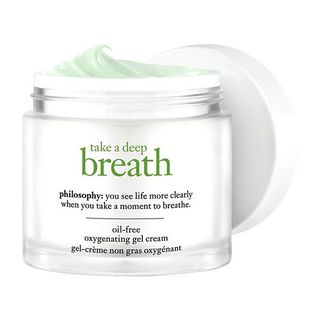
Philosophy Take A Deep Breath Oil-Free Oxygenating Gel Cream
Works for
1 of 1 advertised claim delivered
Moisturizing19 ingredients credited for this claimGood support
“Take a deep breath oil-free, oxygenating moisturizer restores and refreshes a dull, dry complexion suffering from effects of a busy lifestyle that can age skin.”
This product can help improve hydration of the skin with the two types of ingredients.
The first type is called “humectants”:
these ingredients help attract water.
When humectants are on the surface of the skin, they “pull in” the moisture from the outside environment, or from
within deeper layers of the skin. The following ingredients in this product do the job:
glycerin, hydrolyzed hyaluronic acid.
This product also contains ingredients called “occlusives”. They help reduce the speed with which our skin loses moisture to the outside environment. These ingredients also help soften the upper layer of the skin, so it feels less tight and nicer to the touch. The following ingredients in this product do the job: dimethicone, jojoba esters.
Anti-oxidationNot advertised by the brand · 6 ingredients credited for this claimModerate support
This product contains antioxidants (ginkgo biloba leaf extract) that might be able to help neutralize free radicals in skin to lessen the damage it gets from the UV light (sun). There is not enough evidence to confirm their effectiveness in skin though.
Can it cause trouble?
Irritancy2 strong irritants: Citrus aurantium amara peel extract, AlcoholMedium risk
ComedogenicClean of flagged comedogenic ingredientsNone flagged
User reviews
Be the first — your take helps the next person decide.
Ingredients
Filter by role to see what each ingredient is doing.
Water~45–55%
Butylene glycol~6–7.3%
- Irritation risk
- Low
Used to create a nice product texture and help delivery of other ingredients. Might be somewhat helpful in attracting water to the upper layer of the skin
More about Butylene glycolCyclopentasiloxane~4.3–5.3%
- Irritation risk
- Low
A silicone that helps improve the product texture and spreadability. Can absorb oil creating a short-term mattifying effect on the skin
More about CyclopentasiloxaneMethyl gluceth-20~3–3.7%
- Irritation risk
- Low
Helps attract water to the upper layer of the skin and soften it
More about Methyl gluceth-20Cyclohexasiloxane~2.3–2.8%
- Irritation risk
- Low
A silicone that serves as an emollient. Helps create a nice non-greasy feels
More about CyclohexasiloxaneHydrogenated polyisobutene~1.9–2.4%
- Irritation risk
- Low
Used to improve the product consistency and soften the upper layer of the skin
More about Hydrogenated polyisobuteneGlycerin~1.6–2%
- Irritation risk
- Low
One of the best moisturizing ingredients. Naturally present in skin. It attracts water to the upper layer of the skin working as a humectant
More about GlycerinPerfluorodecalin~1.3–1.5%
- Irritation risk
- Low
Tocopherol~0.95–1.2%
- Irritation risk
- Low
Pure form of vitamin E. Can help moisturise and protect the skin from free radicals. Often used to help stabilise other ingredients or the formula itself
More about TocopherolHydrolyzed hyaluronic acid~0.7–1.05%
- Irritation risk
- Low
One of the best moisturizing ingredients. Attracts water into the upper layer of the skin. A version of it is naturally present in skin
More about Hydrolyzed hyaluronic acidLactic acid~0.55–0.8%
- Irritation risk
- Medium
An exfoliating and moisturizing alpha-hydroxy acid (AHA). Typically causes less irritation than other AHAs, for example, glycolic acid. At high concentrations (about 15%), lactic acid can help reduce lines and wrinkles. Recent studies show that lactic acid can support the "good" bacteria living on skin's surface (healthy skin microbiome)
More about Lactic acidCoffea arabica seed extract~0.45–0.7%
- Irritation risk
- Low
Might be helpful in neutralizing free radicals in skin
More about Coffea arabica seed extractCamellia sinensis leaf extract~0.45–0.65%
- Irritation risk
- Low
Can contain potent anti-oxidant compounds (abbreviated ECG, GCG, EGC, and EGCG) that might help protect the skin from free radicals. Can help calm down inflammation and has some anti-bacterial properties. Unfortunately, these antioxidants are unstable and lose their effectiveness very quickly in products. The concentration of the antioxidant compounds in the extract also tends to be low to be effective in topical formulation
More about Camellia sinensis leaf extractJojoba esters~0.4–0.65%
- Irritation risk
- Medium
An emollient made of jojoba oil. Helps soften the skin and support its barrier function
More about Jojoba estersCetyl alcohol~0.4–0.6%
- Irritation risk
- Low
A non-drying alcohol that works to soften the skin and stabilize product formulations helping oil and water mix together
More about Cetyl alcoholC13-14 isoparaffin~0.35–0.65%
- Irritation risk
- Low
Helps soften the upper layer of the skin, dissolve other ingredients and create a thicker product consistency
More about C13-14 isoparaffinSilica~0.5–0.8%
Dimethicone~0.3–0.6%
- Irritation risk
- Low
A silicone that helps to reduce water loss from the surface of the skin. Can temporarily "fill in" lines and wrinkles, absorb oil, and create a nice product finish
More about DimethiconeAngelica archangelica root extract~0.2–0.35%
- Irritation risk
- Low
Citrus aurantium amara peel extract~0.2–0.4%
- Irritation risk
- High
Ginkgo biloba leaf extract~0.2–0.4%
- Irritation risk
- High
A plant extract that might help neutralize free radicals and reduce inflammation in skin. It can be irritating
More about Ginkgo biloba leaf extractPongamia pinnata seed extract~0.2–0.4%
- Irritation risk
- Low
Tocopheryl acetate~0.2–0.4%
- Irritation risk
- Medium
A more stable but less bio-available form of vitamin E compared to Tocopherol. Might help moisturize and protect the skin from free radicals, but mostly used in low concentrations to stabilize other ingredients.
More about Tocopheryl acetatePolysorbate 80~0.25–0.45%
Laureth-7~0.25–0.45%
Hydrolyzed jojoba esters~0.25–0.4%
- Irritation risk
- Low
Helps soften the upper layer of the skin
More about Hydrolyzed jojoba estersCaffeine~0.2–0.4%
- Irritation risk
- Medium
Might be helpful in neutralizing free radicals. Can have a dehydration effect that might somewhat decrease the look of puffy eyes
More about CaffeineHydrogenated lecithin~0.25–0.45%
- Irritation risk
- Low
Helps to retain moisture by creating a protective barrier on the skin. Rich in fatty acids. Improves product texture and helps with the penetration of other ingredients.
More about Hydrogenated lecithinGlucose~0.2–0.4%
- Irritation risk
- Low
Helps attract water to the upper layer of the skin. Could be helpful in restoring the skin barrier function
More about GlucoseDicaprylyl carbonate~0.25–0.45%
- Irritation risk
- Low
Helps products spread more easily and works as an emollient to soften skin
More about Dicaprylyl carbonateOctyldodecyl neopentanoate~0.25–0.5%
- Irritation risk
- Low
An emollient that helps soften the skin. Often used to stabilize other ingredients, for example, sunscreen
More about Octyldodecyl neopentanoateAmmonium acryloyldimethyltaurate/vp copolymer~0.25–0.4%
- Irritation risk
- Low
Increases thickness of a product. Texture enhancer for oil-in-water emulsions
More about Ammonium acryloyldimethyltaurate/vp copolymerButylene/ethylene/styrene copolymer~0.25–0.4%
- Irritation risk
- Low
Used to create a gel-like product texture
More about Butylene/ethylene/styrene copolymerEthylene/propylene/styrene copolymer~0.25–0.4%
- Irritation risk
- Low
Used to create a thicker product consistency
More about Ethylene/propylene/styrene copolymerCarbomer~0.25–0.4%
- Irritation risk
- Low
Helps create a thicker or gel-like product texture. It is not a surfactant but can be used in gentle cleansing formulations
More about CarbomerPolyacrylamide~0.25–0.45%
- Irritation risk
- Medium
Used to improve product texture and help oil and water mix together
More about PolyacrylamideAlcohol~0.25–0.4%
- Irritation risk
- High
Can be drying and contribute to skin irritation. Used in formulars to dissolve other ingredients, create a thinner product consistency or for its antibacterial properties
More about AlcoholBenzyl alcohol~0.2–0.35%
- Irritation risk
- High
A preservative. Can be used to mask unpleasant smell. Can be irritating
More about Benzyl alcohol1,2-hexanediol~0.2–0.4%
Tin oxide~0.35–0.6%
- Irritation risk
- Low
A colorant that can add a pearl-like appearance to the formulation
More about Tin oxidePropylene glycol~0.2–0.4%
- Irritation risk
- High
Helps oil and water mix together and can enhance the penetration of other ingredients into the skin. It can be irritating
More about Propylene glycolSodium benzoate~0.25–0.45%
Potassium sorbate~0.25–0.45%
Disodium edta~0.2–0.4%
Hydrolyzed soy flour~0.2–0.4%
- Irritation risk
- Low
Bht~0.2–0.35%
O-cymen-5-ol~0.05–0.1%
Caprylyl glycol~0.2–0.35%
- Irritation risk
- Medium
Helps preserve products and creates a nice product texture
More about Caprylyl glycolPhenoxyethanol~0.15–0.25%
- Irritation risk
- Low
A preservative. It helps prevent bacterial growth in cosmetic products
More about PhenoxyethanolTitanium dioxide~0.25–0.45%
- Irritation risk
- Low
Works as a UV filter when used in high concentrations. It is photostable and is effective mostly against the UVB light, with some protection in the UVA range. In small concentrations, used for its ability to improve the color of cosmetic products. Is usually well tolerated by the skin
More about Titanium dioxideCi 77891~0.15–0.25%
- Irritation risk
- Low
Ci 42090~0.1–0.15%
Ingredient list view
Water, Butylene glycol, Cyclopentasiloxane, Methyl gluceth-20, Cyclohexasiloxane, Hydrogenated polyisobutene, Glycerin, Perfluorodecalin, Tocopherol, Hydrolyzed hyaluronic acid, Lactic acid, Coffea arabica seed extract, Camellia sinensis leaf extract, Jojoba esters, Cetyl alcohol, C13-14 isoparaffin, Silica, Dimethicone, Angelica archangelica root extract, Citrus aurantium amara peel extract, Ginkgo biloba leaf extract, Pongamia pinnata seed extract, Tocopheryl acetate, Polysorbate 80, Laureth-7, Hydrolyzed jojoba esters, Caffeine, Hydrogenated lecithin, Glucose, Dicaprylyl carbonate, Octyldodecyl neopentanoate, Ammonium acryloyldimethyltaurate/vp copolymer, Butylene/ethylene/styrene copolymer, Ethylene/propylene/styrene copolymer, Carbomer, Polyacrylamide, Alcohol, Benzyl alcohol, 1,2-hexanediol, Tin oxide, Propylene glycol, Sodium benzoate, Potassium sorbate, Disodium edta, Hydrolyzed soy flour, Bht, O-cymen-5-ol, Caprylyl glycol, Phenoxyethanol, Titanium dioxide, Ci 77891, Unknown, Ci 42090
Compare prices
Retailers ranked by price — lowest first.
Sources cited in this review
Every concentration estimate and effectiveness label is anchored to one of these 24 studies and safety reviews.
- 1
- 2
- 3Vitamin E in dermatologyncbi.nlm.nih.gov
- 4Vitamin E and Skin Healthlpi.oregonstate.edu
- 5Efficacy of a New Topical Nano-hyaluronic Acid in Humansncbi.nlm.nih.gov
- 6Physiochemical properties and application of hyaluronic acid: a systematic reviewonlinelibrary.wiley.com

Affiliate links · As an Amazon Associate, WIMJ earns from qualifying purchases.