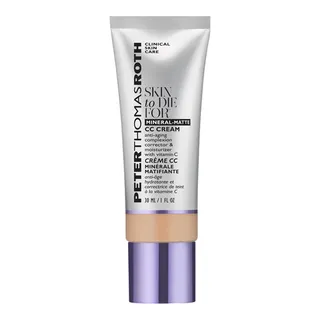
Peter Thomas Roth Skin To Die For Mineral-Matte CC Cream
Works for
MoisturizingCyclopentasiloxane, Isododecane + 11 moreWorks
“Addresses skincare concerns for uneven skin tone, dullness, dehydration”
This product can help improve hydration of the skin with the two types of ingredients.
The first type is called “humectants”:
these ingredients help attract water.
When humectants are on the surface of the skin, they “pull in” the moisture from the outside environment, or from
within deeper layers of the skin. The following ingredients in this product do the job:
glycerin.
This product also contains ingredients called “occlusives”. They help reduce the speed with which our skin loses moisture to the outside environment. These ingredients also help soften the upper layer of the skin, so it feels less tight and nicer to the touch. The following ingredients in this product do the job: dimethicone, peg-10 dimethicone.
Evens skin toneTetrahexyldecyl ascorbate ~0.2–0.35%, below the ~4% it needsUnder-dosed
“Addresses skincare concerns for uneven skin tone, dullness, dehydration”
Effective ingredients missing or their concentration is too low
Anti-agingTetrahexyldecyl ascorbate ~0.2–0.35%, below the ~4% it needsUnder-dosed
“Helps minimize the look of imperfections for skin that looks younger, smoother, brighter and more evenly toned, immediately and over time.”
Effective ingredients missing or their concentration is too low.
Can it cause trouble?
Irritancy7 flagged ingredientsLow risk
ComedogenicClean of flagged comedogenic ingredientsNone flagged
User reviews
Be the first — your take helps the next person decide.
Ingredients
Filter by role to see what each ingredient is doing.
Water~45–55%
Cyclopentasiloxane~7.1–8.7%
- Irritation risk
- Low
A silicone that helps improve the product texture and spreadability. Can absorb oil creating a short-term mattifying effect on the skin
More about CyclopentasiloxaneIsododecane~4.3–5.3%
- Irritation risk
- Low
An emollient that helps soften the skin and can decrease moisture loss. Helps create a nice product texture
More about IsododecaneDimethicone~3.3–4%
- Irritation risk
- Low
A silicone that helps to reduce water loss from the surface of the skin. Can temporarily "fill in" lines and wrinkles, absorb oil, and create a nice product finish
More about DimethiconeC12-15 alkyl benzoate~2.4–3%
- Irritation risk
- Low
Enhances the product texture and makes it more spreadable. Helps reduce water loss from the outer layer of skin. Extands the shelf life by preventing bacteria growth
More about C12-15 alkyl benzoateGlycerin~2–2.5%
- Irritation risk
- Low
One of the best moisturizing ingredients. Naturally present in skin. It attracts water to the upper layer of the skin working as a humectant
More about GlycerinPeg-10 dimethicone~1.8–2.2%
- Irritation risk
- Low
A silicone that works to soften the upper layer of the skin and reduce its water loss
More about Peg-10 dimethiconePolyglyceryl-4 isostearate~1.5–1.8%
- Irritation risk
- Medium
Helps water and oil mix together
More about Polyglyceryl-4 isostearateHexyl laurate~1.2–1.5%
- Irritation risk
- Medium
Helps soften the upper layer of the skin and create a nice product consistency
More about Hexyl laurateCetyl peg/ppg-10/1 dimethicone~0.95–1.15%
- Irritation risk
- Low
A type of silicone that helps water and oil mix together. Can help to soften upper layer of the skin
More about Cetyl peg/ppg-10/1 dimethiconeCyclohexasiloxane~0.7–1.1%
- Irritation risk
- Low
A silicone that serves as an emollient. Helps create a nice non-greasy feels
More about CyclohexasiloxaneKaolin~0.95–1.15%
- Irritation risk
- Low
A type of clay that consists mainly of aluminum silicate. Helps absorb oil and creates a thicker product consistency. Can be used to add a white color
More about KaolinMagnesium sulfate~0.55–0.85%
Nylon-12~0.6–0.85%
Phenyl trimethicone~0.45–0.65%
- Irritation risk
- Low
A type of silicone that can decrease loss of moisture from the skin surface. It helps create a nice product texture
More about Phenyl trimethiconeSorbitan isostearate~0.45–0.65%
- Irritation risk
- Low
Helps oil and water mix together
More about Sorbitan isostearateDimethicone/vinyl dimethicone crosspolymer~0.4–0.6%
- Irritation risk
- Low
Used to stabilize product formulations and create a nice product texture
More about Dimethicone/vinyl dimethicone crosspolymerStearic acid~0.5–0.75%
- Irritation risk
- Low
Helps oil and water mix together and works as an emollient
More about Stearic acidAlumina~0.45–0.7%
- Irritation risk
- Low
The same compound that is used safely in dental implants and bone cements. In cosmetics, it is used to improve the consistency of products
More about AluminaPhenoxyethanol~0.3–0.5%
- Irritation risk
- Low
A preservative. It helps prevent bacterial growth in cosmetic products
More about PhenoxyethanolSilica silylate~0.25–0.5%
Polyhydroxystearic acid~0.3–0.5%
- Irritation risk
- Medium
Used to create a thicker product consistency and stabilize the formulation
More about Polyhydroxystearic acidPolysilicone-11~0.25–0.5%
- Irritation risk
- Low
A silicone that forms a light film on the skin surface helping to bind water and temporarily absorb oils creating a matt and powdery feel
More about Polysilicone-11Triethoxycaprylylsilane~0.2–0.4%
- Irritation risk
- Low
A type of silicone that helps oil and water mix well together. Helps to disperse other ingredients, e.g. pigments, evenly in a formulation
More about TriethoxycaprylylsilaneEthylhexylglycerin~0.25–0.4%
Mica~0.25–0.45%
- Irritation risk
- Low
Creates an illusion of smoother and more radiant skin tone. Adds shimmer to the skin by reflecting light
More about MicaDisodium edta~0.2–0.4%
Silica~0.35–0.6%
Hydrolyzed sodium hyaluronate~0.2–0.35%
- Irritation risk
- Low
Attracts water into the upper layer of the skin
More about Hydrolyzed sodium hyaluronateTocopheryl acetate~0.2–0.4%
- Irritation risk
- Medium
A more stable but less bio-available form of vitamin E compared to Tocopherol. Might help moisturize and protect the skin from free radicals, but mostly used in low concentrations to stabilize other ingredients.
More about Tocopheryl acetateTetrahexyldecyl ascorbate~0.2–0.35%
- Irritation risk
- Medium
Being a lipid soluble form of vitamin C, it is more stable than ascorbic acid, but still degrades quickly and needs to be stabilized in a formulation with another ingredient. It is claimed to penetrate skin better than pure vitamin C and have the the similar benefits, but solid studies of its effectiveness are lacking. Is likely to require a higher concentration in a product than pure vitamin C to be effective. It might be able to help reduce pore clogging.
More about Tetrahexyldecyl ascorbateTitanium dioxide~0.25–0.45%
- Irritation risk
- Low
Works as a UV filter when used in high concentrations. It is photostable and is effective mostly against the UVB light, with some protection in the UVA range. In small concentrations, used for its ability to improve the color of cosmetic products. Is usually well tolerated by the skin
More about Titanium dioxideCi 77891~0.15–0.3%
- Irritation risk
- Low
Zinc oxide~0.2–0.35%
- Irritation risk
- Low
A broad spectrum sunblock (protects from both UVA and UVB rays). Is suitable for most sensitive skins. In small concentrations, can be used as a colorant
More about Zinc oxideCi 77947~0.1–0.2%
- Irritation risk
- Low
Iron oxides~0.1–0.15%
- Irritation risk
- Low
An umbrella term for the following three colorants: CI 77491, CI 77492, CI 77499. They might be able to offer some protection against visible light, but the degree of the protection is not clear
More about Iron oxidesIngredient list view
Water, Cyclopentasiloxane, Isododecane, Dimethicone, C12-15 alkyl benzoate, Glycerin, Peg-10 dimethicone, Polyglyceryl-4 isostearate, Hexyl laurate, Cetyl peg/ppg-10/1 dimethicone, Cyclohexasiloxane, Kaolin, Magnesium sulfate, Nylon-12, Phenyl trimethicone, Sorbitan isostearate, Dimethicone/vinyl dimethicone crosspolymer, Stearic acid, Alumina, Phenoxyethanol, Silica silylate, Polyhydroxystearic acid, Polysilicone-11, Triethoxycaprylylsilane, Ethylhexylglycerin, Mica, Disodium edta, Silica, Hydrolyzed sodium hyaluronate, Tocopheryl acetate, Tetrahexyldecyl ascorbate, Titanium dioxide, Ci 77891, Zinc oxide, Ci 77947, Iron oxides
Compare prices
Retailers ranked by price — lowest first.
Worth comparing, line by line.
Match % combines shared ingredients, the first five ingredients, shared actives and hero ingredients, irritancy (lower counts in the alternative's favour), texture and body area. Only products in the same routine step are compared.
| Peter Thomas RothSkin To Die For Mineral-Matte CC CreamYOUR PRODUCT | L'Oréal ParisMagic Skin Beautifier BB Cream, Light | Lottie LondonVelvet Skin Tint | Dr. Jart+Tiger Grass Color Correcting Treatment | |
|---|---|---|---|---|
| Match | — | 34% | 33% | 29% |
| Price | — | $10.97 | $5.32 | $19.09 |
| Shared key ingredients | — | 4 of 9 | 5 of 9 | 6 of 9 |
| Key difference | — | Panthenol | Cocos Nucifera Fruit Extract | Madecassoside |
| Irritancy | Low | Low | Low | High |
| Drying alcohol | — | — | Contains drying alcohol | — |
| View product | Shop | Shop | Shop |


More alternatives: Kerstin Florian Luminizing CC Creme - PorcelainEtude House Correct & Care CC Cream Glow 30 SPF
Sources cited in this review
Every concentration estimate and effectiveness label is anchored to one of these 12 studies and safety reviews.
- 1
- 2Final Report on the Safety Assessment of Dimethicone Copolyoljournals.sagepub.com
- 3
- 4Safety Assessment of Magnesium Sulfate as Used in Cosmeticsncbi.nlm.nih.gov
- 5
- 6

Affiliate links · As an Amazon Associate, WIMJ earns from qualifying purchases.