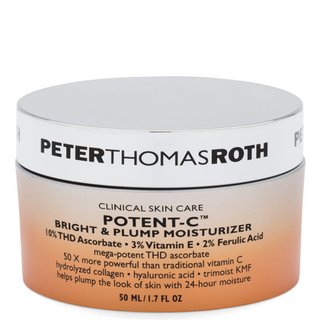
Peter Thomas Roth Potent-C Moisturizer
Works for
3 of 3 advertised claims delivered
Anti-aging7 ingredients credited for this claimStrong support
“Anti-aging, firming and brightening moisturizer that combines THD Ascorbate mega-potent Vitamin C with Hydrolyzed Collagen and Trimoist KMF to plump the look of skin with 24-hour hydration.”
This product can help reduce and prevent fine lines and wrinkles, improve skin elasticity and firmness because it contains tetrahexyldecyl ascorbate.
These ingredients in the product can also be helpful, even though there is less evidence for their effectiveness: carnosine, ferulic acid.
Keep in mind that it typically takes at least 6 weeks to notice any results because the changes that are needed to improve fine lines and elasticity happen in the deeper layers of the skin. No topical anti-aging product can “erase” wrinkles or fully reverse signs of aging.
Moisturizing27 ingredients credited for this claimStrong support
“Potent-C Moisturizer”
This product can help improve hydration of the skin with the two types of ingredients.
The first type is called “humectants”:
these ingredients help attract water.
When humectants are on the surface of the skin, they “pull in” the moisture from the outside environment, or from
within deeper layers of the skin. The following ingredients in this product do the job:
carnosine, glycerin.
This product also contains ingredients called “occlusives”. They help reduce the speed with which our skin loses moisture to the outside environment. These ingredients also help soften the upper layer of the skin, so it feels less tight and nicer to the touch. The following ingredients in this product do the job: glycine soja sterols, hydrolyzed collagen.
The following ingredients in this product are especially good for supporting the skin barrier and helping with the hydration level: ceramide np
Evens skin tone4 ingredients credited for this claimStrong support
“Diamond Powder works to scatter light to impart a healthy-looking luminosity while bioengineered Ginger Root Extract helps to prevent the appearance of age spots and discolouration.”
This product can help reduce hypepigmentation and even out the skin tone because it contains the following effective ingredients: tetrahexyldecyl ascorbate
The following ingredient (ingredients) in this product might be helpful, but there is no evidence to confirm that it actually can help even out the skin tone: ferulic acid.
Keep in mind that you would need to apply any topical skincare targetted at hypigmentation consistently for a couple of months to get a result. No topical skincare product can help get rid of hyperpigmentation (including post-acne marks and age spots) instantly.
Anti-oxidationNot advertised by the brand · 9 ingredients credited for this claimStrong support
This product contains antioxidants (carnosine, ferulic acid, tetrahexyldecyl ascorbate) that can help neutralize free radicals in skin. By doing so, they can lessen the damage the skin gets from the UV light (sun).
The following ingredients - haematococcus pluvialis extract also can have an antioxidant effect, but there is less evidence to confirm their effectiveness in skin.
Can it cause trouble?
Irritancy1 strong irritant: Zingiber officinale root extractMedium risk
Comedogenic1 ingredient rated 2 or more on the 0–5 pore-clogging scale1 flagged
User reviews
Be the first — your take helps the next person decide.
Ingredients
Filter by role to see what each ingredient is doing.
Water~45–55%
Propanediol~4.5–5.5%
- Irritation risk
- Low
Acts as a solvent for other ingredients. Speeds up the absorption of other ingredients into the skin
More about PropanediolTetrahexyldecyl ascorbate~4.2–5.1%
- Irritation risk
- Medium
Being a lipid soluble form of vitamin C, it is more stable than ascorbic acid, but still degrades quickly and needs to be stabilized in a formulation with another ingredient. It is claimed to penetrate skin better than pure vitamin C and have the the similar benefits, but solid studies of its effectiveness are lacking. Is likely to require a higher concentration in a product than pure vitamin C to be effective. It might be able to help reduce pore clogging.
More about Tetrahexyldecyl ascorbateC9-12 alkane~3.3–4%
Saccharomyces ferment filtrate~2.6–3.2%
- Irritation risk
- Low
A product of yeast fermentation. Helps attract water to the upper layer of the skin
More about Saccharomyces ferment filtrateGlycerin~2.2–2.7%
- Irritation risk
- Low
One of the best moisturizing ingredients. Naturally present in skin. It attracts water to the upper layer of the skin working as a humectant
More about GlycerinTocopheryl acetate~1.8–2.2%
- Irritation risk
- Medium
A more stable but less bio-available form of vitamin E compared to Tocopherol. Might help moisturize and protect the skin from free radicals, but mostly used in low concentrations to stabilize other ingredients.
More about Tocopheryl acetateBehenyl alcohol~1.6–2%
- Irritation risk
- Low
Non-drying alcohol that helps water and oil mix together. Also serves as an emollient
More about Behenyl alcoholStearic acid~1.5–1.8%
- Irritation risk
- Low
Helps oil and water mix together and works as an emollient
More about Stearic acidFerulic acid~1.2–1.4%
- Irritation risk
- Low
A potent anti-oxidant that has been shown to be effective in neutralizing free radicals in skin. There seem to have a synergetic effect of ferulic acid, vitamin E and C, meaning that when the ingredients are used together, they enhance each other's ability protect the skin against free radicals. Ferulic acid also helps to stabilize other ingredients - including vitamins C and E. It can help to even out the skin tone. Ferulic acid is approved for use as a sunscreen ingredient in Japan in concentrations up to 10%
More about Ferulic acidCetyl palmitate~1.1–1.3%
- Irritation risk
- Low
An emollient that helps soften the skin and is used to improve product texture and stability
More about Cetyl palmitatePolyglyceryl-2 stearate~0.95–1.15%
- Irritation risk
- Medium
Helps water and oil mix together
More about Polyglyceryl-2 stearateOleic acid~0.95–1.15%
- Irritation risk
- Medium
Helps soften the upper layer of the skin. At the same time, it can weaken the skin's barrier enhancing penetration of other ingredients and increasing the risk of skin dryness
More about Oleic acidSoy acid~0.8–1.2%
Polymethylsilsesquioxane~0.75–1.15%
- Irritation risk
- Low
A silicone that improves product texture and helps dissolve other ingredients. Can form a non-greasy film on the skin to prevent moisture loss
More about PolymethylsilsesquioxaneSodium hyaluronate~0.7–1.05%
- Irritation risk
- Low
One of the best moisturizing ingredients. Attracts water into the upper layer of the skin
More about Sodium hyaluronateHydrolyzed collagen~0.7–1.05%
- Irritation risk
- Low
A typically plant-derived compound that is supposed mimic human collagen. Cannot penetrate the skin barrier so is not particularly useful in skincare products beyond attracting water to the upper layer of the skin
More about Hydrolyzed collagenHydrolyzed elastin~0.65–1%
- Irritation risk
- Low
Diamond powder~0.7–1%
- Irritation risk
- Low
Does not have known skin benefits. Might help create an optical illusion of smoother skin
More about Diamond powderCurcuma longa root extract~0.55–0.8%
- Irritation risk
- High
A plant extract that can contain an active compound curcumin, that may have some anti-inflammatory properties when applied to the skin, but solid research is lacking and the typical concentration used in skincare products is too low. Can be an irritant
More about Curcuma longa root extractZingiber officinale root extract~0.55–0.8%
- Irritation risk
- High
A plant extract that can contain an irritating essential oil. Might have some anti-oxidant effect, but evidence is lacking
More about Zingiber officinale root extractTocopherol~0.55–0.8%
- Irritation risk
- Low
Pure form of vitamin E. Can help moisturise and protect the skin from free radicals. Often used to help stabilise other ingredients or the formula itself
More about TocopherolHaematococcus pluvialis extract~0.5–0.8%
- Irritation risk
- Medium
Green algae extract that might contain antioxidant astaxanthin
More about Haematococcus pluvialis extractGlyceryl stearate~0.6–0.85%
- Irritation risk
- Low
An emollient that softens the skin and forms a protective layer on its surface. Helps water and oil mix together
More about Glyceryl stearateGluconolactone~0.5–0.75%
- Irritation risk
- Medium
A polyhydroxy acid (PHA) that helps shed the dead cells from the skin surface revealing smoother skin. Is believed to be genter than AHAs. It helps attract water to the upper layer of the skin and can stimulate production of skin's own hyaluronic acid resulting in improved hydration levels. It has been shown to be helpful against acne and clogged pores if used consistently (e.g over a period of 12 weeks) in high enough concentration. It can help reduce fine lines and wrinkles and improve skin tone with long-term application. Can help neutralize free radicals
More about GluconolactoneStearyl alcohol~0.55–0.85%
- Irritation risk
- Low
An emollient that helps soften the skin
More about Stearyl alcoholPolyglyceryl-6 distearate~0.55–0.8%
- Irritation risk
- Medium
Helps oil and water mix together while softening the upper layer of the skin
More about Polyglyceryl-6 distearateCarbomer~0.5–0.8%
- Irritation risk
- Low
Helps create a thicker or gel-like product texture. It is not a surfactant but can be used in gentle cleansing formulations
More about CarbomerCoco-caprylate/caprate~0.55–0.8%
- Irritation risk
- Low
Helps to soften the upper layer of the skin without creating a greasy texture
More about Coco-caprylate/caprateSodium pca~0.5–0.75%
- Irritation risk
- Low
Naturally present in skin and helps to attract water to its upper layer
More about Sodium pcaDisodium edta~0.5–0.75%
Vegetable oil~0.55–0.85%
- Irritation risk
- Low
An oil from a mixture of different vegetables. Helps soften the upper layer of the skin
More about Vegetable oilJojoba esters~0.55–0.85%
- Irritation risk
- Medium
An emollient made of jojoba oil. Helps soften the skin and support its barrier function
More about Jojoba estersSodium stearoyl lactylate~0.55–0.8%
- Irritation risk
- Medium
Helps oil and water mix together
More about Sodium stearoyl lactylateCetyl alcohol~0.55–0.85%
- Irritation risk
- Low
A non-drying alcohol that works to soften the skin and stabilize product formulations helping oil and water mix together
More about Cetyl alcoholButyrospermum parkii butter~0.55–0.85%
- Irritation risk
- Low
- Comedogenicity
- 3/5
A great moisturising ingredient that softens the skin and reduces water loss from its upper layer. It also can be helpful in protecting skin from free radicals
More about Butyrospermum parkii butterHistidine hcl~0.5–0.75%
- Irritation risk
- Low
A salt of an amino-acid that helps attract water to the upper layer of the skin. Might be helpful in restoring the skin barrier function
More about Histidine hclSodium lactate~0.5–0.75%
- Irritation risk
- Medium
Helps attract water to the upper layer of the skin. Is often used to adjust the pH level of the product
More about Sodium lactateXanthan gum~0.55–0.8%
- Irritation risk
- Low
Used to create a thicker product consistency
More about Xanthan gumPolyglyceryl-3 beeswax~0.55–0.8%
- Irritation risk
- Medium
Helps water and oil mix together. Could be an allergen (beeswax)
More about Polyglyceryl-3 beeswaxSodium carboxymethyl beta-glucan~0.95–1.15%
- Irritation risk
- Low
Helps thicken the product formulation and create a gel-like texture
More about Sodium carboxymethyl beta-glucanCalcium gluconate~0.45–0.65%
- Irritation risk
- Low
Helps attract water to the upper layer of the skin and helps to improve appearance of the product
More about Calcium gluconateCeramide np~0.45–0.65%
- Irritation risk
- Low
A type of lipid similar to ceramides naturally present in skin. Helps to soften the upper layer of the skin and supports the skin barrier function to keep it hydrated. Can help to prevent inflammation in skin
More about Ceramide npGlycine soja sterols~0.45–0.65%
- Irritation risk
- Low
An emollient that helps soften the skin
More about Glycine soja sterolsSucrose stearate~0.45–0.65%
Carnosine~0.3–0.6%
- Irritation risk
- Low
A type of peptide. It attracts water to the upper layer of the skin. It can help neutralize free radicals in skin combatting the sun damage
More about CarnosineLactic acid~0.3–0.55%
- Irritation risk
- Medium
An exfoliating and moisturizing alpha-hydroxy acid (AHA). Typically causes less irritation than other AHAs, for example, glycolic acid. At high concentrations (about 15%), lactic acid can help reduce lines and wrinkles. Recent studies show that lactic acid can support the "good" bacteria living on skin's surface (healthy skin microbiome)
More about Lactic acidLecithin~0.3–0.6%
- Irritation risk
- Low
Used mostly for creating emulsions - helping oil and water mix together. Helps soften the upper layer of the skin
More about LecithinPolyglyceryl-10 laurate~0.25–0.5%
- Irritation risk
- Medium
Helps water and oil mix together
More about Polyglyceryl-10 laurateWheat amino acids~0.2–0.4%
- Irritation risk
- Low
Ethylhexylglycerin~0.2–0.35%
Mica~0.2–0.35%
- Irritation risk
- Low
Creates an illusion of smoother and more radiant skin tone. Adds shimmer to the skin by reflecting light
More about MicaEdta~0.15–0.25%
Sodium hydroxide~0.15–0.25%
Potassium sorbate~0.15–0.25%
Sodium benzoate~0.1–0.2%
Phenoxyethanol~0.1–0.25%
- Irritation risk
- Low
A preservative. It helps prevent bacterial growth in cosmetic products
More about PhenoxyethanolIngredient list view
Water, Propanediol, Tetrahexyldecyl ascorbate, C9-12 alkane, Saccharomyces ferment filtrate, Glycerin, Tocopheryl acetate, Behenyl alcohol, Stearic acid, Ferulic acid, Cetyl palmitate, Polyglyceryl-2 stearate, Oleic acid, Soy acid, Polymethylsilsesquioxane, Sodium hyaluronate, Hydrolyzed collagen, Hydrolyzed elastin, Diamond powder, Curcuma longa root extract, Zingiber officinale root extract, Tocopherol, Haematococcus pluvialis extract, Glyceryl stearate, Gluconolactone, Stearyl alcohol, Polyglyceryl-6 distearate, Carbomer, Coco-caprylate/caprate, Sodium pca, Disodium edta, Vegetable oil, Jojoba esters, Sodium stearoyl lactylate, Cetyl alcohol, Butyrospermum parkii butter, Histidine hcl, Sodium lactate, Xanthan gum, Polyglyceryl-3 beeswax, Sodium carboxymethyl beta-glucan, Calcium gluconate, Ceramide np, Glycine soja sterols, Sucrose stearate, Carnosine, Lactic acid, Lecithin, Polyglyceryl-10 laurate, Wheat amino acids, Ethylhexylglycerin, Mica, Edta, Sodium hydroxide, Potassium sorbate, Sodium benzoate, Phenoxyethanol
Compare prices
Retailers ranked by price — lowest first.


Product summary
Based on the ingredients included, "Peter Thomas Roth - Potent-C Moisturizer" works well for moisturizing the skin. To work well, any moisturizer needs to include a combination of water-binding and emollient ingredients. Peter Thomas Roth - Potent-C Moisturizer ticks this box. Carnosine, glycerin, hydrolyzed collagen, saccharomyces ferment filtrate and sodium hyaluronate in this product (humectants) attract water molecules to the upper layer of the skin (the water comes from the outside air or from the deeper layers of the skin if the air is dry). Emollients in this formulation (ceramide np, glycine soja sterols, hydrolyzed collagen, jojoba esters and cetyl alcohol) help to reduce the moisture loss from the skin. They also soften the skin surface and relieve the feeling of dryness and tightness.
Ingredient callouts
- This product contains acids (gluconolactone and lactic acid). Their concentration is low, and they will not have a strong exfoliating effect. Instead, they work to support the skin natural acid mantle and to attract water (as humectants). PHAs (gluconolactone) especially are great for improving skin hydration. They might be even able to stimulate the production of skin's natural humectants and support the healthy skin microbiome.
- Another benefit is that this moisturizer contain ceramides (ceramide np 0.45% - 0.65%). Ceramides are an important part of our natural skin barrier. The ceramides used in skincare are synthetic or come from plants. They help soften the skin and can help "fill the gaps" in the skin barrier, keeping the skin hydrated and resilient for longer.
Irritation risk
There are some common irritants in this product, including ingredients that do not have benefits for the skin. We assess the overall irritancy of this moisturizer to be medium. For a detailed overview of all potential irritants: click here
You can see the detailed formula review with the breakdown of all actives in the product and the full ingredient list with estimated concentrations in the tables below.
Price
The product retails for 72.00$ in the United States, for 85.54A$ in Australia, from 43.75£ up to 58.00£ in the United Kingdom and for 90.80CA$ in Canada.
For a detailed price comparison: click here.
Sources cited in this review
Every concentration estimate and effectiveness label is anchored to one of these 38 studies and safety reviews.
- 1
- 2
- 3
- 4
- 5
- 6

Affiliate links · As an Amazon Associate, WIMJ earns from qualifying purchases.