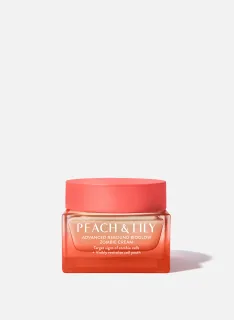
PEACH & LILY Advanced Rebound Bioglow Zombie Cream™
Works for
2 of 2 advertised claims delivered
Anti-aging12 ingredients credited for this claimStrong support
“This patent-pending formula visibly reverses 6 years in 2 weeks** while restoring the look of plump, firm, radiant skin.”
This product can help reduce and prevent fine lines and wrinkles, improve skin elasticity and firmness because it contains adenosine.
These ingredients in the product can also be helpful, even though there is less evidence for their effectiveness: aspartic acid, folic acid, hexapeptide-11, lysine, oligopeptide-1, oligopeptide-3, serine, threonine.
Keep in mind that it typically takes at least 6 weeks to notice any results because the changes that are needed to improve fine lines and elasticity happen in the deeper layers of the skin. No topical anti-aging product can “erase” wrinkles or fully reverse signs of aging.
Moisturizing47 ingredients credited for this claimStrong support
“This patent-pending formula visibly reverses 6 years in 2 weeks** while restoring the look of plump, firm, radiant skin.”
This product can help improve hydration of the skin with the two types of ingredients.
The first type is called “humectants”:
these ingredients help attract water.
When humectants are on the surface of the skin, they “pull in” the moisture from the outside environment, or from
within deeper layers of the skin. The following ingredients in this product do the job:
alanine, arginine.
This product also contains ingredients called “occlusives”. They help reduce the speed with which our skin loses moisture to the outside environment. These ingredients also help soften the upper layer of the skin, so it feels less tight and nicer to the touch. The following ingredients in this product do the job: arginine, squalane.
The following ingredients in this product are especially good for supporting the skin barrier and helping with the hydration level: ceramide np, hexapeptide-11, oligopeptide-1, oligopeptide-3
Anti-oxidationNot advertised by the brand · 7 ingredients credited for this claimStrong support
This product contains antioxidants (superoxide dismutase) that can help neutralize free radicals in skin. By doing so, they can lessen the damage the skin gets from the UV light (sun).
The following ingredients - cysteine, quercetin also can have an antioxidant effect, but there is less evidence to confirm their effectiveness in skin.
Can it cause trouble?
Irritancy1 strong irritant: Chamomilla recutita flower/leaf extractMedium risk
ComedogenicClean of flagged comedogenic ingredientsNone flagged
User reviews
Be the first — your take helps the next person decide.
Ingredients
Filter by role to see what each ingredient is doing.
Water~45–55%
Glycerin~4.3–5.3%
- Irritation risk
- Low
One of the best moisturizing ingredients. Naturally present in skin. It attracts water to the upper layer of the skin working as a humectant
More about GlycerinPropanediol~3.8–4.7%
- Irritation risk
- Low
Acts as a solvent for other ingredients. Speeds up the absorption of other ingredients into the skin
More about PropanediolSqualane~3–3.7%
- Irritation risk
- Low
An oil naturally present in skin. Works as an emollient to soften the skin and form a protective layer on its surface without a greasy feeling.
More about SqualanePentaerythrityl tetraisostearate~2.2–2.7%
- Irritation risk
- Medium
Used to create a thicker product consistency
More about Pentaerythrityl tetraisostearateDicaprylyl ether~1.8–2.2%
- Irritation risk
- Low
Helps soften the upper layer of the skin while creating a non-greasy feel on the skin. Helps to dissolve other ingredients
More about Dicaprylyl etherDiisostearyl malate~1.5–1.8%
- Irritation risk
- Medium
Helps to soften the upper layer of the skin
More about Diisostearyl malate1,2-hexanediol~0.6–0.85%
Polyglyceryl-3 distearate~1.1–1.3%
Behenyl alcohol~0.95–1.15%
- Irritation risk
- Low
Non-drying alcohol that helps water and oil mix together. Also serves as an emollient
More about Behenyl alcoholEpilobium fleischeri flower/leaf/stem extract~0.6–0.9%
- Irritation risk
- Low
Collagen amino acids~0.5–0.75%
- Irritation risk
- Low
Help attract water to the upper layer of the skin, soften it and support the skin barrier function
More about Collagen amino acidsAloe barbadensis leaf juice~0.45–0.65%
- Irritation risk
- Medium
Traditionally used to treat sunburns, dermatitis and inflammation, but evidence for its effectiveness is lacking. The extract can contain humectants that help attract water into the skin
More about Aloe barbadensis leaf juicePhospholipids~0.4–0.6%
- Irritation risk
- Low
Emollients that are naturaly present in skin. In addition, they help water and oil mix together in the product
More about PhospholipidsPolyglutamic acid~0.35–0.6%
- Irritation risk
- Low
Helps attract water to the upper layer of the skin.
More about Polyglutamic acidCeramide np~0.4–0.65%
- Irritation risk
- Low
A type of lipid similar to ceramides naturally present in skin. Helps to soften the upper layer of the skin and supports the skin barrier function to keep it hydrated. Can help to prevent inflammation in skin
More about Ceramide npLactobacillus ferment lysate~0.3–0.6%
- Irritation risk
- Low
A "broth" with parts of dead cells of lactobacteria. Might be helpful supporting diverse microbiome in skin, but evidence is lacking
More about Lactobacillus ferment lysateEctoin~0.3–0.5%
- Irritation risk
- Low
Softens the upper layer of the skin and can support skin barrier function
More about EctoinGlycosphingolipids~0.3–0.55%
- Irritation risk
- Low
A type of lipids naturally present in skin. They can be converted to ceramides in skin
More about GlycosphingolipidsGlycolipids~0.25–0.45%
- Irritation risk
- Low
Sodium hyaluronate~0.25–0.45%
- Irritation risk
- Low
One of the best moisturizing ingredients. Attracts water into the upper layer of the skin
More about Sodium hyaluronateBioflavonoids~0.2–0.4%
- Irritation risk
- Low
Houttuynia cordata extract~0.2–0.4%
- Irritation risk
- Low
Camellia sinensis leaf extract~0.25–0.45%
- Irritation risk
- Low
Can contain potent anti-oxidant compounds (abbreviated ECG, GCG, EGC, and EGCG) that might help protect the skin from free radicals. Can help calm down inflammation and has some anti-bacterial properties. Unfortunately, these antioxidants are unstable and lose their effectiveness very quickly in products. The concentration of the antioxidant compounds in the extract also tends to be low to be effective in topical formulation
More about Camellia sinensis leaf extractBacillus/soybean ferment extract~0.2–0.4%
- Irritation risk
- Low
Hexapeptide-11~0.2–0.4%
- Irritation risk
- Low
A type of peptide. Peptides are excellent moisturizers and might be able support collagen production reducing fine lines and wrinkles
More about Hexapeptide-11Oligopeptide-1~0.2–0.4%
- Irritation risk
- Low
A type of peptide. Peptides are excellent moisturizers and might be able support collagen production reducing fine lines and wrinkles
More about Oligopeptide-1Oligopeptide-2~0.2–0.4%
- Irritation risk
- Low
Oligopeptide-3~0.2–0.4%
- Irritation risk
- Low
A type of peptide. Peptides are excellent moisturizers and might be able support collagen production reducing fine lines and wrinkles
More about Oligopeptide-3Acetyl glutamine~0.2–0.4%
- Irritation risk
- Low
Folic acid~0.2–0.4%
- Irritation risk
- Low
Can help stimulate collagen production in skin. While available studies are promising, more research is needed to confirm the efficacy in skin
More about Folic acidFisetin~0.2–0.4%
- Irritation risk
- Low
Lecithin~0.25–0.5%
- Irritation risk
- Low
Used mostly for creating emulsions - helping oil and water mix together. Helps soften the upper layer of the skin
More about LecithinButylene glycol~0.2–0.4%
- Irritation risk
- Low
Used to create a nice product texture and help delivery of other ingredients. Might be somewhat helpful in attracting water to the upper layer of the skin
More about Butylene glycolSh-polypeptide-121~0.2–0.4%
- Irritation risk
- Low
Chamomilla recutita flower/leaf extract~0.25–0.4%
- Irritation risk
- High
Superoxide dismutase~0.2–0.4%
- Irritation risk
- Low
An antioxidant enzyme that is naturally present in skin. It can help support skin barrier function and reduce inflammation in skin. It is used in topical medications for inflammatory skin conditions including atopic dermatitis (eczema) and psoriasis. There are three types of natural Superoxide Dismutase in human skin. The compound used in topical treatments and cosmetics are mimics of typically one of these natural variants
More about Superoxide dismutaseLactobacillus/rice ferment filtrate~0.25–0.45%
- Irritation risk
- Low
A fermentation product created by bacteria Lactobacillus out of rice. The fermented product helps attract water to the upper layer of the skin. It has anti-bacterial properties and might be helpful in calming down inflammation, but studies are lacking
More about Lactobacillus/rice ferment filtrateAllantoin~0.2–0.4%
- Irritation risk
- Low
Helps calm down inflammation in skin and can help reduce itching. Helps to repair the skin barrier and keep skin hydrated
More about AllantoinHydrogenated lecithin~0.25–0.45%
- Irritation risk
- Low
Helps to retain moisture by creating a protective barrier on the skin. Rich in fatty acids. Improves product texture and helps with the penetration of other ingredients.
More about Hydrogenated lecithinCurcuma longa root extract~0.2–0.4%
- Irritation risk
- High
A plant extract that can contain an active compound curcumin, that may have some anti-inflammatory properties when applied to the skin, but solid research is lacking and the typical concentration used in skincare products is too low. Can be an irritant
More about Curcuma longa root extractAdenosine~0.2–0.4%
- Irritation risk
- Low
Might help improve cell turnover and reduce inflammation in skin. One study shows that the ingredients might be able to help reduce dynamic wrinkles (for example, in the corners of the eyes or on the forehead)
More about AdenosineGlycine~0.2–0.4%
- Irritation risk
- Low
Helps to attract water to the upper layer of the skin and can help restore the skin barrier function
More about GlycineSerine~0.2–0.4%
- Irritation risk
- Low
An amino-acid that helps to attract water to the upper layer of the skin. In combination with other amino-acids, might help to reduce fine lines and wrinkles
More about SerineGlutamic acid~0.2–0.4%
- Irritation risk
- Low
An amino-acid that helps attract water to the upper layer of the skin
More about Glutamic acidAspartic acid~0.2–0.4%
- Irritation risk
- Low
An amino-acid that helps increase skin hydration and might help to slightly improve skin firmness, potentially reducing lines and wrinkles
More about Aspartic acidLeucine~0.2–0.4%
- Irritation risk
- Low
Alanine~0.2–0.4%
- Irritation risk
- Low
An amino-acid that helps to attract water to the upper layer of the skin and might help to lighten the skin, but solid evidence is lacking
More about AlanineLysine~0.2–0.4%
- Irritation risk
- Low
An amino-acid that helps to attract water to the upper layer of the skin. In combination with other amino-acids, might help to reduce fine lines and wrinkles
More about LysineArginine~0.2–0.4%
- Irritation risk
- Low
An amino acid that is naturally present in skin and helps keep it hydrated. When used together with AHAs, it can reduce their irritating effect on the skin
More about ArginineTyrosine~0.2–0.4%
Phenylalanine~0.2–0.4%
- Irritation risk
- Low
Valine~0.2–0.4%
- Irritation risk
- Low
Threonine~0.2–0.4%
- Irritation risk
- Low
An amino-acid that helps to attract water to the upper layer of the skin. In combination with other amino-acids, might help to reduce fine lines and wrinkles
More about ThreonineProline~0.25–0.45%
Isoleucine~0.2–0.4%
- Irritation risk
- Low
An amino acid that can help attract water to the upper layer of the skin and support skin's barrier function
More about IsoleucineHistidine~0.2–0.4%
Methionine~0.2–0.4%
- Irritation risk
- Low
Cysteine~0.2–0.4%
- Irritation risk
- Low
Might help neutralize free radicals in skin and might be helpful against hyperpigmentation
More about CysteineCholesterol~0.25–0.5%
- Irritation risk
- Low
An emollient that is naturally found in skin
More about CholesterolQuercetin~0.2–0.4%
- Irritation risk
- Low
Might be able to help neutralize free radicals in skin
More about QuercetinBrassica oleracea acephala leaf extract~0.2–0.4%
- Irritation risk
- Medium
Might be helpful in neutralizing free radicals in skin but solid research is lacking. Helps attract water to the upper layer of the skin
More about Brassica oleracea acephala leaf extractCaprylyl glycol~0.25–0.45%
- Irritation risk
- Medium
Helps preserve products and creates a nice product texture
More about Caprylyl glycolOctyldodecanol~0.25–0.45%
- Irritation risk
- Low
An emollient that helps to soften the skin and create a pleasant product texture and stabilize the formulation
More about OctyldodecanolC15-23 alkane~0.2–0.4%
C13-14 alkane~0.2–0.4%
- Irritation risk
- Low
Helps soften the upper layer of the skin
More about C13-14 alkaneDecyl glucoside~0.3–0.5%
- Irritation risk
- High
Helps oil and water mix together. Can be irritating
More about Decyl glucosideCitric acid~0.2–0.35%
- Irritation risk
- Medium
Can work as an exfoliant but is typically used to adjust the product pH
More about Citric acidGlyceryl stearate citrate~0.25–0.45%
- Irritation risk
- Low
Helps oil and water mix together while softening the upper layer of the skin
More about Glyceryl stearate citrateSorbitan isostearate~0.2–0.35%
- Irritation risk
- Low
Helps oil and water mix together
More about Sorbitan isostearatePalmitic acid~0.2–0.4%
- Irritation risk
- Low
An emollient that is naturally present in skin and helps soften it
More about Palmitic acidEthylhexylglycerin~0.15–0.3%
Tocopherol~0.15–0.25%
- Irritation risk
- Low
Pure form of vitamin E. Can help moisturise and protect the skin from free radicals. Often used to help stabilise other ingredients or the formula itself
More about TocopherolC12-16 alcohols~0.15–0.25%
- Irritation risk
- Medium
Helps soften the upper layer of the skin and improve the product's texture
More about C12-16 alcoholsHydroxyethyl acrylate/sodium acryloyldimethyl taurate copolymer~0.1–0.2%
- Irritation risk
- Medium
A gelling agent that thickens the product consistency and leaves the skin with a velvety finish
More about Hydroxyethyl acrylate/sodium acryloyldimethyl taurate copolymerPentylene glycol~0.15–0.25%
- Irritation risk
- Medium
Used to preserve products, dissolve other ingredients and create a nice product texture
More about Pentylene glycolTannic acid~0.05%
- Irritation risk
- Low
Sodium phytate~0.01–0.05%
Ingredient list view
Water, Glycerin, Propanediol, Squalane, Pentaerythrityl tetraisostearate, Dicaprylyl ether, Diisostearyl malate, 1,2-hexanediol, Polyglyceryl-3 distearate, Behenyl alcohol, Epilobium fleischeri flower/leaf/stem extract, Collagen amino acids, Aloe barbadensis leaf juice, Phospholipids, Polyglutamic acid, Ceramide np, Lactobacillus ferment lysate, Ectoin, Glycosphingolipids, Glycolipids, Sodium hyaluronate, Bioflavonoids, Houttuynia cordata extract, Camellia sinensis leaf extract, Bacillus/soybean ferment extract, Hexapeptide-11, Oligopeptide-1, Oligopeptide-2, Oligopeptide-3, Acetyl glutamine, Folic acid, Fisetin, Lecithin, Butylene glycol, Sh-polypeptide-121, Chamomilla recutita flower/leaf extract, Superoxide dismutase, Lactobacillus/rice ferment filtrate, Allantoin, Hydrogenated lecithin, Curcuma longa root extract, Adenosine, Glycine, Serine, Glutamic acid, Aspartic acid, Leucine, Alanine, Lysine, Arginine, Tyrosine, Phenylalanine, Valine, Threonine, Proline, Isoleucine, Histidine, Methionine, Cysteine, Cholesterol, Quercetin, Brassica oleracea acephala leaf extract, Caprylyl glycol, Octyldodecanol, C15-23 alkane, C13-14 alkane, Decyl glucoside, Citric acid, Glyceryl stearate citrate, Sorbitan isostearate, Palmitic acid, Ethylhexylglycerin, Tocopherol, C12-16 alcohols, Hydroxyethyl acrylate/sodium acryloyldimethyl taurate copolymer, Pentylene glycol, Tannic acid, Sodium phytate
Compare prices
Retailers ranked by price — lowest first.

Affiliate links · prices updated regularly
Sources cited in this review
Every concentration estimate and effectiveness label is anchored to one of these 33 studies and safety reviews.
- 1
- 2
- 3
- 4
- 5Natural and edible biopolymer poly‐γ‐glutamic acid: synthesis, production, and applicationsonlinelibrary.wiley.com
- 6

Affiliate links · As an Amazon Associate, WIMJ earns from qualifying purchases.