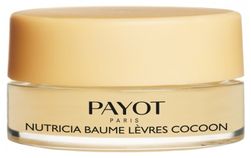
Payot Nutricia Baume Lèvres Cocoon Comforting Nourishing Care
Works for
1 of 1 advertised claim delivered
Moisturizing17 ingredients credited for this claimGood evidence
“It protects, relieves and repairs dry and weakened lips.”
This product can help improve hydration of the skin with the two types of ingredients.
The first type is called “humectants”:
these ingredients help attract water.
When humectants are on the surface of the skin, they “pull in” the moisture from the outside environment, or from
within deeper layers of the skin. The following ingredients in this product do the job:
polyglycerin-3.
This product also contains ingredients called “occlusives”. They help reduce the speed with which our skin loses moisture to the outside environment. These ingredients also help soften the upper layer of the skin, so it feels less tight and nicer to the touch. The following ingredients in this product do the job: beeswax, butyrospermum parkii butter.
Anti-oxidationNot advertised by the brand · 4 ingredients credited for this claimModerate evidence
This product contains antioxidants (rubus idaeus seed oil) that might be able to help neutralize free radicals in skin to lessen the damage it gets from the UV light (sun). There is not enough evidence to confirm their effectiveness in skin though.
Can it cause trouble?
Irritancy1 strong irritant: ParfumMedium risk
Comedogenic3 ingredients rated 2 or more on the 0–5 pore-clogging scale3 flagged
User reviews
Be the first — your take helps the next person decide.
Ingredients
Filter by role to see what each ingredient is doing.
Ricinus communis seed oil~25–37%
- Irritation risk
- Medium
A plant oil that can help soften the skin. It might be helpful in calming down inflammation, but solid research is lacking. Is often used in lip products to create the needed product consistency
More about Ricinus communis seed oilButyrospermum parkii butter~5.3–8%
- Irritation risk
- Low
- Comedogenicity
- 3/5
A great moisturising ingredient that softens the skin and reduces water loss from its upper layer. It also can be helpful in protecting skin from free radicals
More about Butyrospermum parkii butterTridecyl trimellitate~4.7–7.1%
- Irritation risk
- Medium
Used to create a thicker product consistency and soften the upper layer of the skin
More about Tridecyl trimellitateDipentaerythrityl pentaisononanoate~4–6%
- Irritation risk
- Low
Cera alba~3.6–5.3%
- Irritation risk
- Medium
Forms a protective barrier that holds water and keeps dry skin hydrated. Keeps an emulsion from separating into its oil and liquid components, and increases the thickness of a product. Can be an allergen
More about Cera albaBeeswax~2.5–3.8%
- Irritation risk
- Low
Forms a protective barrier that holds water and keeps dry skin hydrated. Keeps an emulsion from separating into its oil and liquid components, and increases the thickness of a product. Can be an allergen
More about BeeswaxHydrogenated castor oil~1.9–2.9%
- Irritation risk
- Medium
A plant oil that can help soften the skin. It might be helpful in calming down inflammation, but solid research is lacking. Is often used in lip products to create the needed product consistency
More about Hydrogenated castor oilCopernicia cerifera cera~1.8–2.6%
- Irritation risk
- Low
Brazilian palm wax. Helps soften the upper layer of the skin
More about Copernicia cerifera ceraCopernicia cerifera wax~1.5–2.3%
- Irritation risk
- Low
Helps to soften the upper layer of the skin and create a nice product consistency
More about Copernicia cerifera waxLimnanthes alba seed oil~1.1–1.7%
- Irritation risk
- Low
This oil's cmposition is closest to rapeseed oil. It is a very stable oil and serves as an emoillient
More about Limnanthes alba seed oilC10-18 triglycerides~0.95–1.4%
- Irritation risk
- Low
Helps soften the skin and attract water to its upper layer. Helps create nice product texture
More about C10-18 triglyceridesJojoba esters~0.85–1.25%
- Irritation risk
- Medium
An emollient made of jojoba oil. Helps soften the skin and support its barrier function
More about Jojoba estersHelianthus annuus seed cera~0.6–1.4%
- Irritation risk
- Low
Helps soften the upper layer of the skin
More about Helianthus annuus seed ceraHelianthus annuus seed wax~0.55–1.3%
- Irritation risk
- Low
Helps soften the upper layer of the skin and support skin's barrier function while creating a thicker product consistency
More about Helianthus annuus seed waxCocos nucifera oil~0.5–1.15%
- Irritation risk
- Low
- Comedogenicity
- 3/5
An emollient. Found to be as effective as a moisturizer for dry skin as mineral oil. Could be comedogenic
More about Cocos nucifera oilAcacia decurrens flower wax~0.45–1.05%
Cocos nucifera oil~0.45–1%
- Irritation risk
- Low
- Comedogenicity
- 3/5
An emollient. Found to be as effective as a moisturizer for dry skin as mineral oil. Could be comedogenic
More about Cocos nucifera oilPrunus amygdalus dulcis seed~0.35–0.85%
- Irritation risk
- Low
Helps soften the upper layer of the skin
More about Prunus amygdalus dulcis seedRubus idaeus seed oil~0.4–0.95%
- Irritation risk
- Medium
A plant oil that might be able to help neutralize free radicals in skin
More about Rubus idaeus seed oilAcacia decurrens flower cera~0.4–0.9%
- Irritation risk
- High
Mimosa flower fax. Helps soften the upper layer of the skin. It adds a nice smell, but could be irritating
More about Acacia decurrens flower ceraAcacia decurrens flower wax~0.35–0.75%
Tocopheryl acetate~0.15–0.65%
- Irritation risk
- Medium
A more stable but less bio-available form of vitamin E compared to Tocopherol. Might help moisturize and protect the skin from free radicals, but mostly used in low concentrations to stabilize other ingredients.
More about Tocopheryl acetatePolyglycerin-3~0.15–0.6%
- Irritation risk
- Low
Helps to attract water to the upper layer of the skin
More about Polyglycerin-3Citric acid~0.15–0.55%
- Irritation risk
- Medium
Can work as an exfoliant but is typically used to adjust the product pH
More about Citric acidParfum~0.1–0.45%
- Irritation risk
- High
An aromatic blend of unspecified and possibly irritating ingredients
More about ParfumMica~0.15–0.6%
- Irritation risk
- Low
Creates an illusion of smoother and more radiant skin tone. Adds shimmer to the skin by reflecting light
More about MicaCi 77891~0.1–0.4%
- Irritation risk
- Low
Titanium dioxide~0.1–0.45%
- Irritation risk
- Low
Works as a UV filter when used in high concentrations. It is photostable and is effective mostly against the UVB light, with some protection in the UVA range. In small concentrations, used for its ability to improve the color of cosmetic products. Is usually well tolerated by the skin
More about Titanium dioxideCi 77491~0.05–0.25%
- Irritation risk
- Low
A red colorant made of iron oxide. Typically is not irritating
More about Ci 77491Iron oxides~0.05–0.25%
- Irritation risk
- Low
An umbrella term for the following three colorants: CI 77491, CI 77492, CI 77499. They might be able to offer some protection against visible light, but the degree of the protection is not clear
More about Iron oxidesIngredient list view
Ricinus communis seed oil, Butyrospermum parkii butter, Tridecyl trimellitate, Dipentaerythrityl pentaisononanoate, Cera alba, Beeswax, Hydrogenated castor oil, Copernicia cerifera cera, Copernicia cerifera wax, Limnanthes alba seed oil, C10-18 triglycerides, Jojoba esters, Helianthus annuus seed cera, Helianthus annuus seed wax, Cocos nucifera oil, Unknown, Acacia decurrens flower wax, Cocos nucifera oil, Prunus amygdalus dulcis seed, Rubus idaeus seed oil, Acacia decurrens flower cera, Acacia decurrens flower wax, Tocopheryl acetate, Polyglycerin-3, Citric acid, Parfum, Mica, Ci 77891, Titanium dioxide, Ci 77491, Iron oxides
Compare prices
Retailers ranked by price — lowest first.

Affiliate links · prices updated regularly
Sources cited in this review
Every concentration estimate and effectiveness label is anchored to one of these 6 studies and safety reviews.
- 1
- 2
- 3
- 4
- 5
- 6

Affiliate links · As an Amazon Associate, WIMJ earns from qualifying purchases.