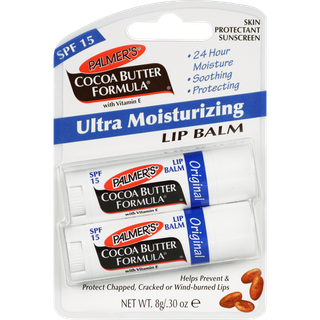
Palmers Cocoa Butter Formula SPF 15 Lip Balm Twin Pack
Works for
1 of 3 advertised claims delivered
Sun protectionSPF 15 · 2 UV filters · Broad spectrumWeak protectionSPF under 30
This product offers broad spectrum sun protection, but it is weak. We recommend to use a broad spectrum sunscreen with at least SPF 30.
This product can be considered "reef safe" because it does not contain the UV filters (oxybenzone and octinoxate) that can be harmful to coral reefs when present in the water in high concentrations.
Moisturizing16 ingredients credited for this claimGood support
“Palmer's Cocoa Butter Formula Ultra Moisturizing Lip Balm SPF 15 Original . . 15 oz Palmer s Cocoa Butter Formula Lip Balm SPF 15 Palmer s Cocoa Butter Formula Lip Balm SPF 15 Palmer s Cocoa Butter Formula Lip Balm SPF 15 Palmer s Cocoa Butter Formula Lip Balm SPF 15 Palmer s Cocoa Butter Formula Lip Balm SPF 15 Palmer s Cocoa Butter Formula Lip Balm SPF 15 Palmer s Cocoa Butter Formula Lip Balm SPF 15 Palmer s Cocoa Butter Formula Lip Balm SPF 15 Palmer s Cocoa Butter Formula Lip Balm SPF 15 Pack of 7 Palmer s Cocoa Butter Formula Lip Balm SPF 15”
This product can help soften the skin and reduce its moisture loss with emollients and occlusives: butyrospermum parkii butter, caprylic/capric triglyceride.
Keep in mind that this product does not contain effective ingredients to attract water to the upper layer of the skin. This is why an additional product with humectants like glycerin or hyaluronic acid can be helpful (apply it before this product for the best results).
Anti-aging3 ingredients credited for this claimLimited support
“Palmer's Cocoa Butter Formula Ultra Moisturizing Lip Balm SPF 15 Original . . 15 oz Palmer s Cocoa Butter Formula Lip Balm SPF 15 Palmer s Cocoa Butter Formula Lip Balm SPF 15 Palmer s Cocoa Butter Formula Lip Balm SPF 15 Palmer s Cocoa Butter Formula Lip Balm SPF 15 Palmer s Cocoa Butter Formula Lip Balm SPF 15 Palmer s Cocoa Butter Formula Lip Balm SPF 15 Palmer s Cocoa Butter Formula Lip Balm SPF 15 Palmer s Cocoa Butter Formula Lip Balm SPF 15 Palmer s Cocoa Butter Formula Lip Balm SPF 15 Pack of 7 Palmer s Cocoa Butter Formula Lip Balm SPF 15”
This product does not contain ingredients that are able to reduce fine lines and wrinkles or help with skin elasticity, but it can improve the look of the skin temporarily through moisturization. Well-moisturized skin might also be able to repair the sun damage better.This ingredient - butyrospermum parkii butter - could be helpful for preventing or repairing signs of aging in theory, but there is no evidence that it actually works.
The biggest anti-aging effect in this product comes from sun protection. Sun damage is the main factor causing early signs of skin aging. We, however, do not recommend using this product as a sunscreen because the protection it offers is not strong enough).
Can it cause trouble?
Irritancy3 strong irritants: Parfum, Aroma + 1 more — patch-test recommendedHigh risk
Comedogenic5 ingredients rated 2 or more on the 0–5 pore-clogging scale5 flagged
User reviews
Be the first — your take helps the next person decide.
Ingredients
Filter by role to see what each ingredient is doing.
Zinc oxide11%
- Irritation risk
- Low
A broad spectrum sunblock (protects from both UVA and UVB rays). Is suitable for most sensitive skins. In small concentrations, can be used as a colorant
More about Zinc oxideDimethicone1.5%
- Irritation risk
- Low
A silicone that helps to reduce water loss from the surface of the skin. Can temporarily "fill in" lines and wrinkles, absorb oil, and create a nice product finish
More about DimethiconeHelianthus annuus seed oil~23–35%
- Irritation risk
- Low
A great emollient due to its high linoleic acid content. One of the most effective plant oils in helping skin hydration and repairing skin barrier function
More about Helianthus annuus seed oilOzokerite~5.4–8.1%
Cocos nucifera oil~4–6%
- Irritation risk
- Low
- Comedogenicity
- 3/5
An emollient. Found to be as effective as a moisturizer for dry skin as mineral oil. Could be comedogenic
More about Cocos nucifera oilButyrospermum parkii butter~2.9–4.4%
- Irritation risk
- Low
- Comedogenicity
- 3/5
A great moisturising ingredient that softens the skin and reduces water loss from its upper layer. It also can be helpful in protecting skin from free radicals
More about Butyrospermum parkii butterPrunus amygdalus dulcis oil~2.2–3.3%
- Irritation risk
- Low
An emollient that softens the skin
More about Prunus amygdalus dulcis oilButyloctyl salicylate~1.8–2.6%
- Irritation risk
- Medium
A synthetic ester of salicylic acid that is used to help disperse pigments and boost effectiveness of sunscreen ingredients. It is able to absorb UV light (working as an organic, or chemical filter), but is not approved as a sunscreen ingredient on its own
More about Butyloctyl salicylateCaprylic/capric triglyceride~1.6–2.4%
- Irritation risk
- Medium
A good mix of fatty acids that forms a protective layer on the skin. Improves the shelf life of products. Derived from coconut and glycerin
More about Caprylic/capric triglycerideCetyl alcohol~1.3–2%
- Irritation risk
- Low
A non-drying alcohol that works to soften the skin and stabilize product formulations helping oil and water mix together
More about Cetyl alcoholTheobroma cacao seed butter~1.1–1.6%
- Irritation risk
- Low
- Comedogenicity
- 3/5
Helps soften the upper layer of the skin and can be helpful in restoring the skin barrier function. Might have some anti-oxidant effect
More about Theobroma cacao seed butterTocopherol~0.85–1.25%
- Irritation risk
- Low
Pure form of vitamin E. Can help moisturise and protect the skin from free radicals. Often used to help stabilise other ingredients or the formula itself
More about TocopherolAloe barbadensis leaf extract~0.55–1.3%
- Irritation risk
- Medium
Traditionally used to treat sunburns, dermatitis and inflammation, but evidence for its effectiveness is lacking. The extract can contain humectants that help attract water into the skin
More about Aloe barbadensis leaf extractLecithin~0.45–1.1%
- Irritation risk
- Low
Used mostly for creating emulsions - helping oil and water mix together. Helps soften the upper layer of the skin
More about LecithinCarthamus tinctorius seed oil~0.4–0.95%
- Irritation risk
- Low
An emollient that helps soften the skin and might help calm down inflammation
More about Carthamus tinctorius seed oilParfum~0.35–0.8%
- Irritation risk
- High
An aromatic blend of unspecified and possibly irritating ingredients
More about ParfumAroma~0.35–0.75%
Dilinoleic acid/butanediol copolymer~0.35–0.8%
- Irritation risk
- Low
Phytosteryl oleate~0.35–0.75%
- Irritation risk
- Low
Hydrogenated vegetable glycerides~0.3–0.75%
- Irritation risk
- Low
Help soften the upper layer of the skin
More about Hydrogenated vegetable glyceridesIsostearic acid~0.35–0.8%
- Irritation risk
- Low
Used to create a nice product texture
More about Isostearic acidPolyglyceryl-3 polyricinoleate~0.2–0.7%
- Irritation risk
- Medium
Helps oil and water mix together
More about Polyglyceryl-3 polyricinoleateVp/eicosene copolymer~0.15–0.6%
- Irritation risk
- Medium
Used to improve the product adherence to the skin, for example, to pro-long the protective effect of sunscreens. Can be irritating to very sensitive skin
More about Vp/eicosene copolymerPolyhydroxystearic acid~0.15–0.6%
- Irritation risk
- Medium
Used to create a thicker product consistency and stabilize the formulation
More about Polyhydroxystearic acidIsopropyl myristate~0.15–0.6%
- Irritation risk
- Low
- Comedogenicity
- 3/5
An emollient that helps soften the skin. Could be comedogenic
More about Isopropyl myristateMyristyl alcohol~0.15–0.6%
- Irritation risk
- High
Helps to stabilize the product formulation while softening the upper layer of the skin. Can be irritating
More about Myristyl alcoholStearyl alcohol~0.15–0.55%
- Irritation risk
- Low
An emollient that helps soften the skin
More about Stearyl alcoholLauryl alcohol~0.1–0.5%
Zea mays oil~0.05–0.3%
- Irritation risk
- Low
- Comedogenicity
- 3/5
A good moisturizing plant oil. Due to the high linoleic acid content, it helps soften the upper layer of the skin, reduce water loss and support skin barrier function
More about Zea mays oilBeta-carotene~0.05–0.25%
Ci 40800~0.05–0.2%
- Irritation risk
- Low
Benzyl benzoate~0.05–0.15%
- Irritation risk
- High
Fragrance with sweet balsamic smell. Help to preserve products and dissolve other ingredients. Could trigger allergic reactions and be irritating
More about Benzyl benzoateIngredient list view
Zinc oxide, Dimethicone, Helianthus annuus seed oil, Ozokerite, Cocos nucifera oil, Butyrospermum parkii butter, Prunus amygdalus dulcis oil, Butyloctyl salicylate, Caprylic/capric triglyceride, Cetyl alcohol, Theobroma cacao seed butter, Tocopherol, Aloe barbadensis leaf extract, Lecithin, Carthamus tinctorius seed oil, Parfum, Aroma, Dilinoleic acid/butanediol copolymer, Phytosteryl oleate, Hydrogenated vegetable glycerides, Isostearic acid, Polyglyceryl-3 polyricinoleate, Vp/eicosene copolymer, Polyhydroxystearic acid, Isopropyl myristate, Myristyl alcohol, Stearyl alcohol, Lauryl alcohol, Zea mays oil, Beta-carotene, Ci 40800, Benzyl benzoate
Compare prices
Retailers ranked by price — lowest first.

Product summary
"Palmers - Cocoa Butter Formula SPF 15 Lip Balm Twin Pack" offers broad spectrum protection. It means that it protects from both UVA and UVB rays (you can remember UVB as "burning" sunlight - they cause sunburn. You can remember UVA rays as "aging" - they do not lead to sunburn, but they cause photodamage and contribute to early signs of skin aging and hyperpigmentation). On the negative side, the SPF of this lip product is not high enough. We recommend to use a sunscreen with at least SPF 30 daily.
Sunscreen filters
This sunscreen uses a mixture of both mineral and organic (so-called "chemical") UV filters. Here are the organic filters this product uses: butyloctyl salicylate. As for the mineral filters, this sunscreen uses zinc oxide.
Irritation risk
We assess the overall irritancy of this lip sunscreen to be high. For a detailed overview of all potential irritants: click here
You can see the detailed formula review with the breakdown of all actives in the product and the full ingredient list with estimated concentrations in the tables below.
Price
The product retails from 5.70$ up to 15.99$ in the United States.
For a detailed price comparison: click here.
Sources cited in this review
Every concentration estimate and effectiveness label is anchored to one of these 21 studies and safety reviews.
- 1A review of inorganic UV filters zinc oxide and titanium dioxideonlinelibrary.wiley.com
- 2
- 3
- 4
- 5
- 6

Affiliate links · As an Amazon Associate, WIMJ earns from qualifying purchases.