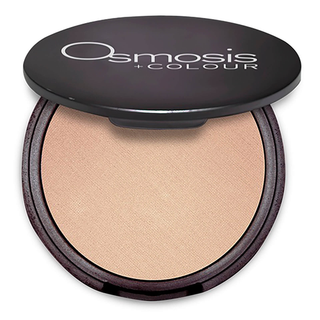
Osmosis +Beauty Osmosis Color Pressed Base Powder
Works for
2 of 2 advertised claims delivered
Evens skin tone2 ingredients credited for this claimModerate support
“It contains natural, broad spectrum UV protection to help prevent premature ageing and hyperpigmentation, and lends the skin a perfected appearance with long-wearing results.”
The following ingredient (ingredients) in this product might be helpful, but there is no evidence to confirm that it actually works: retinyl palmitate.
Anti-aging5 ingredients credited for this claimModerate support
“It contains natural, broad spectrum UV protection to help prevent premature ageing and hyperpigmentation, and lends the skin a perfected appearance with long-wearing results.”
This product contains retinyl palmitate. This ingredient might be able to help reduce and prevent fine lines and wrinkles, improve skin elasticity and firmness, but there is not enough evidence that it actually works.
Anti-oxidationNot advertised by the brand · 6 ingredients credited for this claimModerate support
This product contains antioxidants (camellia sinensis leaf extract, lycium barbarum fruit extract) that might be able to help neutralize free radicals in skin to lessen the damage it gets from the UV light (sun). There is not enough evidence to confirm their effectiveness in skin though.
MoisturizingNot advertised by the brand · 6 ingredients credited for this claimGood support
This product can help soften the skin and reduce its moisture loss with emollients and occlusives: caprylic/capric triglyceride, moringa oleifera seed oil.
Keep in mind that this product does not contain effective ingredients to attract water to the upper layer of the skin. This is why an additional product with humectants like glycerin or hyaluronic acid can be helpful (apply it before this product for the best results).
Can it cause trouble?
Irritancy1 strong irritant: Retinyl palmitateMedium risk
ComedogenicClean of flagged comedogenic ingredientsNone flagged
User reviews
Be the first — your take helps the next person decide.
Ingredients
Filter by role to see what each ingredient is doing.
Mica~23–34%
- Irritation risk
- Low
Creates an illusion of smoother and more radiant skin tone. Adds shimmer to the skin by reflecting light
More about MicaOctyldodecyl stearoyl stearate~6.2–9.3%
- Irritation risk
- Low
Zinc stearate~5.7–8.5%
- Irritation risk
- Low
Lauroyl lysine~4.2–6.4%
- Irritation risk
- Low
Helps soften the upper layer of the skin and creates a nice product texture
More about Lauroyl lysineZinc oxide~4.1–6.1%
- Irritation risk
- Low
A broad spectrum sunblock (protects from both UVA and UVB rays). Is suitable for most sensitive skins. In small concentrations, can be used as a colorant
More about Zinc oxidePolymethyl methacrylate~2.7–4%
- Irritation risk
- Low
Is used to enhance product texture and can help to optically mask skin imperfections
More about Polymethyl methacrylateSilica~2–3.1%
Boron nitride~1.6–2.4%
- Irritation risk
- Low
Helps to absord oil and evenly disperse other ingredients (for example, pigment) in product formulation
More about Boron nitrideLonicera japonica flower extract~1.4–2.1%
- Irritation risk
- High
A plant extract that might help neutralize free radicals in skin. Can contain volalite oils and be irritating
More about Lonicera japonica flower extractLonicera caprifolium flower extract~1–1.6%
- Irritation risk
- High
A plant extract that might help neutralize free radicals in skin. Can contain volalite oils and be irritating
More about Lonicera caprifolium flower extractRetinyl palmitate~0.85–1.25%
- Irritation risk
- High
Three steps removed from the active form of vitamin A - retinoic acid. To have an effect in the skin, it first needs to be converted twice to become the retinoic acid. This means it is less potent than retinol, but could also be less irritating. Once converted to the retinoic acid in the skin, it helps against all signs of aging, improves skin cell turnover and helps fight blemishes and clogged pores. However, in many cosmetic formulations, it is used in a concentration that is too low to have the full effect
More about Retinyl palmitateAscorbyl palmitate~0.6–1.4%
- Irritation risk
- Medium
Being a lipid soluble form of vitamin C, it is more stable and can penetrate the skin better than L-Ascorbic acid. It is effective in protecting the skin from free radicals, as well as evening the skin tone, but is less effective in stimulating collagen production compared to L-Ascorbic acid.
More about Ascorbyl palmitateLycium barbarum fruit extract~0.6–1.35%
- Irritation risk
- Medium
A plant extract that can help neutralize free radicals in skin and attract water to its upper layer
More about Lycium barbarum fruit extractTocopherol~0.5–1.15%
- Irritation risk
- Low
Pure form of vitamin E. Can help moisturise and protect the skin from free radicals. Often used to help stabilise other ingredients or the formula itself
More about TocopherolCamellia sinensis leaf extract~0.5–1.15%
- Irritation risk
- Low
Can contain potent anti-oxidant compounds (abbreviated ECG, GCG, EGC, and EGCG) that might help protect the skin from free radicals. Can help calm down inflammation and has some anti-bacterial properties. Unfortunately, these antioxidants are unstable and lose their effectiveness very quickly in products. The concentration of the antioxidant compounds in the extract also tends to be low to be effective in topical formulation
More about Camellia sinensis leaf extractMoringa oleifera seed oil~0.55–1.25%
- Irritation risk
- Medium
A plant oil that helps soften the upper layer of the skin. Is unlikely to be helpful in restoring skin barrier function due to the low content of linoleic acid
More about Moringa oleifera seed oilCaprylic/capric triglyceride~0.5–1.2%
- Irritation risk
- Medium
A good mix of fatty acids that forms a protective layer on the skin. Improves the shelf life of products. Derived from coconut and glycerin
More about Caprylic/capric triglycerideTitanium dioxide~0.5–1.15%
- Irritation risk
- Low
Works as a UV filter when used in high concentrations. It is photostable and is effective mostly against the UVB light, with some protection in the UVA range. In small concentrations, used for its ability to improve the color of cosmetic products. Is usually well tolerated by the skin
More about Titanium dioxideCi 77891~0.4–1%
- Irritation risk
- Low
Iron oxides~0.35–0.85%
- Irritation risk
- Low
An umbrella term for the following three colorants: CI 77491, CI 77492, CI 77499. They might be able to offer some protection against visible light, but the degree of the protection is not clear
More about Iron oxidesCi 77491~0.2–0.75%
- Irritation risk
- Low
A red colorant made of iron oxide. Typically is not irritating
More about Ci 77491Iron oxides~0.15–0.7%
- Irritation risk
- Low
An umbrella term for the following three colorants: CI 77491, CI 77492, CI 77499. They might be able to offer some protection against visible light, but the degree of the protection is not clear
More about Iron oxidesCi 77492~0.15–0.6%
Iron oxides~0.15–0.5%
- Irritation risk
- Low
An umbrella term for the following three colorants: CI 77491, CI 77492, CI 77499. They might be able to offer some protection against visible light, but the degree of the protection is not clear
More about Iron oxidesCi 77499~0.15–0.5%
Ci 75470~0.15–0.5%
Ci 77742~0.1–0.4%
Chromium oxide greens~0.1–0.35%
- Irritation risk
- Low
Ci 77288~0.1–0.35%
- Irritation risk
- Low
Ingredient list view
Mica, Octyldodecyl stearoyl stearate, Zinc stearate, Lauroyl lysine, Zinc oxide, Polymethyl methacrylate, Silica, Boron nitride, Lonicera japonica flower extract, Lonicera caprifolium flower extract, Retinyl palmitate, Ascorbyl palmitate, Lycium barbarum fruit extract, Unknown, Tocopherol, Camellia sinensis leaf extract, Moringa oleifera seed oil, Caprylic/capric triglyceride, Titanium dioxide, Ci 77891, Iron oxides, Ci 77491, Iron oxides, Ci 77492, Iron oxides, Ci 77499, Ci 75470, Ci 77742, Chromium oxide greens, Ci 77288
Compare prices
Retailers ranked by price — lowest first.
Affiliate links · prices updated regularly · As an Amazon Associate, WIMJ earns from qualifying purchases.
Sources cited in this review
Every concentration estimate and effectiveness label is anchored to one of these 15 studies and safety reviews.
- 1A review of inorganic UV filters zinc oxide and titanium dioxideonlinelibrary.wiley.com
- 2
- 3
- 4
- 5
- 6Safety Assessment of Boron Nitride as Used in Cosmetics cir-safety.org

Affiliate links · As an Amazon Associate, WIMJ earns from qualifying purchases.