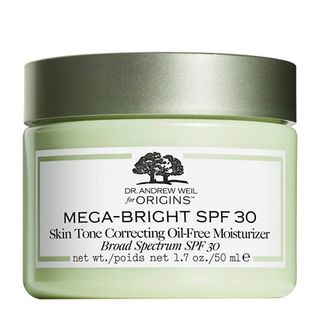
Origins Dr. Andrew Weil for Origins Mega-Bright SPF35 Skin Tone Correcting Oil-Free Moisturizer

Origins Dr. Andrew Weil for Origins Mega-Bright SPF35 Skin Tone Correcting Oil-Free Moisturizer

SPF 35Efficacy100/100IrritancyHigh·5 UV filters
Edit

Works for

2 of 2 advertised claims delivered

Sun protection
SPF 35 · 5 UV filters
Broad spectrum
SPF 35Broad spectrumChemical filtersNo white cast

This product offers a good level of protection against both UVB and UVA rays.

This sunscreen uses organic (so-called "chemical") sunscreen filters. Organic, or "chemical" filters usually provide reliable sun protection and rarely leave a white cast. Sunscreens with organic filters can sting eyes.

This product can be considered "reef safe" because it does not contain the UV filters (oxybenzone and octinoxate) that can be harmful to coral reefs when present in the water in high concentrations.

UV spectrum
UVB290–320 nmUVA II320–340 nmUVA I340–400 nm
Butyloctyl Salicylate
Homosalate
Octisalate
Octocrylene
Avobenzone
FilterCoverageWhat it doesEst. amount
Butyloctyl SalicylateUVBA synthetic ester of salicylic acid that is used to help disperse pigments and boost effectiveness of sunscreen ingredients. It is able to absorb UV light (working as an organic, or chemical filter), but is not approved as a sunscreen ingredient on its own~6.4–7.9%
HomosalateUVB Photo-stable A weak sunscreen that offers some protection against the sun rays that cause sunburn (UVB), but does not offer meaningful protection against protect against the most aging sun rays (UVA). It loses its effectiveness quickly when exposed to sunlight. It is an organic, or so called "chemical" sunscreen. When used in low concentrations, helps to stabilize the product formulation5%
OctisalateEthylhexyl SalicylateUVBOctisalate. A UV filter. It offers some protection against the sun rays that cause sunburn (UVB), but does not protect against the most aging sun rays (UVA). It loses its effectiveness quickly when exposed to sunlight. It is an organic, or so called "chemical" sunscreen5%
OctocryleneUVB Photo-stable A weak sunscreen that protects against the sun rays that cause sunburn (UVB) and is somewhat effective against the UVA rays. It is quite stable and can help stabilize other, more vulnerable, sunscreen ingredients like Avobenzone. It is an organic, or so called "chemical" sunscreen2.7%
AvobenzoneButyl MethoxydibenzoylmethaneUVA1Avobenzone. An organic, or so-called "chemical" UV filter. Protects against both UVA and UVB rays. Needs to be combined with other filters in a formulation to be stable.3%
~ marks concentrations estimated from label position and typical use levels
Reef-safe
No oxybenzone or octinoxate — the two filters banned in Hawaii, Florida Keys and Aruba.
Evens skin tone
Ascorbyl glucoside, Morus nigra root extract + 3 more
Strong evidence
What the product description says
“Dr. Andrew Weil for Origins Mega-Bright SPF35 Skin Tone Correcting Oil-Free Moisturizer”
From product name

This product offers broad spectrum sun protection. It means that it can prevent hyperpigmentation and help keep the skin tone even (sun damage is the main factor causing age spots, darkening of post-acne marks and other discolorations).

Ascorbyl glucosideKey activeEffect: MediumA vitamin C derivative that is more stable but less potent than pure form of vitamin C. Has a potential to boost collagen production, nutralise free radicals and reduce hyperpigmentation, but the required concentration is likely to be much higher than for the pure form of vitamin C, limiting the ingredient's effectiveness in products~1–1.2%
Morus nigra root extractEffect: LowA plant extract that might help neutralize free radicals in skin and have some skin-lightening effect, but good evidence is missing~0.3–0.55%
Hydrolyzed rice bran extractEffect: LowA plant extract that might contain an active compound orthosilicic acid that could be helpful to regulate the level of pigment in skin, but solid research is lacking~0.3–0.55%
Dipotassium glycyrrhizateEffect: Low, below effective doseA salt derived from licorice. Works as an emollient to soften the upper layer of the skin and can help calm down inflammation. Might be helpful for skin lightening~0.3–0.55%
Salicylic acidEffect: Low, below effective doseUsed for skin exfoliation. It has an anti-inflammatory and anti-bacterial effect, helps to unclog pores, prevent blemishes and speed up healing of the existing ones. Sometimes referred to as a BHA (beta-hydroxy acid)~0.3–0.55%
Moisturizing
Not advertised by the brand · Linoleic acid, Myristyl myristate + 25 more
Strong evidence

This product can help improve hydration of the skin with the two types of ingredients.

The first type is called “humectants”:
these ingredients help attract water. When humectants are on the surface of the skin, they “pull in” the moisture from the outside environment, or from within deeper layers of the skin. The following ingredients in this product do the job: betaine, glycerin.

This product also contains ingredients called “occlusives”. They help reduce the speed with which our skin loses moisture to the outside environment. These ingredients also help soften the upper layer of the skin, so it feels less tight and nicer to the touch. The following ingredients in this product do the job: dimethicone, myristyl myristate.

The following ingredients in this product are especially good for supporting the skin barrier and helping with the hydration level: linoleic acid

Linoleic acidHero· EmollientEffect: HighAn excellent emollient. Helps soften the skin, restore its barrier function, and can help to calm down inflammation. It can be helpful to prevent blemishes and clogged pores~0.5–0.75%
Myristyl myristateKey active· Emollient, OcclusiveEffect: HighAn emollient. Is not recommended for acne-prone skin as it can be comedogenic~1.8–2.2%
Octyldodecyl neopentanoateKey active· EmollientEffect: HighAn emollient that helps soften the skin. Often used to stabilize other ingredients, for example, sunscreen~3.4–4.1%
Palmaria palmata extractKey activeEffect: HighRed algae extract that helps attract water to the upper layer of the skin~0.3–0.6%
Saccharum officinarum extractKey activeEffect: HighSugar extract that helps attract water to the upper layer of the skin~0.3–0.55%
Sodium hyaluronateKey active· HumectantEffect: HighOne of the best moisturizing ingredients. Attracts water into the upper layer of the skin~0.3–0.55%
SqualaneKey active· Emollient, OcclusiveEffect: HighAn oil naturally present in skin. Works as an emollient to soften the skin and form a protective layer on its surface without a greasy feeling.~0.45–0.65%
SucroseKey active· HumectantEffect: HighCan help attract water to the upper layer of the skin. In crystal form, it can work as a gentle exfoliant, gentler than the salt scrub. Helps stabilize the emulsion~0.25–0.45%
TrehaloseKey active· HumectantEffect: HighA sugar that attracts water to the upper layer of the skin~0.3–0.55%
BetaineKey active· HumectantEffect: HighHelps attract water to the upper layer of the skin and improves the product texture~0.3–0.55%
CholesterolKey active· EmollientEffect: HighAn emollient that is naturally found in skin~0.45–0.65%
DimethiconeKey active· Emollient, OcclusiveEffect: HighA silicone that helps to reduce water loss from the surface of the skin. Can temporarily "fill in" lines and wrinkles, absorb oil, and create a nice product finish~2–2.4%
GlycerinKey active· HumectantEffect: HighOne of the best moisturizing ingredients. Naturally present in skin. It attracts water to the upper layer of the skin working as a humectant~0.35–0.65%
Cetyl estersKey active· EmollientEffect: MediumHelps soften upper layer of the skin and can enhance penetration of other ingredients into the upper layer of the skin~1.3–1.6%
Vitis vinifera fruit extractKey activeEffect: MediumA plant extract that helps attract water to the upper layer of the skin. It might be helpful in neutralizing free radicals in skin, but is less potent than the extract from the seeds~0.3–0.55%
Molasses extractKey active· HumectantEffect: MediumHelps attract water to the upper layer of the skin. Might have a weak skin-lightening effect, but solid research is missing~0.3–0.55%
Glyceryl stearate· EmollientEffect: LowAn emollient that softens the skin and forms a protective layer on its surface. Helps water and oil mix together~0.45–0.65%
Behenyl alcohol· Emollient, OcclusiveEffect: LowNon-drying alcohol that helps water and oil mix together. Also serves as an emollient~5.9–7.2%
Peg-6· HumectantEffect: LowHelps to dissolve other ingredients and attract water to the upper layer of the skin~0.3–0.6%
Butylene glycol· HumectantEffect: LowUsed to create a nice product texture and help delivery of other ingredients. Might be somewhat helpful in attracting water to the upper layer of the skin~2.3–2.8%
Scutellaria baicalensis root extract· HumectantEffect: LowA plant extract that might contain a compound baicalin that could be helpful in neutralizing free radicals and reducing inflammation in skin. The baicalin concentration in skincare products is often too low for an effective action. Can be used for its fragrant properties~0.3–0.55%
Caprylyl glycol· Humectant, EmollientEffect: LowHelps preserve products and creates a nice product texture~0.4–0.65%
Myristyl alcohol· EmollientEffect: LowHelps to stabilize the product formulation while softening the upper layer of the skin. Can be irritating~0.45–0.65%
Rosa damascena flower oilEffect: LowUsed as a fragrance. Can be irritating~0.5–0.7%
Dipotassium glycyrrhizateUnder-dosedEffect: HighA salt derived from licorice. Works as an emollient to soften the upper layer of the skin and can help calm down inflammation. Might be helpful for skin lightening~0.3–0.55%
Triticum vulgare germ extractUnder-dosedEffect: MediumPlant extract that might have moisturizing properties. Avoid if you suffer from wheat or gluten intolerance~0.4–0.65%
Gentiana lutea root extractEffect: Low, below effective doseA plant extract that can help strengthen the skin barrier function and improve skin moisture levels~0.3–0.55%
Anti-aging
Not advertised by the brand · Ascorbyl glucoside
Strong evidence

This product can help prevent early signs of skin aging because it offers a good level of broad spectrum sun protection. Sun damage is the main cause of premature skin aging, and protecting your skin from the sun is the best anti-aging strategy.

These ingredients in the product might also be helpful for reducing and preventing fine lines, wrinkles, and skin elasticity, even though there is no conclusive evidence for their effectiveness: ascorbyl glucoside.

Ascorbyl glucosideKey activeEffect: MediumA vitamin C derivative that is more stable but less potent than pure form of vitamin C. Has a potential to boost collagen production, nutralise free radicals and reduce hyperpigmentation, but the required concentration is likely to be much higher than for the pure form of vitamin C, limiting the ingredient's effectiveness in products~1–1.2%
Anti-oxidation
Not advertised by the brand · Ascorbyl glucoside, Rosa roxburghii fruit extract + 9 more
Moderate evidence

This product contains antioxidants (ascorbyl glucoside) that might be able to help neutralize free radicals in skin to lessen the damage it gets from the UV light (sun). There is not enough evidence to confirm their effectiveness in skin though.

Ascorbyl glucosideKey activeEffect: MediumA vitamin C derivative that is more stable but less potent than pure form of vitamin C. Has a potential to boost collagen production, nutralise free radicals and reduce hyperpigmentation, but the required concentration is likely to be much higher than for the pure form of vitamin C, limiting the ingredient's effectiveness in products~1–1.2%
Rosa roxburghii fruit extractEffect: LowA fruit extract that might help neutralize free radicals in skin, but evidence of effectiveness is missing~0.3–0.55%
Scutellaria baicalensis root extractEffect: LowA plant extract that might contain a compound baicalin that could be helpful in neutralizing free radicals and reducing inflammation in skin. The baicalin concentration in skincare products is often too low for an effective action. Can be used for its fragrant properties~0.3–0.55%
Palmaria palmata extractEffect: LowRed algae extract that helps attract water to the upper layer of the skin~0.3–0.6%
Punica granatum fruit juiceEffect: LowA fruit juice. Might have some anti-oxidant properties but is unlikely to have any benefit when used in skincare~0.3–0.55%
Pelargonium graveolens flower oilEffect: LowAn essential oil. Can be irritating. Can become an allergen with oxidation~0.55–0.8%
Vitis vinifera fruit extractEffect: LowA plant extract that helps attract water to the upper layer of the skin. It might be helpful in neutralizing free radicals in skin, but is less potent than the extract from the seeds~0.3–0.55%
Morus nigra root extractEffect: LowA plant extract that might help neutralize free radicals in skin and have some skin-lightening effect, but good evidence is missing~0.3–0.55%
Hordeum vulgare extractEffect: Low, below effective doseA plant extract that might have some anti-oxidant properties. Avoid if you are sensitive to gluten~0.4–0.65%
Tocopheryl acetateEffect: Low, below effective doseA more stable but less bio-available form of vitamin E compared to Tocopherol. Might help moisturize and protect the skin from free radicals, but mostly used in low concentrations to stabilize other ingredients.~0.3–0.6%
Triticum vulgare germ extractEffect: Low, below effective dosePlant extract that might have moisturizing properties. Avoid if you suffer from wheat or gluten intolerance~0.4–0.65%

Can it cause trouble?

Irritancy
15 strong irritants: Citrus aurantium dulcis peel oil, Pelargonium graveolens flower oil + 13 more — patch-test recommended
High risk
We flagged 39 ingredients with irritancy potential. Severity depends on your sensitivity threshold; the table lists the worst offenders first.
IngredientFunctionIrritationEst. amount
Citrus aurantium dulcis peel oilAn essentil oil from orange peel. Potential allergen and can be irritatingHigh~0.55–0.85%est.
Pelargonium graveolens flower oilAn essential oil. Can be irritating. Can become an allergen with oxidationHigh~0.55–0.8%est.
Cananga odorata flower oilAn essential oil. Can be irritatingHigh~0.5–0.7%est.
Eugenia caryophyllus bud oilUsed as a fragrance. Can be irritatingHigh~0.45–0.7%est.
Rosa damascena flower oilUsed as a fragrance. Can be irritatingHigh~0.5–0.7%est.
Viola odorata flower/leaf extractContains an essential oil. Can be irritatingHigh~0.4–0.6%est.
Polianthes tuberosa extract—High~0.5–0.75%est.
FarnesolAdded to create a nice product smell. Can be irritatingHigh~0.3–0.6%est.
EugenolA fragrance. Is a likely irritantHigh~0.3–0.55%est.
Benzyl salicylateA fragrance. Is a likely irritantHigh~0.3–0.55%est.
CitronellolA fragrance. Can be irritatingHigh~0.3–0.55%est.
CitralA fragrance with a lemon scent. A likely irritantHigh~0.3–0.55%est.
Benzyl benzoateFragrance with sweet balsamic smell. Help to preserve products and dissolve other ingredients. Could trigger allergic reactions and be irritatingHigh~0.3–0.55%est.
GeraniolA fragrance. Can be irritatingHigh~0.3–0.55%est.
Citrus grandis peel extractAn aromatic irritating plant extract that can cause photosensitivity in skinHigh~0.25–0.5%est.
Scutellaria baicalensis root extractA plant extract that might contain a compound baicalin that could be helpful in neutralizing free radicals and reducing inflammation in skin. The baicalin concentration in skincare products is often too low for an effective action. Can be used for its fragrant propertiesHigh~0.3–0.55%est.
Curcuma longa root extractA plant extract that can contain an active compound curcumin, that may have some anti-inflammatory properties when applied to the skin, but solid research is lacking and the typical concentration used in skincare products is too low. Can be an irritantHigh~0.3–0.55%est.
Salicylic acidUsed for skin exfoliation. It has an anti-inflammatory and anti-bacterial effect, helps to unclog pores, prevent blemishes and speed up healing of the existing ones. Sometimes referred to as a BHA (beta-hydroxy acid)High~0.3–0.55%est.
Myristyl alcoholHelps to stabilize the product formulation while softening the upper layer of the skin. Can be irritatingHigh~0.45–0.65%est.
Butyl methoxydibenzoylmethaneAvobenzone. An organic, or so-called "chemical" UV filter. Protects against both UVA and UVB rays. Needs to be combined with other filters in a formulation to be stable.Medium3%
HomosalateA weak sunscreen that offers some protection against the sun rays that cause sunburn (UVB), but does not offer meaningful protection against protect against the most aging sun rays (UVA). It loses its effectiveness quickly when exposed to sunlight. It is an organic, or so called "chemical" sunscreen. When used in low concentrations, helps to stabilize the product formulationMedium5%
OctocryleneA weak sunscreen that protects against the sun rays that cause sunburn (UVB) and is somewhat effective against the UVA rays. It is quite stable and can help stabilize other, more vulnerable, sunscreen ingredients like Avobenzone. It is an organic, or so called "chemical" sunscreenMedium2.7%
Butyloctyl salicylateA synthetic ester of salicylic acid that is used to help disperse pigments and boost effectiveness of sunscreen ingredients. It is able to absorb UV light (working as an organic, or chemical filter), but is not approved as a sunscreen ingredient on its ownMedium~6.4–7.9%est.
Myristyl myristateAn emollient. Is not recommended for acne-prone skin as it can be comedogenicMedium~1.8–2.2%est.
Ascorbyl glucosideA vitamin C derivative that is more stable but less potent than pure form of vitamin C. Has a potential to boost collagen production, nutralise free radicals and reduce hyperpigmentation, but the required concentration is likely to be much higher than for the pure form of vitamin C, limiting the ingredient's effectiveness in productsMedium~1–1.2%est.
Rosa roxburghii fruit extractA fruit extract that might help neutralize free radicals in skin, but evidence of effectiveness is missingMedium~0.3–0.55%est.
Triticum vulgare germ extractPlant extract that might have moisturizing properties. Avoid if you suffer from wheat or gluten intoleranceMedium~0.4–0.65%est.
Hordeum vulgare extractA plant extract that might have some anti-oxidant properties. Avoid if you are sensitive to glutenMedium~0.4–0.65%est.
Morus nigra root extractA plant extract that might help neutralize free radicals in skin and have some skin-lightening effect, but good evidence is missingMedium~0.3–0.55%est.
Punica granatum fruit juiceA fruit juice. Might have some anti-oxidant properties but is unlikely to have any benefit when used in skincareMedium~0.3–0.55%est.
Gentiana lutea root extractA plant extract that can help strengthen the skin barrier function and improve skin moisture levelsMedium~0.3–0.55%est.
Vitis vinifera fruit extractA plant extract that helps attract water to the upper layer of the skin. It might be helpful in neutralizing free radicals in skin, but is less potent than the extract from the seedsMedium~0.3–0.55%est.
Di-ppg-2 myreth-10 adipate—Medium~0.4–0.65%est.
Steareth-21Helps oil and water mix togetherMedium~0.45–0.65%est.
Tocopheryl acetateA more stable but less bio-available form of vitamin E compared to Tocopherol. Might help moisturize and protect the skin from free radicals, but mostly used in low concentrations to stabilize other ingredients.Medium~0.3–0.6%est.
Di-c12-18 alkyl dimonium chlorideCreates a nice, smooth skin finishMedium~0.3–0.55%est.
Caprylyl glycolHelps preserve products and creates a nice product textureMedium~0.4–0.65%est.
Sodium dehydroacetateA preservativeMedium~0.3–0.6%est.
Hexylene glycolHelps create a more spreadable product textureMedium~0.3–0.55%est.
Comedogenic
3 ingredients rated 2 or more on the 0–5 pore-clogging scale
3 flagged
These ingredients have a comedogenic rating of 2 or more on a 0–5 scale; the table shows each one's rating. In leave-on products they can clog pores in acne-prone skin.
IngredientFunctionRatingEst. amount
Myristyl myristateAn emollient. Is not recommended for acne-prone skin as it can be comedogenic3/5~1.8–2.2%est.
Triticum vulgare germ extractPlant extract that might have moisturizing properties. Avoid if you suffer from wheat or gluten intolerance3/5~0.4–0.65%est.
Palmaria palmata extractRed algae extract that helps attract water to the upper layer of the skin3/5~0.3–0.6%est.
Edit

User reviews

Would you recommend?
No community reviews yet.

Be the first — your take helps the next person decide.

Write a review · ~30s

Ingredients

Filter by role to see what each ingredient is doing.

Butyl methoxydibenzoylmethane3%
UV filterKey activeIrritant · medium
Irritation risk
Medium
Works for
Sun protection

Avobenzone. An organic, or so-called "chemical" UV filter. Protects against both UVA and UVB rays. Needs to be combined with other filters in a formulation to be stable.

More about Butyl methoxydibenzoylmethane
Homosalate5%
UV filterKey activeIrritant · medium
Irritation risk
Medium
Works for
Sun protection

A weak sunscreen that offers some protection against the sun rays that cause sunburn (UVB), but does not offer meaningful protection against protect against the most aging sun rays (UVA). It loses its effectiveness quickly when exposed to sunlight. It is an organic, or so called "chemical" sunscreen. When used in low concentrations, helps to stabilize the product formulation

More about Homosalate
Ethylhexyl salicylate5%
UV filter
Irritation risk
Low
Works for
Sun protection

Octisalate. A UV filter. It offers some protection against the sun rays that cause sunburn (UVB), but does not protect against the most aging sun rays (UVA). It loses its effectiveness quickly when exposed to sunlight. It is an organic, or so called "chemical" sunscreen

More about Ethylhexyl salicylate
Octocrylene2.7%
UV filterKey activeIrritant · medium
Irritation risk
Medium
Works for
Sun protection

A weak sunscreen that protects against the sun rays that cause sunburn (UVB) and is somewhat effective against the UVA rays. It is quite stable and can help stabilize other, more vulnerable, sunscreen ingredients like Avobenzone. It is an organic, or so called "chemical" sunscreen

More about Octocrylene
Water~45–55%
Formula
Irritation risk
Low

Plain old water

More about Water
Butyloctyl salicylate~6.4–7.9%
UV filterKey activeIrritant · medium
Irritation risk
Medium
Works for
Sun protection

A synthetic ester of salicylic acid that is used to help disperse pigments and boost effectiveness of sunscreen ingredients. It is able to absorb UV light (working as an organic, or chemical filter), but is not approved as a sunscreen ingredient on its own

More about Butyloctyl salicylate
Behenyl alcohol~5.9–7.2%
Formula
Irritation risk
Low
Works for
Moisturizing

Non-drying alcohol that helps water and oil mix together. Also serves as an emollient

More about Behenyl alcohol
Nylon-12~4.3–5.2%
Formula
Irritation risk
Low

Used to create a nice product consistency

More about Nylon-12
Octyldodecyl neopentanoate~3.4–4.1%
Key active
Irritation risk
Low
Works for
Moisturizing

An emollient that helps soften the skin. Often used to stabilize other ingredients, for example, sunscreen

More about Octyldodecyl neopentanoate
Butylene glycol~2.3–2.8%
Formula
Irritation risk
Low
Works for
Moisturizing

Used to create a nice product texture and help delivery of other ingredients. Might be somewhat helpful in attracting water to the upper layer of the skin

More about Butylene glycol
Dimethicone~2–2.4%
Key active
Irritation risk
Low
Works for
MoisturizingMattifying

A silicone that helps to reduce water loss from the surface of the skin. Can temporarily "fill in" lines and wrinkles, absorb oil, and create a nice product finish

More about Dimethicone
Myristyl myristate~1.8–2.2%
Key activeComedogenic 3/5Irritant · medium
Irritation risk
Medium
Comedogenicity
3/5
Works for
Moisturizing

An emollient. Is not recommended for acne-prone skin as it can be comedogenic

More about Myristyl myristate
Cetyl esters~1.3–1.6%
Key active
Irritation risk
Low
Works for
Moisturizing

Helps soften upper layer of the skin and can enhance penetration of other ingredients into the upper layer of the skin

More about Cetyl esters
Ascorbyl glucoside~1–1.2%
Key activeIrritant · medium
Irritation risk
Medium
Works for
Evens skin toneAnti-agingAnti-oxidation

A vitamin C derivative that is more stable but less potent than pure form of vitamin C. Has a potential to boost collagen production, nutralise free radicals and reduce hyperpigmentation, but the required concentration is likely to be much higher than for the pure form of vitamin C, limiting the ingredient's effectiveness in products

More about Ascorbyl glucoside
Polyethylene~1.1–1.4%
Formula
Irritation risk
Low

Used to thicken the product's texture

More about Polyethylene
Ammonium acryloyldimethyltaurate/vp copolymer~0.65–0.95%
Formula
Irritation risk
Low

Increases thickness of a product. Texture enhancer for oil-in-water emulsions

More about Ammonium acryloyldimethyltaurate/vp copolymer
Citrus aurantium dulcis peel oil~0.55–0.85%
Irritant · high
Irritation risk
High

An essentil oil from orange peel. Potential allergen and can be irritating

More about Citrus aurantium dulcis peel oil
Pelargonium graveolens flower oil~0.55–0.8%
Irritant · high
Irritation risk
High
Works for
Anti-oxidation

An essential oil. Can be irritating. Can become an allergen with oxidation

More about Pelargonium graveolens flower oil
Cananga odorata flower oil~0.5–0.7%
Irritant · high
Irritation risk
High

An essential oil. Can be irritating

More about Cananga odorata flower oil
Eugenia caryophyllus bud oil~0.45–0.7%
Irritant · high
Irritation risk
High

Used as a fragrance. Can be irritating

More about Eugenia caryophyllus bud oil
Rosa damascena flower oil~0.5–0.7%
Irritant · high
Irritation risk
High
Works for
Moisturizing

Used as a fragrance. Can be irritating

More about Rosa damascena flower oil
Jasminum officinale oil~0.4–0.6%
Formula
Viola odorata flower/leaf extract~0.4–0.6%
Irritant · high
Irritation risk
High

Contains an essential oil. Can be irritating

More about Viola odorata flower/leaf extract
Polianthes tuberosa extract~0.5–0.75%
Irritant · high
Farnesol~0.3–0.6%
Irritant · high
Irritation risk
High

Added to create a nice product smell. Can be irritating

More about Farnesol
Eugenol~0.3–0.55%
Irritant · high
Irritation risk
High

A fragrance. Is a likely irritant

More about Eugenol
Benzyl salicylate~0.3–0.55%
Irritant · high
Irritation risk
High

A fragrance. Is a likely irritant

More about Benzyl salicylate
Citronellol~0.3–0.55%
Irritant · high
Irritation risk
High

A fragrance. Can be irritating

More about Citronellol
Citral~0.3–0.55%
Irritant · high
Irritation risk
High

A fragrance with a lemon scent. A likely irritant

More about Citral
Benzyl benzoate~0.3–0.55%
Irritant · high
Irritation risk
High

Fragrance with sweet balsamic smell. Help to preserve products and dissolve other ingredients. Could trigger allergic reactions and be irritating

More about Benzyl benzoate
Geraniol~0.3–0.55%
Irritant · high
Irritation risk
High

A fragrance. Can be irritating

More about Geraniol
Rosa roxburghii fruit extract~0.3–0.55%
Irritant · medium
Irritation risk
Medium
Works for
Anti-oxidation

A fruit extract that might help neutralize free radicals in skin, but evidence of effectiveness is missing

More about Rosa roxburghii fruit extract
Paeonia albiflora root extract~0.3–0.55%
Formula
Molasses extract~0.3–0.55%
Key active
Irritation risk
Low
Works for
Moisturizing

Helps attract water to the upper layer of the skin. Might have a weak skin-lightening effect, but solid research is missing

More about Molasses extract
Saccharum officinarum extract~0.3–0.55%
Key active
Irritation risk
Low
Works for
Moisturizing

Sugar extract that helps attract water to the upper layer of the skin

More about Saccharum officinarum extract
De m?lasse
Not recognized
Citrus grandis peel extract~0.25–0.5%
Irritant · high
Irritation risk
High

An aromatic irritating plant extract that can cause photosensitivity in skin

More about Citrus grandis peel extract
Triticum vulgare germ extract~0.4–0.65%
Under-dosedComedogenic 3/5Irritant · medium
Irritation risk
Medium
Comedogenicity
3/5
Works for
MoisturizingAnti-oxidation

Plant extract that might have moisturizing properties. Avoid if you suffer from wheat or gluten intolerance

More about Triticum vulgare germ extract
Hordeum vulgare extract~0.4–0.65%
Irritant · medium
Irritation risk
Medium
Works for
Anti-oxidation

A plant extract that might have some anti-oxidant properties. Avoid if you are sensitive to gluten

More about Hordeum vulgare extract
Palmaria palmata extract~0.3–0.6%
Key activeComedogenic 3/5
Irritation risk
Low
Comedogenicity
3/5
Works for
MoisturizingAnti-oxidation

Red algae extract that helps attract water to the upper layer of the skin

More about Palmaria palmata extract
Morus nigra root extract~0.3–0.55%
Irritant · medium
Irritation risk
Medium
Works for
Evens skin toneAnti-oxidation

A plant extract that might help neutralize free radicals in skin and have some skin-lightening effect, but good evidence is missing

More about Morus nigra root extract
Punica granatum fruit juice~0.3–0.55%
Irritant · medium
Irritation risk
Medium
Works for
Anti-oxidation

A fruit juice. Might have some anti-oxidant properties but is unlikely to have any benefit when used in skincare

More about Punica granatum fruit juice
Scutellaria baicalensis root extract~0.3–0.55%
Irritant · high
Irritation risk
High
Works for
Anti-oxidationMoisturizingReduces irritationAntibacterialAnti-inflammatory

A plant extract that might contain a compound baicalin that could be helpful in neutralizing free radicals and reducing inflammation in skin. The baicalin concentration in skincare products is often too low for an effective action. Can be used for its fragrant properties

More about Scutellaria baicalensis root extract
Hydrolyzed rice bran extract~0.3–0.55%
Formula
Irritation risk
Low
Works for
Evens skin tone

A plant extract that might contain an active compound orthosilicic acid that could be helpful to regulate the level of pigment in skin, but solid research is lacking

More about Hydrolyzed rice bran extract
Gentiana lutea root extract~0.3–0.55%
Irritant · medium
Irritation risk
Medium
Works for
Moisturizing

A plant extract that can help strengthen the skin barrier function and improve skin moisture levels

More about Gentiana lutea root extract
Curcuma longa root extract~0.3–0.55%
Irritant · high
Irritation risk
High
Works for
Anti-inflammatory

A plant extract that can contain an active compound curcumin, that may have some anti-inflammatory properties when applied to the skin, but solid research is lacking and the typical concentration used in skincare products is too low. Can be an irritant

More about Curcuma longa root extract
Vitis vinifera fruit extract~0.3–0.55%
Key activeIrritant · medium
Irritation risk
Medium
Works for
MoisturizingAnti-oxidation

A plant extract that helps attract water to the upper layer of the skin. It might be helpful in neutralizing free radicals in skin, but is less potent than the extract from the seeds

More about Vitis vinifera fruit extract
Sucrose~0.3–0.55%
Key active
Irritation risk
Low
Works for
Moisturizing

Can help attract water to the upper layer of the skin. In crystal form, it can work as a gentle exfoliant, gentler than the salt scrub. Helps stabilize the emulsion

More about Sucrose
Glyceryl stearate~0.45–0.65%
Formula
Irritation risk
Low
Works for
CleansingMoisturizing

An emollient that softens the skin and forms a protective layer on its surface. Helps water and oil mix together

More about Glyceryl stearate
Peg-100 stearate~0.45–0.65%
Formula
Irritation risk
Low
Works for
Cleansing

Helps oil and water mix togehter and creates a nice product texture

More about Peg-100 stearate
Peg-6~0.3–0.6%
Formula
Irritation risk
Low
Works for
Moisturizing

Helps to dissolve other ingredients and attract water to the upper layer of the skin

More about Peg-6
Glycerin~0.35–0.65%
Key active
Irritation risk
Low
Works for
Moisturizing

One of the best moisturizing ingredients. Naturally present in skin. It attracts water to the upper layer of the skin working as a humectant

More about Glycerin
Cholesterol~0.45–0.65%
Key active
Irritation risk
Low
Works for
CleansingMoisturizing

An emollient that is naturally found in skin

More about Cholesterol
Linoleic acid~0.5–0.75%
Hero · Moisturizing
Irritation risk
Low
Works for
MoisturizingCleansingAnti-blemish

An excellent emollient. Helps soften the skin, restore its barrier function, and can help to calm down inflammation. It can be helpful to prevent blemishes and clogged pores

More about Linoleic acid
Salicylic acid~0.3–0.55%
Irritant · high
Irritation risk
High
Works for
ExfoliationAnti-blemishAnti-inflammatoryAntibacterialEvens skin tone

Used for skin exfoliation. It has an anti-inflammatory and anti-bacterial effect, helps to unclog pores, prevent blemishes and speed up healing of the existing ones. Sometimes referred to as a BHA (beta-hydroxy acid)

More about Salicylic acid
Di-ppg-2 myreth-10 adipate~0.4–0.65%
Irritant · medium
Irritation risk
Medium
Works for
Cleansing
More about Di-ppg-2 myreth-10 adipate
Sodium hyaluronate~0.3–0.55%
Key active
Irritation risk
Low
Works for
Moisturizing

One of the best moisturizing ingredients. Attracts water into the upper layer of the skin

More about Sodium hyaluronate
Betaine~0.3–0.55%
Key active
Irritation risk
Low
Works for
Moisturizing

Helps attract water to the upper layer of the skin and improves the product texture

More about Betaine
Dipotassium glycyrrhizate~0.3–0.55%
Under-dosed
Irritation risk
Low
Works for
MoisturizingAnti-inflammatoryEvens skin tone

A salt derived from licorice. Works as an emollient to soften the upper layer of the skin and can help calm down inflammation. Might be helpful for skin lightening

More about Dipotassium glycyrrhizate
Steareth-21~0.45–0.65%
Irritant · medium
Irritation risk
Medium
Works for
Cleansing

Helps oil and water mix together

More about Steareth-21
Trehalose~0.3–0.55%
Key active
Irritation risk
Low
Works for
Moisturizing

A sugar that attracts water to the upper layer of the skin

More about Trehalose
Tocopheryl acetate~0.3–0.6%
Irritant · medium
Irritation risk
Medium
Works for
Anti-oxidation

A more stable but less bio-available form of vitamin E compared to Tocopherol. Might help moisturize and protect the skin from free radicals, but mostly used in low concentrations to stabilize other ingredients.

More about Tocopheryl acetate
Myristyl laurate~0.3–0.55%
Formula
Irritation risk
Low
Works for
Cleansing
More about Myristyl laurate
Trisiloxane~0.3–0.55%
Formula
Irritation risk
Low

A type of silicone. Used to improve product texture

More about Trisiloxane
Di-c12-18 alkyl dimonium chloride~0.3–0.55%
Irritant · medium
Irritation risk
Medium

Creates a nice, smooth skin finish

More about Di-c12-18 alkyl dimonium chloride
Caprylyl glycol~0.4–0.65%
Irritant · medium
Irritation risk
Medium
Works for
Moisturizing

Helps preserve products and creates a nice product texture

More about Caprylyl glycol
Squalane~0.45–0.65%
Key active
Irritation risk
Low
Works for
Moisturizing

An oil naturally present in skin. Works as an emollient to soften the skin and form a protective layer on its surface without a greasy feeling.

More about Squalane
Myristyl alcohol~0.45–0.65%
Irritant · high
Irritation risk
High
Works for
Moisturizing

Helps to stabilize the product formulation while softening the upper layer of the skin. Can be irritating

More about Myristyl alcohol
Tromethamine~0.3–0.55%
Formula
Irritation risk
Low

Helps adjust pH in products

More about Tromethamine
Sodium dehydroacetate~0.3–0.6%
Irritant · medium
Irritation risk
Medium

A preservative

More about Sodium dehydroacetate
Hexylene glycol~0.3–0.55%
Irritant · medium
Irritation risk
Medium
Works for
Cleansing

Helps create a more spreadable product texture

More about Hexylene glycol
Sodium hydroxide~0.3–0.55%
Formula
Irritation risk
Low

Used to adjust the product's pH

More about Sodium hydroxide
Phenoxyethanol~0.25–0.5%
Formula
Irritation risk
Low

A preservative. It helps prevent bacterial growth in cosmetic products

More about Phenoxyethanol
Mica~0.3–0.6%
Formula
Irritation risk
Low

Creates an illusion of smoother and more radiant skin tone. Adds shimmer to the skin by reflecting light

More about Mica
Essential oil
Not recognized
Sucrose~0.25–0.45%
Key active
Irritation risk
Low
Works for
Moisturizing

Can help attract water to the upper layer of the skin. In crystal form, it can work as a gentle exfoliant, gentler than the salt scrub. Helps stabilize the emulsion

More about Sucrose
Datem~0.35–0.65%
Formula
Irritation risk
Low
Works for
Cleansing
More about Datem
Ingredient list view

Butyl methoxydibenzoylmethane, Homosalate, Ethylhexyl salicylate, Octocrylene, Water, Butyloctyl salicylate, Behenyl alcohol, Nylon-12, Octyldodecyl neopentanoate, Butylene glycol, Dimethicone, Myristyl myristate, Cetyl esters, Ascorbyl glucoside, Polyethylene, Ammonium acryloyldimethyltaurate/vp copolymer, Citrus aurantium dulcis peel oil, Pelargonium graveolens flower oil, Cananga odorata flower oil, Eugenia caryophyllus bud oil, Rosa damascena flower oil, Jasminum officinale oil, Viola odorata flower/leaf extract, Polianthes tuberosa extract, Farnesol, Eugenol, Benzyl salicylate, Citronellol, Citral, Benzyl benzoate, Geraniol, Rosa roxburghii fruit extract, Paeonia albiflora root extract, Molasses extract, Saccharum officinarum extract, Unknown, Citrus grandis peel extract, Triticum vulgare germ extract, Hordeum vulgare extract, Palmaria palmata extract, Morus nigra root extract, Punica granatum fruit juice, Scutellaria baicalensis root extract, Hydrolyzed rice bran extract, Gentiana lutea root extract, Curcuma longa root extract, Vitis vinifera fruit extract, Sucrose, Glyceryl stearate, Peg-100 stearate, Peg-6, Glycerin, Cholesterol, Linoleic acid, Salicylic acid, Di-ppg-2 myreth-10 adipate, Sodium hyaluronate, Betaine, Dipotassium glycyrrhizate, Steareth-21, Trehalose, Tocopheryl acetate, Myristyl laurate, Trisiloxane, Di-c12-18 alkyl dimonium chloride, Caprylyl glycol, Squalane, Myristyl alcohol, Tromethamine, Sodium dehydroacetate, Hexylene glycol, Sodium hydroxide, Phenoxyethanol, Mica, Unknown, Sucrose, Datem

Compare prices

Retailers ranked by price — lowest first.

No pricing data available yet for this product.

Worth comparing, line by line.

Match % combines shared ingredients, the first five ingredients, shared actives and hero ingredients, irritancy (lower counts in the alternative's favour), texture and body area. Only products in the same routine step are compared.

Side-by-side comparison of this product against its closest alternatives
OriginsDr. Andrew Weil for Origins Mega-Bright SPF35 Skin Tone Correcting Oil-Free MoisturizerYOUR PRODUCTCliniqueNEW UV Solutions Mattifying Sunscreen SPF 50Paula's choiceDEFENSE Essential Glow Moisturizer SPF 30La Roche-PosayEffaclar Duo+ SPF 30
Match—77%76%74%
Price—$40.10$9.60$24.05
Shared key ingredients—7 of 205 of 206 of 20
Key difference—Algae ExtractNiacinamideNiacinamide
Irritancy High Low Medium Medium
SPFSPF 35SPF 50SPF 30SPF 30
Drying alcohol——— Contains drying alcohol
View product Shop Shop Shop
Cheaper alternatives? Browse formulas in the same category.
We compare ingredient profiles across our catalog — pick the closest match for your budget.
Open dupe finder

Product summary

We assess that "Origins - Dr. Andrew Weil for Origins Mega-Bright SPF35 Skin Tone Correcting Oil-Free Moisturizer" can provide reliable sun protection based on the ingredient list. It can protect from both UVA and UVB rays. This is great news because not all sunscreens with SPF ratings give UVA protection. (UVA rays do not cause sunburn, but still damage our skin and lead to early aging).

This moisturizer should also be hydrating enough to use without an additional moisturizer during the day. Like all broad-spectrum sunscreens, this product has an anti-aging benefit.

Sunscreen filters

This is a so-called "chemical" sunscreen. It means that it uses organic UV filters. They typically offer good sun protection and rarely leave a white cast, but they can be irritating for some people with sensitive skin. Here are the exact UV filters in this sunscreen: avobenzone 3.00% (declared), butyloctyl salicylate 6.40% - 7.90%, octisalate 5.00% (declared), homosalate 5.00% (declared) and octocrylene 2.70% (declared).

Irritation risk

This moisturizer contains a bunch of common irritants, including ingredients that do not provide any known benefit for the skin. It might not be the best choice if your skin is sensitive. We assess the overall irritancy of this moisturizer to be high. For a detailed overview of all potential irritants: click here

You can see the detailed formula review with the breakdown of all actives in the product and the full ingredient list with estimated concentrations in the tables below.

Price

The product retails for 44.50£ in the United Kingdom.

For a detailed price comparison: click here.

Sources cited in this review

Every concentration estimate and effectiveness label is anchored to one of these 45 studies and safety reviews.

  1. 1
  2. 2
  3. 3
  4. 4
  5. 5
  6. 6
Origins Dr. Andrew Weil for Origins Mega-Bright SPF35 Skin Tone Correcting Oil-Free Moisturizer
OriginsDr. Andrew Weil for Origins Mega-Bright SPF35 Skin Tone Correcting Oil-Free Moisturizer

Affiliate links · As an Amazon Associate, WIMJ earns from qualifying purchases.

As an Amazon Associate, WIMJ earns from qualifying purchases.
