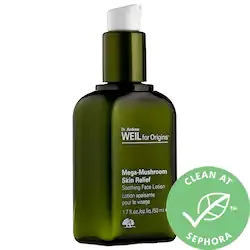
Origins Dr. Andrew Weil For Origins Mega-Mushroom Skin Relief Soothing Face Lotion
Works for
2 of 2 advertised claims delivered
Anti-agingTocotrienols, Magnesium ascorbyl phosphate + 2 moreModerate evidence
“Aging is not simply the passage of time marked by line and wrinkles.”
This product contains tocotrienols. This ingredient might be able to help reduce and prevent fine lines and wrinkles, improve skin elasticity and firmness, but there is not enough evidence that it actually works.
MoisturizingLactoperoxidase, Sodium hyaluronate + 23 moreGood evidence
“This lightweight hydrating lotion instantly calms skin while visibly reducing redness and sensitivity.”
This product can help improve hydration of the skin with the two types of ingredients.
The first type is called “humectants”:
these ingredients help attract water.
When humectants are on the surface of the skin, they “pull in” the moisture from the outside environment, or from
within deeper layers of the skin. The following ingredients in this product do the job:
sodium hyaluronate, glucose.
This product also contains ingredients called “occlusives”. They help reduce the speed with which our skin loses moisture to the outside environment. These ingredients also help soften the upper layer of the skin, so it feels less tight and nicer to the touch. The following ingredients in this product do the job: dimethicone, helianthus annuus seed oil.
Anti-oxidationNot advertised by the brand · Tocotrienols, Squalene + 6 moreStrong evidence
This product contains antioxidants (tocotrienols) that can help neutralize free radicals in skin. By doing so, they can lessen the damage the skin gets from the UV light (sun).
The following ingredients - squalene also can have an antioxidant effect, but there is less evidence to confirm their effectiveness in skin.
Can it cause trouble?
Irritancy16 strong irritants: Citrus aurantium dulcis oil, Lavandula angustifolia oil + 14 more — patch-test recommendedHigh risk
Comedogenic2 ingredients rated 2 or more on the 0–5 pore-clogging scale2 flagged

User reviews
Be the first — your take helps the next person decide.
Ingredients
Filter by role to see what each ingredient is doing.
Water~45–55%
Dicaprylyl carbonate~4.3–5.3%
- Irritation risk
- Low
Helps products spread more easily and works as an emollient to soften skin
More about Dicaprylyl carbonateHydrogenated lecithin~3.7–4.5%
- Irritation risk
- Low
Helps to retain moisture by creating a protective barrier on the skin. Rich in fatty acids. Improves product texture and helps with the penetration of other ingredients.
More about Hydrogenated lecithinCetyl ricinoleate~3.2–3.9%
- Irritation risk
- Low
An emollient that helps soften the upper layer of the skin
More about Cetyl ricinoleateSimmondsia chinensis seed oil~2.5–3%
- Irritation risk
- Medium
Softens the upper layer of skin and helps restore the healthy skin barrier. Has shown to help calm down inflammation in skin. It is a stable oil, meaning that it retains its properties even when exposed to air.
More about Simmondsia chinensis seed oilSucrose stearate~2–2.4%
Butylene glycol~1.6–2%
- Irritation risk
- Low
Used to create a nice product texture and help delivery of other ingredients. Might be somewhat helpful in attracting water to the upper layer of the skin
More about Butylene glycolCitrus aurantium dulcis oil~1.4–1.7%
- Irritation risk
- High
Used as a fragrance. It can be irritating and cause photosensitivity
More about Citrus aurantium dulcis oilLavandula angustifolia oil~1.1–1.3%
- Irritation risk
- High
An essential oil. Potential allergen and can be irritating. It has some anti-bacterial properties
More about Lavandula angustifolia oilPogostemon cablin oil~0.95–1.15%
- Irritation risk
- Low
Citrus nobilis peel oil~0.6–0.9%
- Irritation risk
- High
A plant oil with high content of volatile compounds that, especially when exposed to air, can cause allergic reactions and irritate the skin
More about Citrus nobilis peel oilPelargonium graveolens flower oil~0.55–0.8%
- Irritation risk
- High
An essential oil. Can be irritating. Can become an allergen with oxidation
More about Pelargonium graveolens flower oilBoswellia carterii oil~0.45–0.65%
Limonene~0.4–0.6%
- Irritation risk
- High
A common frangrance that can easily irritate skin, especially if exposed to air, light or heat
More about LimoneneLinalool~0.3–0.6%
Citronellol~0.3–0.6%
Geraniol~0.3–0.55%
Citral~0.3–0.5%
Olea europaea fruit oil~0.3–0.55%
- Irritation risk
- Medium
An emollient that helps soften the skin but is not effective for restoring its barrier function. Might be helpful to calm down inflammation
More about Olea europaea fruit oilHippophae rhamnoides extract~0.25–0.45%
- Irritation risk
- Low
Ganoderma lucidum extract~0.25–0.45%
- Irritation risk
- Medium
Helps attract water to the upper layer of the skin
More about Ganoderma lucidum extractCurcuma longa root extract~0.2–0.4%
- Irritation risk
- High
A plant extract that can contain an active compound curcumin, that may have some anti-inflammatory properties when applied to the skin, but solid research is lacking and the typical concentration used in skincare products is too low. Can be an irritant
More about Curcuma longa root extractZingiber officinale root extract~0.2–0.35%
- Irritation risk
- High
A plant extract that can contain an irritating essential oil. Might have some anti-oxidant effect, but evidence is lacking
More about Zingiber officinale root extractOcimum sanctum leaf extract~0.25–0.45%
- Irritation risk
- High
A plant extract that is rich in a fragrance compound eugenol that is a frequent allergen and can be irritating. It might also contain anti-oxidants to help neutralize free radicals
More about Ocimum sanctum leaf extractCordyceps sinensis extract~0.25–0.5%
- Irritation risk
- Low
Menyanthes trifoliata leaf extract~0.25–0.45%
- Irritation risk
- Low
Olea europaea fruit extract~0.3–0.5%
- Irritation risk
- Low
An emollient that helps soften the skin but is not effective for restoring its barrier function. Might be helpful to calm down inflammation
More about Olea europaea fruit extractCalluna vulgaris extract~0.25–0.45%
- Irritation risk
- Low
Laminaria digitata extract~0.25–0.45%
- Irritation risk
- Low
- Comedogenicity
- 3/5
Seaweed extract that helps the skin to attract water and make it more smooth for touch. Also shows promise of anti-aging properties, but good research is lacking at the moment
More about Laminaria digitata extractHelianthus annuus seed extract~0.25–0.45%
- Irritation risk
- Low
Silybum marianum fruit extract~0.25–0.45%
- Irritation risk
- Low
Triticum vulgare bran extract~0.25–0.45%
- Irritation risk
- Low
Helianthus annuus seed oil~0.3–0.55%
- Irritation risk
- Low
A great emollient due to its high linoleic acid content. One of the most effective plant oils in helping skin hydration and repairing skin barrier function
More about Helianthus annuus seed oilHexyldecyl stearate~0.3–0.5%
- Irritation risk
- Medium
Helps create a nice product feeling on the skin and help soften its upper layer
More about Hexyldecyl stearateCladosiphon okamuranus extract~0.25–0.45%
- Irritation risk
- Low
Sodium hyaluronate~0.25–0.45%
- Irritation risk
- Low
One of the best moisturizing ingredients. Attracts water into the upper layer of the skin
More about Sodium hyaluronateRosa damascena extract~0.25–0.45%
- Irritation risk
- High
Oil of a very fragrant pink rose used as fragrance in cosmetics. Extensive research has shown it has mixed benefits. In the pro column, inhaling this flower’s scent seems to have relaxing properties and the plant’s petals contain skin-soothing and antioxidant compounds that can benefit skin. On the flipside, the numerous chemicals that create this rose’s distinctive fragrance pose a risk of causing skin aggravation.
More about Rosa damascena extractTocotrienols~0.25–0.45%
- Irritation risk
- Low
A type of vitamin E that is more powerful in neutralizing free radicals compared to its other forms
More about TocotrienolsGlucose oxidase~0.25–0.5%
- Irritation risk
- Low
Helps attract water to the upper layer of the skin
More about Glucose oxidaseLactoperoxidase~0.25–0.5%
- Irritation risk
- Low
Helps attract water to the upper layer of the skin. In theory, could support healthy skin's microbiome, but evidence of effectiveness in skin is lacking
More about LactoperoxidaseElaeis guineensis oil~0.3–0.55%
- Irritation risk
- Low
Helps soften the upper layer of the skin
More about Elaeis guineensis oilGlyceryl stearate~0.3–0.55%
- Irritation risk
- Low
An emollient that softens the skin and forms a protective layer on its surface. Helps water and oil mix together
More about Glyceryl stearateJojoba esters~0.3–0.55%
- Irritation risk
- Medium
An emollient made of jojoba oil. Helps soften the skin and support its barrier function
More about Jojoba estersCaprylyl glycol~0.3–0.55%
- Irritation risk
- Medium
Helps preserve products and creates a nice product texture
More about Caprylyl glycolDimethicone~0.3–0.6%
- Irritation risk
- Low
A silicone that helps to reduce water loss from the surface of the skin. Can temporarily "fill in" lines and wrinkles, absorb oil, and create a nice product finish
More about DimethiconeCarbomer~0.25–0.5%
- Irritation risk
- Low
Helps create a thicker or gel-like product texture. It is not a surfactant but can be used in gentle cleansing formulations
More about CarbomerCholesterol~0.3–0.55%
- Irritation risk
- Low
An emollient that is naturally found in skin
More about CholesterolLinoleic acid~0.4–0.6%
- Irritation risk
- Low
An excellent emollient. Helps soften the skin, restore its barrier function, and can help to calm down inflammation. It can be helpful to prevent blemishes and clogged pores
More about Linoleic acidMagnesium ascorbyl phosphate~0.25–0.45%
- Irritation risk
- Medium
A derivative of vitamin C that is more stable, but less bioavailable than the pure form of vitamin C. It does not penetrate the skin well, but has been shown to convert to pure vitamin C once in skin. It can be helpful in stimulating collagen production and lightening the skin tone, but the required concentration is likely to be very high
More about Magnesium ascorbyl phosphateGlucose~0.25–0.5%
- Irritation risk
- Low
Helps attract water to the upper layer of the skin. Could be helpful in restoring the skin barrier function
More about GlucoseXanthan gum~0.25–0.5%
- Irritation risk
- Low
Used to create a thicker product consistency
More about Xanthan gumDextrin~0.3–0.55%
- Irritation risk
- Low
A sugar that is used to stabilize the product formulation. Can help attract water to the upper layer of the skin
More about DextrinTocopherol~0.25–0.5%
- Irritation risk
- Low
Pure form of vitamin E. Can help moisturise and protect the skin from free radicals. Often used to help stabilise other ingredients or the formula itself
More about TocopherolSqualene~0.3–0.55%
- Irritation risk
- Low
- Comedogenicity
- 2/5
An oil that is naturally part of skin sebum that helps to soften its upper layer, reduce water loss and neutralize free radicals. It might be comedogenic. Avoid applying large concentrations (or pure oil) before sun exposure as oxidized squalene can clog pores and lead to skin irritation. Today squalene is mostly derived from vegetable oils or synthetized by yeast
More about SqualeneCellulose~0.3–0.55%
- Irritation risk
- Low
Can be used to help absorb oil as well as add volume and imporve texture of products.
More about CellulosePhytosterols~0.3–0.55%
- Irritation risk
- Medium
Lipids that work as an emollient and can be helpful in repairing skin barrier function
More about PhytosterolsPotassium hydroxide~0.25–0.5%
Potassium sorbate~0.25–0.5%
Sodium dehydroacetate~0.25–0.45%
Phenoxyethanol~0.25–0.5%
- Irritation risk
- Low
A preservative. It helps prevent bacterial growth in cosmetic products
More about PhenoxyethanolSimmondsia chinensis seed oil~0.3–0.55%
- Irritation risk
- Medium
Softens the upper layer of skin and helps restore the healthy skin barrier. Has shown to help calm down inflammation in skin. It is a stable oil, meaning that it retains its properties even when exposed to air.
More about Simmondsia chinensis seed oilOlea europaea fruit oil~0.25–0.45%
- Irritation risk
- Medium
An emollient that helps soften the skin but is not effective for restoring its barrier function. Might be helpful to calm down inflammation
More about Olea europaea fruit oilHelianthus annuus seed oil~0.25–0.5%
- Irritation risk
- Low
A great emollient due to its high linoleic acid content. One of the most effective plant oils in helping skin hydration and repairing skin barrier function
More about Helianthus annuus seed oilRosa damascena extract~0.2–0.4%
- Irritation risk
- High
Oil of a very fragrant pink rose used as fragrance in cosmetics. Extensive research has shown it has mixed benefits. In the pro column, inhaling this flower’s scent seems to have relaxing properties and the plant’s petals contain skin-soothing and antioxidant compounds that can benefit skin. On the flipside, the numerous chemicals that create this rose’s distinctive fragrance pose a risk of causing skin aggravation.
More about Rosa damascena extractZingiber officinale extract~0.2–0.4%
- Irritation risk
- Low
Curcuma longa root extract~0.2–0.35%
- Irritation risk
- High
A plant extract that can contain an active compound curcumin, that may have some anti-inflammatory properties when applied to the skin, but solid research is lacking and the typical concentration used in skincare products is too low. Can be an irritant
More about Curcuma longa root extractCitrus aurantium dulcis seed oil~0.15–0.3%
- Irritation risk
- High
Citrus reticulata extract~0.15–0.3%
- Irritation risk
- High
Pogostemon cablin oil~0.15–0.25%
- Irritation risk
- Low
Geranium maculatum oil~0.1–0.15%
Lavandula angustifolia oil~0.1–0.15%
- Irritation risk
- High
An essential oil. Potential allergen and can be irritating. It has some anti-bacterial properties
More about Lavandula angustifolia oilIngredient list view
Water, Dicaprylyl carbonate, Hydrogenated lecithin, Cetyl ricinoleate, Simmondsia chinensis seed oil, Sucrose stearate, Butylene glycol, Citrus aurantium dulcis oil, Lavandula angustifolia oil, Pogostemon cablin oil, Citrus nobilis peel oil, Pelargonium graveolens flower oil, Boswellia carterii oil, Limonene, Linalool, Citronellol, Geraniol, Citral, Olea europaea fruit oil, Hippophae rhamnoides extract, Ganoderma lucidum extract, Curcuma longa root extract, Zingiber officinale root extract, Ocimum sanctum leaf extract, Cordyceps sinensis extract, Menyanthes trifoliata leaf extract, Olea europaea fruit extract, Calluna vulgaris extract, Laminaria digitata extract, Helianthus annuus seed extract, Silybum marianum fruit extract, Triticum vulgare bran extract, Helianthus annuus seed oil, Hexyldecyl stearate, Cladosiphon okamuranus extract, Sodium hyaluronate, Rosa damascena extract, Tocotrienols, Glucose oxidase, Lactoperoxidase, Elaeis guineensis oil, Glyceryl stearate, Jojoba esters, Caprylyl glycol, Dimethicone, Carbomer, Cholesterol, Linoleic acid, Magnesium ascorbyl phosphate, Glucose, Xanthan gum, Dextrin, Tocopherol, Squalene, Cellulose, Phytosterols, Potassium hydroxide, Potassium sorbate, Sodium dehydroacetate, Phenoxyethanol, Simmondsia chinensis seed oil, Olea europaea fruit oil, Helianthus annuus seed oil, Rosa damascena extract, Zingiber officinale extract, Curcuma longa root extract, Unknown, Citrus aurantium dulcis seed oil, Citrus reticulata extract, Unknown, Pogostemon cablin oil, Geranium maculatum oil, Lavandula angustifolia oil
Compare prices
Retailers ranked by price — lowest first.
Affiliate links · prices updated regularly · As an Amazon Associate, WIMJ earns from qualifying purchases.
Worth comparing, line by line.
Match % combines shared ingredients, the first five ingredients, shared actives and hero ingredients, irritancy (lower counts in the alternative's favour), texture and body area. Only products in the same routine step are compared.
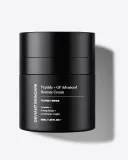
| OriginsDr. Andrew Weil For Origins Mega-Mushroom Skin Relief Soothing Face LotionYOUR PRODUCT | UltraceuticalsLIMITED EDITION SIZE Ultra Hydrating Lotion | Deviant SkincarePeptide + Growth Factor Advanced Restore Cream | CliniqueRepairwear Laser Focus Night Line Smoothing Cream | |
|---|---|---|---|---|
| Match | — | 56% | 53% | 52% |
| Price | $48.00 | $139.00+$91.00 | $98.00+$50.00 | $45.00−$3.00 |
| Shared key ingredients | — | 6 of 14 | 6 of 14 | 5 of 14 |
| Key difference | — | Ceramide 3 | Sh-Polypeptide-9 | Aminopropyl Ascorbyl Phosphate |
| Irritancy | High | Medium | Medium | Medium |
| Drying alcohol | — | — | — | — |
| View product | Shop | Shop | Shop |


Sources cited in this review
Every concentration estimate and effectiveness label is anchored to one of these 35 studies and safety reviews.
- 1
- 2
- 3Air oxidation increases skin irritation from fragrance terpenesonlinelibrary.wiley.com
- 4
- 5
- 6Use of “natural” oils for moisturization: Review of olive, coconut, and sunflower seed oilonlinelibrary.wiley.com

Affiliate links · As an Amazon Associate, WIMJ earns from qualifying purchases.