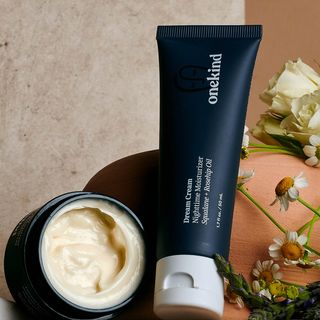
Onekind Dream Cream Nighttime Moisturizer
Works for
1 of 2 advertised claims delivered
MoisturizingTheobroma cacao seed butter, Caprylic/capric triglyceride + 16 moreGood evidence
“Dream Cream Nighttime Moisturizer”
This product can help improve hydration of the skin with the two types of ingredients.
The first type is called “humectants”:
these ingredients help attract water.
When humectants are on the surface of the skin, they “pull in” the moisture from the outside environment, or from
within deeper layers of the skin. The following ingredients in this product do the job:
glycerin.
This product also contains ingredients called “occlusives”. They help reduce the speed with which our skin loses moisture to the outside environment. These ingredients also help soften the upper layer of the skin, so it feels less tight and nicer to the touch. The following ingredients in this product do the job: caprylic/capric triglyceride, copernicia cerifera wax.
Anti-agingPrunus amygdalus dulcis oil, Butyrospermum parkii butter + 1 moreWeak evidence
“Rich in squalane and rosehip oils, it locks in moisture and antioxidants to combat pesky signs of aging.”
Effective ingredients missing or their concentration is too low.
Can it cause trouble?
Irritancy6 strong irritants: Lavandula angustifolia oil, Alcohol + 4 more — patch-test recommendedHigh risk
Comedogenic3 ingredients rated 2 or more on the 0–5 pore-clogging scale3 flagged
User reviews
Ingredients
Filter by role to see what each ingredient is doing.
Water~45–55%
Coco-caprylate~5.9–7.2%
- Irritation risk
- Medium
An emollient that softens skin and creates a nice product texture
More about Coco-caprylateGlycerin~4.1–5%
- Irritation risk
- Low
One of the best moisturizing ingredients. Naturally present in skin. It attracts water to the upper layer of the skin working as a humectant
More about GlycerinCetearyl alcohol~2.6–3.2%
- Irritation risk
- Low
- Comedogenicity
- 2/5
A non-drying alcohol. Works as an emollient. Helps water and oil mix together and creates a nice product texture
More about Cetearyl alcoholCaprylic/capric triglyceride~2.5–3.1%
- Irritation risk
- Medium
A good mix of fatty acids that forms a protective layer on the skin. Improves the shelf life of products. Derived from coconut and glycerin
More about Caprylic/capric triglycerideCopernicia cerifera wax~2.1–2.6%
- Irritation risk
- Low
Helps to soften the upper layer of the skin and create a nice product consistency
More about Copernicia cerifera waxGlyceryl stearate~1.7–2.1%
- Irritation risk
- Low
An emollient that softens the skin and forms a protective layer on its surface. Helps water and oil mix together
More about Glyceryl stearateSqualane~1.6–1.9%
- Irritation risk
- Low
An oil naturally present in skin. Works as an emollient to soften the skin and form a protective layer on its surface without a greasy feeling.
More about SqualanePhenoxyethanol~0.5–1%
- Irritation risk
- Low
A preservative. It helps prevent bacterial growth in cosmetic products
More about PhenoxyethanolSodium acrylates copolymer~1–1.2%
- Irritation risk
- Medium
Used to create a thicker product consistency
More about Sodium acrylates copolymerCetearyl glucoside~0.7–1.05%
- Irritation risk
- Medium
Helps water and oil in the product mix well together and improves product texture
More about Cetearyl glucosidePrunus amygdalus dulcis oil~0.6–0.95%
- Irritation risk
- Low
An emollient that softens the skin
More about Prunus amygdalus dulcis oilButyrospermum parkii butter~0.55–0.85%
- Irritation risk
- Low
- Comedogenicity
- 3/5
A great moisturising ingredient that softens the skin and reduces water loss from its upper layer. It also can be helpful in protecting skin from free radicals
More about Butyrospermum parkii butterHelianthus annuus seed oil~0.5–0.75%
- Irritation risk
- Low
A great emollient due to its high linoleic acid content. One of the most effective plant oils in helping skin hydration and repairing skin barrier function
More about Helianthus annuus seed oilRosa canina fruit oil~0.5–0.7%
- Irritation risk
- Medium
A great emollient. Contains vitamin E (tocopherol) which may give it some anti-oxidant properties. Can contain volatile compounds and can be irritating
More about Rosa canina fruit oilSesamum indicum seed oil~0.45–0.7%
- Irritation risk
- Low
A good moisturizing plant oil. Due to the high linoleic acid content, it helps soften the upper layer of the skin, reduce water loss and support skin barrier function
More about Sesamum indicum seed oilTheobroma cacao seed butter~0.45–0.65%
- Irritation risk
- Low
- Comedogenicity
- 3/5
Helps soften the upper layer of the skin and can be helpful in restoring the skin barrier function. Might have some anti-oxidant effect
More about Theobroma cacao seed butterLecithin~0.45–0.65%
- Irritation risk
- Low
Used mostly for creating emulsions - helping oil and water mix together. Helps soften the upper layer of the skin
More about LecithinEthylhexylglycerin~0.3–0.6%
Olea europaea fruit oil~0.3–0.55%
- Irritation risk
- Medium
An emollient that helps soften the skin but is not effective for restoring its barrier function. Might be helpful to calm down inflammation
More about Olea europaea fruit oilSodium phytate~0.25–0.5%
Lavandula angustifolia oil~0.25–0.45%
- Irritation risk
- High
An essential oil. Potential allergen and can be irritating. It has some anti-bacterial properties
More about Lavandula angustifolia oilAlcohol~0.2–0.4%
- Irritation risk
- High
Can be drying and contribute to skin irritation. Used in formulars to dissolve other ingredients, create a thinner product consistency or for its antibacterial properties
More about AlcoholChamomilla recutita flower extract~0.2–0.4%
- Irritation risk
- High
Plant extract that can have healing and anti-inflammatory properties. It is a potential allergen and can be irritating
More about Chamomilla recutita flower extractHordeum vulgare seed extract~0.2–0.4%
- Irritation risk
- Low
A grain extract. It might contain compounds that help neutralize free radicals in skin
More about Hordeum vulgare seed extractTocopheryl acetate~0.2–0.4%
- Irritation risk
- Medium
A more stable but less bio-available form of vitamin E compared to Tocopherol. Might help moisturize and protect the skin from free radicals, but mostly used in low concentrations to stabilize other ingredients.
More about Tocopheryl acetateAnthemis nobilis flower oil~0.15–0.3%
- Irritation risk
- High
An essential oil that is used as a fragrance and can be irritating. It might have some anti-oxidant effect in skin
More about Anthemis nobilis flower oilCymbopogon martini oil~0.15–0.3%
- Irritation risk
- High
Aromatic plant oil used in cosmetics as a fragrance. A likely irritant
More about Cymbopogon martini oilChamomilla recutita oil~0.15–0.3%
- Irritation risk
- Low
Pelargonium graveolens flower oil~0.2–0.35%
- Irritation risk
- High
An essential oil. Can be irritating. Can become an allergen with oxidation
More about Pelargonium graveolens flower oilRosa damascena flower oil~0.15–0.25%
- Irritation risk
- High
Used as a fragrance. Can be irritating
More about Rosa damascena flower oilLinalool~0.1–0.2%
Canola oil~0.15–0.25%
- Irritation risk
- Medium
A plant oil that can help soften the upper layer of the skin
More about Canola oilAloe barbadensis leaf juice~0.1–0.15%
- Irritation risk
- Medium
Traditionally used to treat sunburns, dermatitis and inflammation, but evidence for its effectiveness is lacking. The extract can contain humectants that help attract water into the skin
More about Aloe barbadensis leaf juiceIngredient list view
Water, Coco-caprylate, Glycerin, Cetearyl alcohol, Caprylic/capric triglyceride, Copernicia cerifera wax, Glyceryl stearate, Squalane, Phenoxyethanol, Sodium acrylates copolymer, Cetearyl glucoside, Prunus amygdalus dulcis oil, Butyrospermum parkii butter, Helianthus annuus seed oil, Rosa canina fruit oil, Sesamum indicum seed oil, Theobroma cacao seed butter, Lecithin, Ethylhexylglycerin, Olea europaea fruit oil, Sodium phytate, Lavandula angustifolia oil, Alcohol, Chamomilla recutita flower extract, Hordeum vulgare seed extract, Tocopheryl acetate, Anthemis nobilis flower oil, Cymbopogon martini oil, Unknown, Chamomilla recutita oil, Pelargonium graveolens flower oil, Rosa damascena flower oil, Linalool, Canola oil, Aloe barbadensis leaf juice
Compare prices
Retailers ranked by price — lowest first.

Sources cited in this review
Every concentration estimate and effectiveness label is anchored to one of these 16 studies and safety reviews.
- 1
- 2
- 3
- 4
- 5
- 6Effect of topically applied lipids on surfactant-irritated skinonlinelibrary.wiley.com

Affiliate links · As an Amazon Associate, WIMJ earns from qualifying purchases.