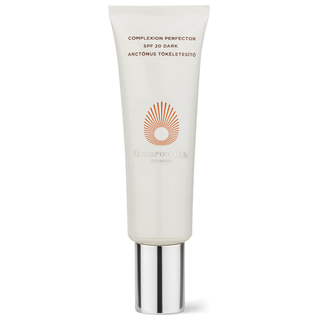
Omorovicza Complexion Perfector SPF 20 - Dark
Works for
1 of 4 advertised claims delivered
Sun protectionSPF 20 · 2 UV filters · Broad spectrumWeak protectionSPF under 30
This product offers broad spectrum sun protection, but it is weak. We recommend to use a broad spectrum sunscreen with at least SPF 30.
This product can be considered "reef safe" because it does not contain the UV filters (oxybenzone and octinoxate) that can be harmful to coral reefs when present in the water in high concentrations.
Moisturizing16 ingredients credited for this claimGood support
“Fortified with Zinc Oxide (a mineral filter), the tinted moisturizer blends seamlessly onto skin and creates a protective veil that shields from the damaging effects of pollution and UVA/UVB rays.”
This product can help improve hydration of the skin with the two types of ingredients.
The first type is called “humectants”:
these ingredients help attract water.
When humectants are on the surface of the skin, they “pull in” the moisture from the outside environment, or from
within deeper layers of the skin. The following ingredients in this product do the job:
glycerin, sodium hyaluronate.
This product also contains ingredients called “occlusives”. They help reduce the speed with which our skin loses moisture to the outside environment. These ingredients also help soften the upper layer of the skin, so it feels less tight and nicer to the touch. The following ingredients in this product do the job: caprylic/capric triglyceride, squalane.
Evens skin tone2 ingredients credited for this claimLimited support
“A dose of skin-brightening Vitamin C helps to correct uneven tone, as the brand's patented Healing ConcentrateTM delivery system infuses minerals into the deeper layers of skin to promote a firm, luminous and refined complexion.”
This product contains ingredients () that could help reduce hyperpigmentation (for example, post-acne marks or age spots) in theory, but there is not enough evidence that they actually work.
The biggest effect for evening out skin tone in this product comes from sun protection. Sun damage is the main factor causing age spots, darkening of post-acne marks and other discolorations. This is why sun protection is the best strategy for maintaining an even skin tone. We, however, do not recommend using this product as a sunscreen because the protection it offers is not strong enough).
Anti-aging3 ingredients credited for this claimLimited support
“Providing the benefits of a sunscreen, concealer, foundation and anti-aging cream in one unique formula, the blemish balm hydrates and softens skin, while minimizing the appearance of fine lines and wrinkles, and reigniting a fresh, dewy glow.”
This product does not contain ingredients that are able to reduce fine lines and wrinkles or help with skin elasticity, but it can improve the look of the skin temporarily through moisturization. Well-moisturized skin might also be able to repair the sun damage better.
The biggest anti-aging effect in this product comes from sun protection. Sun damage is the main factor causing early signs of skin aging. We, however, do not recommend using this product as a sunscreen because the protection it offers is not strong enough).
Can it cause trouble?
Irritancy5 strong irritants: Rosa damascena extract, Geraniol + 3 more — patch-test recommendedHigh risk
Comedogenic4 ingredients rated 2 or more on the 0–5 pore-clogging scale4 flagged
User reviews
Be the first — your take helps the next person decide.
Ingredients
Filter by role to see what each ingredient is doing.
Water~45–55%
Caprylic/capric triglyceride~5.7–7%
- Irritation risk
- Medium
A good mix of fatty acids that forms a protective layer on the skin. Improves the shelf life of products. Derived from coconut and glycerin
More about Caprylic/capric triglycerideZinc oxide~5.3–6.5%
- Irritation risk
- Low
A broad spectrum sunblock (protects from both UVA and UVB rays). Is suitable for most sensitive skins. In small concentrations, can be used as a colorant
More about Zinc oxideTitanium dioxide~4–4.9%
- Irritation risk
- Low
Works as a UV filter when used in high concentrations. It is photostable and is effective mostly against the UVB light, with some protection in the UVA range. In small concentrations, used for its ability to improve the color of cosmetic products. Is usually well tolerated by the skin
More about Titanium dioxideGlycerin~2.9–3.6%
- Irritation risk
- Low
One of the best moisturizing ingredients. Naturally present in skin. It attracts water to the upper layer of the skin working as a humectant
More about GlycerinSqualane~2.5–3%
- Irritation risk
- Low
An oil naturally present in skin. Works as an emollient to soften the skin and form a protective layer on its surface without a greasy feeling.
More about SqualaneIsononyl isononanoate~2–2.5%
- Irritation risk
- Low
Forms a protective film on the surface of the skin to prevent moisture loss. Gives a velvety feel to products while reducing tackiness
More about Isononyl isononanoateStearyl heptanoate~1.6–2%
Cetearyl olivate~1.4–1.7%
Ethylhexyl dodecanol~1.2–1.4%
- Irritation risk
- Low
Cetearyl ethylhexanoate~1–1.2%
- Irritation risk
- Low
An emollient that helps soften the skin
More about Cetearyl ethylhexanoateSorbitan olivate~0.75–1.15%
Cetearyl alcohol~0.95–1.15%
- Irritation risk
- Low
- Comedogenicity
- 2/5
A non-drying alcohol. Works as an emollient. Helps water and oil mix together and creates a nice product texture
More about Cetearyl alcoholPhenoxyethanol~0.7–1%
- Irritation risk
- Low
A preservative. It helps prevent bacterial growth in cosmetic products
More about PhenoxyethanolMica~0.7–1.05%
- Irritation risk
- Low
Creates an illusion of smoother and more radiant skin tone. Adds shimmer to the skin by reflecting light
More about MicaIsopropyl myristate~0.7–1.05%
- Irritation risk
- Low
- Comedogenicity
- 3/5
An emollient that helps soften the skin. Could be comedogenic
More about Isopropyl myristateRosa damascena extract~0.6–0.9%
- Irritation risk
- High
Oil of a very fragrant pink rose used as fragrance in cosmetics. Extensive research has shown it has mixed benefits. In the pro column, inhaling this flower’s scent seems to have relaxing properties and the plant’s petals contain skin-soothing and antioxidant compounds that can benefit skin. On the flipside, the numerous chemicals that create this rose’s distinctive fragrance pose a risk of causing skin aggravation.
More about Rosa damascena extractAscorbyl tetraisopalmitate~0.6–0.9%
- Irritation risk
- Medium
A vitamin C derivative. Studies show that is might be effective in reducing hyperpigmentation, but there are no studies confirming that it is effectively converted into the bioavailable form of Vitamin C in skin. It is not clear how this derivative compares in effectiveness to the topical application of bioavailable form of vitamin C (L-ascorbic acid)
More about Ascorbyl tetraisopalmitatePolyhydroxystearic acid~0.6–0.85%
- Irritation risk
- Medium
Used to create a thicker product consistency and stabilize the formulation
More about Polyhydroxystearic acidSucrose palmitate~0.55–0.85%
Disodium edta~0.5–0.75%
Glyceryl linoleate~0.55–0.85%
- Irritation risk
- Medium
Helps oil and water mix together
More about Glyceryl linoleateIsopropyl titanium triisostearate~0.55–0.85%
- Irritation risk
- Medium
Helps water and oil mix together
More about Isopropyl titanium triisostearatePyrus malus fruit extract~0.5–0.7%
- Irritation risk
- Medium
Can have some moisturizing properties due to its sugar content
More about Pyrus malus fruit extractTocopheryl acetate~0.5–0.75%
- Irritation risk
- Medium
A more stable but less bio-available form of vitamin E compared to Tocopherol. Might help moisturize and protect the skin from free radicals, but mostly used in low concentrations to stabilize other ingredients.
More about Tocopheryl acetateSodium hyaluronate~0.45–0.7%
- Irritation risk
- Low
One of the best moisturizing ingredients. Attracts water into the upper layer of the skin
More about Sodium hyaluronateGeraniol~0.45–0.65%
Stearalkonium hectorite~0.45–0.7%
Prunus armeniaca kernel oil~0.5–0.75%
- Irritation risk
- Medium
An emollient that helps soften the skin
More about Prunus armeniaca kernel oilTocopherol~0.45–0.65%
- Irritation risk
- Low
Pure form of vitamin E. Can help moisturise and protect the skin from free radicals. Often used to help stabilise other ingredients or the formula itself
More about TocopherolEthylhexylglycerin~0.3–0.6%
Lactic acid~0.3–0.55%
- Irritation risk
- Medium
An exfoliating and moisturizing alpha-hydroxy acid (AHA). Typically causes less irritation than other AHAs, for example, glycolic acid. At high concentrations (about 15%), lactic acid can help reduce lines and wrinkles. Recent studies show that lactic acid can support the "good" bacteria living on skin's surface (healthy skin microbiome)
More about Lactic acidIsostearic acid~0.45–0.7%
- Irritation risk
- Low
Used to create a nice product texture
More about Isostearic acidCitronellol~0.3–0.5%
Parfum~0.3–0.5%
- Irritation risk
- High
An aromatic blend of unspecified and possibly irritating ingredients
More about ParfumXanthan gum~0.3–0.55%
- Irritation risk
- Low
Used to create a thicker product consistency
More about Xanthan gumPropylene carbonate~0.3–0.55%
- Irritation risk
- Low
Is used to dissolve other ingredients and create nice product texture
More about Propylene carbonateChlorella vulgaris/lupinus albus protein ferment~0.25–0.45%
- Irritation risk
- Low
- Comedogenicity
- 2/5
Pectin~0.25–0.45%
- Irritation risk
- Low
Phospholipids~0.25–0.45%
- Irritation risk
- Low
Emollients that are naturaly present in skin. In addition, they help water and oil mix together in the product
More about PhospholipidsLinalool~0.15–0.3%
Potassium sorbate~0.15–0.25%
Ci 77492~0.15–0.3%
Ci 77491~0.15–0.25%
- Irritation risk
- Low
A red colorant made of iron oxide. Typically is not irritating
More about Ci 77491Ci 77499~0.1–0.15%
Iron oxides~0.1–0.15%
- Irritation risk
- Low
An umbrella term for the following three colorants: CI 77491, CI 77492, CI 77499. They might be able to offer some protection against visible light, but the degree of the protection is not clear
More about Iron oxidesIngredient list view
Water, Caprylic/capric triglyceride, Zinc oxide, Titanium dioxide, Glycerin, Squalane, Isononyl isononanoate, Stearyl heptanoate, Cetearyl olivate, Ethylhexyl dodecanol, Cetearyl ethylhexanoate, Sorbitan olivate, Cetearyl alcohol, Phenoxyethanol, Mica, Isopropyl myristate, Rosa damascena extract, Ascorbyl tetraisopalmitate, Polyhydroxystearic acid, Sucrose palmitate, Disodium edta, Glyceryl linoleate, Isopropyl titanium triisostearate, Pyrus malus fruit extract, Tocopheryl acetate, Sodium hyaluronate, Geraniol, Stearalkonium hectorite, Prunus armeniaca kernel oil, Tocopherol, Ethylhexylglycerin, Lactic acid, Isostearic acid, Citronellol, Parfum, Xanthan gum, Propylene carbonate, Chlorella vulgaris/lupinus albus protein ferment, Pectin, Phospholipids, Linalool, Potassium sorbate, Ci 77492, Ci 77491, Ci 77499, Iron oxides
Compare prices
Retailers ranked by price — lowest first.
Affiliate links · prices updated regularly · As an Amazon Associate, WIMJ earns from qualifying purchases.
Product summary
"Omorovicza - Complexion Perfector SPF 20 - Dark" offers broad spectrum protection. It means that it protects from both UVA and UVB rays (you can remember UVB as "burning" sunlight - they cause sunburn. You can remember UVA rays as "aging" - they do not lead to sunburn, but they cause photodamage and contribute to early signs of skin aging and hyperpigmentation). On the negative side, the SPF of this moisturizer is not high enough. We recommend to use a sunscreen with at least SPF 30 daily.
Because it includes good moisturizing ingredients, it can also work as a hydrating day cream.
Sunscreen filters
This moisturizer is a mineral sunscreen. It uses titanium dioxide and zinc oxide for sun protection. Both titanium dioxide and zinc oxide almost never irritate even the most sensitive skin and eyes, but can leave a white cast.
Irritation risk
There are quite a few common irritants in this product, including ingredients without particular skin benefits. We would not recommend it for sensitive skin. We assess the overall irritancy of this moisturizer to be high. For a detailed overview of all potential irritants: click here
You can see the detailed formula review with the breakdown of all actives in the product and the full ingredient list with estimated concentrations in the tables below.
About the brand
According to Cruelty-Free Kitty "Omorovicza" is cruelty free and so is its parent company.
Sources cited in this review
Every concentration estimate and effectiveness label is anchored to one of these 17 studies and safety reviews.
- 1A review of inorganic UV filters zinc oxide and titanium dioxideonlinelibrary.wiley.com
- 2
- 3
- 4
- 5
- 6

Affiliate links · As an Amazon Associate, WIMJ earns from qualifying purchases.