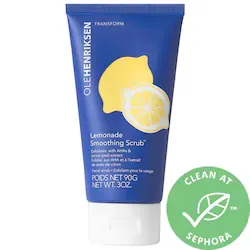
Works for
ExfoliationGlycolic acid, Lactic acidWorks well
“A refreshing, exfoliating face scrub that instantly retexturizes, polishes and reduces the look of pores, with AHAs, lemon peel and sugar.”
This product can help exfoliate the skin. In other words, it helps break down the bonds between dead cells on the surface of the skin and speed up the skin turnover. Skin often appears softer and brighter after exfoliation, but overdoing it can result in disrupted skin barrier. The following ingredient is doing the exfoliating job in this product: glycolic acid.
Evens skin toneSide benefit the brand mentions · Glycolic acid, Glycyrrhiza glabra root extract + 1 moreWorks well
“Fine Lines and Wrinkles, Dullness, and Uneven Texture Formulation.”
This product can help reduce hypepigmentation and even out the skin tone because it contains the following effective ingredients: glycolic acid
The following ingredient (ingredients) in this product might be helpful, but there is no evidence to confirm that it actually can help even out the skin tone: glycyrrhiza glabra root extract.
Keep in mind that you would need to apply any topical skincare targetted at hypigmentation consistently for a couple of months to get a result. No topical skincare product can help get rid of hyperpigmentation (including post-acne marks and age spots) instantly.
Anti-agingSide benefit the brand mentions · Glycolic acid, Lactic acidWorks well
“Fine Lines and Wrinkles, Dullness, and Uneven Texture Formulation.”
This product can help reduce and prevent fine lines and wrinkles, improve skin elasticity and firmness because it contains glycolic acid.
Keep in mind that it typically takes at least 6 weeks to notice any results because the changes that are needed to improve fine lines and elasticity happen in the deeper layers of the skin. No topical anti-aging product can “erase” wrinkles or fully reverse signs of aging.
MoisturizingSide benefit the brand mentions · Glycerin, Sucrose + 5 moreWorks
“Fine Lines and Wrinkles, Dullness, and Uneven Texture Formulation.”
This product contains good ingredients to attract water to the upper layer of the skin. These ingredients are called "humectants": glycerin, sodium lactate.
When humectants are on the surface of the skin, they “pull in” the moisture from the outside environment, or from within deeper layers of the skin. If the air is dry, humectants can speed up the moisture loss from the skin. This is why it is a good idea to use another product on top of this one to help "seal in" the moisture (look for ingredients like dimethicone, squalane, oils and butters).
Can it cause trouble?
Irritancy10 strong irritants: Citrus limon peel powder, Citrus limon fruit extract + 8 more — patch-test recommendedHigh risk
Comedogenic1 ingredient rated 2 or more on the 0–5 pore-clogging scale1 flagged

User reviews
Be the first — your take helps the next person decide.
Ingredients
Filter by role to see what each ingredient is doing.
Water~45–55%
Glycerin~4.6–5.7%
- Irritation risk
- Low
One of the best moisturizing ingredients. Naturally present in skin. It attracts water to the upper layer of the skin working as a humectant
More about GlycerinGlycolic acid~4.3–5.2%
- Irritation risk
- High
An alpha-hydroxy acid (AHA) that helps to remove the dead skin cells on the surface of the skin reveling a more even, smoother complexation. It is also able to stimulate collagen production with long-term use. Could help to reduce pore congestion. It can be irritating to the skin. Apply sunscreen daily if using products with glycolic acid
More about Glycolic acidSucrose~3–3.7%
- Irritation risk
- Low
Can help attract water to the upper layer of the skin. In crystal form, it can work as a gentle exfoliant, gentler than the salt scrub. Helps stabilize the emulsion
More about SucroseHydrated silica~2.6–3.2%
Polyglyceryl-10 dipalmitate~2.1–2.6%
Propanediol~1.7–2.1%
- Irritation risk
- Low
Acts as a solvent for other ingredients. Speeds up the absorption of other ingredients into the skin
More about PropanediolLactic acid~1.4–1.7%
- Irritation risk
- Medium
An exfoliating and moisturizing alpha-hydroxy acid (AHA). Typically causes less irritation than other AHAs, for example, glycolic acid. At high concentrations (about 15%), lactic acid can help reduce lines and wrinkles. Recent studies show that lactic acid can support the "good" bacteria living on skin's surface (healthy skin microbiome)
More about Lactic acidSodium cocoyl isethionate~1.3–1.5%
- Irritation risk
- Medium
Helps water and oil mix together. Can be used as a cleansing agent
More about Sodium cocoyl isethionatePolyacrylate crosspolymer-6~0.95–1.15%
- Irritation risk
- Low
Sodium hydroxide~0.7–1%
Sodium lactate~0.55–0.85%
- Irritation risk
- Medium
Helps attract water to the upper layer of the skin. Is often used to adjust the pH level of the product
More about Sodium lactateAcrylamide/sodium acryloyldimethyltaurate copolymer~0.5–0.8%
- Irritation risk
- Low
Helps water and oil mix together and create gel-like textures
More about Acrylamide/sodium acryloyldimethyltaurate copolymerCitrus limon peel powder~0.5–0.7%
- Irritation risk
- High
Citrus limon fruit extract~0.45–0.65%
- Irritation risk
- High
Used as a fragrance. Can be irritating and cause photosensitivity
More about Citrus limon fruit extractOcimum sanctum leaf extract~0.45–0.65%
- Irritation risk
- High
A plant extract that is rich in a fragrance compound eugenol that is a frequent allergen and can be irritating. It might also contain anti-oxidants to help neutralize free radicals
More about Ocimum sanctum leaf extractChamomilla recutita flower extract~0.4–0.6%
- Irritation risk
- High
Plant extract that can have healing and anti-inflammatory properties. It is a potential allergen and can be irritating
More about Chamomilla recutita flower extractGlycyrrhiza glabra root extract~0.3–0.6%
- Irritation risk
- Medium
A plant extract that can help lighten the skin and calm down inflammation. Might be helpful in neutralizing free radicals
More about Glycyrrhiza glabra root extractSaccharum officinarum extract~0.3–0.55%
- Irritation risk
- Low
Sugar extract that helps attract water to the upper layer of the skin
More about Saccharum officinarum extractCitrus aurantifolia peel extract~0.3–0.6%
- Irritation risk
- High
Santalum album extract~0.3–0.6%
Citrus limon peel oil~0.25–0.5%
Citrus aurantium bergamia peel oil~0.3–0.5%
- Irritation risk
- High
Leuconostoc/radish root ferment filtrate~0.3–0.5%
- Irritation risk
- Medium
A preservative that comes from radishes fermented by a bacteria. New research suggests that the preservation properties in the ingredient come from an ammonium salt that is not present naturally in radish root but used in its cultivation. Is problematic because the exact amount of the preservative agents is difficult to determine
More about Leuconostoc/radish root ferment filtrateCoconut acid~0.45–0.65%
Sodium riboflavin phosphate~0.25–0.5%
- Irritation risk
- Low
Dimethylhydroxy furanone~0.25–0.45%
- Irritation risk
- Low
Isohexadecane~0.4–0.6%
- Irritation risk
- Low
Improves the texture of the product and helps soften the skin. Helps oil and water mix together and can be used as a cleansing agent
More about IsohexadecanePolysorbate 80~0.3–0.5%
Sodium isethionate~0.3–0.55%
- Irritation risk
- Low
Sorbitan oleate~0.25–0.45%
- Irritation risk
- Medium
- Comedogenicity
- 2/5
Helps oil and water mix together
More about Sorbitan oleateTriethyl citrate~0.2–0.4%
Vanillin~0.2–0.4%
- Irritation risk
- Low
Pentaerythrityl tetra-di-t-butyl hydroxyhydrocinnamate~0.2–0.4%
- Irritation risk
- Low
Used to increase stability of product formulations
More about Pentaerythrityl tetra-di-t-butyl hydroxyhydrocinnamateCaprylyl glycol~0.2–0.35%
- Irritation risk
- Medium
Helps preserve products and creates a nice product texture
More about Caprylyl glycolPhenoxyethanol~0.15–0.3%
- Irritation risk
- Low
A preservative. It helps prevent bacterial growth in cosmetic products
More about PhenoxyethanolLimonene~0.1–0.2%
- Irritation risk
- High
A common frangrance that can easily irritate skin, especially if exposed to air, light or heat
More about LimoneneLinalool~0.1–0.15%
Citral~0.05–0.1%
Ingredient list view
Water, Glycerin, Glycolic acid, Sucrose, Hydrated silica, Polyglyceryl-10 dipalmitate, Propanediol, Lactic acid, Sodium cocoyl isethionate, Polyacrylate crosspolymer-6, Sodium hydroxide, Sodium lactate, Acrylamide/sodium acryloyldimethyltaurate copolymer, Citrus limon peel powder, Citrus limon fruit extract, Ocimum sanctum leaf extract, Chamomilla recutita flower extract, Glycyrrhiza glabra root extract, Saccharum officinarum extract, Citrus aurantifolia peel extract, Santalum album extract, Citrus limon peel oil, Citrus aurantium bergamia peel oil, Leuconostoc/radish root ferment filtrate, Coconut acid, Sodium riboflavin phosphate, Dimethylhydroxy furanone, Isohexadecane, Polysorbate 80, Sodium isethionate, Sorbitan oleate, Triethyl citrate, Vanillin, Pentaerythrityl tetra-di-t-butyl hydroxyhydrocinnamate, Caprylyl glycol, Phenoxyethanol, Limonene, Linalool, Citral
Compare prices
Retailers ranked by price — lowest first.

Worth comparing, line by line.
Match % combines shared ingredients, the first five ingredients, shared actives and hero ingredients, irritancy (lower counts in the alternative's favour), texture and body area. Only products in the same routine step are compared.
| OleHenriksenLemonade Smoothing ScrubYOUR PRODUCT | CeraVeBlemish Control Gel Moisturiser with 2% Salicylic Acid & Niacinamide for Blemish-Prone Skin | Paula's choiceResist Anti-Aging Advanced Smoothing Treatment AHA Full size | SuperciliumPrep Peel Gel | |
|---|---|---|---|---|
| Match | — | 60% | 58% | 57% |
| Price | $36.00 | $11.89−$24.11 | $50.50+$14.50 | — |
| Shared key ingredients | — | 3 of 7 | 4 of 7 | 4 of 7 |
| Key difference | — | Niacinamide | Salicylic Acid | Sodium Pca |
| Irritancy | High | Low | Medium | High |
| Drying alcohol | — | — | — | Contains drying alcohol |
| View product | Shop | Shop | Shop |


More alternatives: REVOLUTION SKINCARE Multi Acid Peeling SolutionWish Formula Aesthetic Peeling Base Emulsion
Sources cited in this review
Every concentration estimate and effectiveness label is anchored to one of these 11 studies and safety reviews.
- 1
- 2
- 3Glycolic acid peel therapy – a current reviewncbi.nlm.nih.gov
- 4
- 5Epidermal and dermal effects of topical lactic acidncbi.nlm.nih.gov
- 6Dual Effects of Alpha-Hydroxy Acids on the Skinpdfs.semanticscholar.org

Affiliate links · As an Amazon Associate, WIMJ earns from qualifying purchases.